The Italian Air Force Museum - MUSAM 2023
(Museo Storico dell' Aeronautica Militare Italiana)
Vigna di Valle, Rome
June 2023 |
Ready for the 100th Anniversary?
The Italian Air Force Museum (Museo Storico dell' Aeronautica Militare) at Vigna di Valle has undergone a major overhaul for the air arm's centenary.
Philip Stevens reports for Aviation News took a sneak peek at the reimagined museum before it reopened.
|
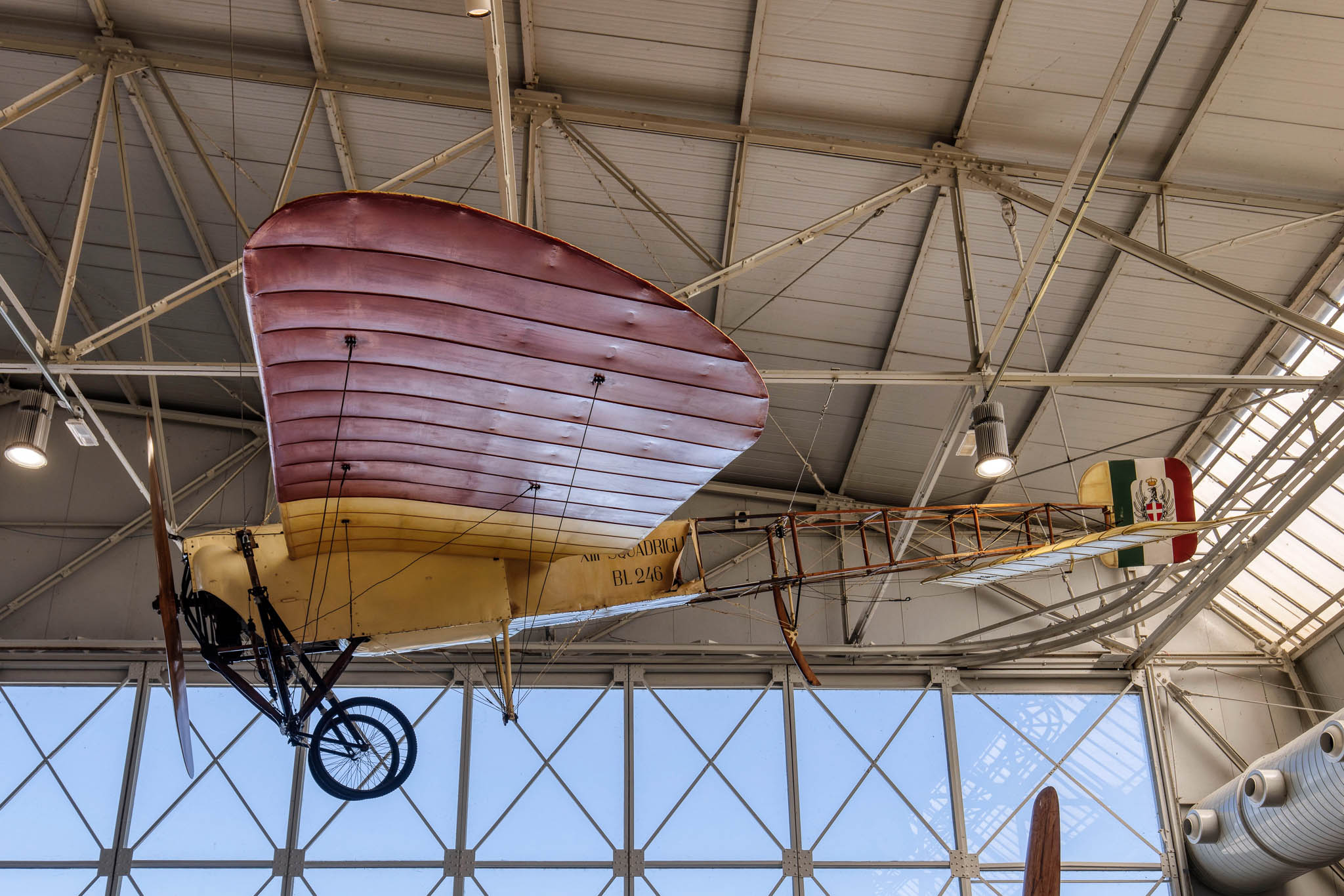
| Blériot-SIT XI-2 (BL246) inscribed 'XIII Squadriglia BL 246'. The Blériot XI was designed by French aviators Louis Blériot and Raymond Saulnier in 1909. The French, British and Italian air forces took delivery of 132 Blériot XIs from 1910. It was the first aircraft to be used in war when it was fl own by the Italian Air Force during the Italo-Turkish war of 1911-1912. |
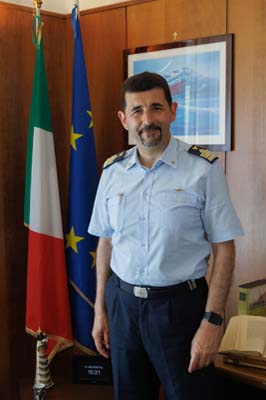 |
Vigna di Valle Commanding Officer Colonel Luigi Barbagallo. |
Deputy Chief of Staff of the Italian Air Force, General Aurelio Colagrande spoke at the official inauguration on May 4: "We are extremely proud of the work accomplished. We feel that aviation enthusiasts will appreciate the improvements and layout of the collection. We still have to apply a few tweaks, but the overall result is already impressive." At this event it was announced that the museum would be opened to the public in two weeks time. It was actually re-opened to the public on June 16, 2023.
Extensive reconstruction of the whole museum had taken place over the previous 18 months in readiness for the 100th anniversary of the Italian Air Force celebrations. Commanding Officer Colonel Luigi Barbagallo, posted to the Vigna di Valle base is responsible for managing the project known as 'MUSAM 2023'. In an exclusive interview he admitted when he arrived: "I did not have particular interest in historic aircraft but now I do, it's natural that here you feel involved with the Italian aviation history." Col Barbagallo had worked with the Chief of Staff of the Air Force in Rome as a human resources specialist. This project employed a team of 120 personnel, he said: "Everything has changed in the museum, the infrastructure, the floors, the lighting, graphics, and IT, I had to coordinate all their activities. The biggest challenge was the very short period we had do this work."
Despite the museum's reopening to the public being just days away at the time of my visit, Col Barbagallo conceded: "The work is not finished even though the museum is about to open, we have lots of groups and associations that want to come here. We now must manage how the museum operates, it is a different museum now. This involves the audio guides, the new bookshop and ticket office, re-modelled cafeteria, and conference room. Everything must work well."
The museum has been free to enter since it first opened in on May 24, 1977, but Barbagallo said the Air Force Chief of Staff had to consider the best way to fund the operation. So far, the project had been funded by the Ministry of Defence and included money for aircraft renovations. Now, there is an admission fee, but with some exclusions for current and former military and civilian defence personnel.
|
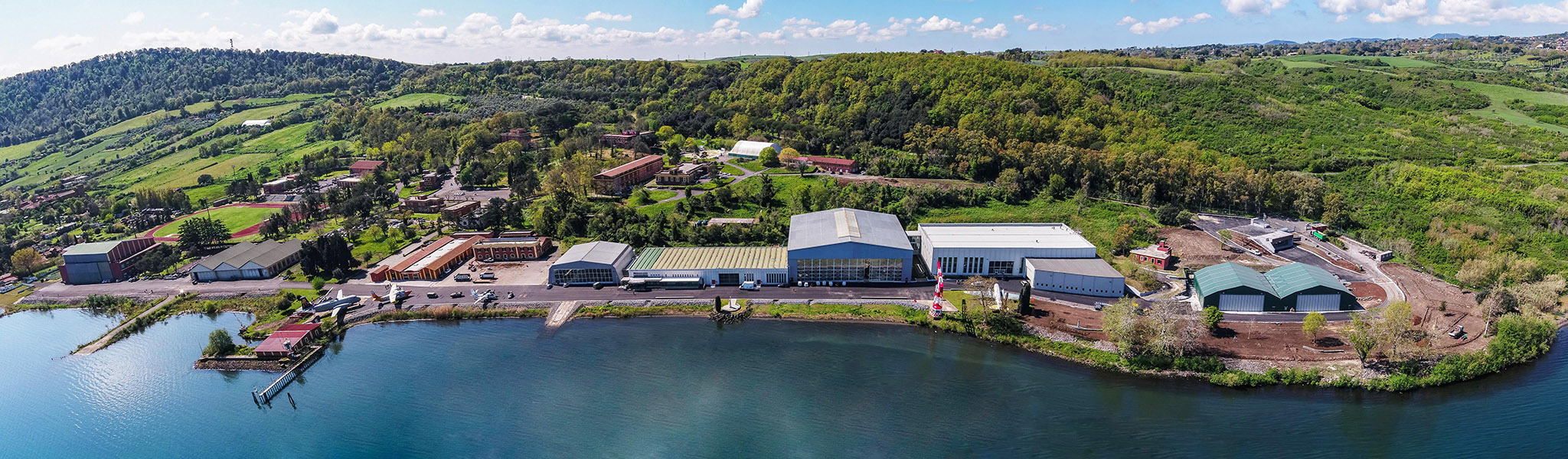 |
A panoramic image shot taken from a drone flying over Lake Bracciano. It shows the whole of Vigna di Valle air base and the museum hangars or halls along the shore line in April 2023.
From right to left: Hangar 100, Skema Hall was added in 1993 with an annex added to it in 2009, Badoni Hall (1930) is connected to Troster Hall by Velo Hall, built in 1976 for the opening of the museum.
Photo credit: My friend, Fabrizio Sanetti-Italian Air Force Museum of Vigna di Valle. |
What's new?
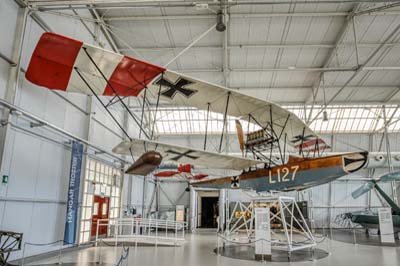 |
Lohner L-1 (L-127). The Lohner L-1 was operated by the Austro-Hungarian Navy and used on bombing raids against Italian positions during World War One. On June 3, 1918, while based at Lussino and used for reconnaissance over the Dalmatian coastline, it was stolen by two defecting naval pilots of Italian decent, who flew it across the Adriatic to Fano, where it was captured. |
The exhibition area has expanded by 30%, it now covers 52,500 sq ft (16,000 m2). The new 'Hangar 100' has been constructed, painted green it houses the more modern aircraft in the large collection. A space has been left here for a Eurofighter Typhoon which is to arrive after the 100th anniversary air show at Pratica di Mare where it was on display. Inside the double-span hangar was new arrival, a Tornado IDS resplendent in a stunning 1991 Gulf War desert yellow 'Canarino' scheme, as applied for Operazione Locusta when part of Operation Desert Storm. During Operation Locusta, the Italian Air Force Tornados flew 1,108 missions dropping 565 bombs between October 1990 and March 1991, they operated from Al Dhafra Air Base, near Abu Dhabi, United Arab Emirates.
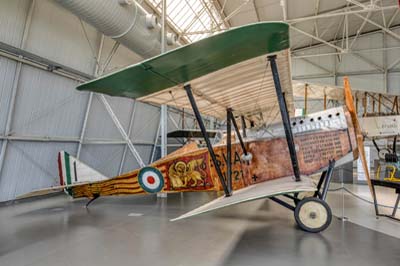 |
Ansaldo SVA-5 (11721). More than 2,000 Ansaldo SVA-5s were built from 1917. The type was the first all-Italian aircraft to take part in World War One and was predominantly used for reconnaissance. Its most memorable sortie was made by aircraft from 87th Squadron - including that now on display at Vigna di Valle - over Vienna on August 9, 1918, when they dropped leaflets inviting Austria to surrender. |
An historic building at the opposite end of the Lake Bracciano shoreline has been made available to house a large aero-engine collection which includes a Bariquand & Marre Wright Vertical 4, designed by Orville Wright and built in Paris under license till 1910. It is the oldest aero engine still working in Europe. Here also, is a multimedia area with flight simulators and virtual reality.
The existing hangars or halls now have two tone grey painted floors. Air conditioning has been installed which will protect the priceless exhibits and new LED lighting fitted to provide an attractive bright appearance to each building. The obtrusive amateur paintings and other 'clutter' which in my opinion detracted from the collection has all been removed to my delight. The existing aircraft which totals around 80 have nearly all moved to new locations in each hall and are now more evenly spaced, I am sure will be appreciated by all photographers. Re-designed information boards have been produced and new rope barriers are placed around the exhibits.
The collection now includes the oldest aeronautical relic in the world, a recently restored balloon constructed by French balloonist André-Jacques Garnerin who died in 1823. Two other recent arrivals are an Agusta-Bell HH-212 and a Sikorsky HH-3F Pelican.
Some of the inmates have been renovated, notably the Savoia-Marchetti SM.79 Sparviero which was restored onsite, or should I say, "patched up", in the Badoni Hall over a three month period by two restorers under the Superintendent of Cultural Heritage. New fabric was placed over the original fabric which had cracked over many years on display in a hangar subject to vast daily temperature changes. The original fabric can still be seen from the inside of the aircraft. Replacing the distinctive green/sand camouflage, the all over olive green paint scheme now applied is authentic from the time the aircraft was delivered to the Aeronautica Militare in 1936. The aircraft is now devoid of its serial and squadron code as is a Piaggio P.166ML1 which has also been repainted.
The beautiful and only surviving Reggiane Re.2002 Ariete has returned. On completing its restoration in 2017 and unveiling for the 40th anniversary of the museum, it had been removed from display not long after.
Some aircraft have left the site, the Savoia-Marchetti S.56, Partenavia P.53 Aeroscooter and Aermacchi MB.323, which I believe is now residing in a new museum storage facility at Piacenza air force base.
|
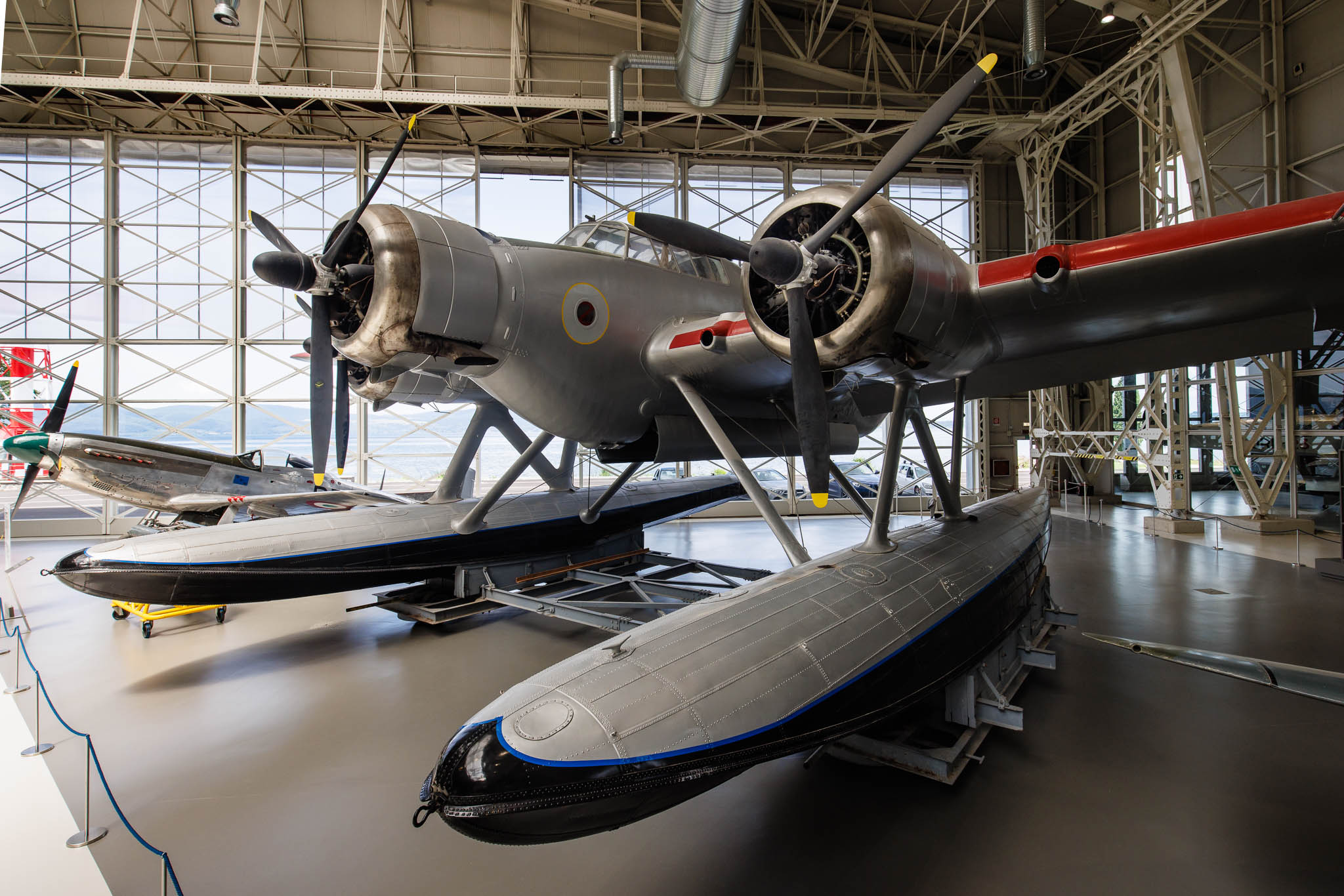 |
| CRDA Cant Z.506S Airone (MM45425 '84-4'). The CANT Z.506S Airone made its first flight in August 1936 and soon after gained eight world speed records and two altitude records for a seaplane. It was later developed as the faster Z.506B to drop bombs and torpedoes. Some were converted to Z.506S standard, for its new role as a maritime search and rescue aircraft, with 84º Gruppo based at Vigna di Valle. Remarkably, the wooden-built type was not withdrawn from service until 1960. |
Historic Vigna di Valle
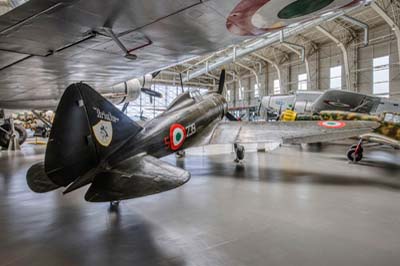 |
Reggiane Re.2002 Ariete (MM8669 '5-239'). The Reggiane Re.2002 Ariete first flew in October 1940 and 100 aircraft were delivered before the Armistice September 3, 1943 Re.2002s attacked the allied landings in Sicily suffering many losses then, following the Armistice, they participated in attacks against German ships off the coast of Greece. |
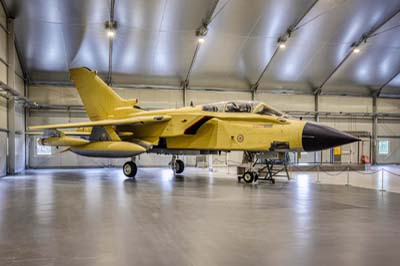 |
Panavia Tornado IDS MLU (MM7071 '71'). This Tornado IDS has been returned to the colours in which it served during the Operazione Locusta - Italy's contribution to Operation Desert Storm. The jet operated from Al Dhafra Air Base in the United Arab Emirates during the 1991 conflict in this 'Canarino' desert camouflage. |
For those unfamiliar with this wonderful museum, it is situated on a beautiful location beside Lake Bracciano, the historic site dates back to 1904. In 1908 the first Italian military airship flew from here and in 1922 the 2nd Experimental Seaplane Squadron was formed. From 1930 the 88º Gruppo 'Caccia Marittima' (Maritime Hunter) was established, initially equipped with Macchi M.41bis and Fiat CR.20 Idro seaplanes.
They were replaced by the Cantieri Aeronautici e Navali Triestini (CANT) 10 and CANT 25 and subsequently by IMAM Ro.43 and Ro.44 until their withdrawal in 1945. The only existing Ro.43 reconnaissance single float seaplane is still on display here. In 1948 Vigna di Valle became the headquarters of the Air Rescue Command with 84° Gruppo, operating the CANT Z.506 Airone, a three engine twin-float seaplane, until 1961 when the unit re-located to Rome-Ciampino. The only surviving CANT Z.506 is also in Badoni Hall.
Troster Hall is the oldest aeronautical building in Italy, it was obtained as war reparation from Austria at the end of World War One. It houses the oldest aircraft ranging a Blèriot XI to aircraft from World War One, including a Ansaldo SVA-5 which took part in the Italian raid on Vienna in 1918.
Unfinished business
Col Barbagallo admitted his work is far from finished, marketing plans need to be drawn up and visitor numbers are expected to rise. Before the museum closure visitor figures were 50,000 per year. An enthusiastic Col Barbagallo spoke: "My first objective is to increase the number of visitors because of the importance of the museum to the Air Force, I would like to increase the visitor numbers by ten times." He added: "The museum has to be known across the region and across the country. Many of our visitors are school children, we want the visitors to fall in love with our Air Force because they are our future." In conclusion he said: "I very much like working with all the people involved in this project it's clear to me that managing the museum is not just a job, it is a passion for me and my staff.
|
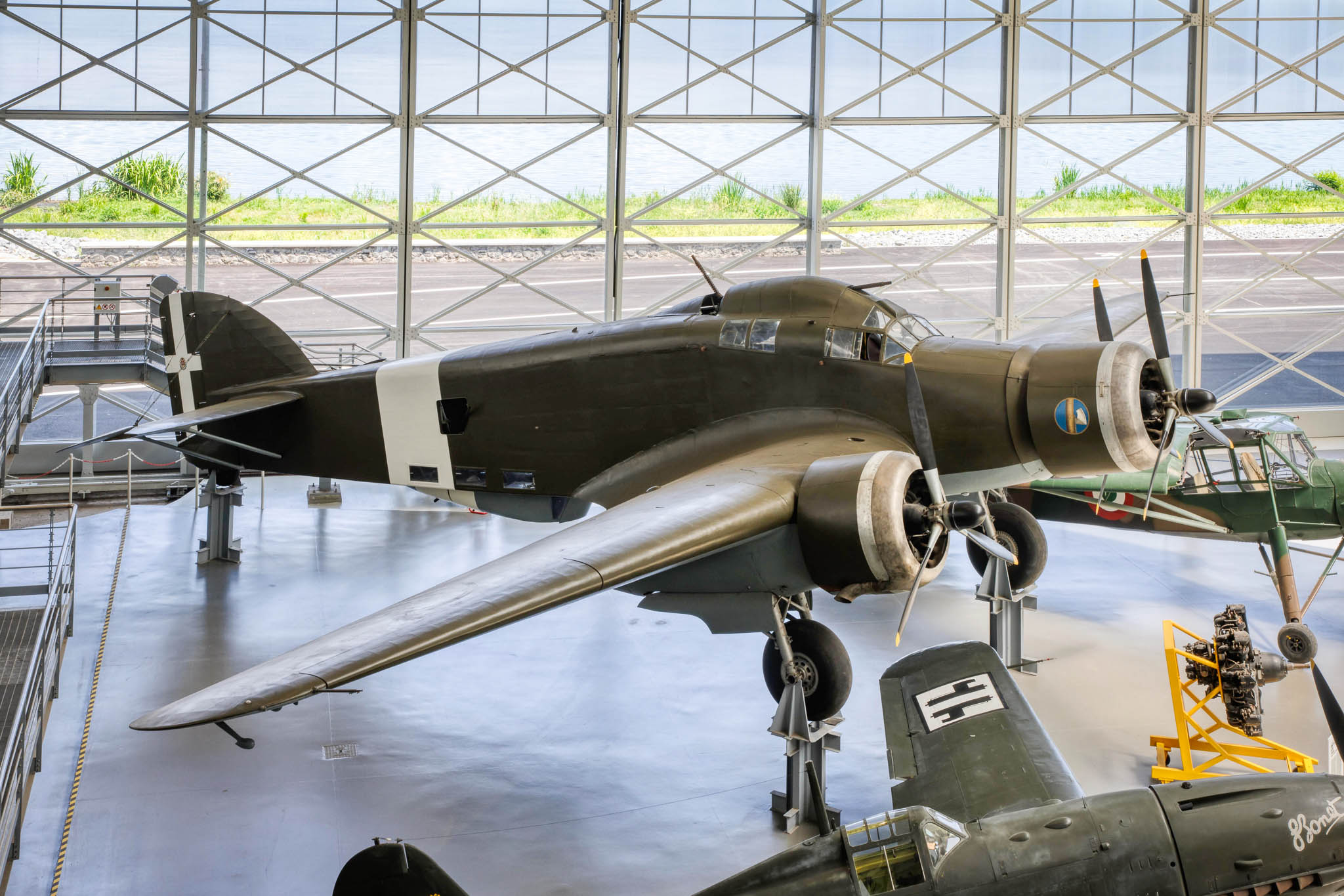 |
Savoia-Marchetti SM.79 Sparviero (Sparrow Hawk). The Savoia-Marchetti SM.79 Sparviero was designed to serve as both a conventional and a torpedo bomber. It entered service with 12° Stormo in 1936 and flew until the early 1950s as a transport aircraft. The example on display at Vigna di Valle was recovered from Lebanon and is one of two survivors, the other SM.79 is on display at the Gianni Caproni Museum of Aeronautics in Trento, northern Italy.
The only other complete SM.79 is at the Gianni Caproni Museum of Aeronautics, Trento. |