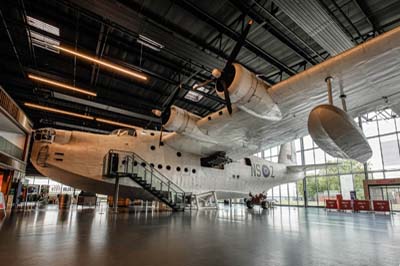
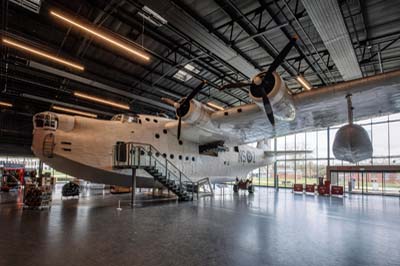
Royal Air Force Museum
Hendon
1989, 2006, 2007, 2008, 2009, 2012, 2013, 2019, 2020, 2021, 2022, 2023, 2024 and 2025
|
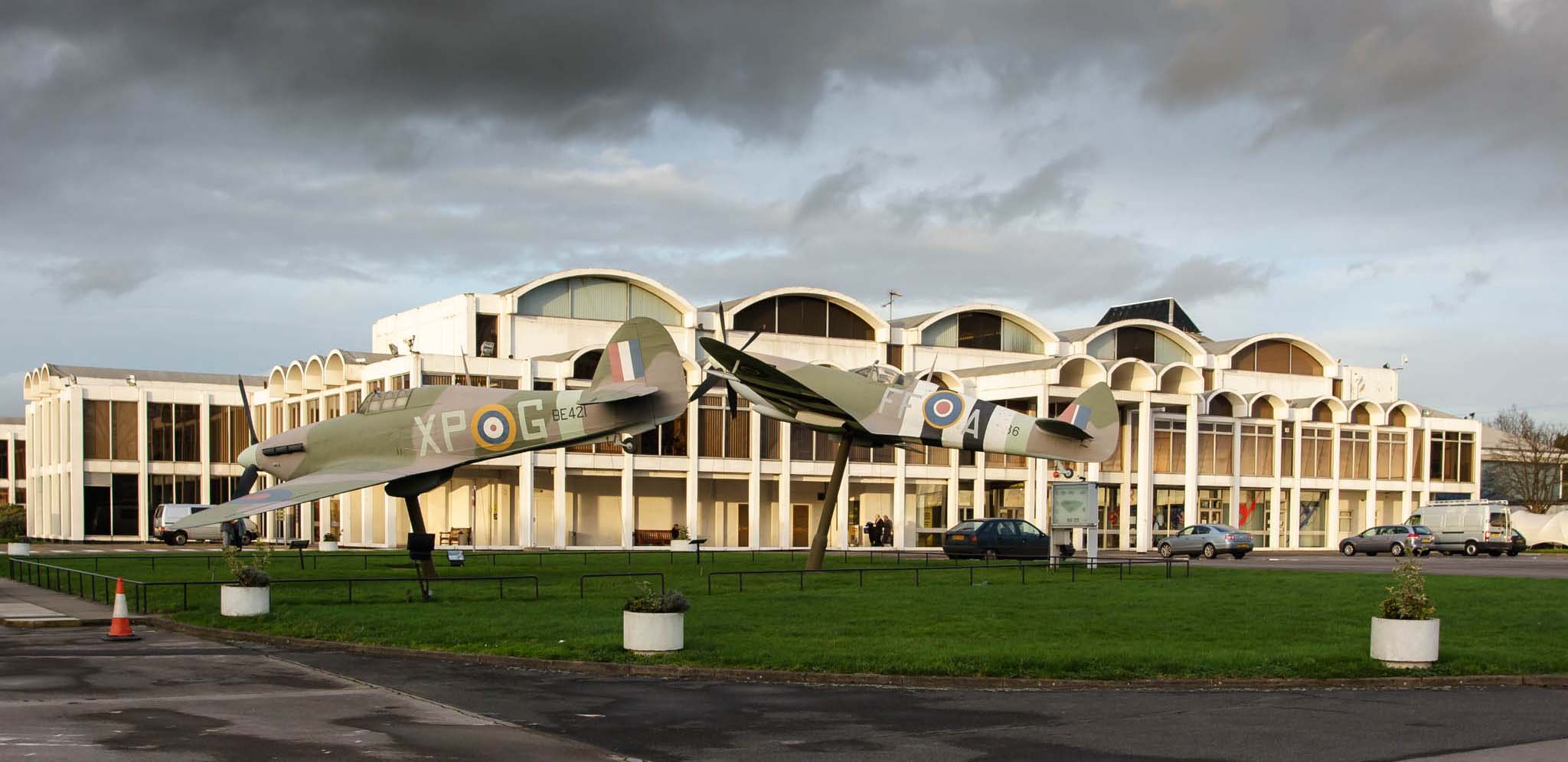
| The historic hangars 3, 4, and 5 with a modern facade of offices and shop. |
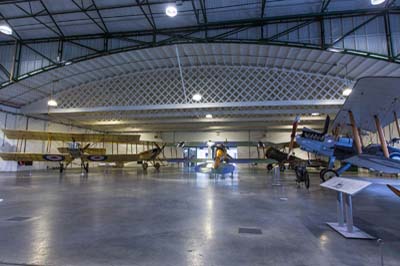 |
Hangar 2: The Grahame-White Factory and Offices in 2013. |
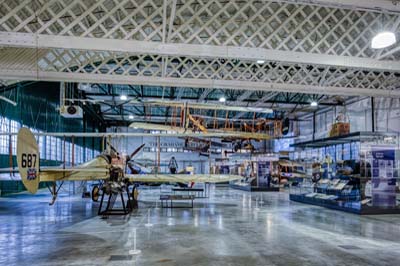 |
Hangar 2: The Grahame-White Factory and Offices in 2020. |
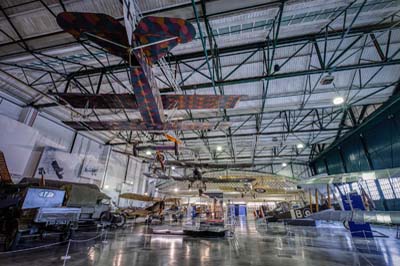 |
Hangar 2: The Grahame-White Factory and Offices in 2022. |
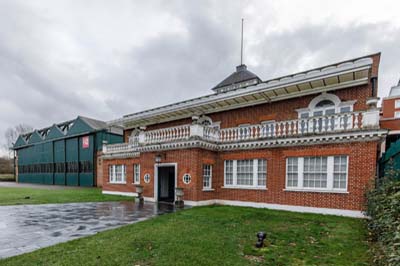
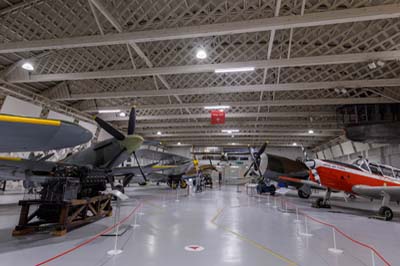
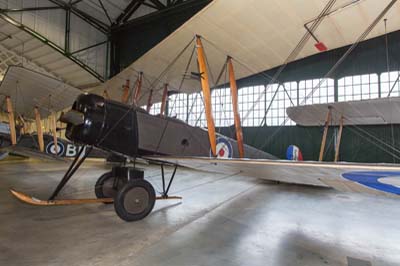
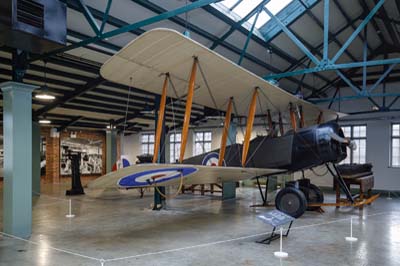
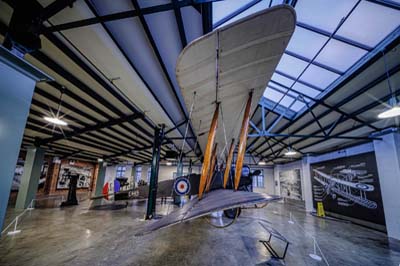
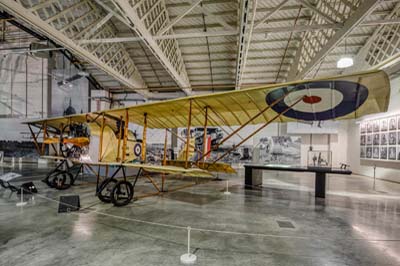
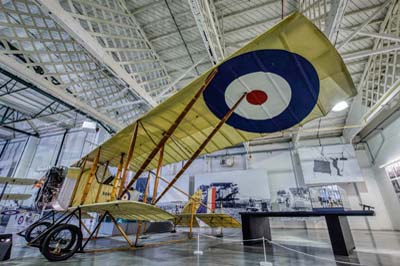
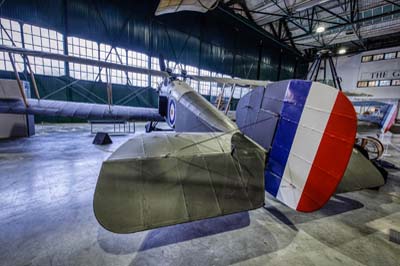
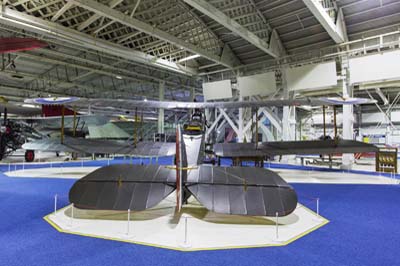
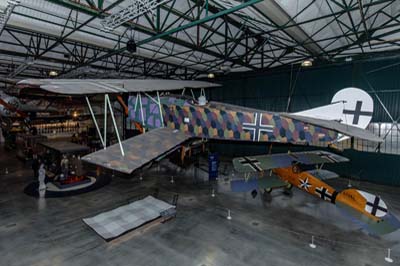
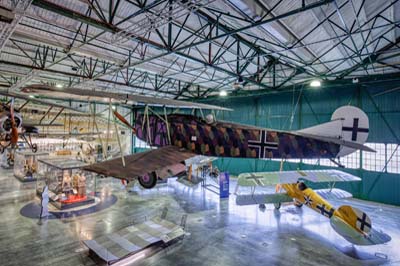
The Museum at Hendon is situated on the site of an historic Royal Air Force airfield that dates back to World War One and is comprised of four main buildings which are open to the public. One building the Claude Grahame-White Factory was dismantled and moved to the Museum site and completely restored.
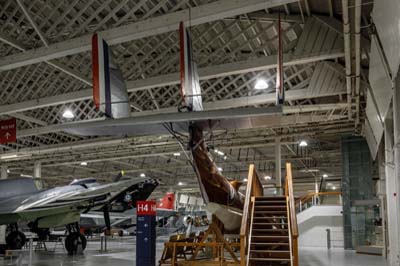
The Bomber Command Collection and the Historic Hangars Collection can be found in hangars that date back to World War One. The Milestones of Flight Exhibition (Hangar 6) and the former Battle of Britain Collection (Hangar 1) are housed in very modern buildings that unfortunately lack the character of the older historic buildings.
The Royal Air Force Museum at Hendon was opened by the Queen on November 15, 1972 with initially just 36 aircraft on display. I noted around 100 aircraft during my visit in January 2007. There are reserve collections at RAF Cosford, which is also open to the public and also at various other locations around the UK, which are not.
What I like about the aircraft on display is that they nearly all appear to have some direct connection with the RAF or Great Britain. The aircraft either served in or with the RAF or fought against the RAF in two World Wars. The collection of captured German aircraft from World War Two is surely the best in the world, more cab been seen at RAFM Cosford. The development of flight is covered from its start to the latest fast jets. A prototype Eurofighter Typhoon were found hanging from the roof next to a Blériot. Around half dozen replica aircraft are on display where original aircraft are not readily available. The replicas don't impress me that much and so I have chosen not to feature them here. Some of the aircraft are presented very well with wartime scenery and artifacts. The aircraft information boards are excellent, I particularly liked the aircraft histories, taking you from an aircraft's first squadron and on to how and when it ended up in the care of the RAF Museum. |
Left to right:
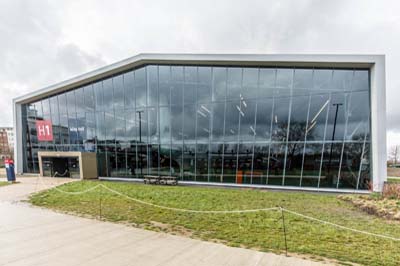
Hangar 1: housing the 'RAF First 100 Years Exhibition' from 2018, formally it held the Battle of Britain Exhibition,
Hangar 2: Grahame-White Watch Office and Factory which date back to 1915,
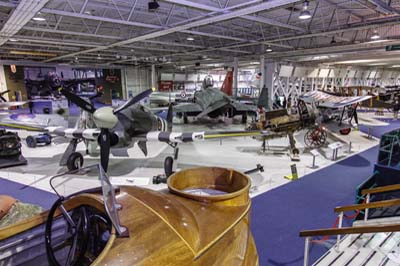
Hangars 3, 4 and 5: inside hangar 4 in 2009 and 2021, which includes the Bomber Command Collection. |
Left to right:
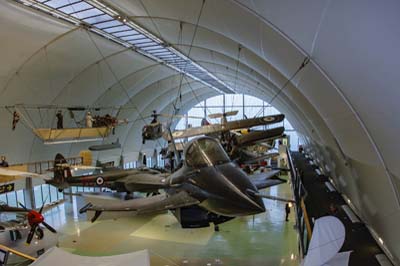
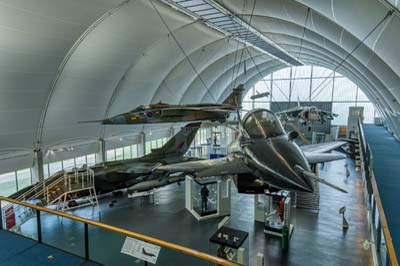
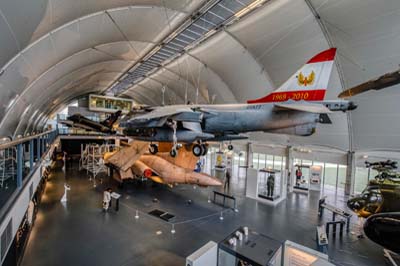
Hangar 6: held the Milestones of Flight Exhibition in 2008 with the more recent arrival in the foreground, a Eurofighter Typhoon prototype, photographed in 2008 and 2021. |
The Aircraft on Display
Aircraft from World War One |
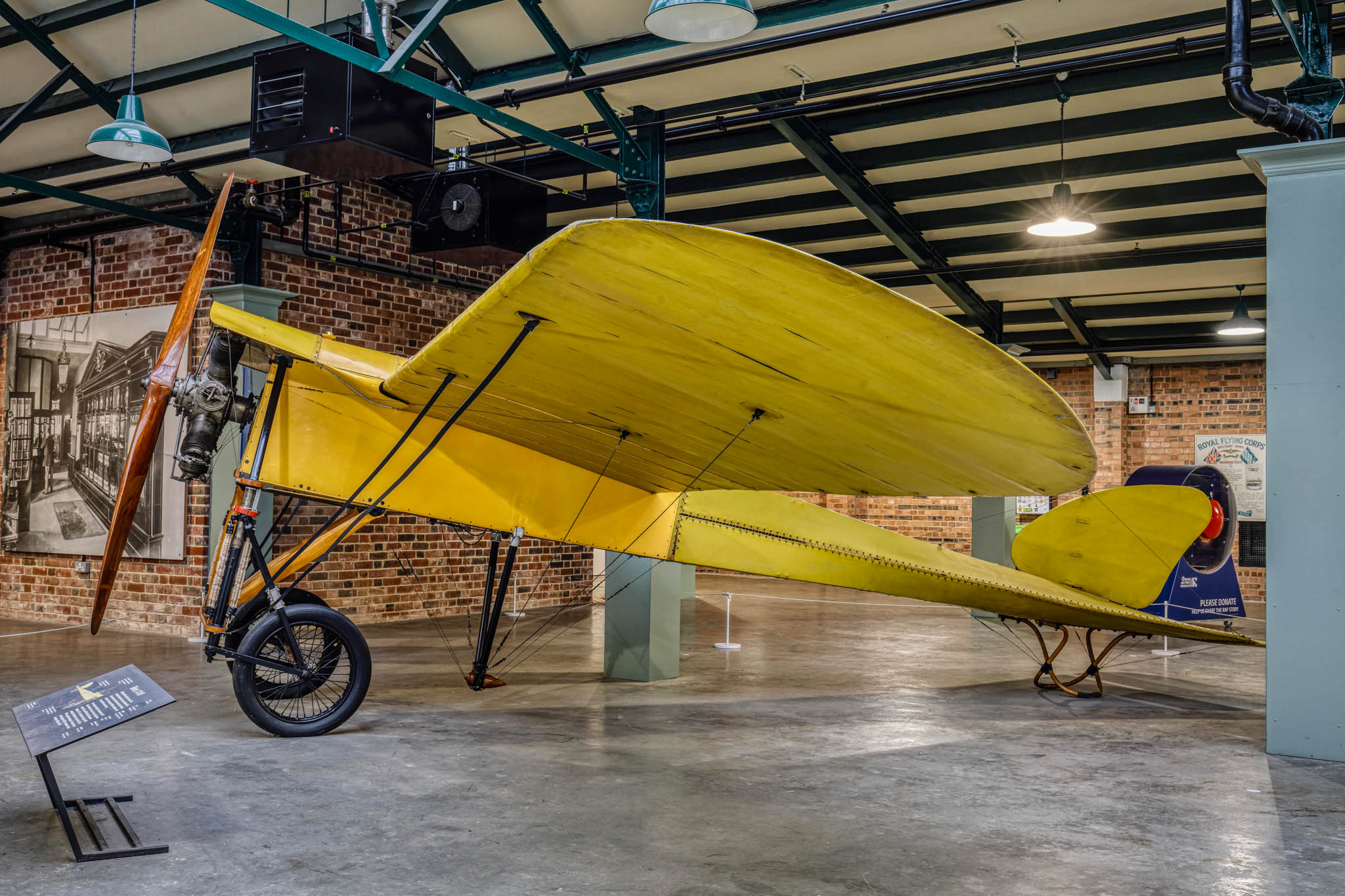
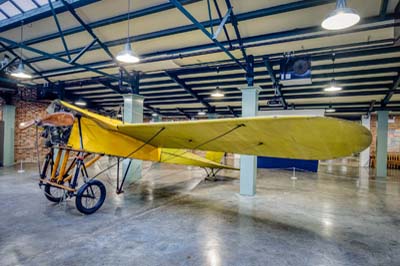
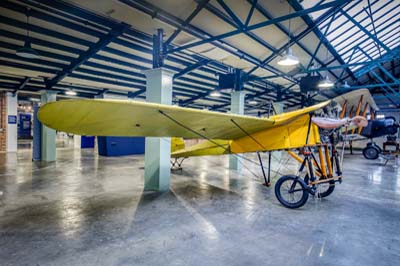
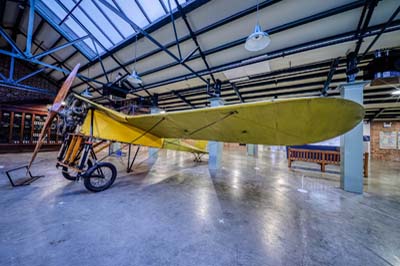
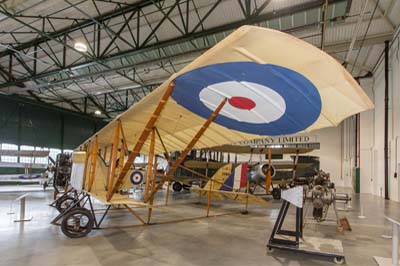
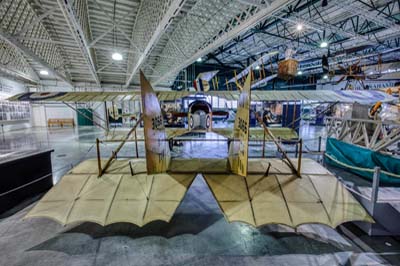
| Blériot XXVII (unmarked and c/n 433 later BAPC107 and later 9202M). The aircraft on display first flew in September 1911. In 1914 it went into store at Le Harve before being discovered by Richard Nash in 1936 and taken to Weybridge. Following a crash and rebuild the Blériot was loaned to the Science Museum in London in June 1939. Following a period of storage, it was put on display at Farnborough in 1950. In 1953 the Royal Aeronautical Society bought it from the Nash Collection. It was moved to Upavon in 1962 for the 50th Anniversary of Flight Exhibition. In 1963 it was restored at Lyneham and then delivered to the RAF Museum store at Henlow in 1964. Further restoration took place at Cardington in 1974. In November 2004 it was transferred to Hendon for display in the Grahame-White Factory. |
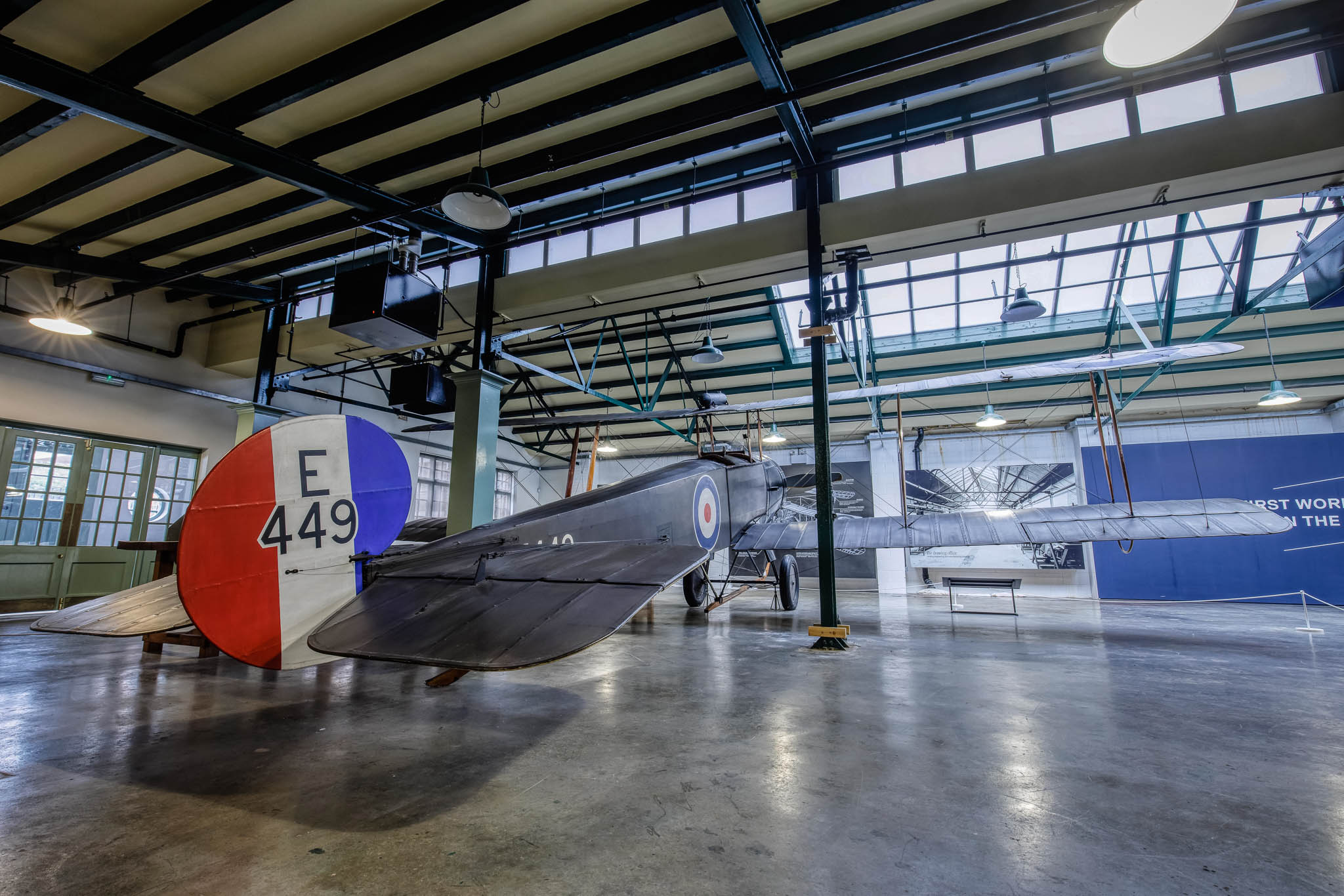 |
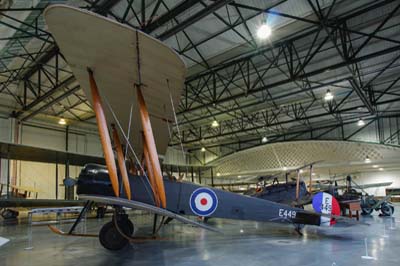
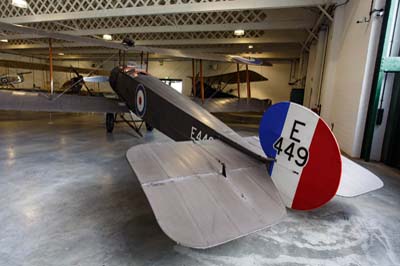
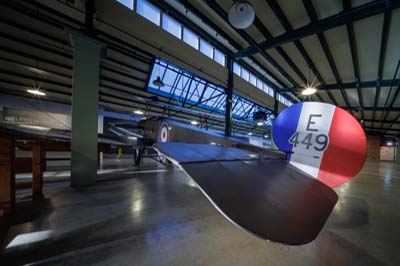
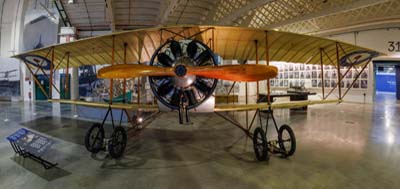
Avro 504K ('E449' and 9205M). The Avro 504K was a primary two-seat trainer with a top speed of 85 mph (137 km/h). Over 10,000 were built from 1913 to 1932 when production ended.
The aircraft on display is a composite aircraft assembled using the wings of an Avro 548A (E499 and G-EBKN) and the fuselage of an Avro 504K (G-EBJE). Another aircraft from the Nash Collection, it was put together in the 1950s when in the charge of the Royal Aeronautical Society, by engineers of British European Airways. It was later restored using another engine at RAF Abingdon to flying status, taking to the air on June 24, 1966. It was further restored and repainted at Henlow before it moving to Hendon in 1972. Along with other aircraft in the Nash Collection it was bought by the Museum in 1992. |
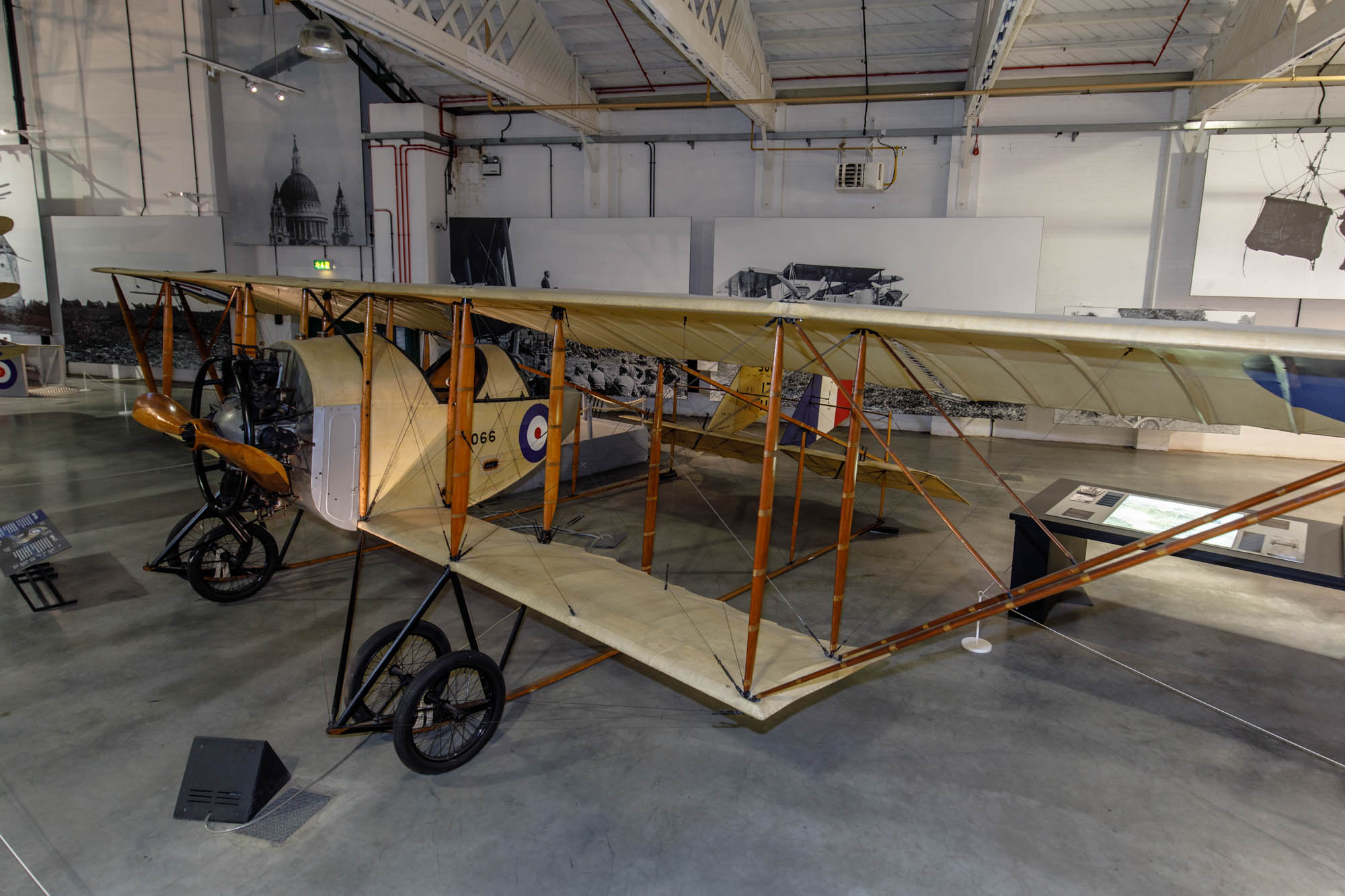 |
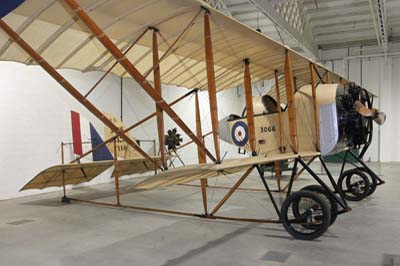
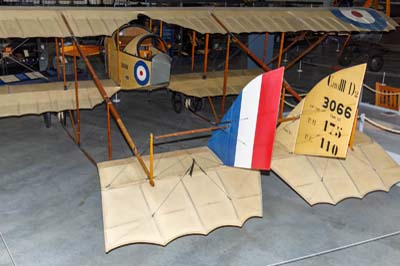
Caudron G.III (ex O-BELA, OO-ELA and 9203M painted as '3066'). The Caudron G.III was designed by Gaston and Rene Caudron and was in production from May 1914 as a two-seat reconnaissance trainer. It had a maximum speed of 65mph (105 km/h).
This particular example was built in 1916, nothing else is known about its identity and service history. By 1921 it was registered in Belgium as O-BELA but changed to OO-ELA in 1929. After appearing at the RAF Display at Hendon in June 1936 it was acquired by the Nash Collection and allocated G-AETA. The Royal Aeronautical Society bought the aircraft in 1953, handing it to the RAF in 1964. It was moved to Henlow and rebuilt as '(N)3066' of the RNAS Flying school at Vendôme in 1917. It moved to Hendon in 1972 and is now on display in the Grahame-White Factory hangar. |
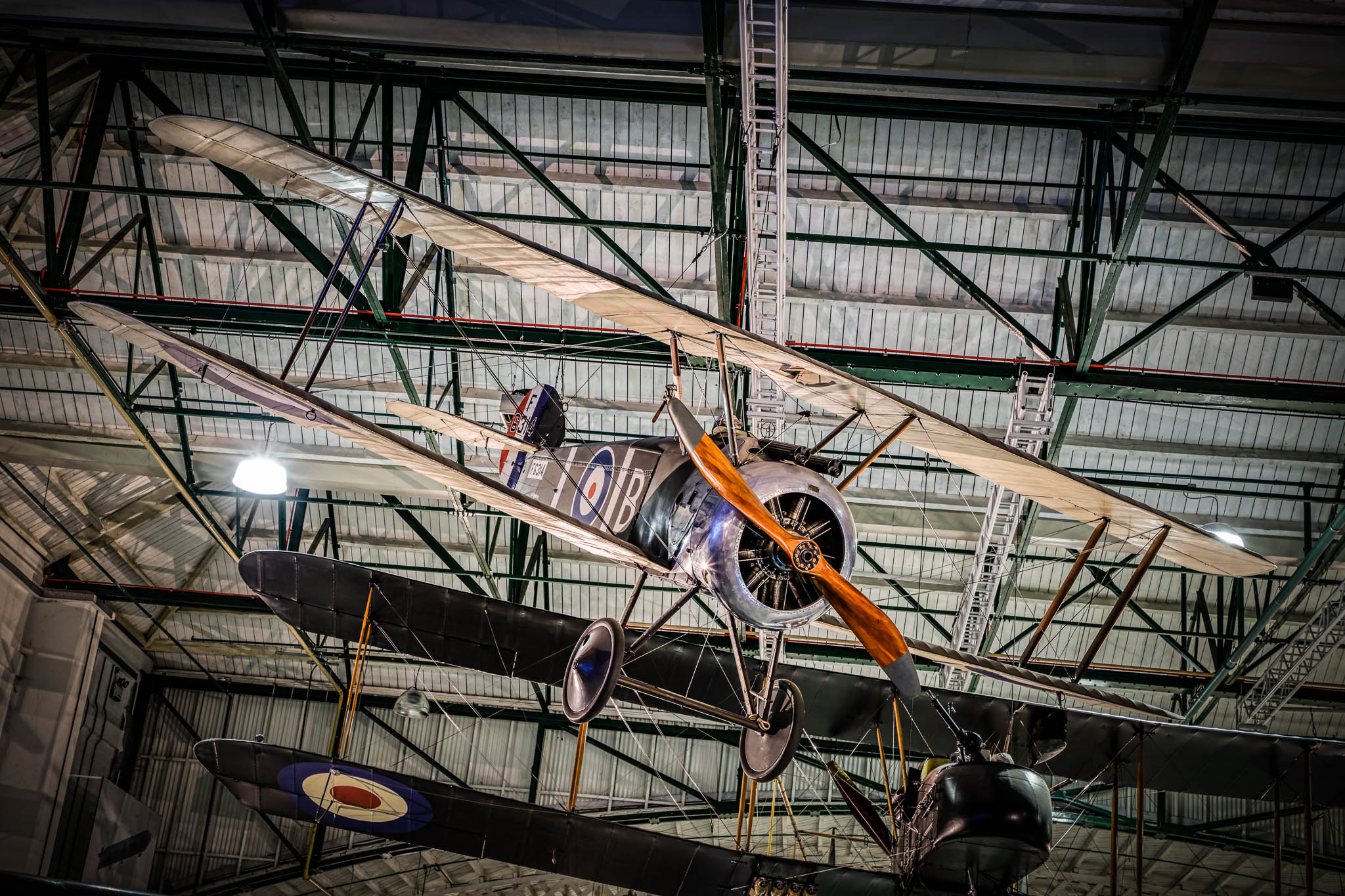 |
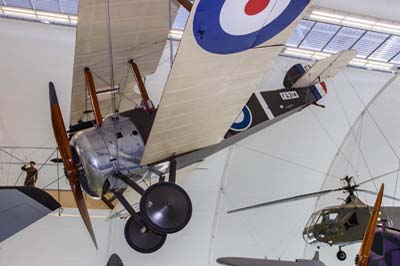
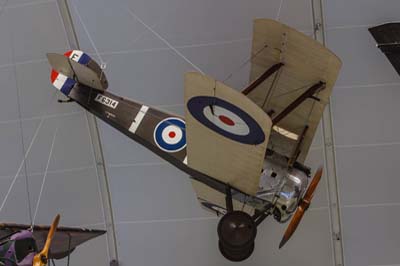
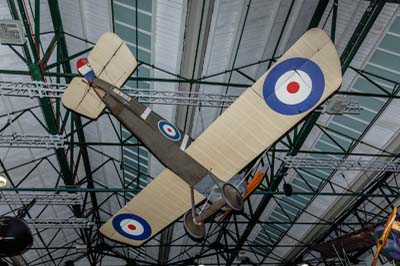
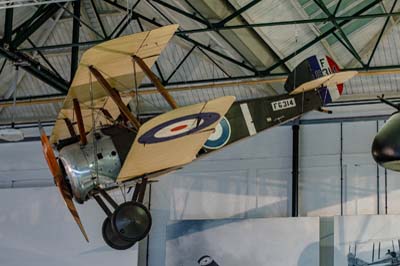
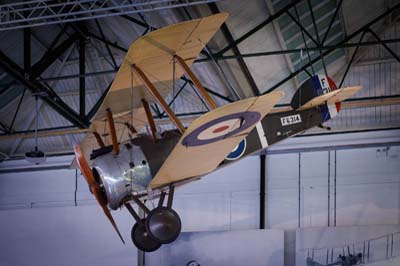
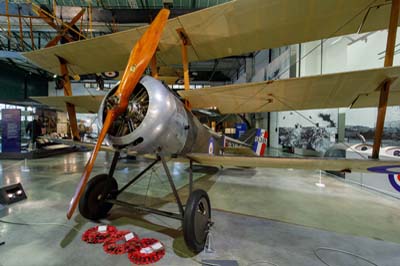
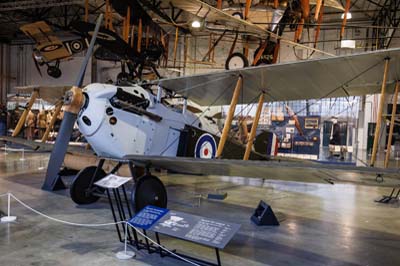
| Sopwith Camel F.1 (F6314 later 9206M). Developed from the Sopwith Pup, it was the most successful aircraft of World War One. It's name was derived from a slight hump forward of the cockpit. 5,490 Pups were produced from 1916, they claimed more kills (1,294) of German aircraft than any other allied fighter. Eleven companies apart from Sopwith Aviation Company built the Camel, including Fairey Aviation. It was found to be a difficult aircraft to fly due to its rotary engine that generated torque, which unless full right rudder was used on take off, caused inexperienced pilots to ground loop. During World War One, 413 Sopwith Camel pilots died in action with 385 pilots being killed due to accidents. F6314 was manufactured by Boulton and Paul. |
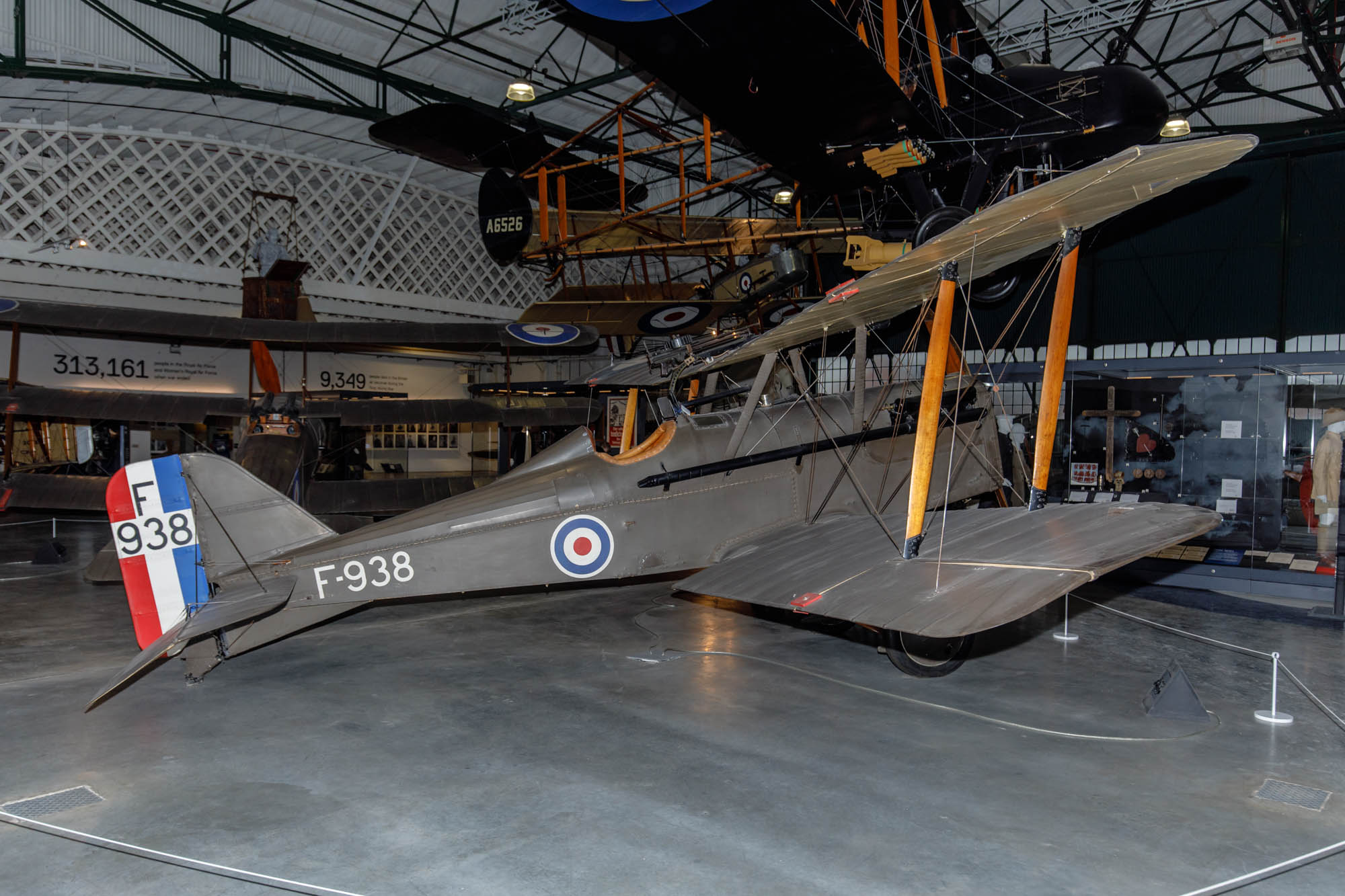 |
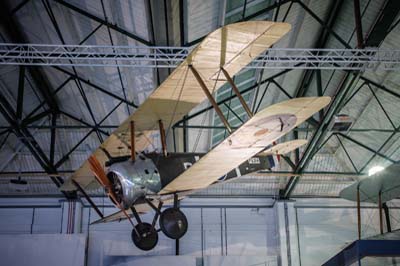
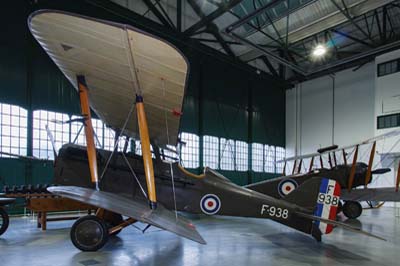
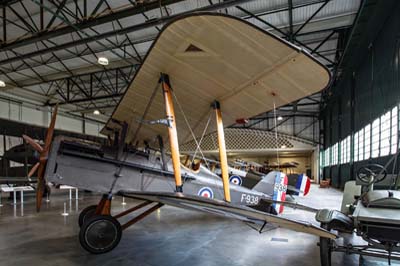
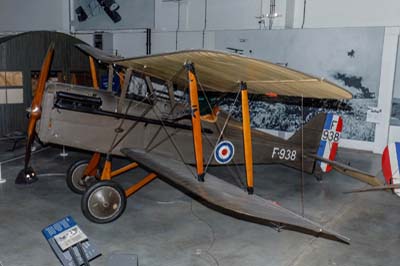
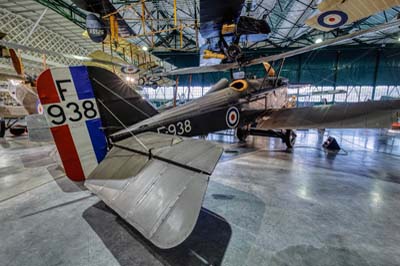
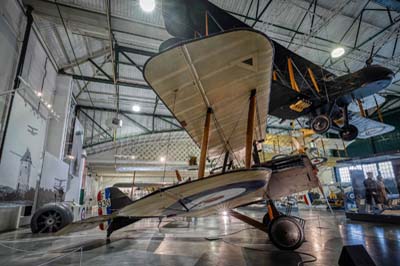
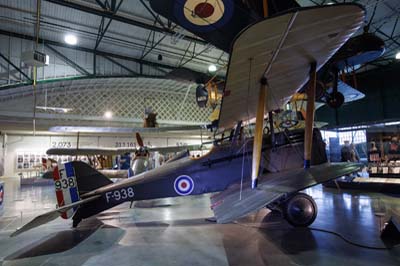
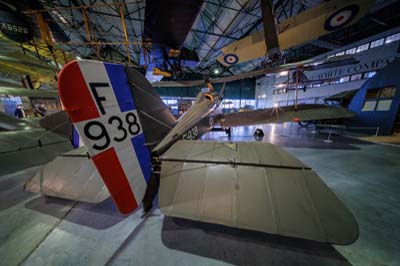
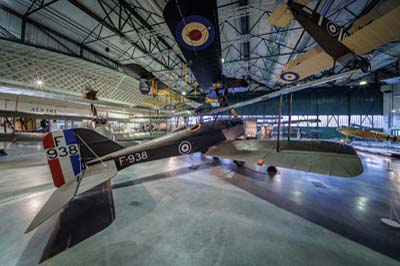
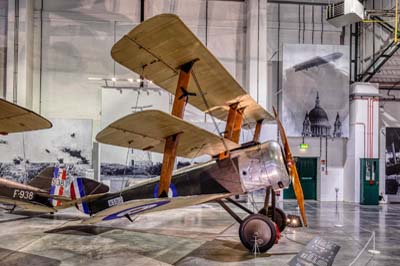
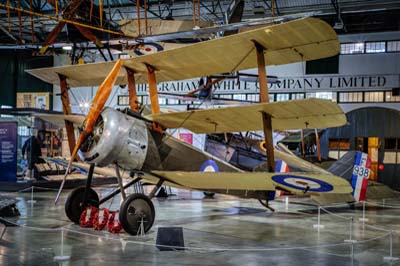
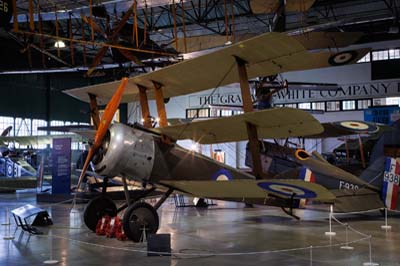
Royal Aircraft Factory SE.5A (F938 later 9208M formally registered G-EBIC). The RAF SE.5A was in production between 1917 and 1920 as a single seat fighter. It had a top speed of 120 mph (193 km/h).
The aircraft on display was built by Wolesey Motors of Birmingham in 1918. After a period of storage it was registered as G-EBIC in 1923 and moved to Hendon for skywriting operations by Major John Clifford `Jack' Savage and his Savage Skywriting Co Ltd based at Hendon from 1922 until 1934. Another example G-EBIB is on display at the Science Museum in London. By 1930 it had been acquired by Richard Nash and was put on display at the Royal Tournament in 1938. Throughout the 1950s it was displayed at various events. In 1968 it was completely overhauled at the RAF Museum workshops at Henlow. It was moved to Hendon in 1972 for the Museum's opening and purchased by them in 1992. The Shuttleworth Trust has (F909 registered G-ABIA). |
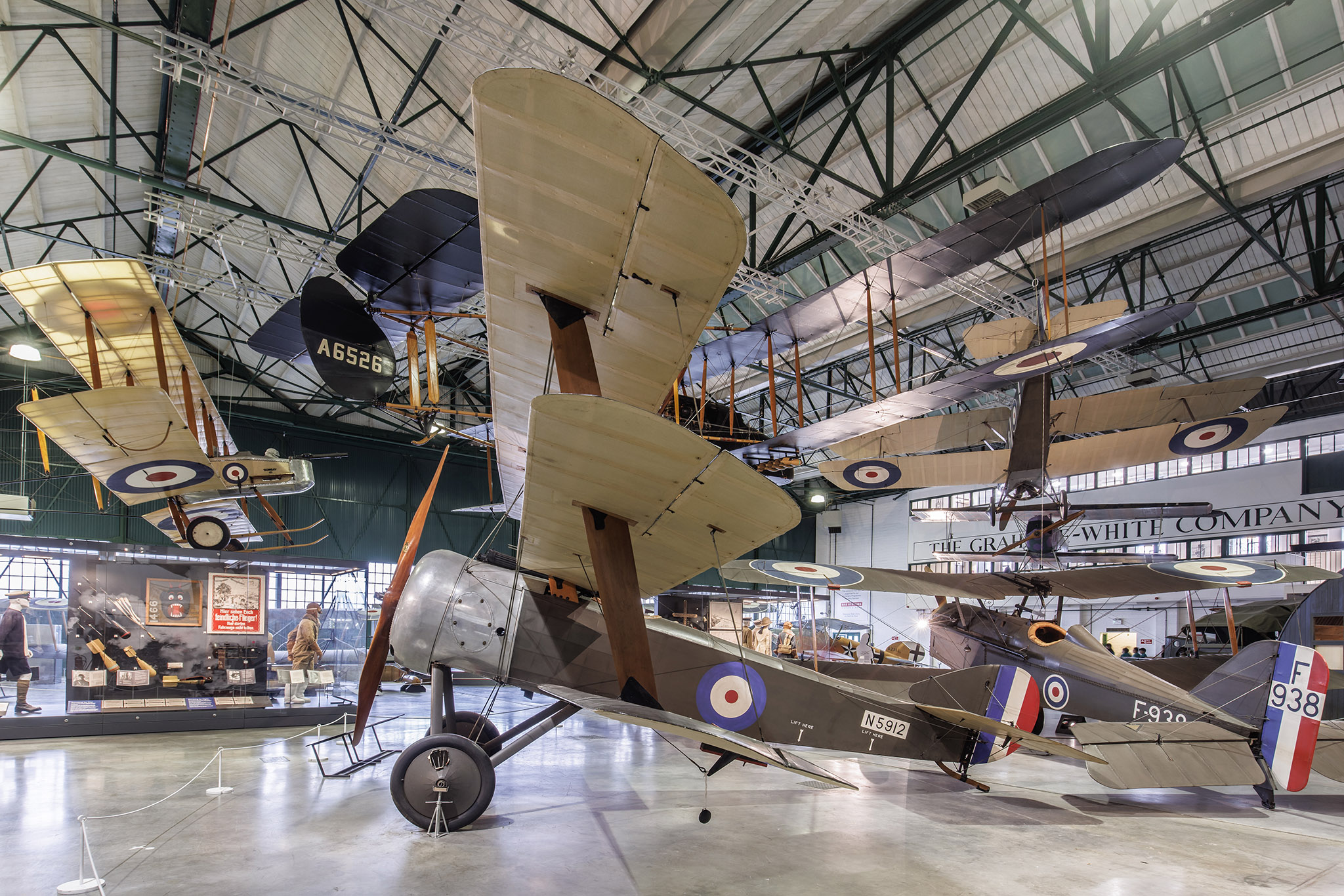 |
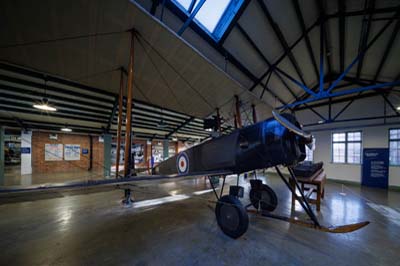
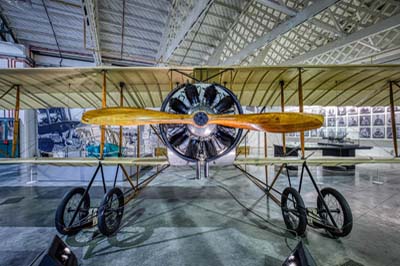
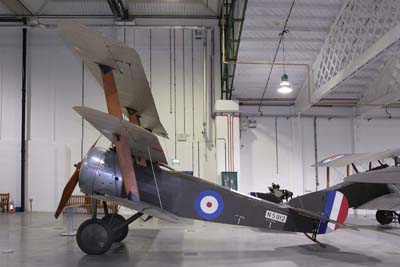
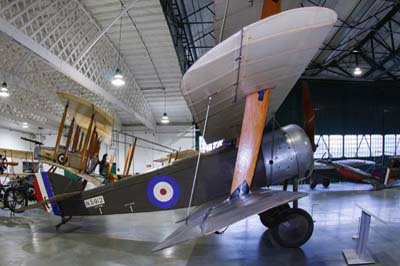
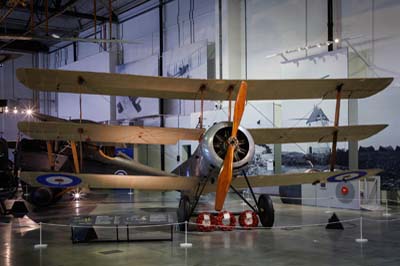
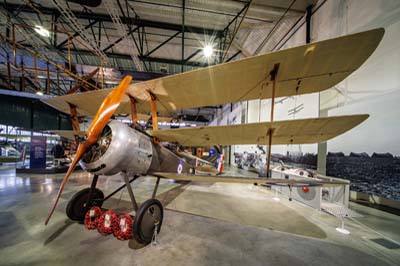
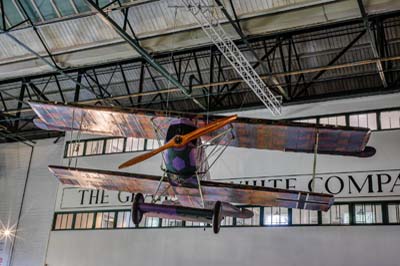
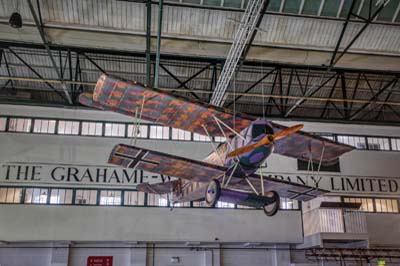
Sopwith Triplane (N5912 later 8385M). A single seat fighter in service from 1917 to 1919 and was capable of 113 mph (182 km/h).
This particular aircraft was manufactured by Oakley & Co in 1917. It was delivered to the School of Aerial Fighting at Marske in Yorkshire, by 1919, it had been struck off charge. It was held in store at RAF Cardington till the late 1920s before being moved to the fire dump. In 1936 it was transferred to RAF Hendon for reconstruction and display. Following long periods of storage, restoration at Henlow and display at various events, the Triplane arrived at Hendon in 1972 and is now on display in the Grahame-White Factory hangar. |
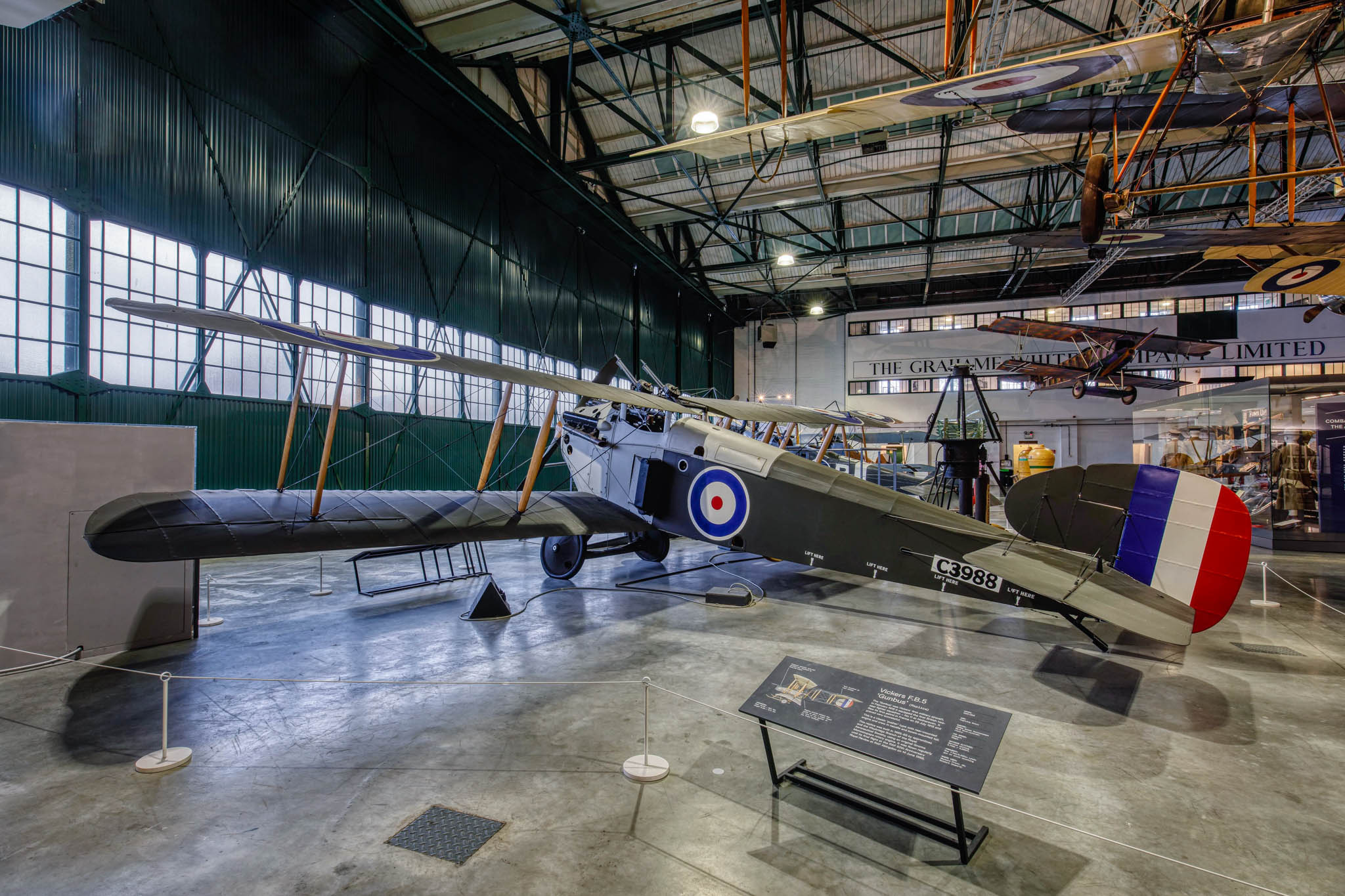 |
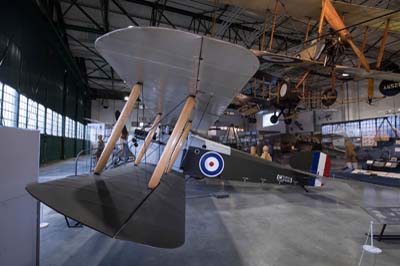
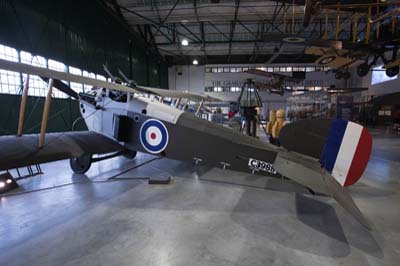
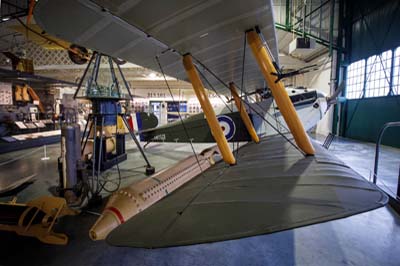
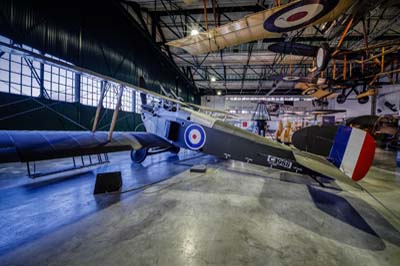
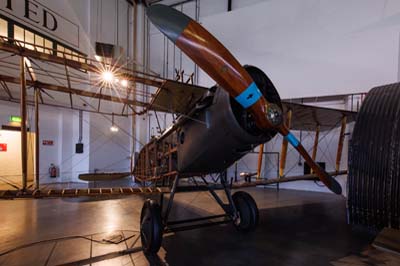
The Sopwith Dolphin 5F.1 (C3988) is a single-seat fighting scout, the pilot sat with his head above the top wing, allowing an excellent view, but he could not see the nose to use it as a reference. It entered service with the Royal Flying Corps in January 1918 with five RAF squadrons mostly in France. Production continued until 1919, however in 1921 the type was declared obsolete.
The composite on display is the result of an extensive reconstruction starting at Cardington in 1997 with parts gathered from the late 1960s originating from Sopwith Dolphins; D5329, C4033 and D3725. The original components includes; the rear fuselage of C3988, the cowlings, radiator, fuel tank, header tank, wheels, struts and fin from D5329, tailplane from C4033 and the elevators from D3725.It was completed at Cosford in 2012 and transferred to RAFM Hendon later that year. |
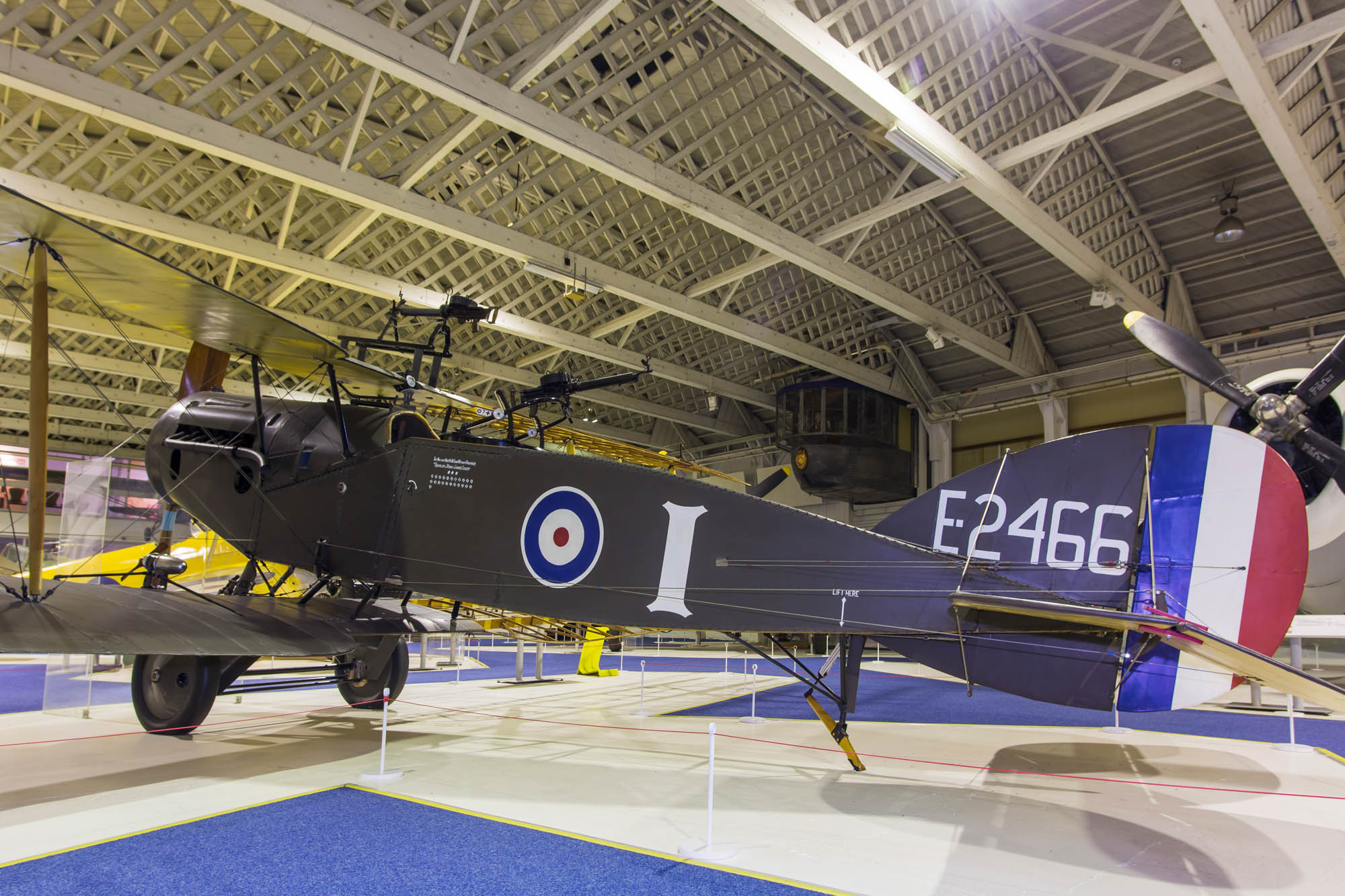 |
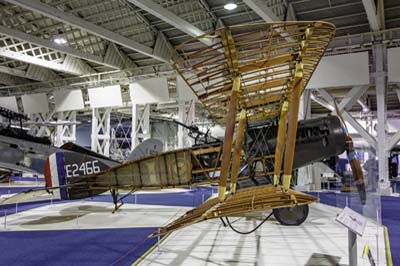
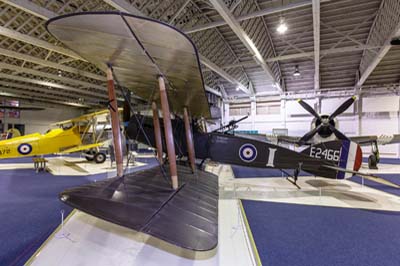
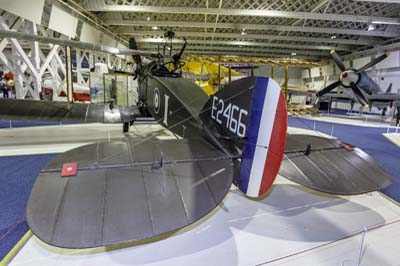
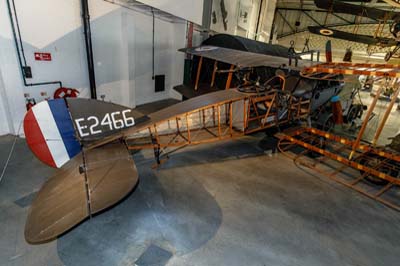
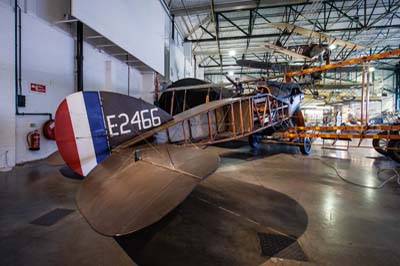
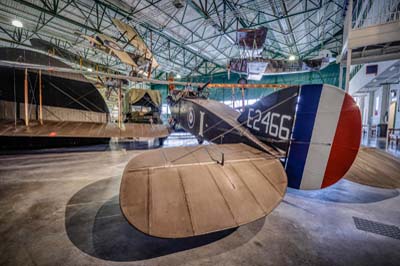
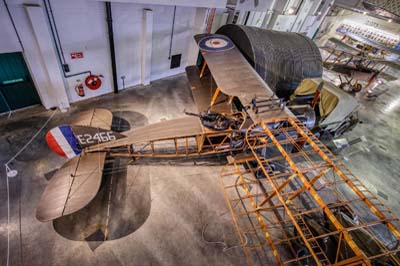
Bristol F.2b ('E2466' 'I'). Built by the Bristol Aeroplane Company, the prototype F.2A made its first flight in September 1916. After some modifications the F.2B went into production. Eventually 5,329 examples were delivered, some serving until 1932.
E2466 is a composite rebuild using one of six fuselage frames bought privately in 1919 by a farmer to support a barn roof in Weston on the Green, they have no known identity. After recovery of four of them in 1965 they were taken to RAF Henlow. The airframe was restored in 1972 and put on display at Hendon till 1979 when it was taken to Cardington, where it was fitted with a fabricated engine and dummy radiator. By 1983 a fin, rudder and cowlings were added along with an original tail plane and lower left wing from the Shuttleworth Collection. The other wing sections came from a batch of wings built in 1918 but never delivered. These were acquired by RAFM in 1971 along with an original machine gun and wheels. All the additional parts were assembled in 1986 and the composite aircraft was taken to Hendon for display. It is painted in the markings of 22 Squadron from 1918 and the starboard side of the fuselage and wing is left uncovered. |
 |
 |
 |
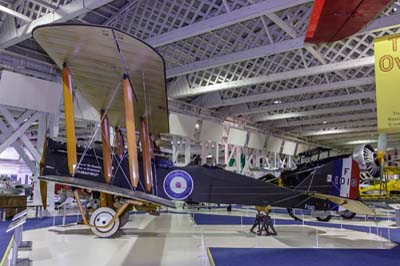
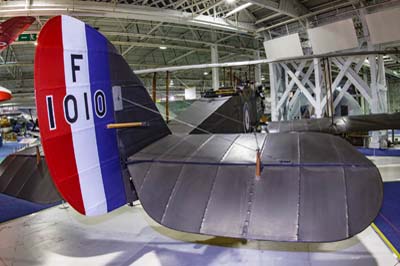
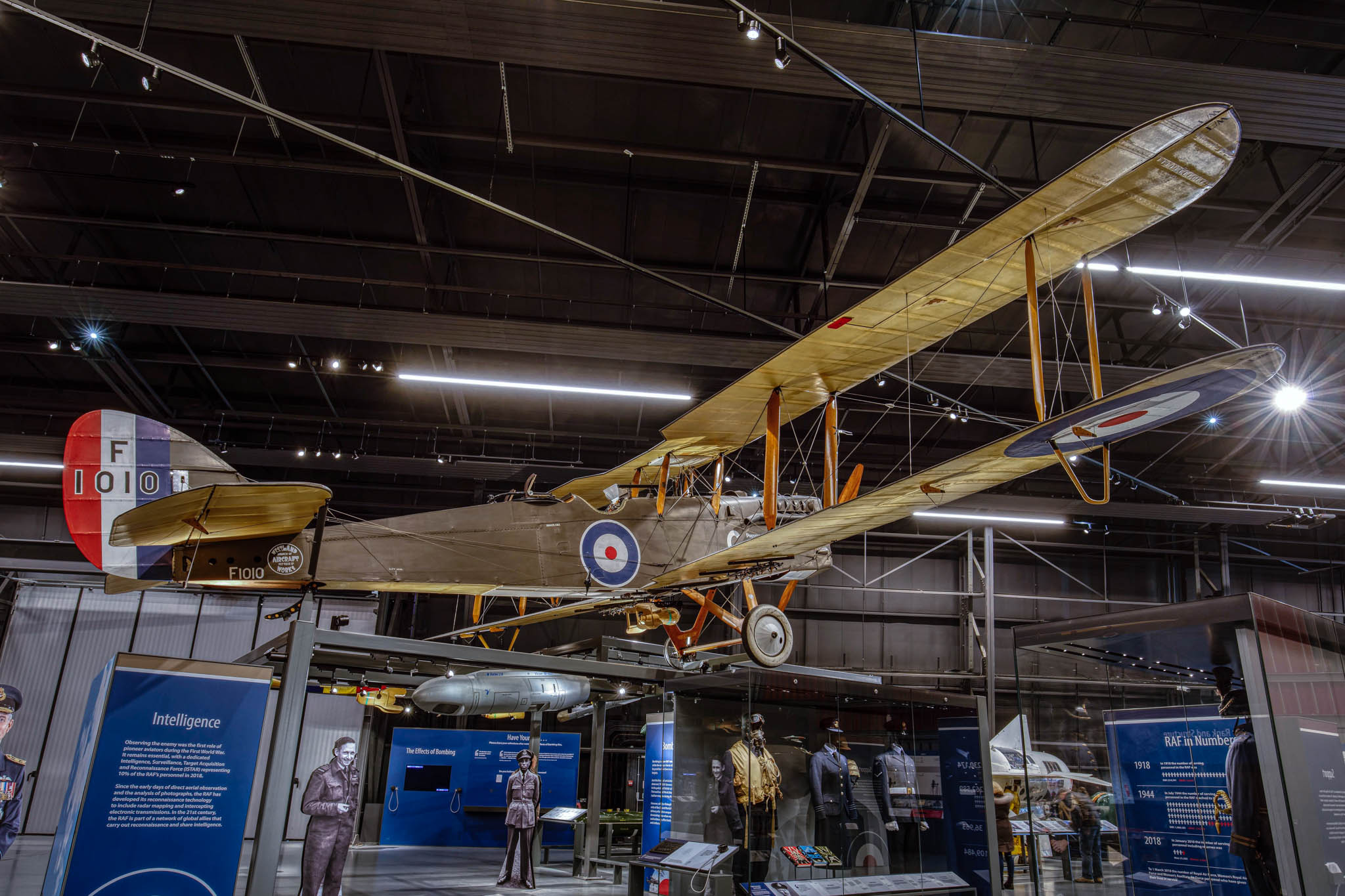
Airco DH.9A 'Ninak' (F1010). The DH.9A was built by Aircraft Manufacturing Co. (Airco) of Hendon (with several sub-contractors) and designed by Capt. Geoffrey de Havilland. He later formed is own company when Airco were taken over by BSA in 1920. The DH.9A was in service from 1918 to 1931 as a two-seat bomber. 900 were built during 1918 in Great Britain, the Russians even produced unlicensed aircraft for the Red Air Force. After World War One the DH.9A was used extensively in Iraq and India.
In 1918 the first squadron (110) were equipped with the DH.9A. Unusually 110 Squadron's aircraft including the aircraft on display were purchased for the RAF by His Serene Highness, the Nizam of Hyderabad. The squadron was consequently named 110 (Hyderabad) Squadron and F1010 is also inscribed to this effect. In 1918 on a long range bombing range from its French base F1010 was brought down and captured by the Germans following a forced landing at Kaiserslautern. It was moved to the Berlin Museum as a war trophy. During World War Two it was damaged in a bombing raid and moved with other aircraft to a forest at Czarnikau, Germany for storage. Discovered by Polish troops in 1945 it was moved to Deblin, Poland. By 1963 it was put on display at a Museum in Krakow. In 1977 it was swapped for a Spitfire XV1e (SM411) and subsequently restored at Cardington before being put on display at Hendon in 1983. |
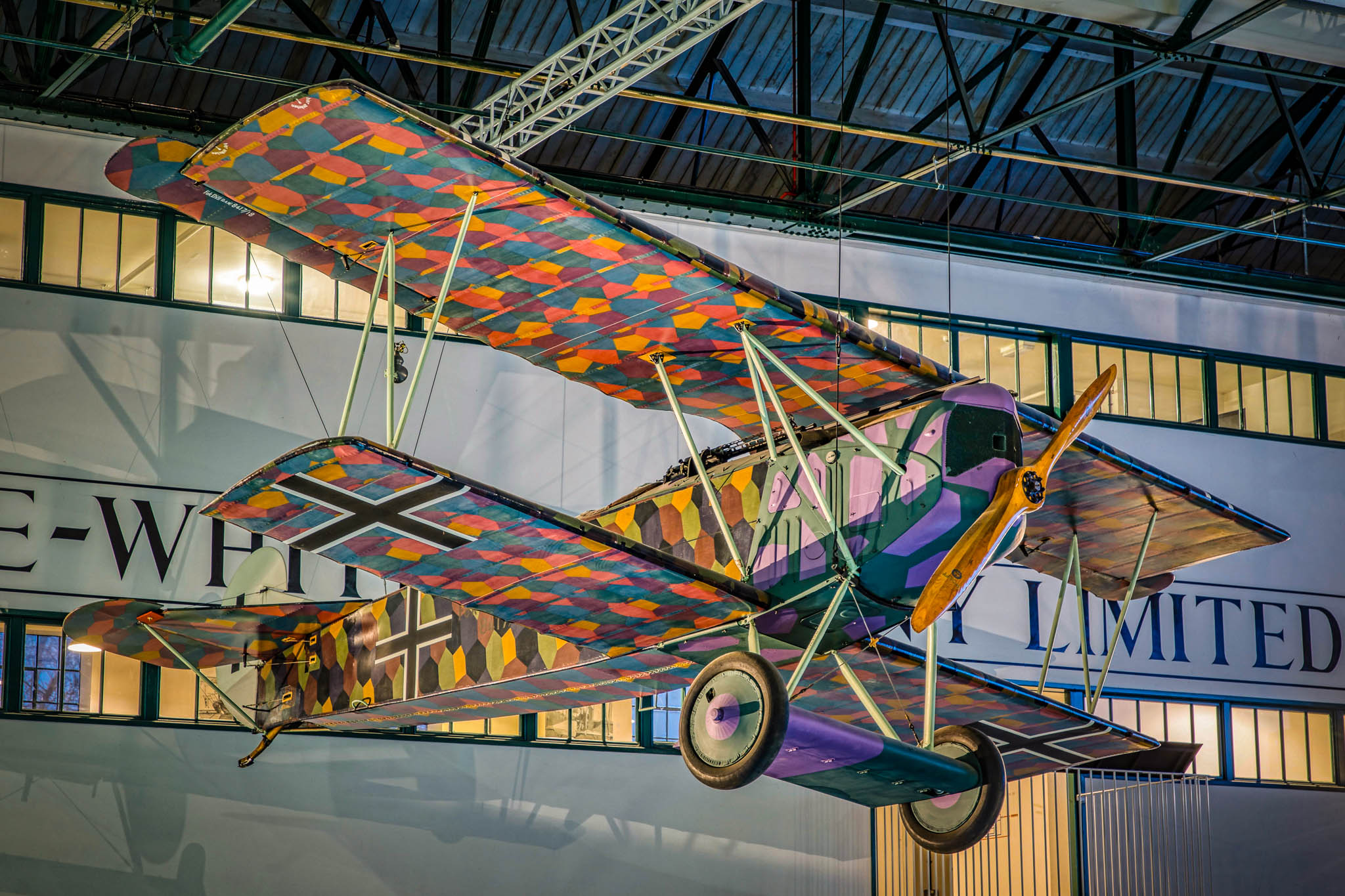 |
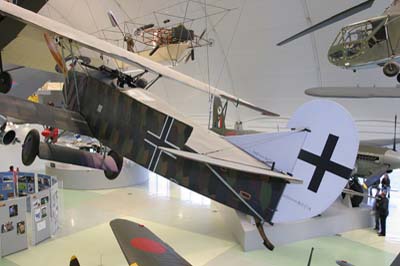
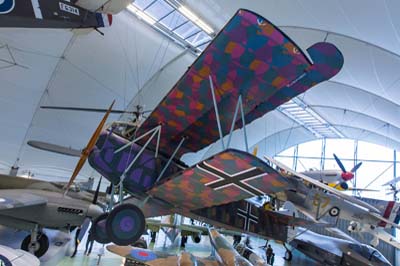
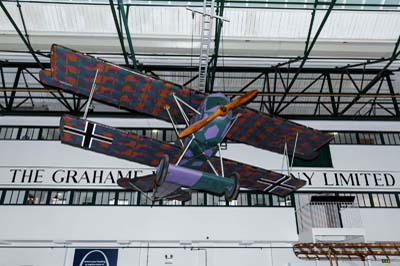
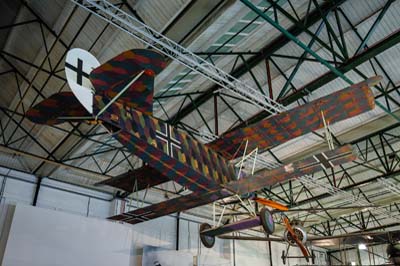
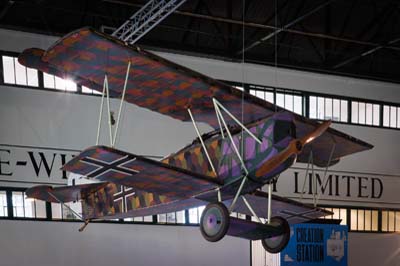
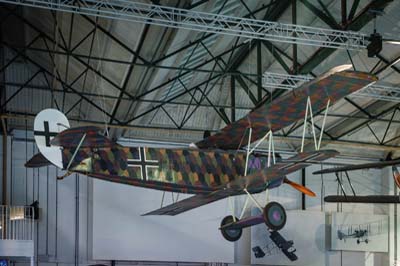
Fokker D.VII (8417/18 and 9207M). Designed by Reinhold Platz at Fokker, Baron Manfred von Richthofen 'Red Baron' in a competition for the best fighter flew the D.VII, after directing some improvements to be made, it was declared the winner. Production was ordered not only from Fokker but from Albatross and AEG. The first aircraft entered service in May 1918, too late for von Richthofen who had been killed just days before it was introduced. By the end of World War One this aircraft was considered to be the best German fighter. 120 examples were moved to Holland and further 142 were shipped to the United States at the end of the war. The US Air Force were flying them to the mid 1920s.
The example on display is one of seventy-five D.VII supplied to the Belgian Military Aviation (Aviation Militaire Belge) in 1919 under the Treaty of Versailles. Modified as a two-seater, it was registered OO-AMY and OO-UPP before being sold in 1938 to the Nash Collection. For many years it was in a red overall scheme, but following a four-year restoration it emerged in 1997 in an authentic five-colour lozenge camouflage scheme. Today, this example is one of seven D.VII survivors. |
| 'Faster, Higher, Further' Exhibition (Aircraft from between the wars 1919 to 1939). |
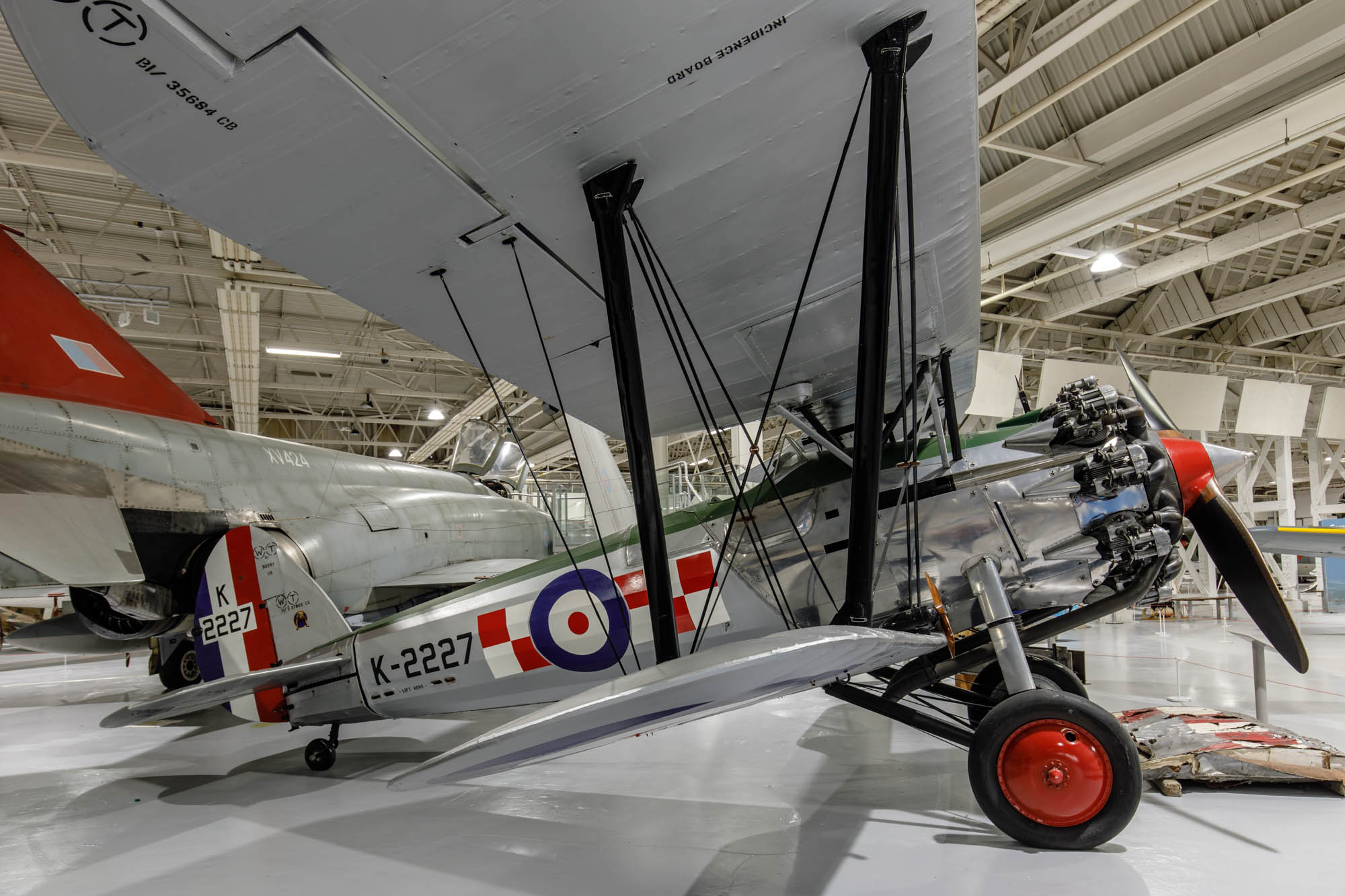 |
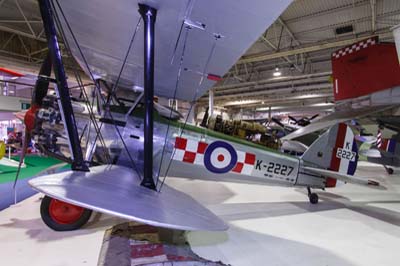
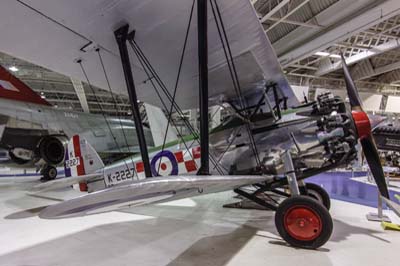
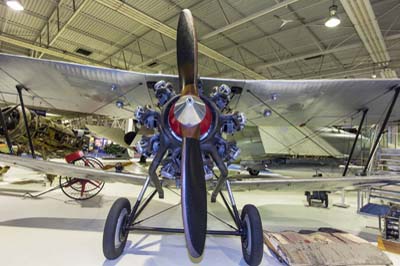
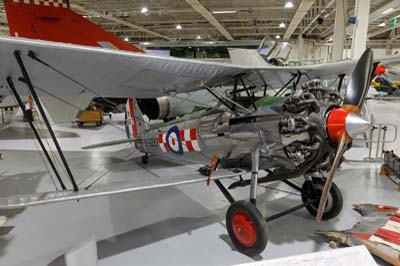
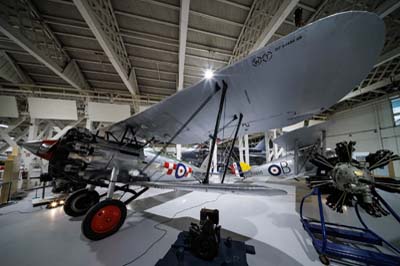
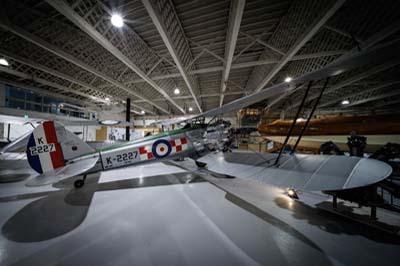
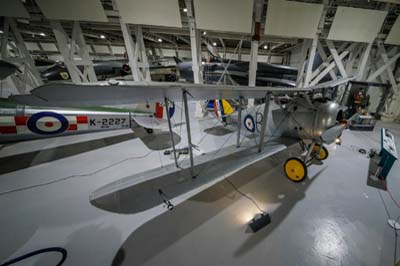
Bristol Bulldog IIA (G-ABBB but painted as 'K2227'). The Bulldog was built by the Bristol Aeroplane Company and was designed as a single seat day and night fighter. The prototype took to the skies in May 1927. It entered service with the RAF in 1928 but was withdrawn in 1938 in favour of the Hawker Hurricane. The aircraft was exported to Australia, Denmark, Estonia, Finland, Japan, Latvia, Siam, Spain and Sweden.
The aircraft on display was built in 1930 and was the Company demonstrator until it was retired and put into store at Filton, Bristol. In 1939 it went to the Science Museum in South Kensington, London. It was used in the making of the 1955 film 'Reach for the Sky' about Douglas Bader, who lost his legs when flying a Bulldog. It was restored to flying condition by 1960 and by 1961 it was painted as 'K2227' and presented to the Shuttleworth Trust. It suffered a number of accidents over the next three years. Extensive restoration was carried out throughout the 1990s before being put on display at Hendon. In February 2010 it had been transferred to Filton. |
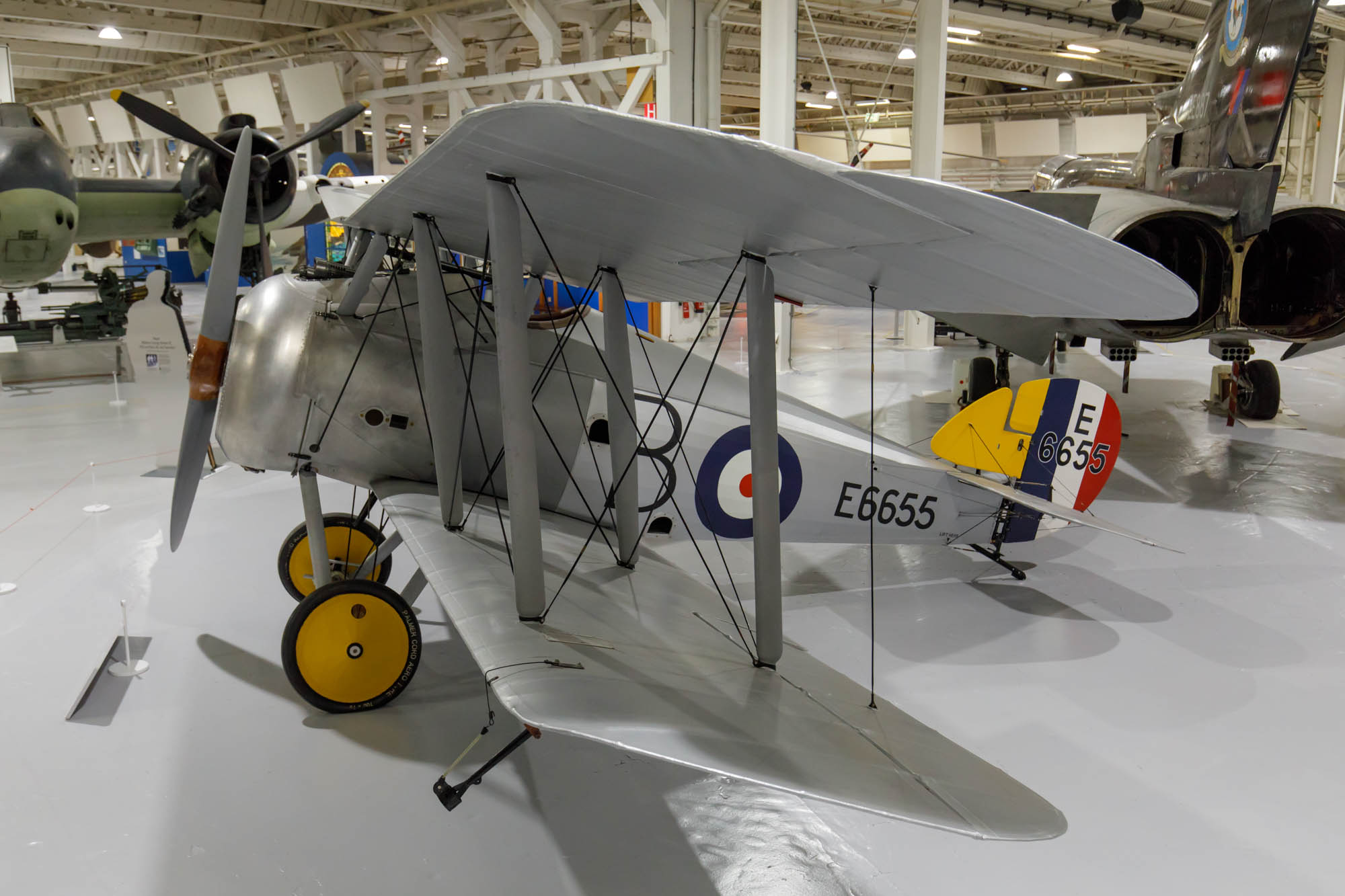 |
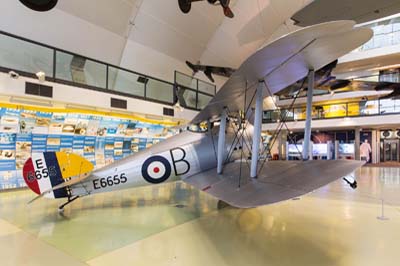
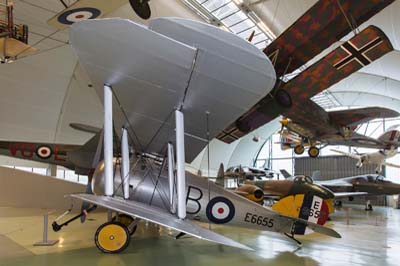
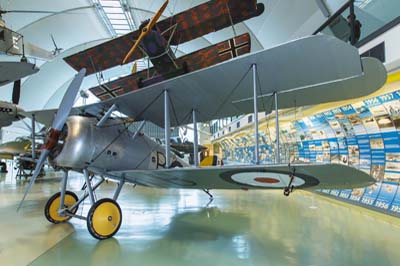
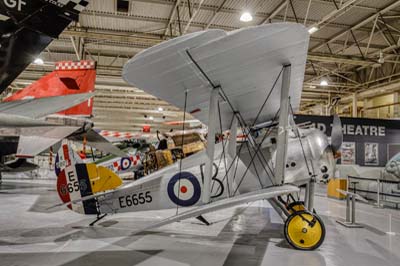
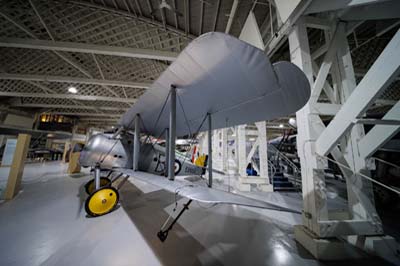
Sopwith Snipe ('E6655'). Not quite a replica this Snipe has been constructed using some original parts (pair of port and starboard upper ailerons, instrument lamps and other small components) and also some 'Snipe type' all-metal parts (fin, rudder and horizontal surfaces) from a similar aircraft, a Sopwith Dove (G-EBKY) which had been with the Shuttleworth Collection. The Bentley BR.2 rotary engine is of the type fitted to the Snipe and is original it is fitted with an original Snipe propeller.
The work completed on the composite Snipe was undertaken by the Vintage Aviator Ltd (TVAL) of Wellington in New Zealand. It is painted in a scheme representing a No 1 Squadron aircraft (E6655 'B') originally flown from RAF Hinaidi in Iraq in 1926, which was one of 150 Snipes ordered from Coventry Ordnance Works in March 1918 and were delivered in 1919. |
 |
 |
 |
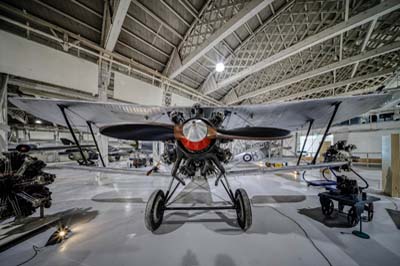
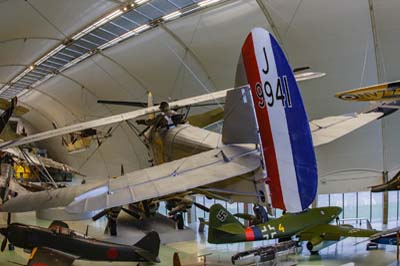
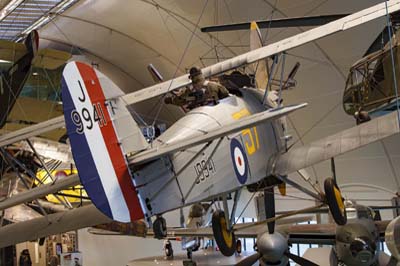
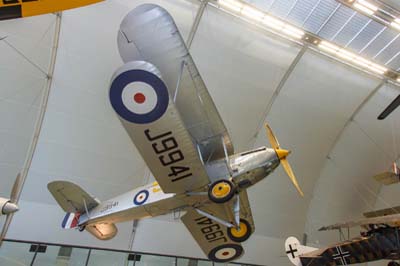
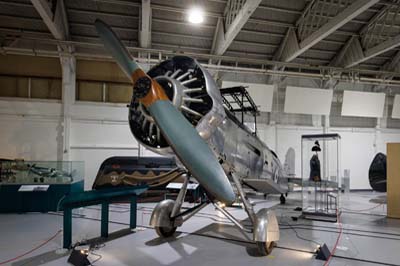
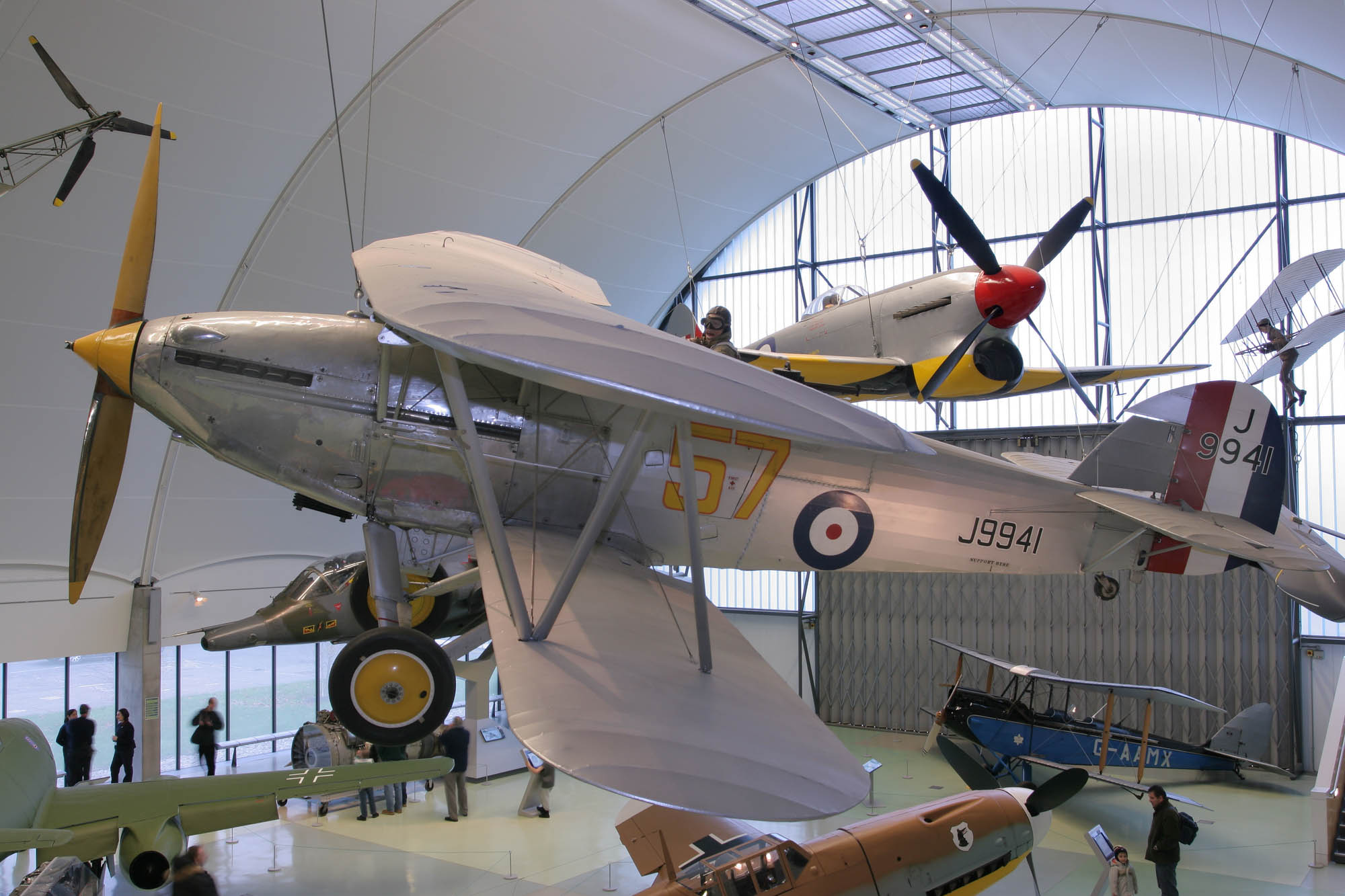
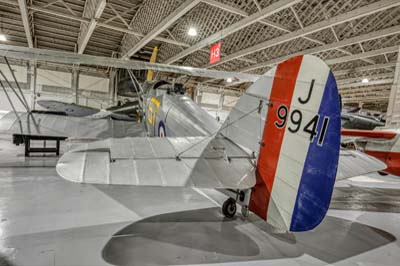
| Hawker Hart ('J9941' and G-ABMR). The Hart was designed by Sydney Camm as a two-seater light bomber, it took to the air for the first time in 1928. 400 aircraft were built for the RAF. The Hawker Hind and Hector aircraft were developed from the very capable Hart design. |
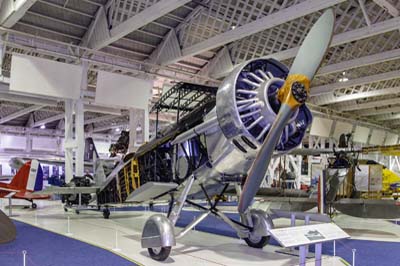
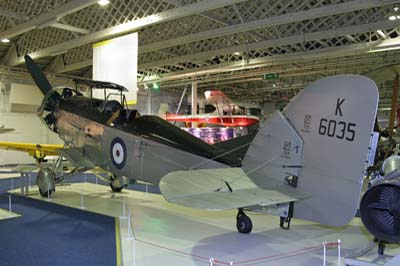
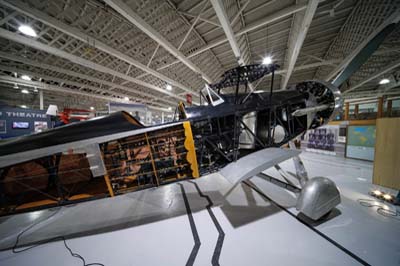
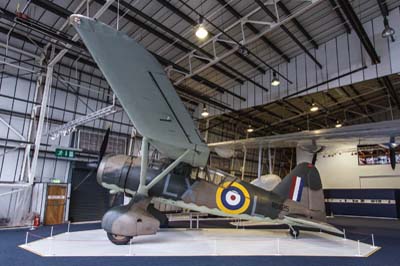
Westland Wallace II (K6035 later 2361M). The Wallace was a general purpose biplane built from 1931. Its short service carrier ended with it being used for towing targets and as wireless trainers. In 1933 a Wallace prototype was fitted with a supercharged Pegasus engine and other necessary equipment for a private venture to fly over Mount Everest for the first time. In the company of a PV3 Torpedo plane and in temperatures of -60 degrees Centigrade, the record was set on April 3, 1933.
The Wallace on display served with 502 Squadron in 1936 before moving to RAF Cranwell with the 1 Electrical and Wireless School (later renamed 1 Signals School) a year later. It was retired from flying service in 1940. After being used for ground instruction it was towed to the edge of Cranwell airfield with two others to lay there untouched for 30 years. In 1987 restoration was started using 80% of the original parts and in 1993 it was put on display at Hendon. After an extensive period in storage at the RAF Museum Reserve Collection at Stafford, it returned to Hendon in October 2023. |
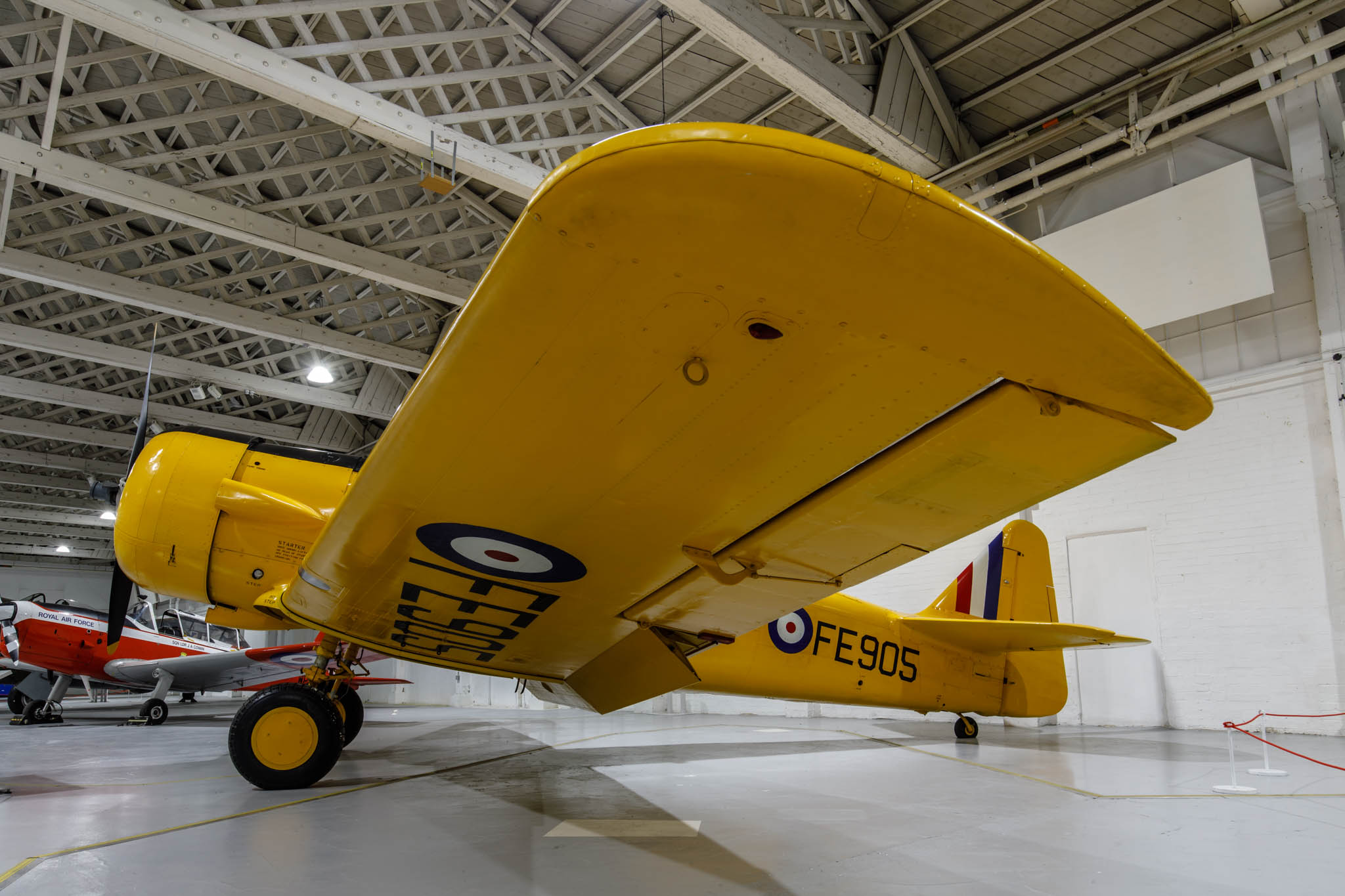 |
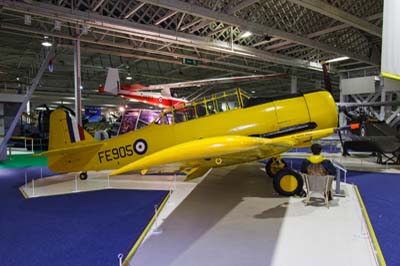
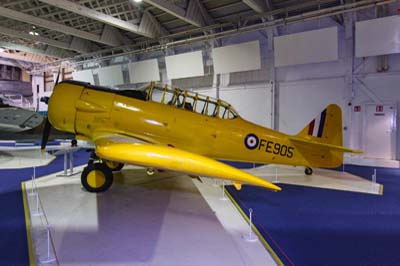
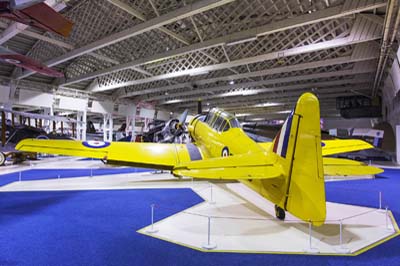
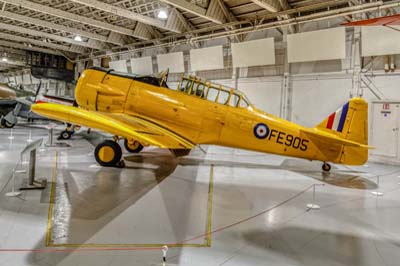
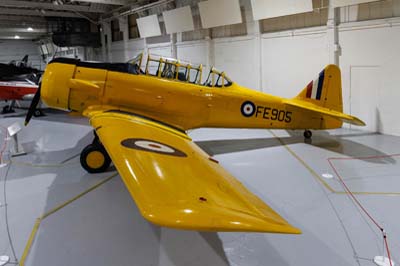
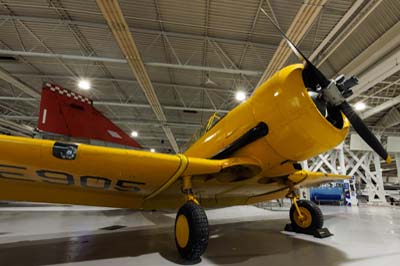
North American AT-6 Harvard IIB (FE905 formally 31-329 RDAF and LN-BNM). 17,096 AT-6s were built before and during World War Two. In USAAF service it was known as the AT-6 Texan, the 5,000 supplied to British and Commonwealth Air Forces were known as the Harvard. The first order for the Harvard was placed in June 1938. Following the outbreak of war most deliveries were made to Canada, Southern Rhodesia and the United States where pilot training was safer. The last Harvards were withdrawn from service with the RAF in the 1950s.
FE905 was built in 1943 by Noorduyn Aviation in Montreal, Canada and was supplied to the RAF under the lend-lease program and delivered to the RCAF with 41 Service Flying Training School at Weyburn, Saskatchewan. By 1943 it was transferred to 37 FTS at Calgary, Alberta later returning to Weyburn with 8 SFTS where became surplus to requirements and was struck off charge in 1946 having only flown 76 hours. In 1949 it was sold to the Danish Air Force becoming 31-329 and initially based at Kastrup. By 1960 having flown 1,900 hours it was struck off charge and sold in Norway for target owing duties as LN-BNM. After its C of A had expired in 1968 it was sold to the Historic Aircraft Museum at Southend, Essex and delivered in 1972. In 1983 the museum auctioned the aircraft for £6,000 and by 1985 it had passed to the RAF Museum at Cardington where it was to be restored. In 1991 it was loaned to the Newark Air Museum for three years before it was moved to Hendon. |
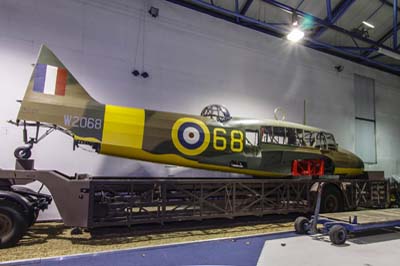
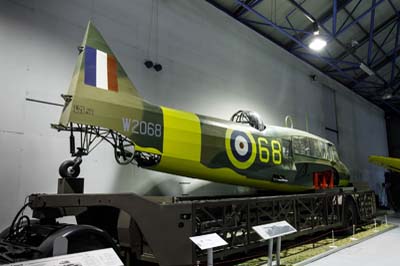
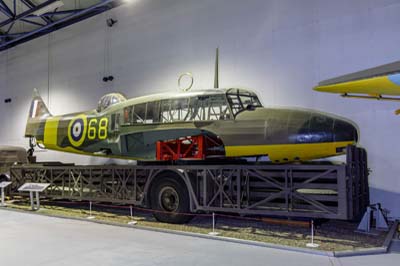
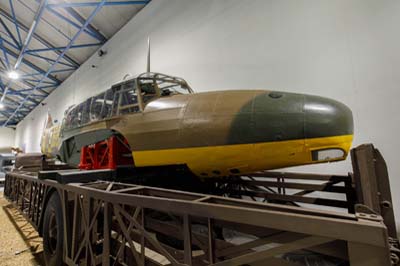
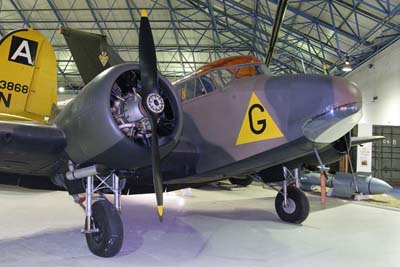
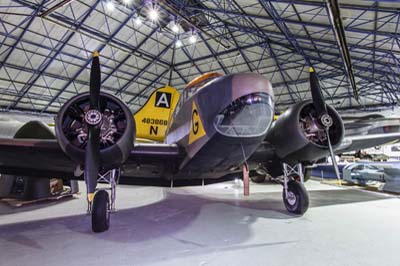
Avro Anson I (W2068 '68'). The Anson was designed in 1936 for maritime reconnaissance duties for which it quickly became obsolete when war broke out and it was more ably employed as a crew trainer and communications aircraft. By 1952 over 8,000 examples had been built by Avro in Great Britain with nearly 3,00 more built in Canada by Canadian Federal Aircraft. The Anson remained in service with the RAF until 1954 and 1968 for the later redesigned C.19 variant, with many moving on to civilian operations.
This example was built at the Avro factory at Newton Heath in Birmingham in 1941 and shipped out to Australia where it served till the end of World War Two. In 1946 is was sold off becoming VH-ASM with East-West Airlines Pty till 1950. Bought by Marshall Airways in 1951 it was flown by them from 1956 till 1962. From 1972 after a period of storage it was put on display at various locations. Following a restoration in 1996 the fuselage only was put on display at RAFM Hendon. It is displayed on an original 'Queen Mary' semi-trailer which were built to transport non-flyable aircraft between airfields and factories. |
 |
 |
 |
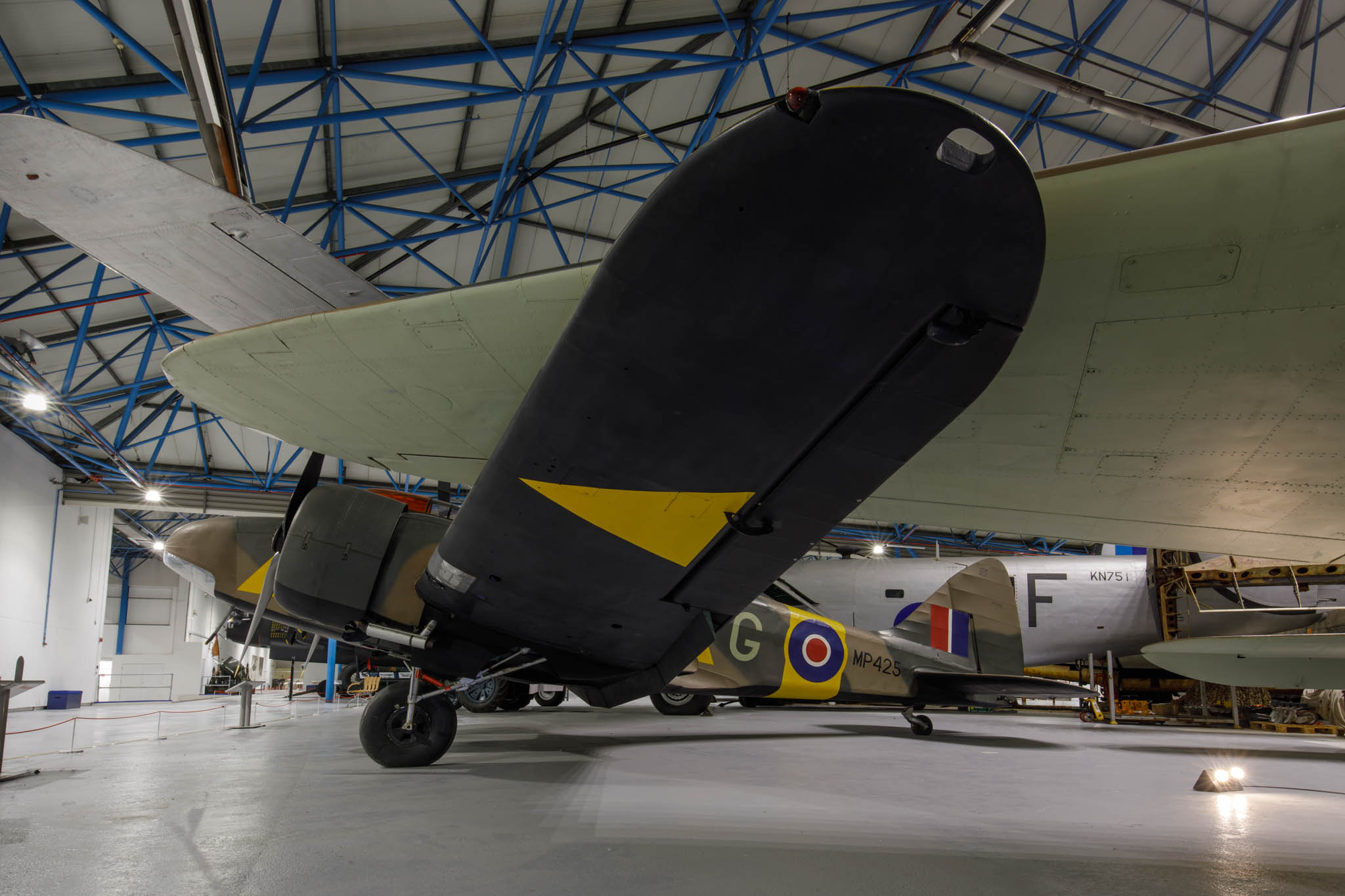
Airspeed AS.10 Oxford I (MP425 and G-AITB). The Oxford was a three seat advanced trainer in service from 1937 to 1954. They were used to train pilots for night operations. Originally named 'Blind Approach Training Flights' (BAT Flights), in 1941 they were renamed 'Beam Approach Training Flights'.
The aircraft on display was built by the Standard Motor Company in Coventry. In March 1943 it was assigned to the No.1536 (Beam Approach Training) Flight at RAF Spittlegate. It finished it service carrier with No.18 (Pilot's) Advanced Training Unit at RAF Peterborough, before going into storage with 12 MU.
In 1946 it was sold to Air Service Training at Hamble and registered as G-AITB. it was withdrawn in 1961 and acquired by the RAF Museum in 1969. Following a complete restoration at Cardington it was loaned to the Newark Air Museum in June 1991 for three years. 42 Oxfords were transferred to Belgium for use as communications aircraft with 367 Squadron at the end of the War, remaining in service till 1954. Click for additional information on Belgian Oxfords. |
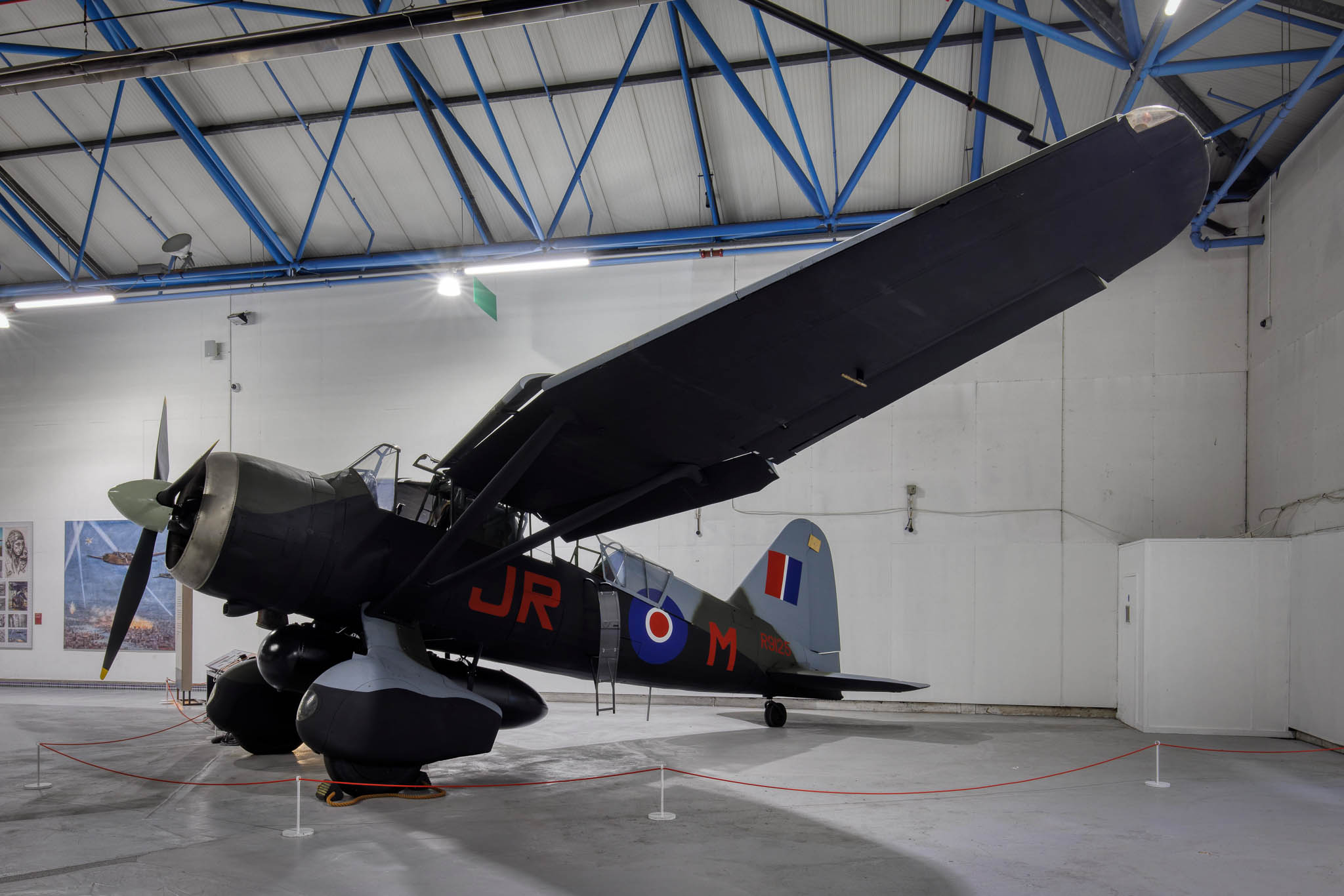 |
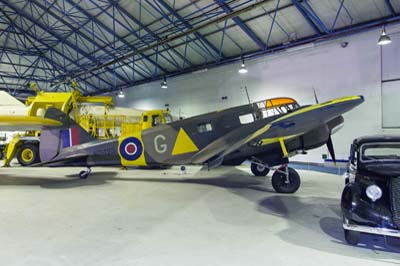
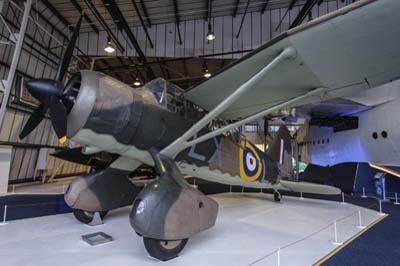
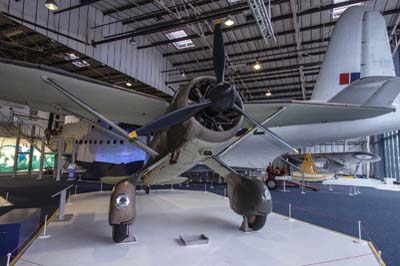
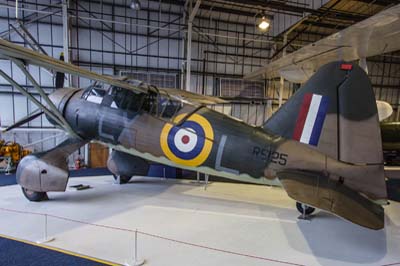
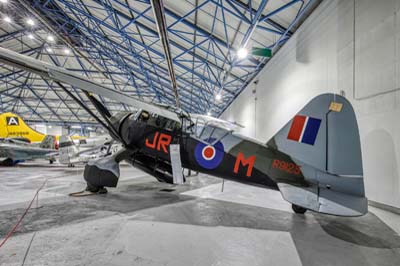
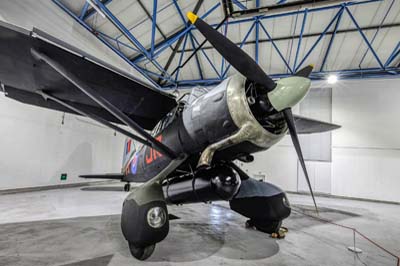
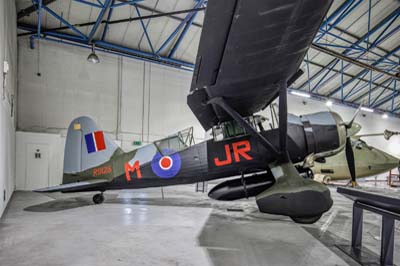
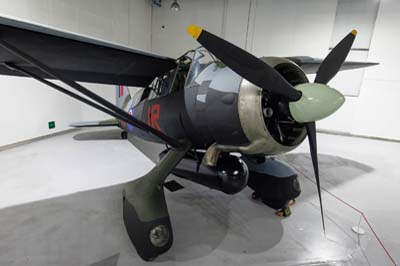
Westland Lysander III (R9125 'LX-L' later marked 'JR-M'). The Lysander was designed to operate closely with the Army as a special transport and observation aircraft. It was a very rugged aircraft able to land on small and unprepared landing fields. Four squadrons with 170 Lysanders were moved to France in 1939. At the end of their time in France only 50 aircraft returned. They were later used to patrol coastal areas for downed airmen and could deploy dinghies when necessary. The Lysander operated with the RAF from 1938 to 1946.
The aircraft on display operated with 225 (Army Co-operation) Squadron at RAF Tilshead in 1940. It was modified for target towing in 1941 before being assigned to its first Gunnery School. In 1944 it was assigned to 161 (Special Duties) Squadron at RAF Tempsford. At the end of the war it went in storage, before transferring to the RAF Museum storage facility at Henlow in 1967. It moved to Hendon in 1971. Since 2016 it had been restored with a new fabric outer skin and complete repaint as 'JR-M' in the Museum's Michael Beetham Conservation Centre (MBCC) in Cosford. In February 2022 it returned to Hendon in hangar 5. |
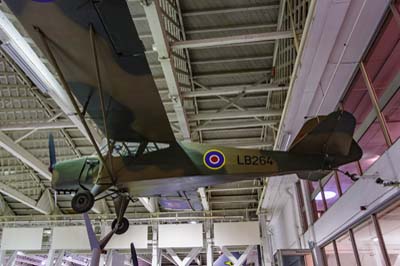
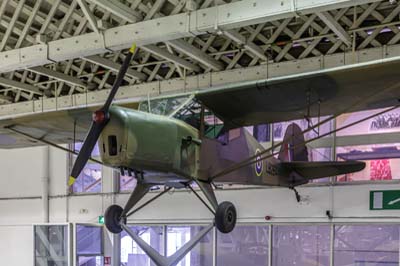
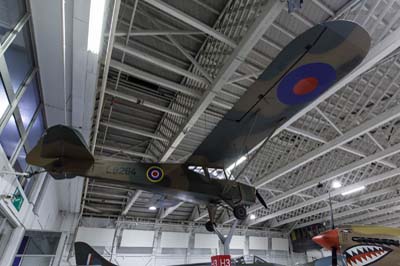
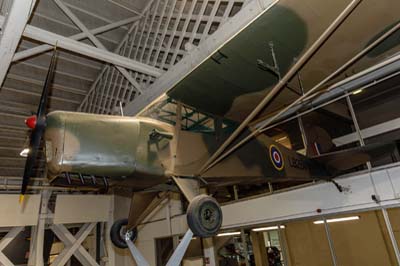
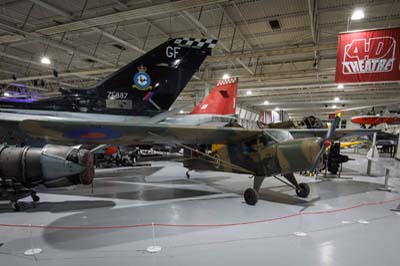
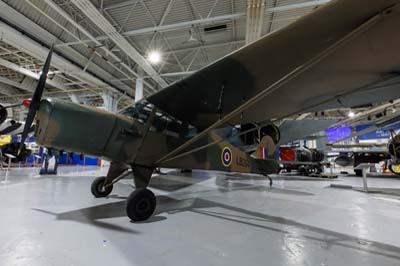
Taylorcraft-Auster Mk.1 (LB264 later G-AIXA). Taylorcraft Aeroplanes (England) based in Leicestershire developed the US designed Taylorcraft Plus C and D models in 1940 to produce the Taylorcraft-Auster Army Observation Post (AOP) aircraft. This light and manoeuvrable aircraft could operate from small airstrips and could evade enemy fighters by flying at very low-level. It was used to advise field commanders of enemy troop movements and artillery. Taylorcraft Aeroplanes (England) later became Auster Aircraft and its AOP aircraft formed the basis of the modern Army Air Corps.
LB264 was built in 1942 and was delivered to the A & AEE at Boscombe down. It later moved to 653 Squadron at Rearsby and was used for camouflage tests. In 1943 it was transferred to 1 Elementary Flying Training School (EFTS) at Holwell Hyde near Hatfield and then to 22 EFTS at Caxton Gibbet. At the end of the war it was sold to Cotswold Aero Club which was the first of many operators and private owners till in 2000 it was restored in its original 1942 camouflage and markings before being sold to the RAF Museum in 2002, it arrived at Hendon in 2003. By November 2025 it had its wings removed but was still on display. |
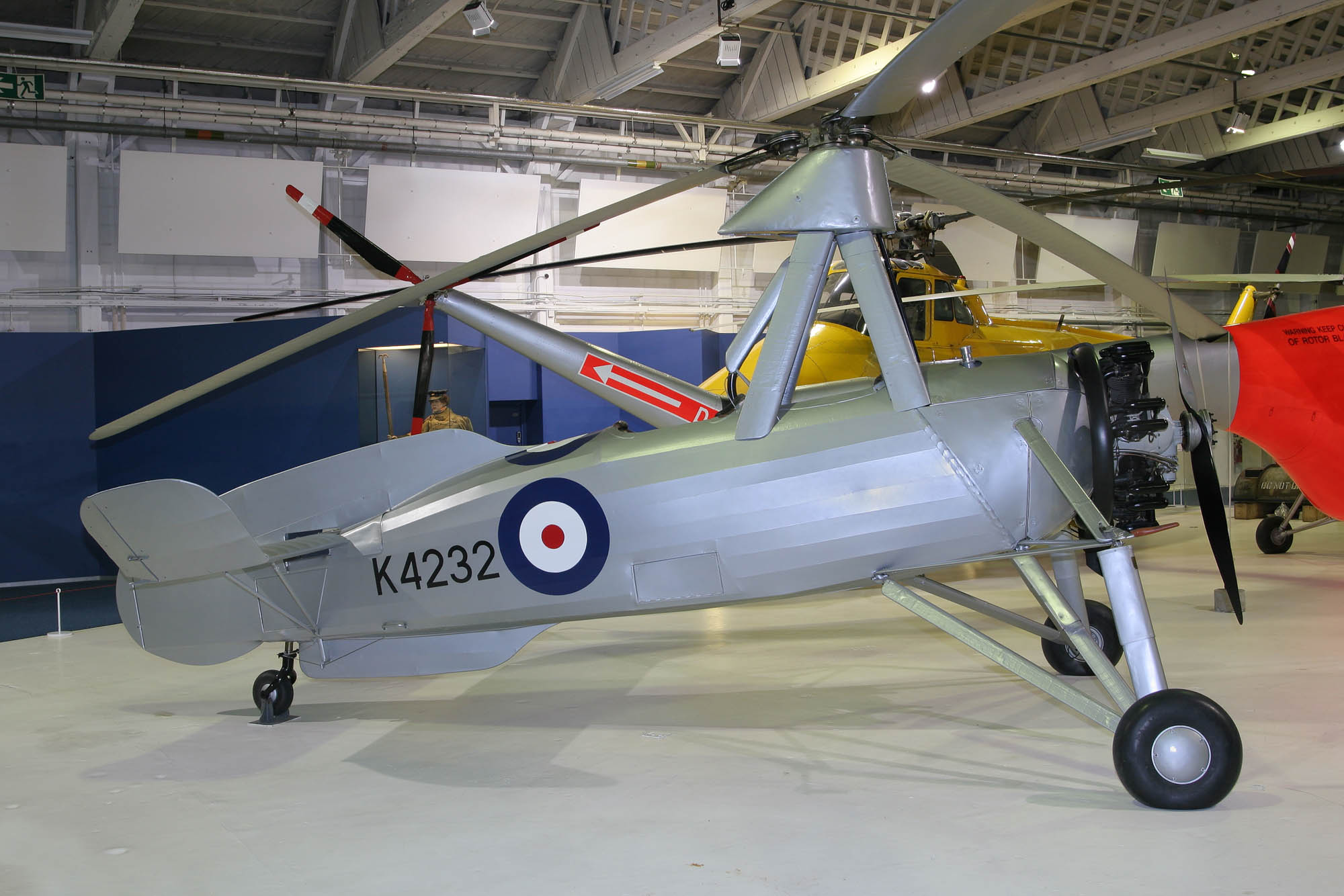 |
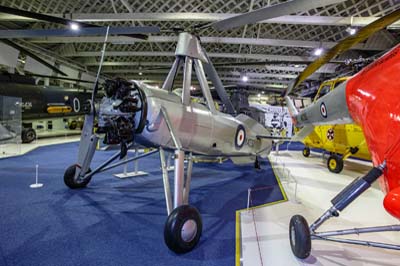
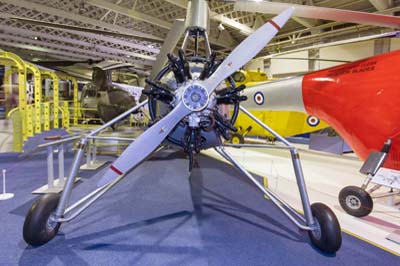
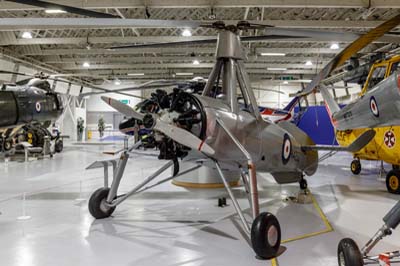
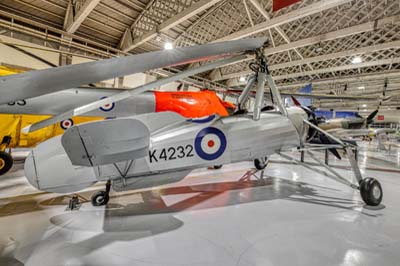
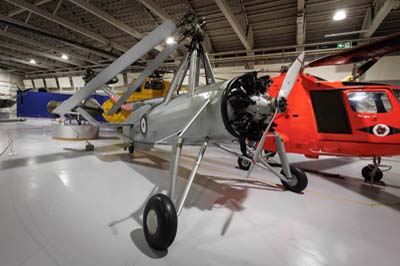
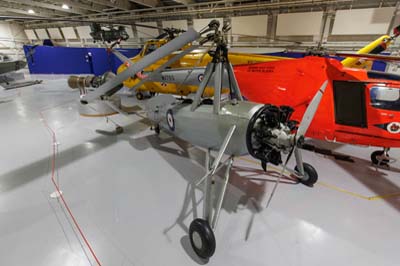
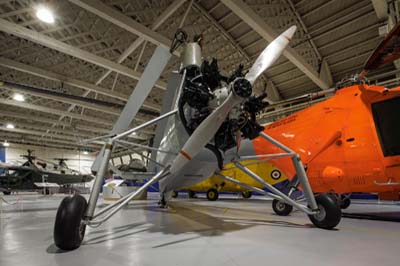
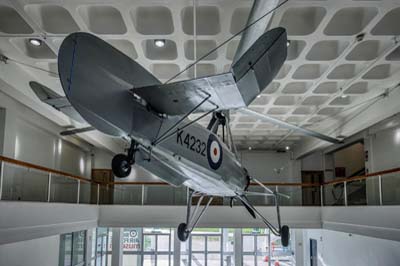
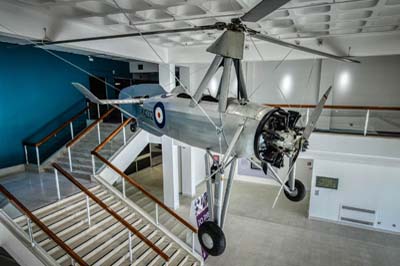
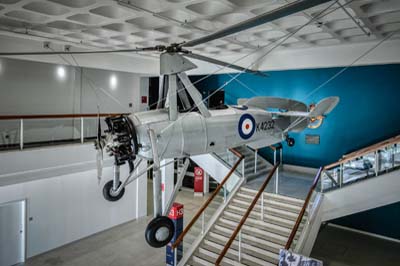
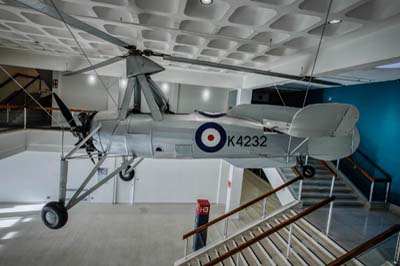
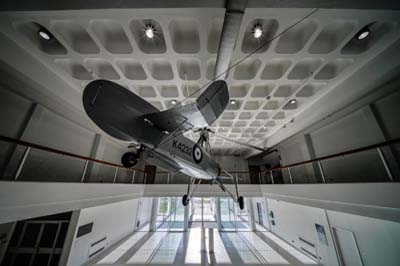
Avro 671 Rota I (Cierva C.30A) (K4232 later SE-AZB). In 1934 Juan de la Cierva, a Spaniard, developed the C.30A autogyro. This unique aircraft was eventually license built by A V Roe & Co as the Rota 1 for the civil and military market, subsequently building 66 examples. Twelve Avro built Rota 1 autogyros were supplied to the RAF in the mid 1930s (serials K4230 to K4239 and K4296 and K4775), serving with the School of Army Co-operation at Old Sarum. They were used by 1448 (Rota) Flight at Duxford, (later reformed at Halton as 529 Squadron), in great secrecy to calibrate Britain's coastal radar stations during the war. Put into storage in 1945, K4232 was sold to the Cierva autogyro Co. in 1946, before being sold on in Sweden and registered SE-AZB. The RAF Museum bought the aircraft in 1977, restoring it to its pre-war RAF markings.
In November 2022 it was moved to the entrance hall of hangars 3,4 and 5, replacing the Grasshopper. |
| Aircraft of World War Two |
| The Spitfire I and Hurricane I in the former Battle of Britain Hall now known as Hangar 1 |
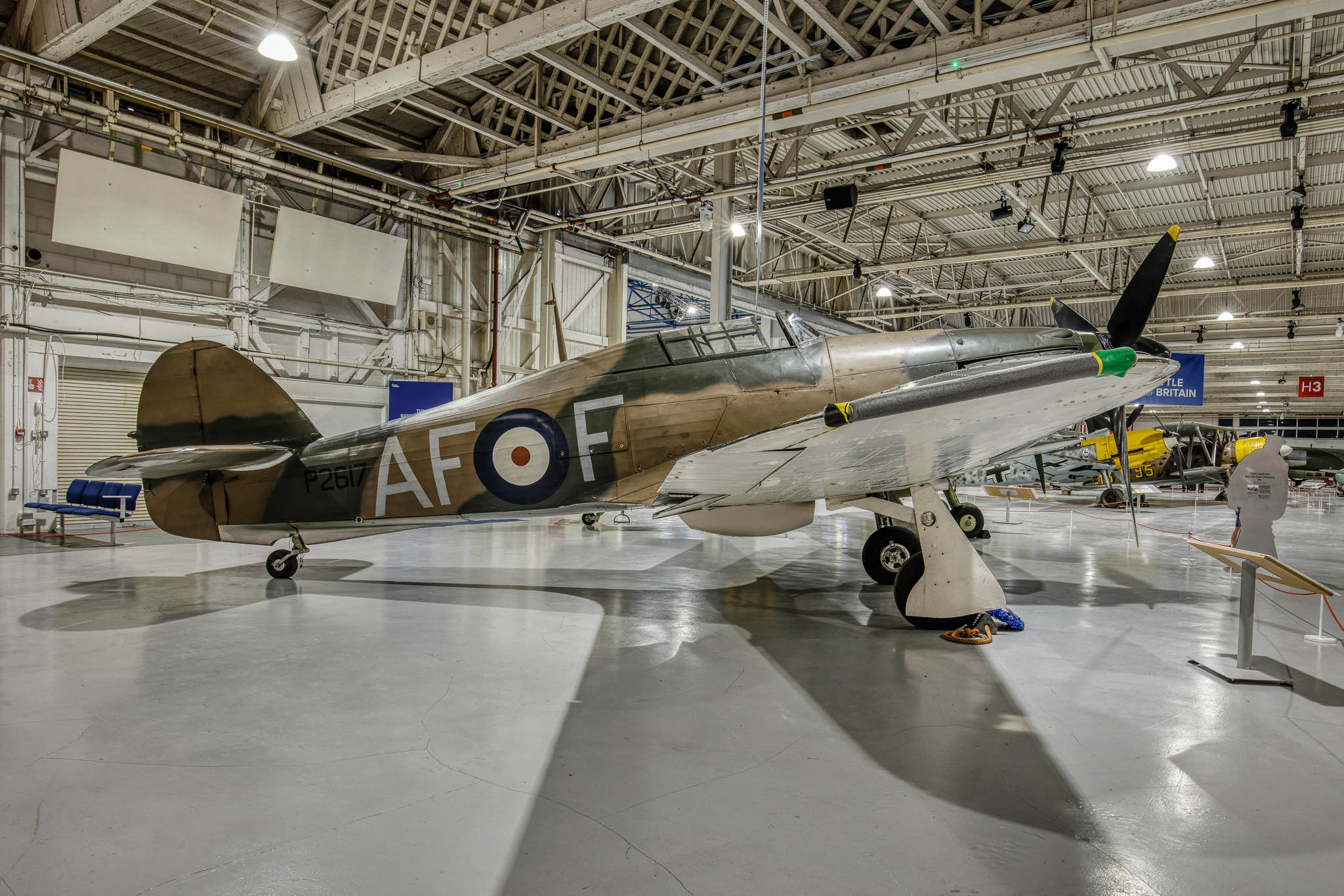
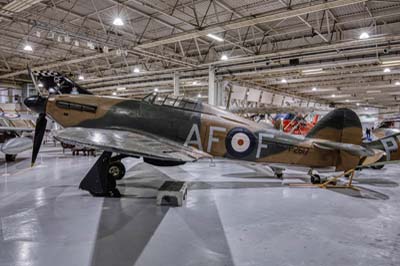
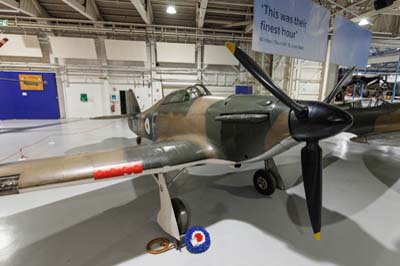
| Hawker Hurricane I (P2617 'AF-F' later 8373M). It was designed in 1934 and entered service in 1937 as the fastest fighter in service by 100 mph. By 1939 500 were in service with eventually 32 squadrons being equipped with them. Hurricanes shot down more enemy aircraft during the Battle of Britain than all the other air and ground defences combined. They later were used in North Africa and in the Far East against Japan. The aircraft on display was used in the film 'Reach for the sky'. |
 |
 |
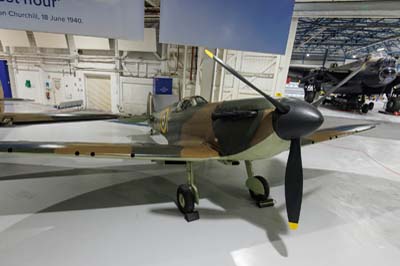 |
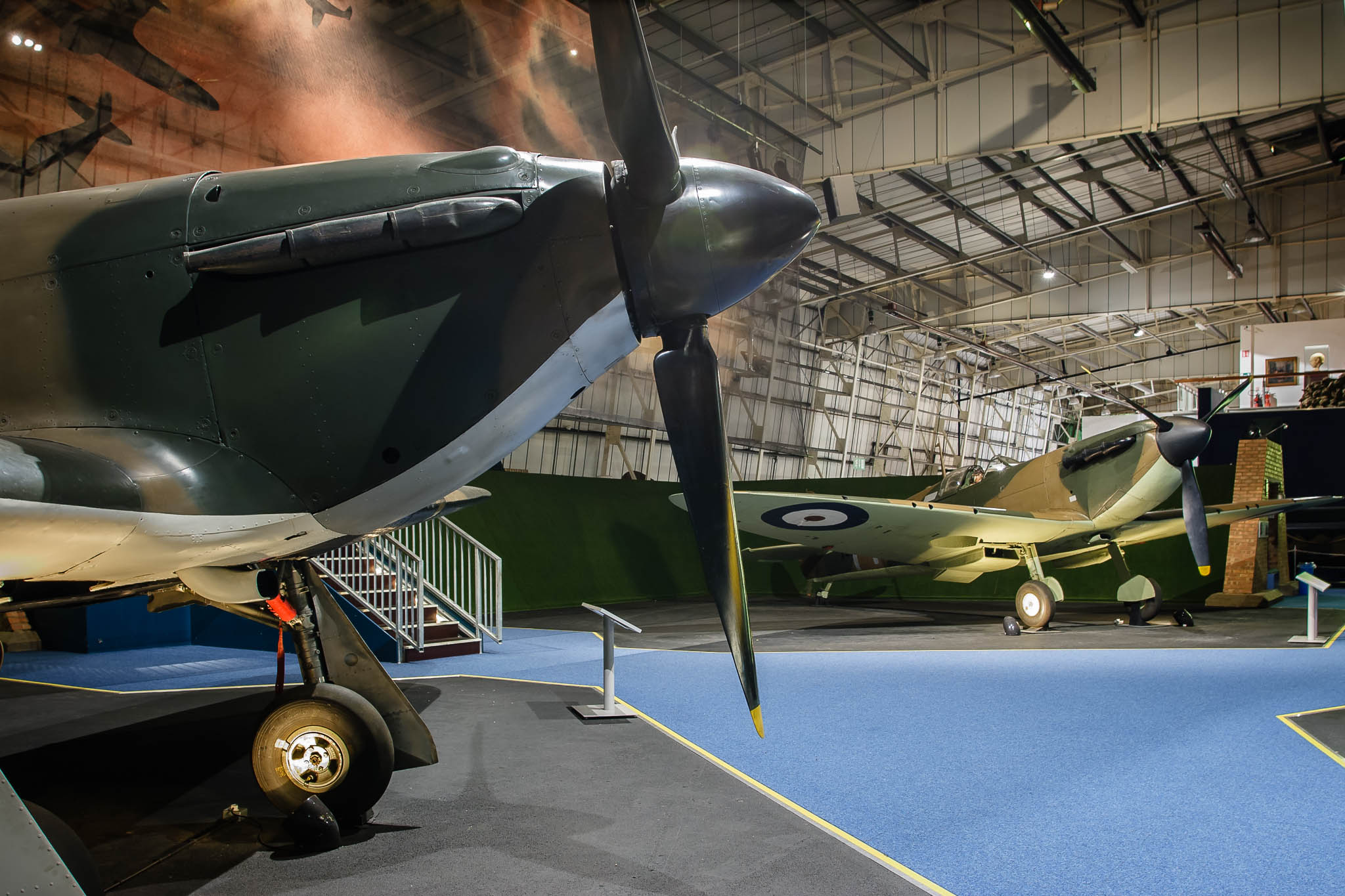
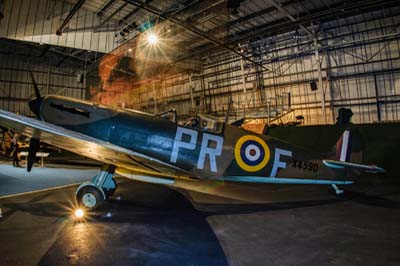
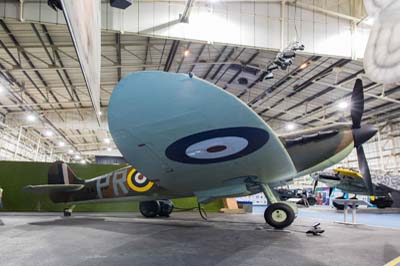
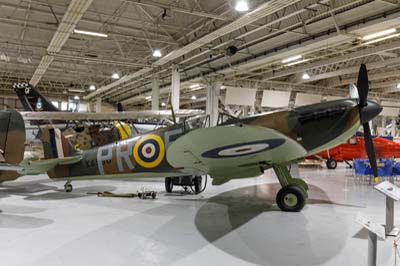
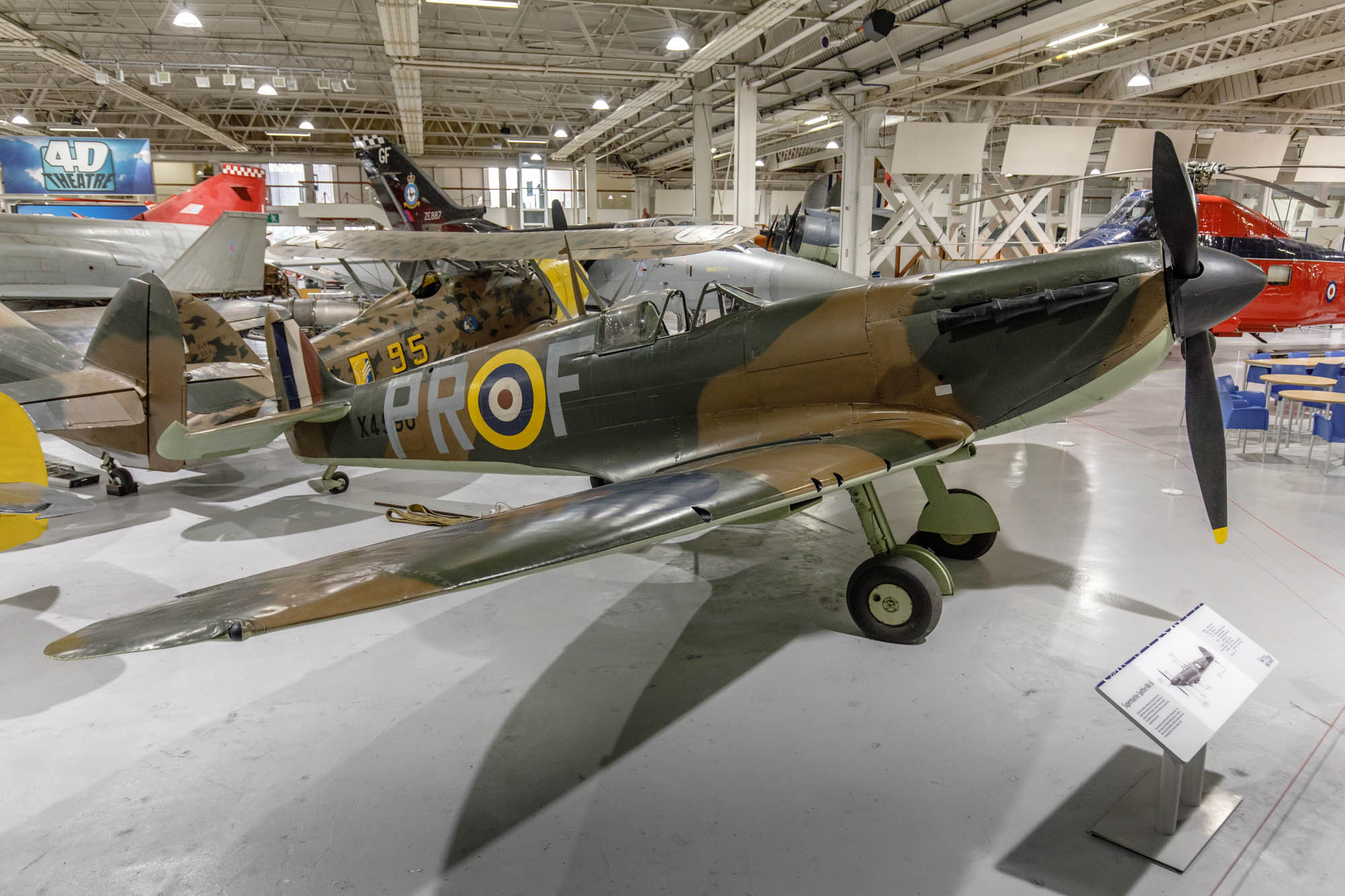
Supermarine Spitfire I (X4590 'PR-F' later 8384M). The first Spitfire Mk.1s entered service in August 1938 and by the outbreak of war nine squadrons were equipped with them. The Spitfire was the only aircraft that could match the German Messerschmitt Bf 109E in aerial combat during the Battle of Britain.
The Spitfire Mk.1 on display entered service in October 1940 with 609 Squadron based at Middle Wallop later moving to RAF Warmwell in Dorset. After transferring to 66 Squadron at Exeter in 1941 it was briefly moved 57 Operational Training Unit at RAF Hawarden before passing to 303 (Polish) Squadron at RAF Speke Liverpool in July 1941.
By 1942 it was employed by various training units before being moved to a Maintenance unit and long term storage. In 1972 it was moved to the RAF Museum store at Henlow before being put on display at Cosford in 1976 and at Hendon in 1978 in the Battle of Britain Hall. |
 |
 |
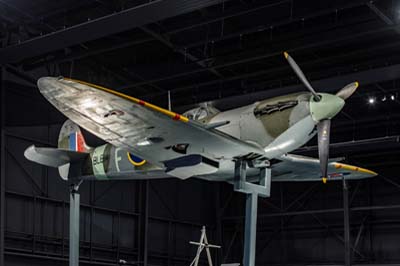 |
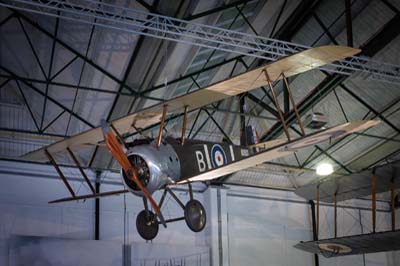
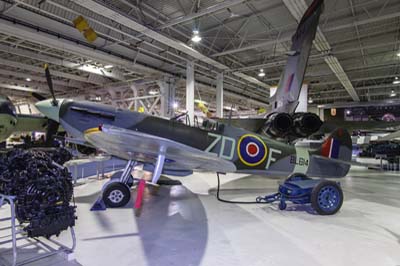
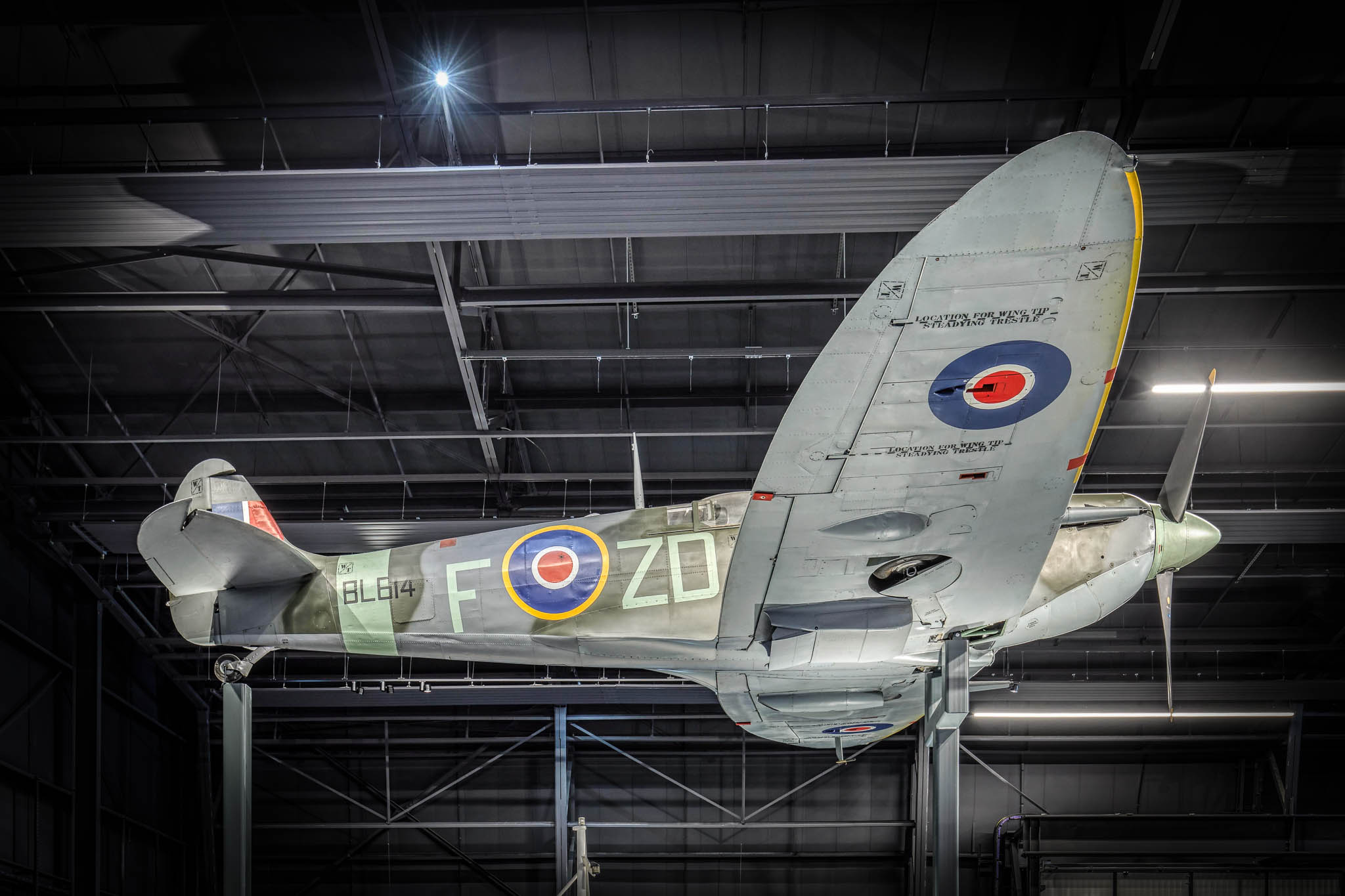
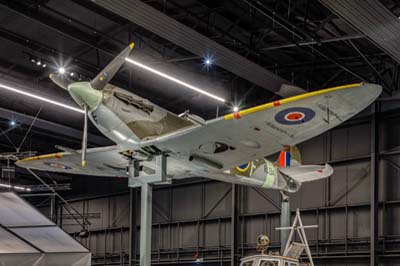
Supermarine Spitfire Vb (BL614 'ZD-F'). 6,500 Mk.Vs were built between 1941 and 1943 and served with over 140 squadrons. By 1944 only five squadrons still operated the variant.
BL614 was delivered in 1942 to 8 MU at Little Rissington and was later transferred to RAF Drem near Edinburgh where it served with 611, 242 and 222 Squadrons. In 1943 it served with 64 and 118 Squadrons before it was moving to 2 School of Technical Training at RAF Cosford and later to 6 School of Technical Training at RAF Hednesford. By 1948 it was with 7 Recruits Centre at RAF Bridgenorth before becoming the gate guard at RAF Credenhill from 1955. After appearing in the film 'Battle of Britain' it was put on display at RAF Colerne from 1972, with the Historic Aircraft Collection at RAF St Athan from 1975 and at the Manchester Air and Space Museum from 1980. Medway Preservation Society started a restoration from 1995 once completed it was moved to RAFM at Hendon in 1997. |
 |
 |
 |
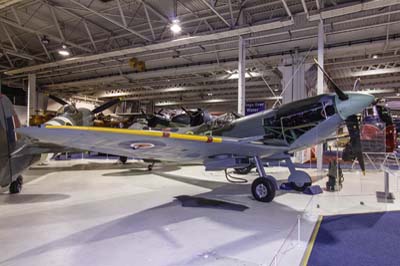
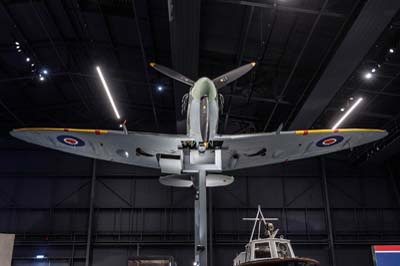
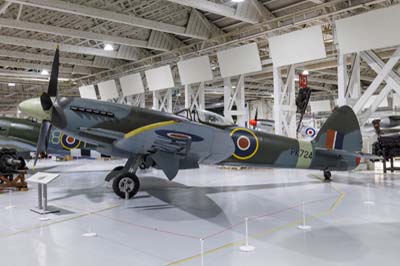
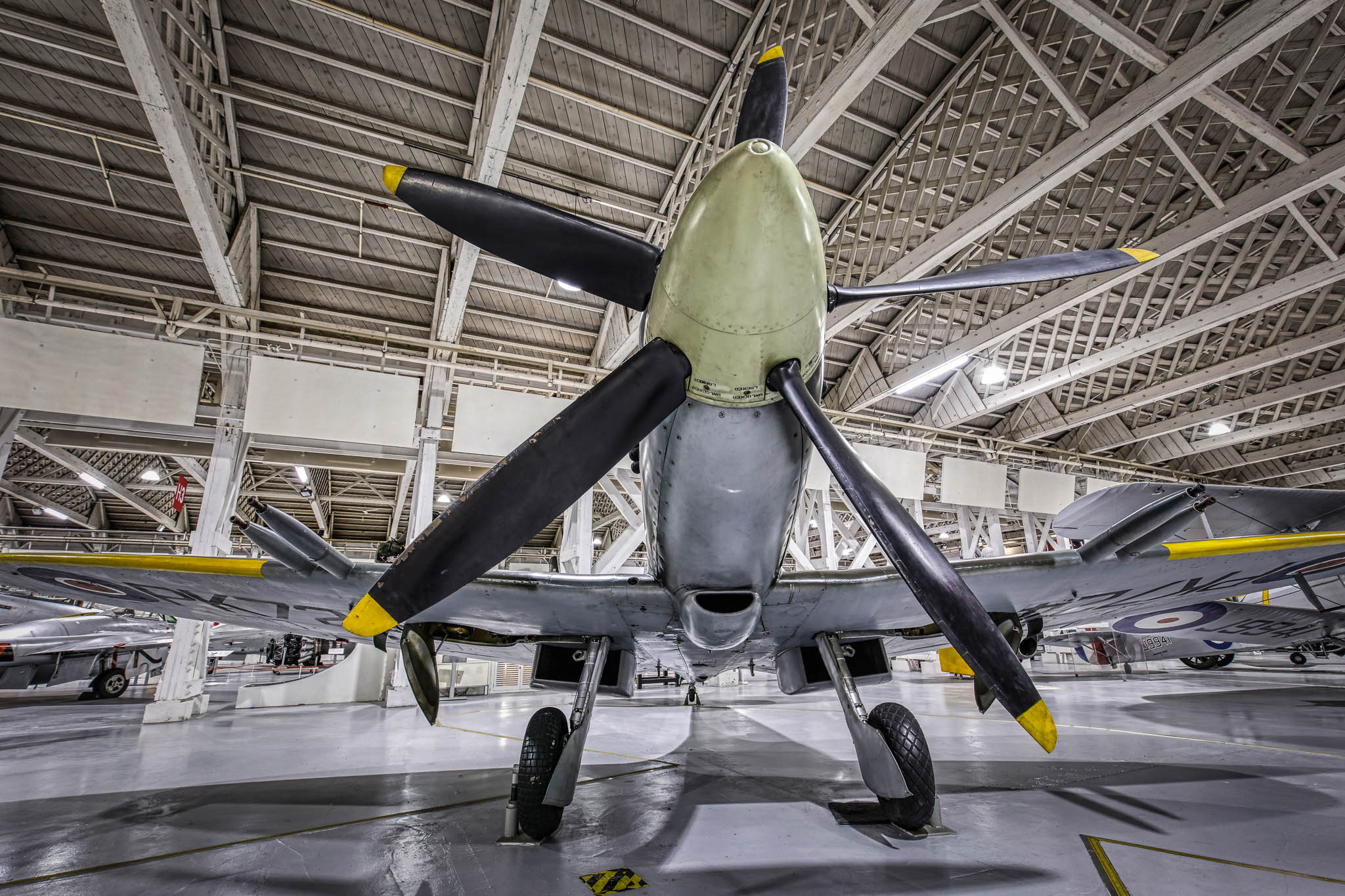
Supermarine Spitfire F.24 (PK724 later 7288M). The Spitfire F.24 was the final variant of the illustrious World War Two fighter. Only 70 examples were supplied to the RAF and mostly went into storage as in 1946 the type was now making way for jet aircraft.
Built at the Castle Bromwich factory PK724 was handed over to 33 MU at Lyneham where it stayed till 1950 with only seven hours on the clock. It was then moved to 9 MU at Cosford where it was declared non-effective in 1954 with most of the other F.24 which were scrapped in 1956. By 1961 PK724 was gate guardian at RAF Gaydon till 1970 before moving to Hendon. Two other Spitfire F.24s survive, PK683/7150M Southampton Hall of Aviation (Solent Sky) and VN485/7326M at IWM Duxford. As photographed in 1989. |
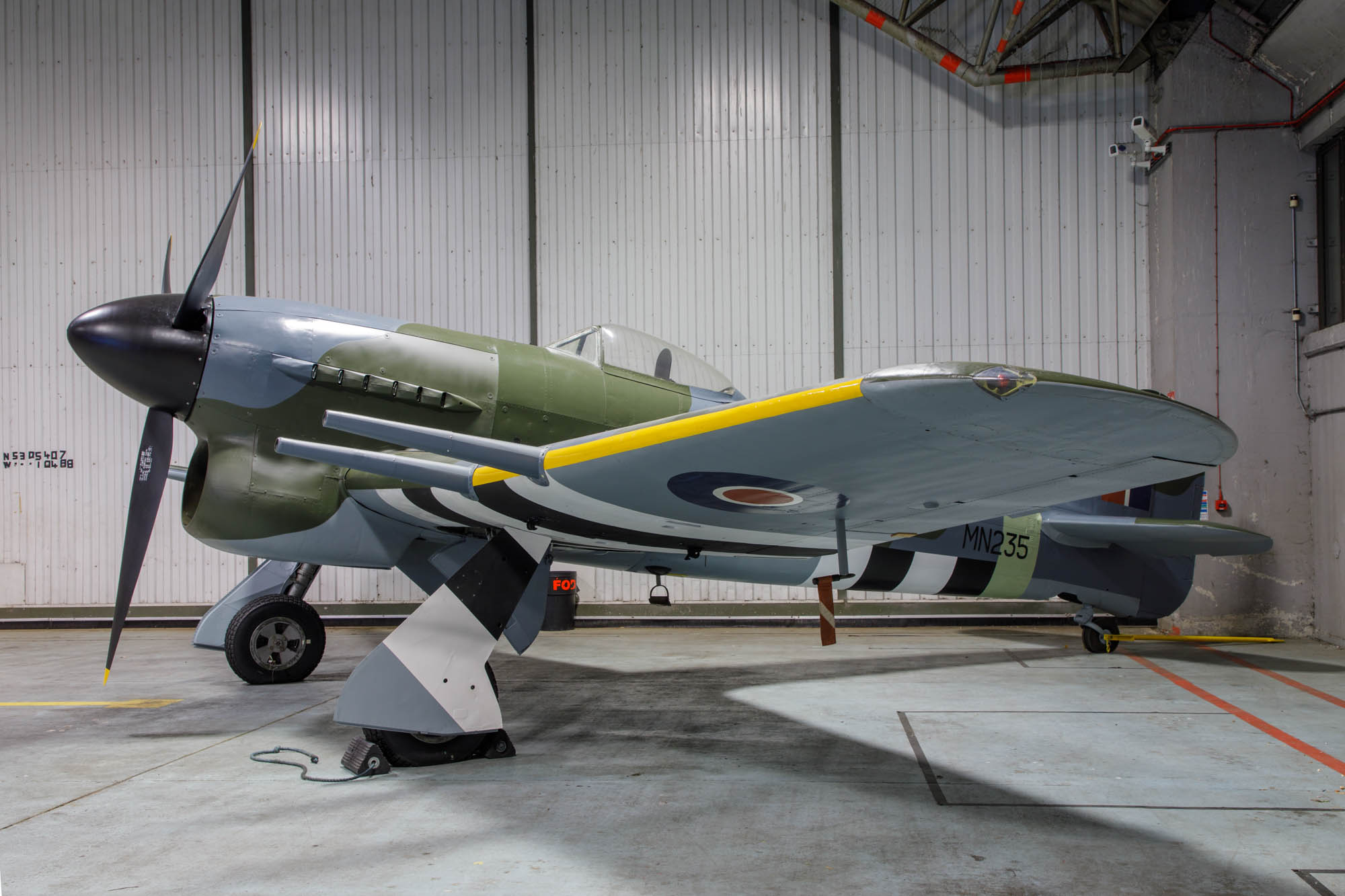
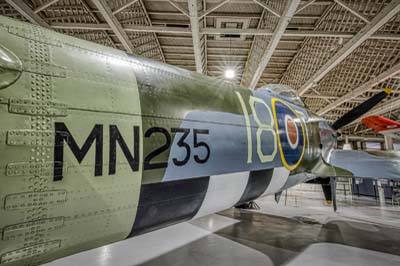
| Hawker Typhoon 1B (MN235) on display at RAF Coningsby in October 2018. |
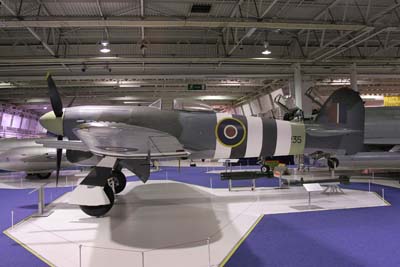
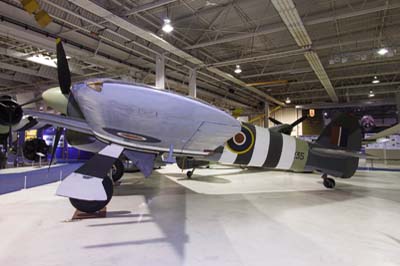
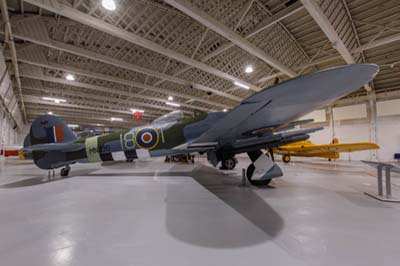
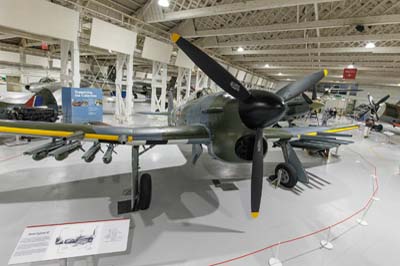
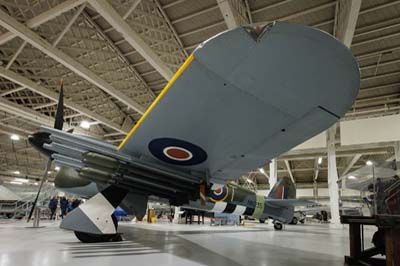
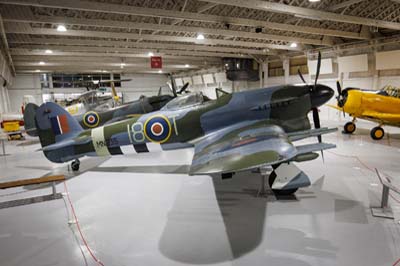
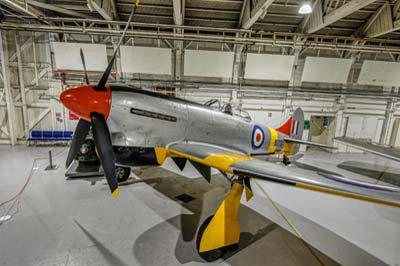
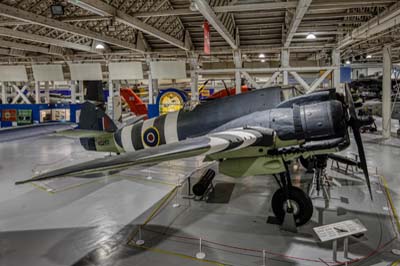
Hawker Typhoon 1B (MN235 '18-T'). The Typhoon was designed as a low-level and close-support ground attack fighter-bomber for use against tanks, armoured vehicles, airfields and communications. Entering service in 1942, it was the first 400mph (640km/h) fighter with the RAF. The Typhoon was withdrawn from service at the end of the war.
This actual aircraft was built by Gloster Aircraft Company and delivered to the RAF in 1944. Shortly after delivery it was transferred to the United States for evaluation. It was flight tested for two months, before being moved to the Smithsonian Institution's National Air Museum. It is now the only surviving complete Typhoon and in 1967 was exchanged for a Hurricane for the 50th Anniversary of the RAF celebrations. It was refurbished at RAF Shawbury before moving to Hendon in 1972. In February 2014 it was dismantled and shipped to the Canada Aviation and Space Museum in Rockcliffe, Ottawa, for D-Day's 70th anniversary returning to Hendon in November 2018 after a spell at RAF Stafford and RAF Coningsby. |
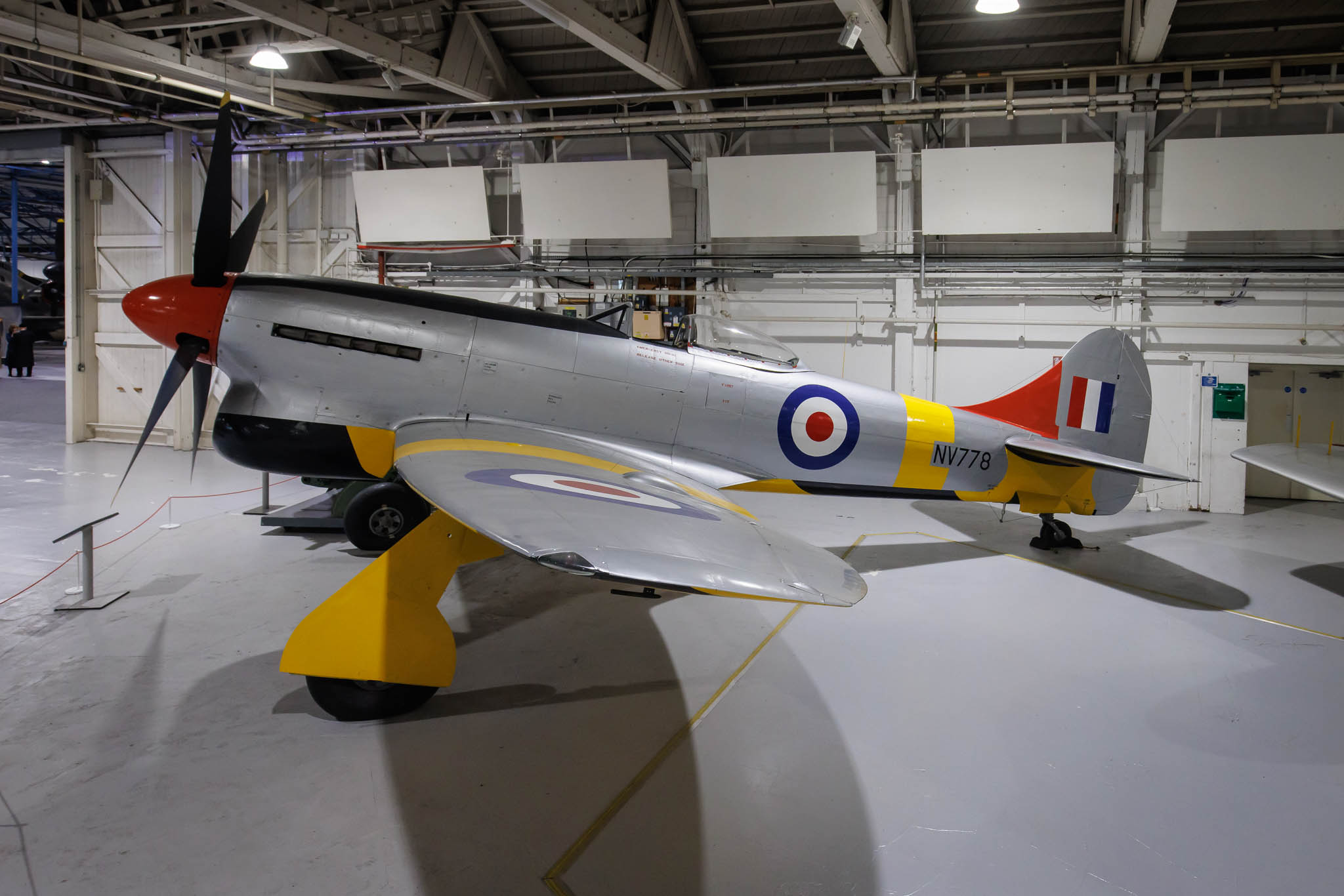 |
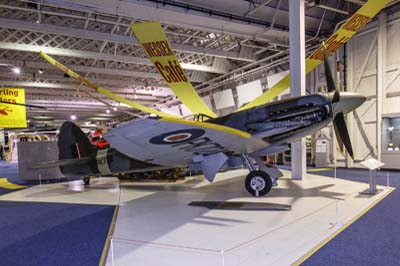
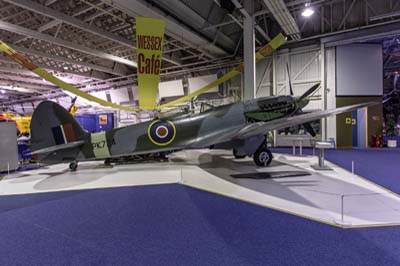
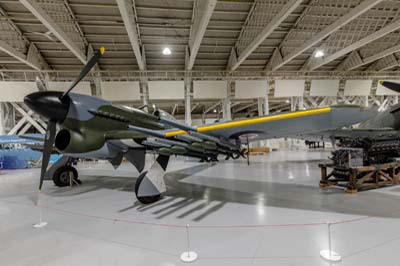
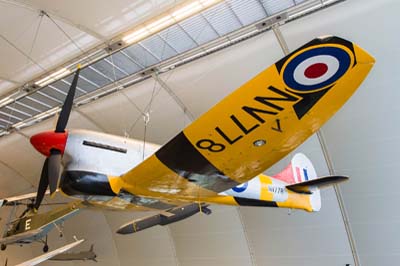
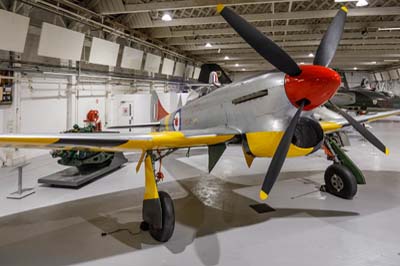
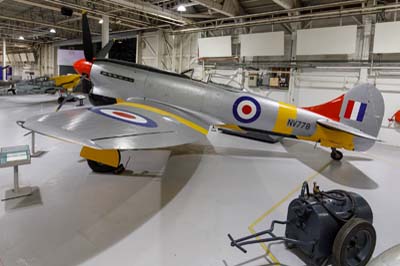
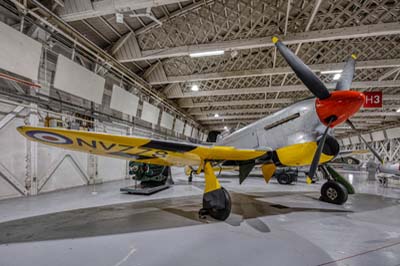
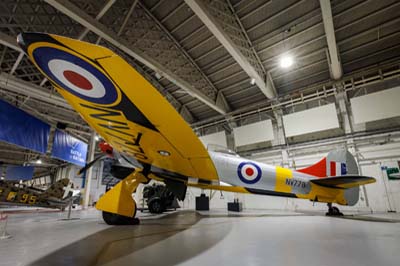
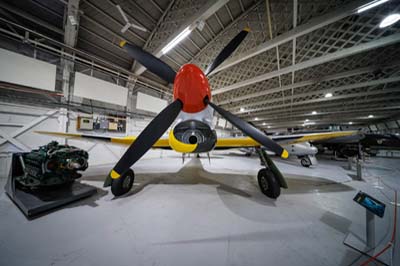
| Hawker Tempest TT.5 (NV778 later 8368M). This is a converted Mk.5 for target towing. Built in November 1944 and after seeing little action was put into storage before being converted in 1950. In 1950 it was one of 80 Tempest Mk.5s converted to TT.5 for high speed target tug duties. From 1952 to 1955 it was with 233 OCU based in Pembrey when Meteors took over their role. Following a period of gate-guarding at Middleton St. George and Leeming it was moved to Cardington for restoration to flying status and flew again in the early 1970s. It finally went on display at Hendon in 1972. In 1991 it was restored at Cardington as a TT.5 and after a further period of storage it was displayed at Cosford before returning to Hendon in 2003 in a 233 OCU scheme. It is on display at the Milestones of Flight Exhibition. |
Left to right:
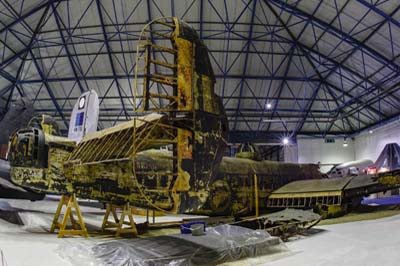
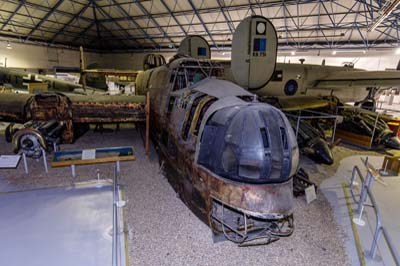
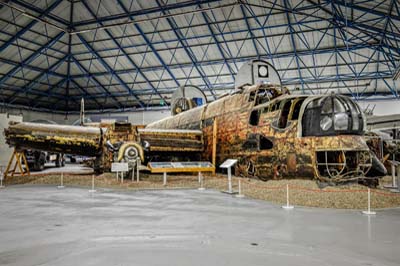
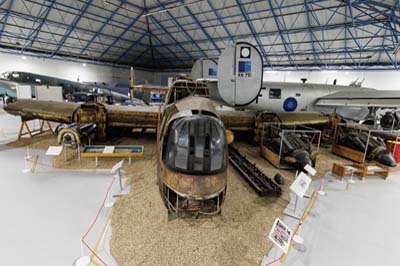
Handley Page Hampden TB Mk.I (P1344 'PL-K') being restored. The nose section has been built from scratch. The sections have been photographed from the wing section looking towards the nose and tail. It is not expected that the wings will be restored. It arrived at Hendon by November 2025 from Cosford's Michael Beetham Conservation Centre (MBCC). |
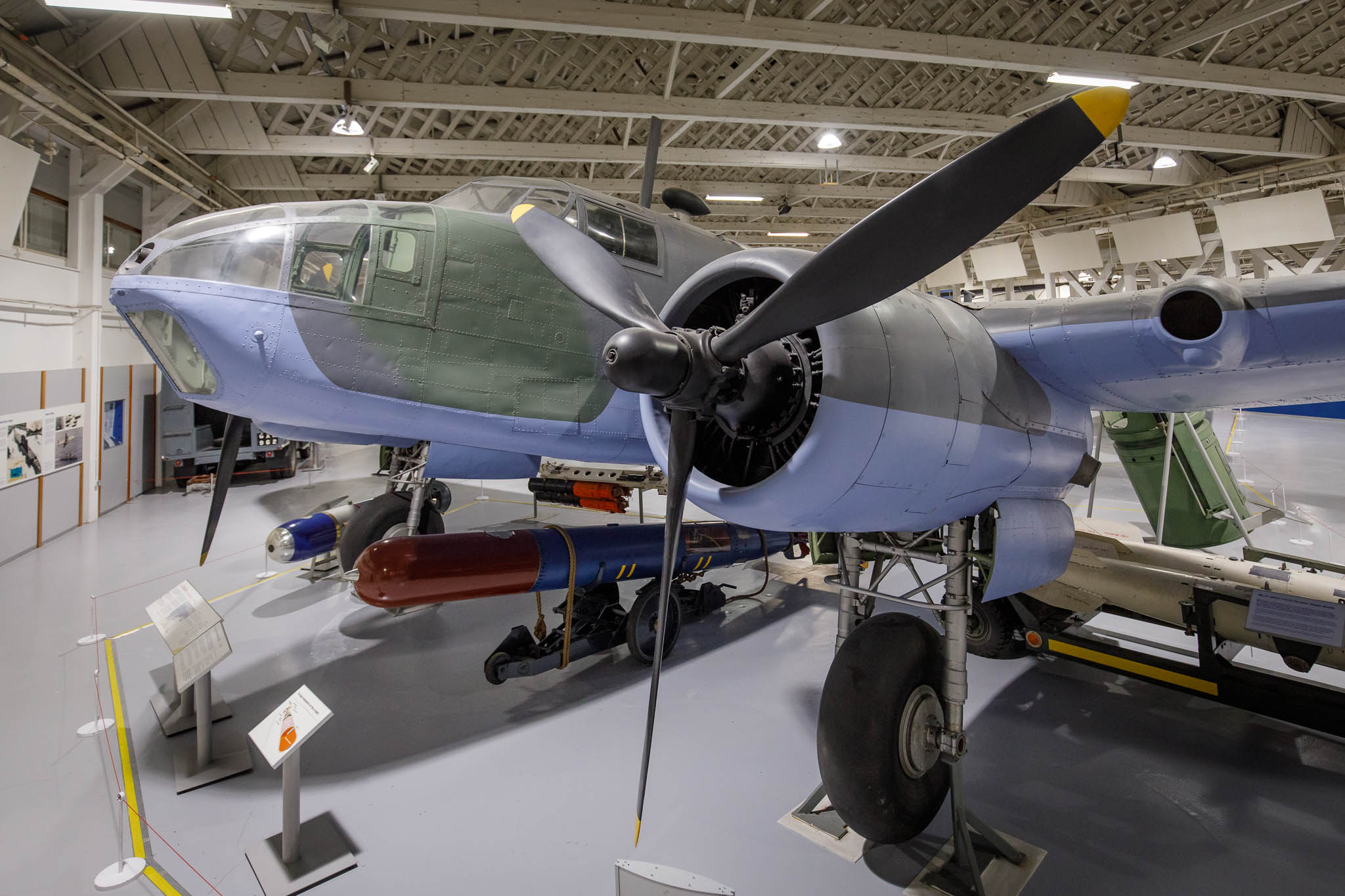 |
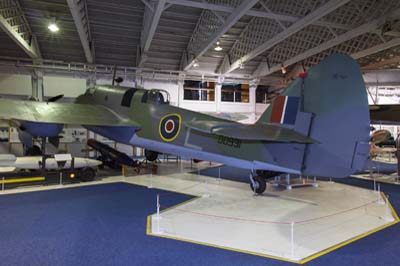
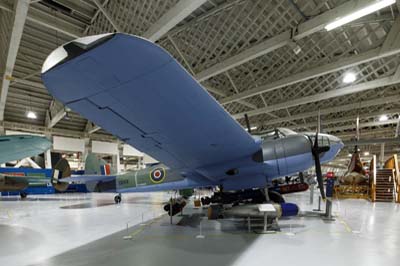
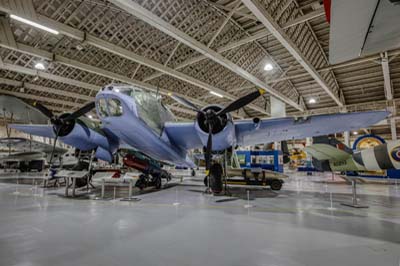
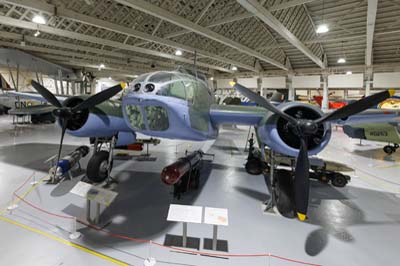
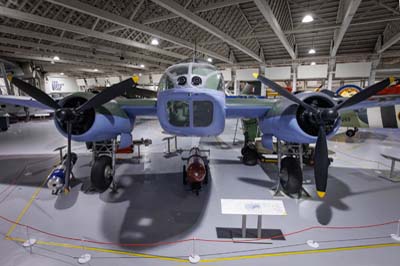
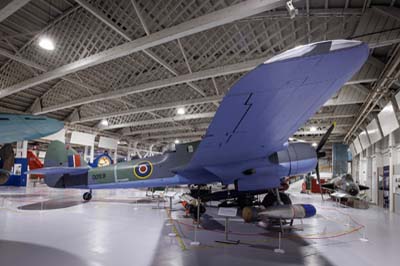
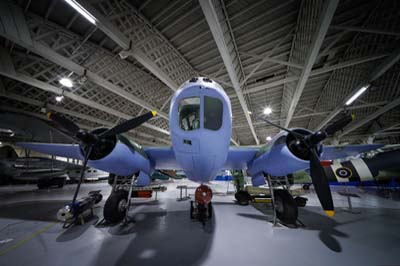
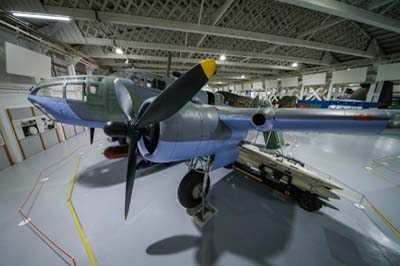
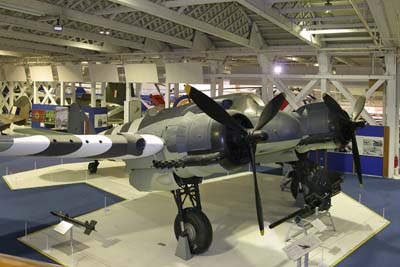
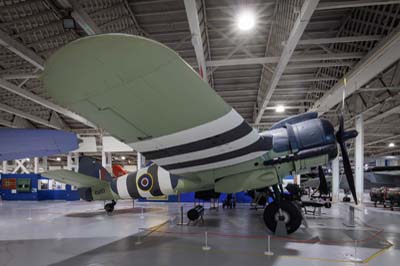
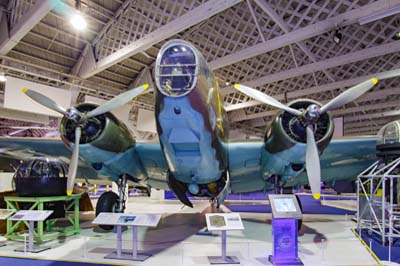
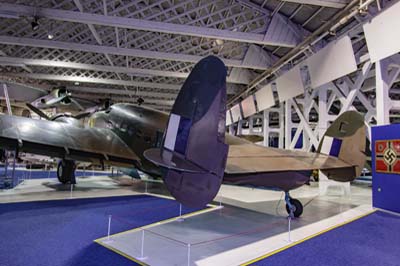
Bristol Beaufort VIII ('DD931' later 9131M). The Beaufort first flew on October 15, 1938 entering service with 22 Squadron in November 1939. It had a crew of four and was in service until 1946. Throughout the early part of the war they were operated by RAF Coastal Command as a torpedo bomber. They were also used to drop magnetic mines until 1943. Later many Beauforts were flown in Africa and in the Far East. 1,380 were built including 700 in Australia.
The aircraft on display has been assembled using parts recovered from several aircraft found in New Guinea combined with re-manufactured parts. It is painted in the markings of 39 Squadron as 'DD931' when operating from Malta in 1942. |
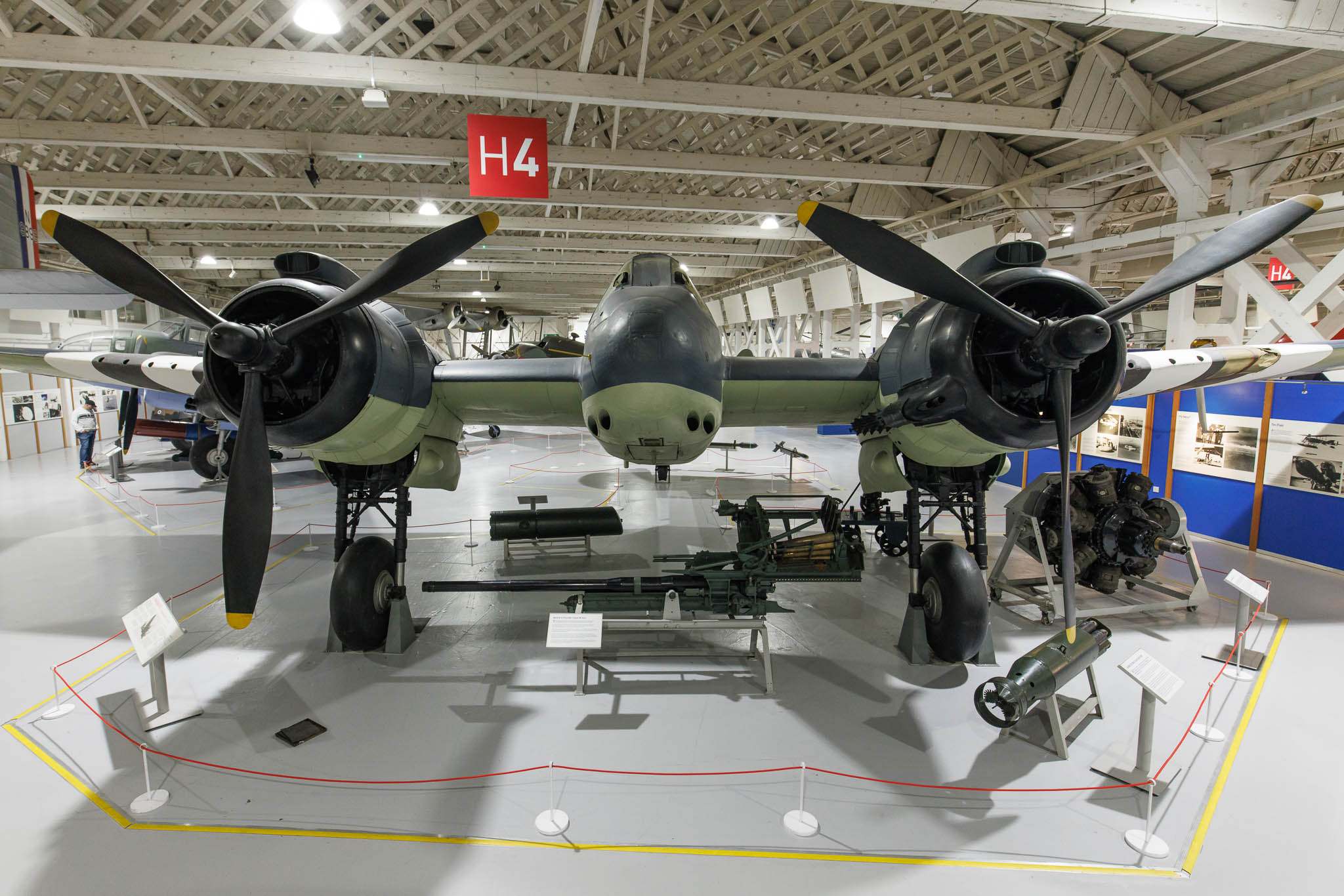 |
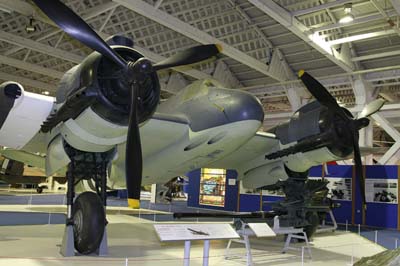
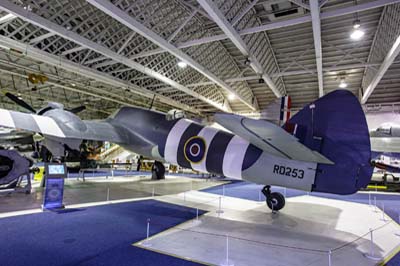
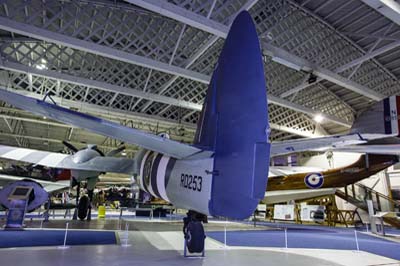
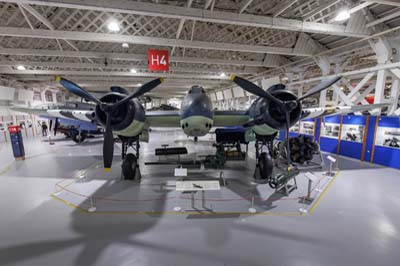
Bristol Beaufighter TF.X (RD253 later 7931M previously FAP BF-13). The Beaufighter was a two-seat anti-shipping strike fighter, remaining in service from 1940 for 20 years. It carried four 20mm cannon in the nose and six machine guns on the wings and another on top of the fuselage. It could also carry one torpedo or eight rockets and two bombs. The prototype first flew on July 17, 1939, RAF Fighter Command taking delivery of the first aircraft in April 1940. They were fitted with radar and performed well at night against Germany. The last of 5,562 Beaufighters was delivered in September 1945. Towards the end of its career many were converted to target tugs.
The aircraft on display was built by the Bristol Aircraft Company at Oldmixon and delivered to the RAF in November 1944. In 1945 it was transferred to the Portuguese Navy for maritime patrol. After a period of ground instruction use it was given to the Lisbon Technical Institute. It was stored outside for 15 years before being presented to the RAF in 1965. At RAF Bicester it was cannibalised for spares for another Beaufighter that was being prepared for Canada. The remains were sent to St Athan where RD253 was completely restored and moved to Hendon in 1972. |
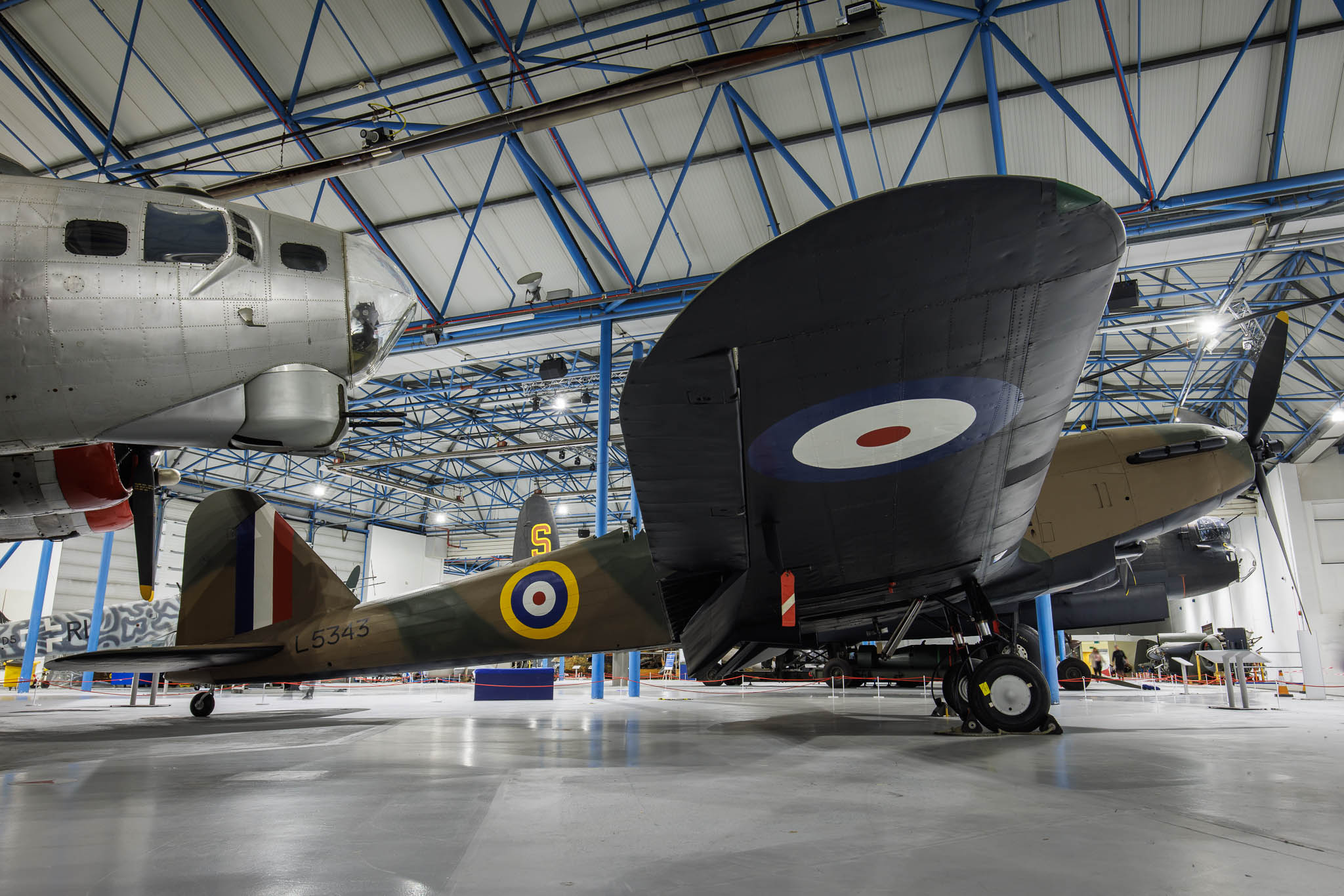 |
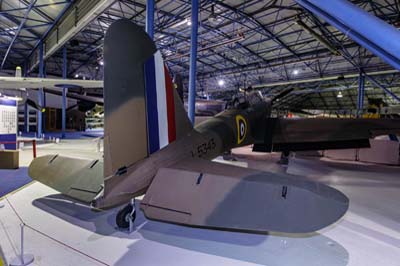
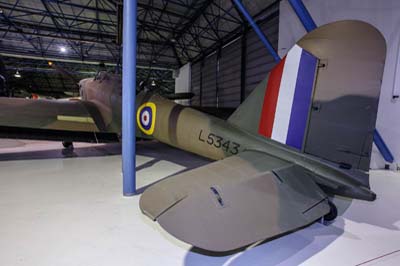
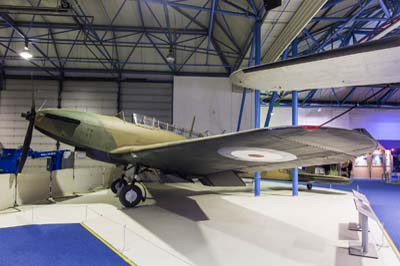
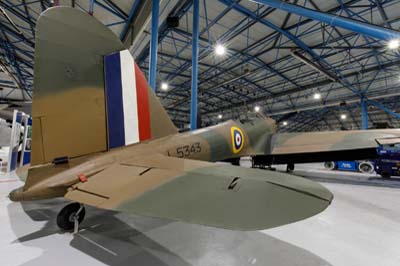
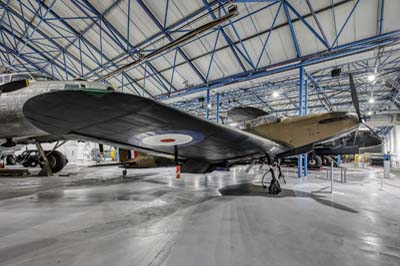
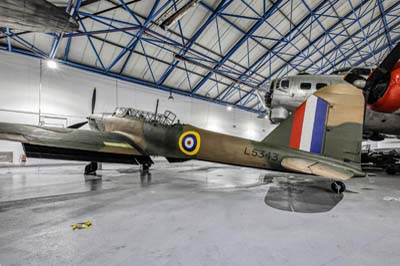
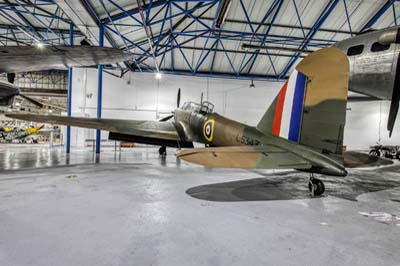
| Fairey Battle 1 (L5343 using parts from L5340). Built in 1939 it served with 266 then 98 Squadron before its transfer to Coastal Command in 1940 for operations in Iceland. Soon after its arrival it force landed in a remote area and was subsequently torched. In the early 1970s parts were recovered for restoration at RAF Leeming and later at Henlow with extensive part from another Battle L5340. Restoration was completed at St Athan. (The finished restoration was completed in 1990 and is around 40% original, 30% L5343 from Iceland, 25% L5340 and 5% from donated components. It retains the serial L5343 as the major identifiable parts are from that aircraft). Further work was done at Rochester from 2006 by Medway Aircraft Preservation Society till 2008 when it moved to RAFM Hendon and Cosford before it was ready for display in 2010. |
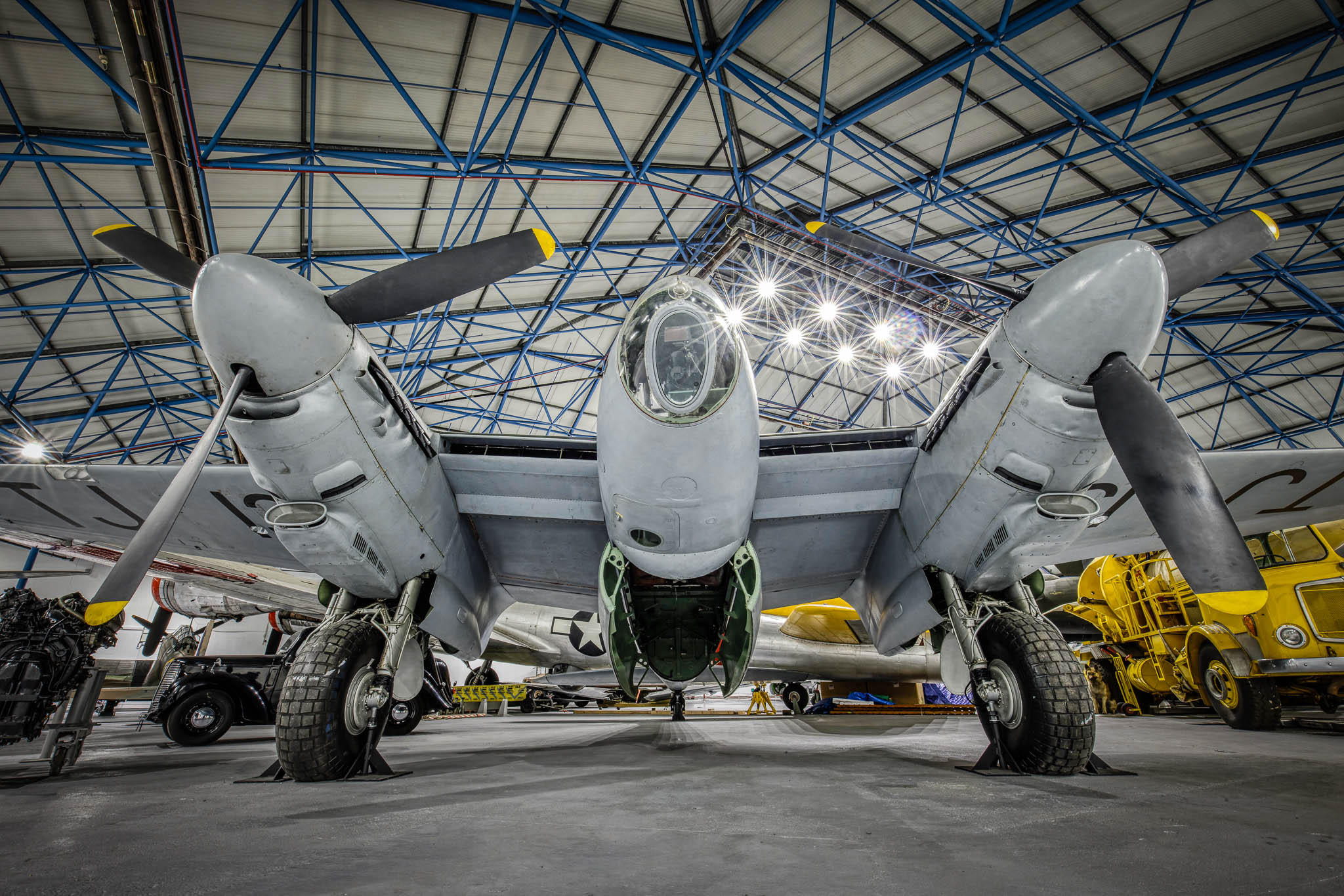 |
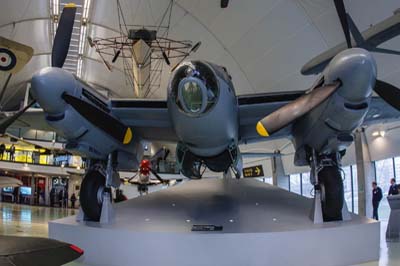
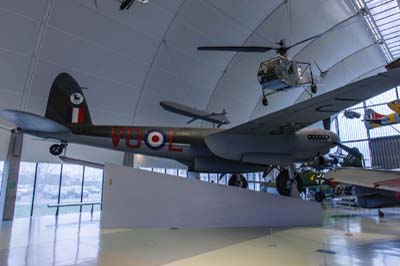
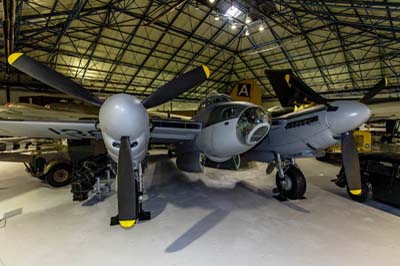
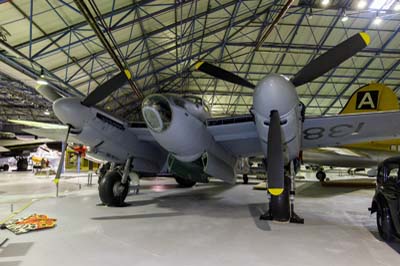
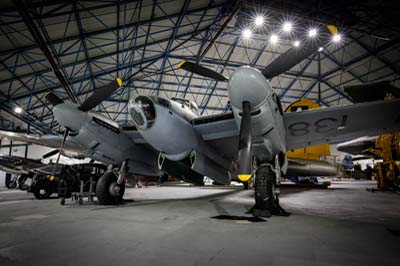
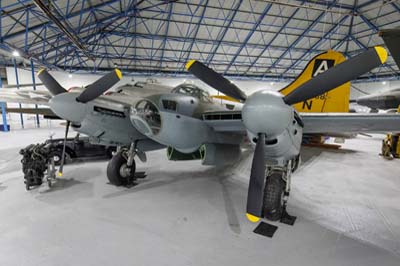
de Havilland DH-98 Mosquito TT.35 (TJ138 'VO-L' later 7607M). The Mosquito was designed to be fast. Constructed out of wood it was light and with conventional armament eliminated it was very light. It could carry 1,000 lb of bombs 1,500 miles at a speed of almost 400 mph. This was twice the speed of contemporary British bombers. Using the experience of building the DH.88 Comet Racer de Havilland conceived the aircraft in 1938, with the prototype day bomber taking to the air for the first time in November 1940. The Mosquito would eventually be used in a variety of roles, including; low-level tactical daytime bomber, high altitude night bomber, pathfinder, day and night fighter, trainer and for reconnaissance. Towards the end of its career it was used as a target tug. 7,781 were built the last was completed in 1950.
TJ138 was part of a batch of 70 Mosquito B.35s ordered in 1944 but not delivered till the latter half of 1945 when it was put into storage with 27 MU at RAF Shawbury. In 1950 it was put in to service with 98 Squadron at Celle in Germany and later Fassberg. In 1951 it returned to storage at 38 MU Landlow to make way for the Vampire FB.5 at 98 Squadron. In 1953 it became one of 205 B.35s converted to TT.35 standard to be used as target tugs, initially at Llanbedr in 1954 and later at Woodvale from 1958. In 1959 it was put into storage at 27 MU Shawbury. Declared to be of historical significance it was moved to 71 MU Bicester in 1959 and moved on to RAF Thorney Island in 1960. By 1967 it was at RAF Colerne where it was refurbished in 1970. With the closure of Colerne in 1975 it was moved first to RAF Finningley and then to RAF Swinderby before arriving at RAF St Athan in 1986. It was repainted in the colours of 98 Squadron in 1991 to join the RAFM Hendon in 1992. |
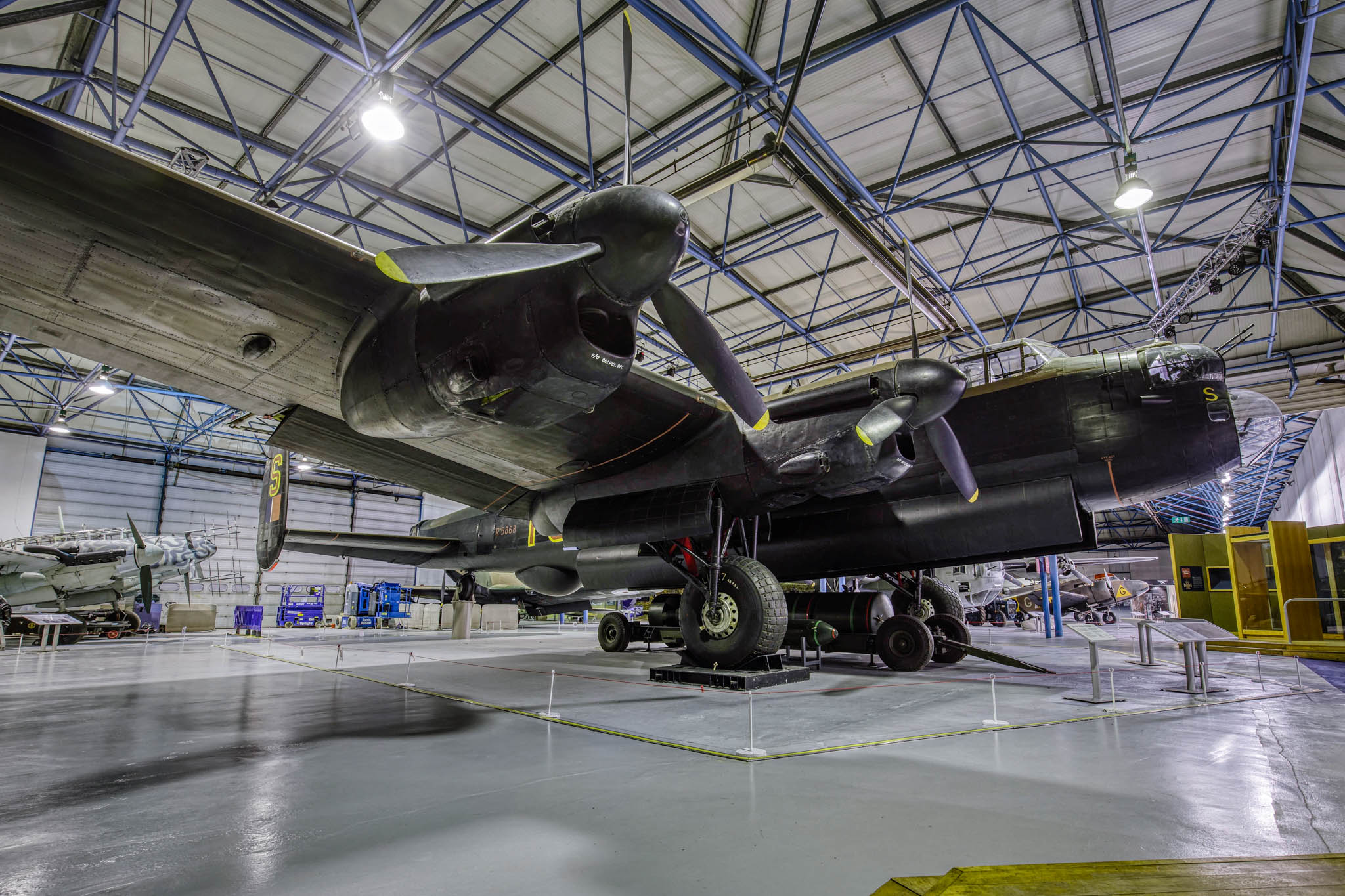 |
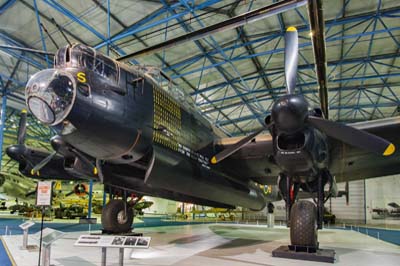
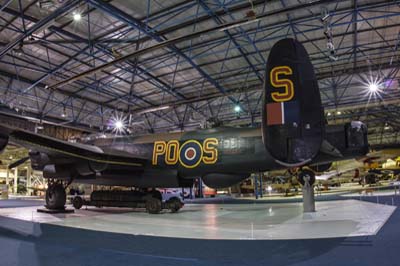
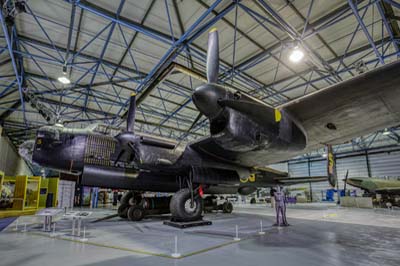
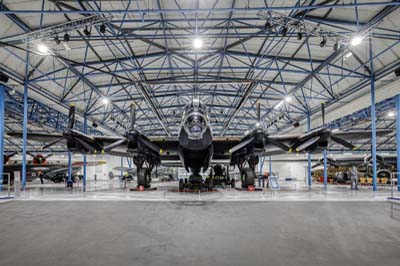
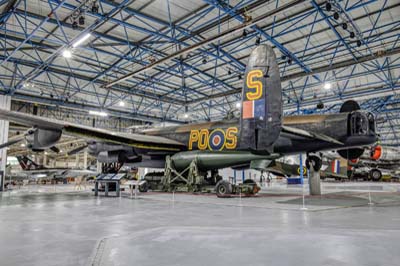
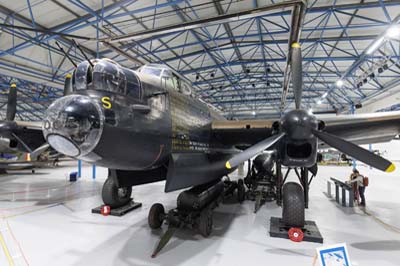
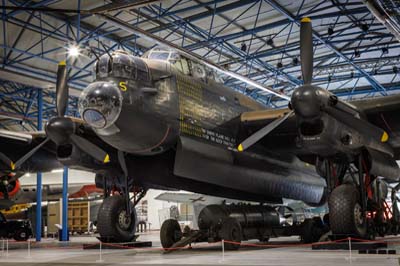
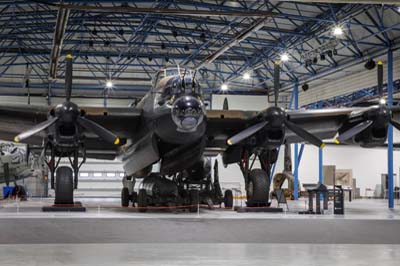
Avro Lancaster I (R5868 'PO-S' later 7325M). The Lancaster was based on the twin engine Avro Manchester and made its first flight on January 9, 1941. It employed four Rolls-Royce Merlin engines. By the time production had ended 7,377 aircraft had been built by six major companies. During the last three years of the War it was a very successful night bomber and continued in service until 1954. Today only 17 survive and of those only two are maintained in flying condition.
The aircraft on display was built by Metropolitan Vickers in 1942. It started its service life with 83 Squadron, before transferring to 467 Squadron RAAF. During the War Lancasters on average flew 21 missions before being lost. Little more than 20 flew over 100 missions, R5868 flew a total of 137 missions. In 1945 it went into storage at Wroughton. By 1970 it had been refurbished at Bicester before moving to Hendon in March 1972. |
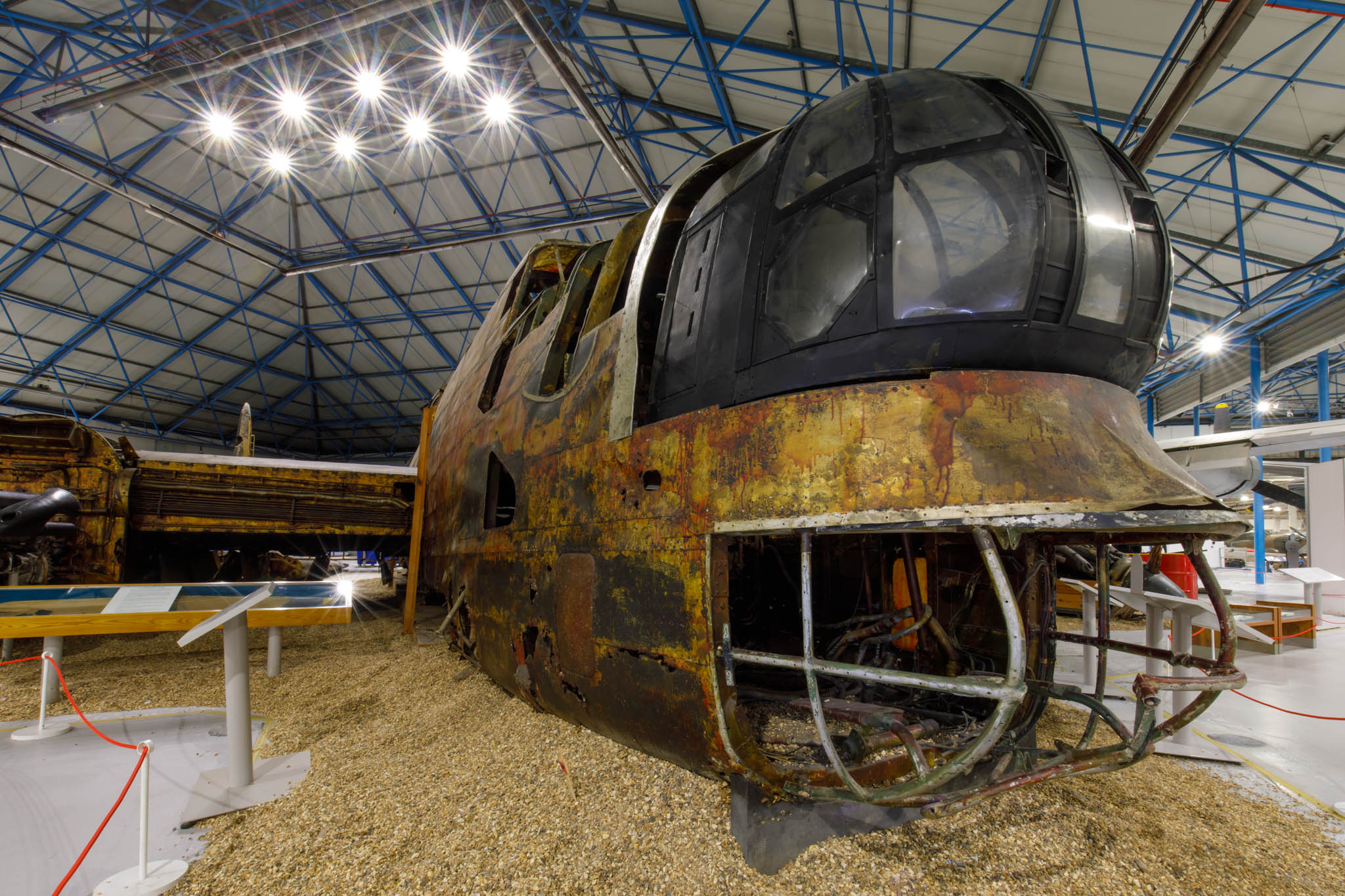 |
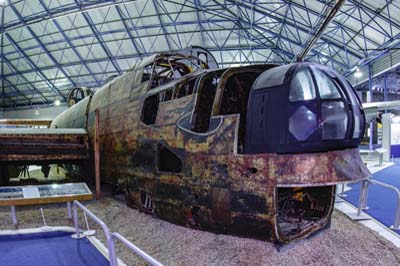
Handley Page Halifax II (W1048 'TL-S'). The Halifax was often overshadowed by the more renowned Lancaster, which also entered RAF service in 1941. However, it earned its own place in history as the first RAF bomber to fly over Germany, participating in a raid on Hamburg in March of that year. Between 1941 and 1945, Halifaxes carried out over 75,000 bombing sorties, delivering more than a quarter of all bombs dropped over Germany by the RAF. Although it was replaced as a front-line bomber at the end of the war, the Halifax continued to serve with Coastal Command and Transport Command until 1952.
Halifax W1048, undertook its first mission in April 1942 as part of an eleven-plane raid by 35 Squadron, based at Linton-on-Ouse, targeting the German battleship Tirpitz, which was reported to be moored in Fættenfjord, Norway. Taking off from RAF Kinloss, W1048 descended to just 200 feet to release her mines but was struck by enemy flak and forced to make a wheels-up landing on the frozen surface of Lake Hoklingen. Five of the crew managed to escape to neutral Sweden, while a sixth, injured with a broken ankle, was captured. Twelve hours after the crash, the aircraft broke through the ice and sank.
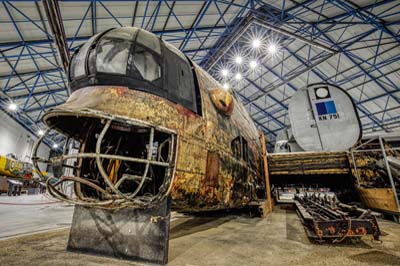
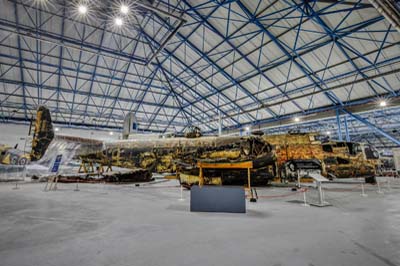
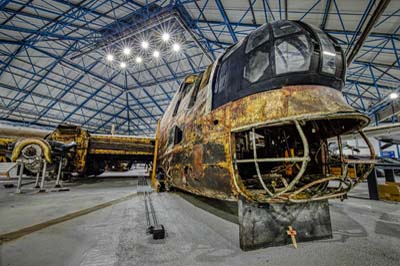
In 1971, W1048 was rediscovered in remarkable condition at the bottom of the lake. Two years later, in 1973, it was raised using oil drums filled with air and towed to the shore. Inside, recovery teams found 8,000 rounds of ammunition, the navigator's gloves still neatly folded in a drawer, as well as survival rations and first aid kits. When power was reconnected, the instrument panel lit up, and the engines could still be turned by hand. The aircraft was dismantled and returned to the UK. Although a full restoration was considered, it was ultimately decided that W1048 should be displayed as she was found, as a moving tribute to the courage and sacrifice of the crews of Bomber Command. |
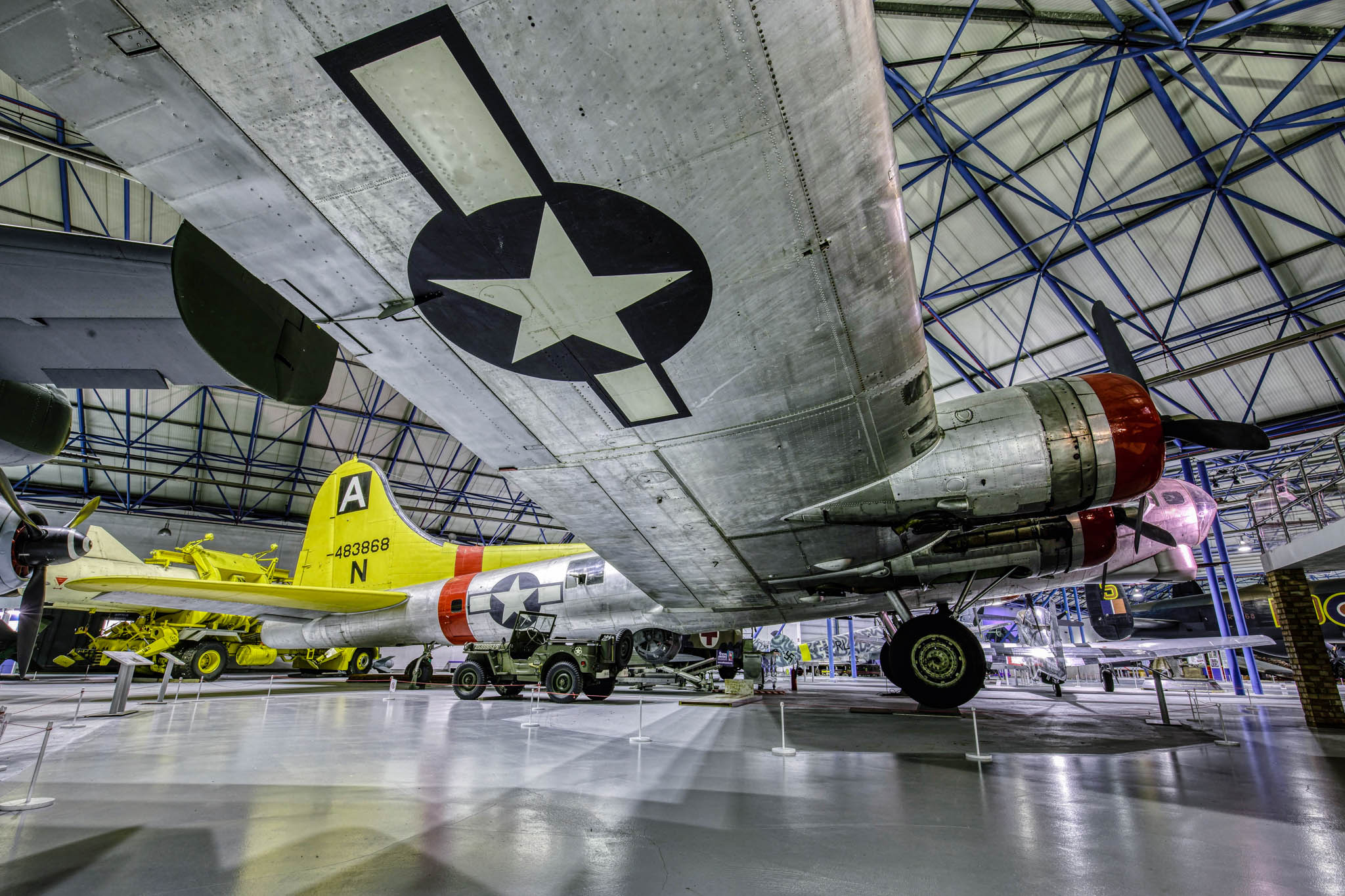 |
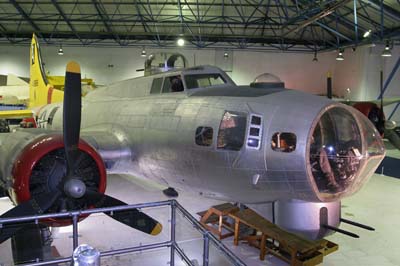
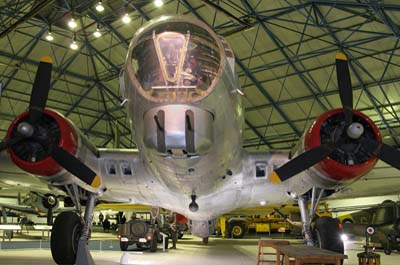
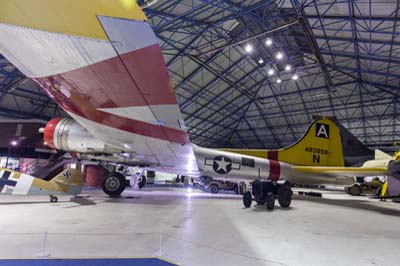
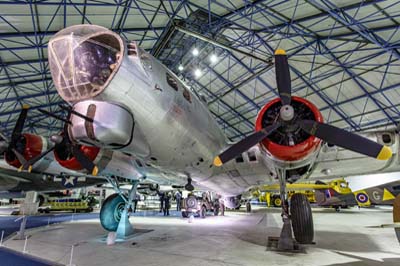
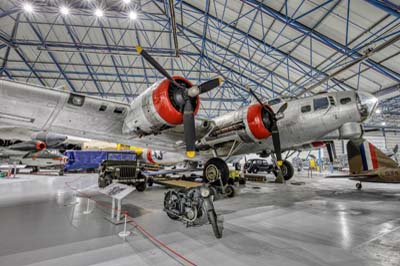
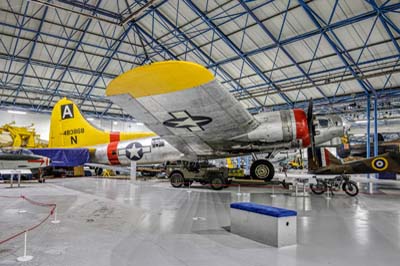
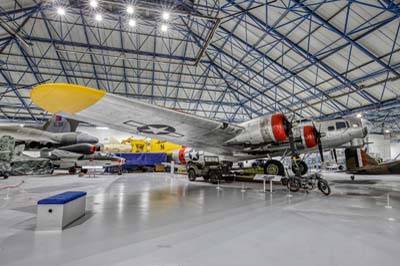
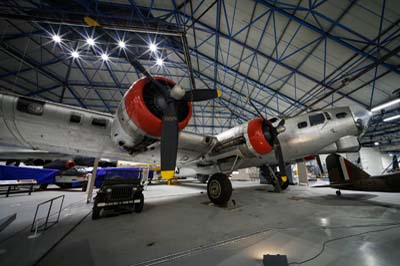
Boeing B-17G-95-DL Flying Fortress (44-83868 'N' later registered N5237V). The B-17 started life on the drawing board in 1934 with deliveries starting in 1937. At the time of the attack on Pearl Harbour there were fewer than 200 B-17s in service. Production was immediately stepped up and at Boeing's Seattle plant alone production rose to an aircraft every 90 minutes. It was the first massed produced large aircraft and 12,731 were built in total. Just over 200 B-17s were supplied to the RAF starting in 1941.
The B-17G on display was built by Douglas Aircraft Corporation in 1944. In July 1945 it was transferred to the US Navy and equipped with radar as a PB-IW long-range Airborne Early Warning aircraft to serve along the US West Coast. In 1955 it was withdrawn from service and sold to Butler Aviation who converted it into a water bomber for firefighting duties. After its retirement in 1982 it was flown to the UK in 1983. It is painted in the markings of 94th Bombardment Group when based at Bury St Edmunds, Suffolk. |
 |
 |
 |
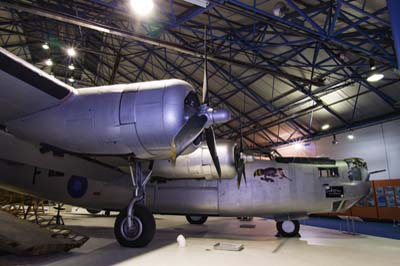
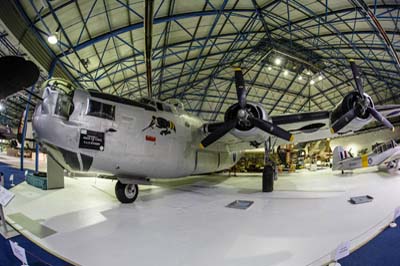
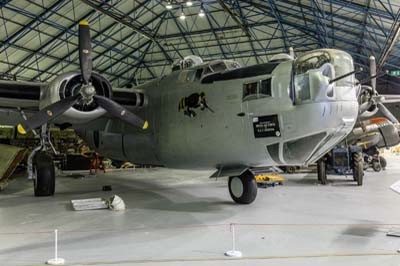
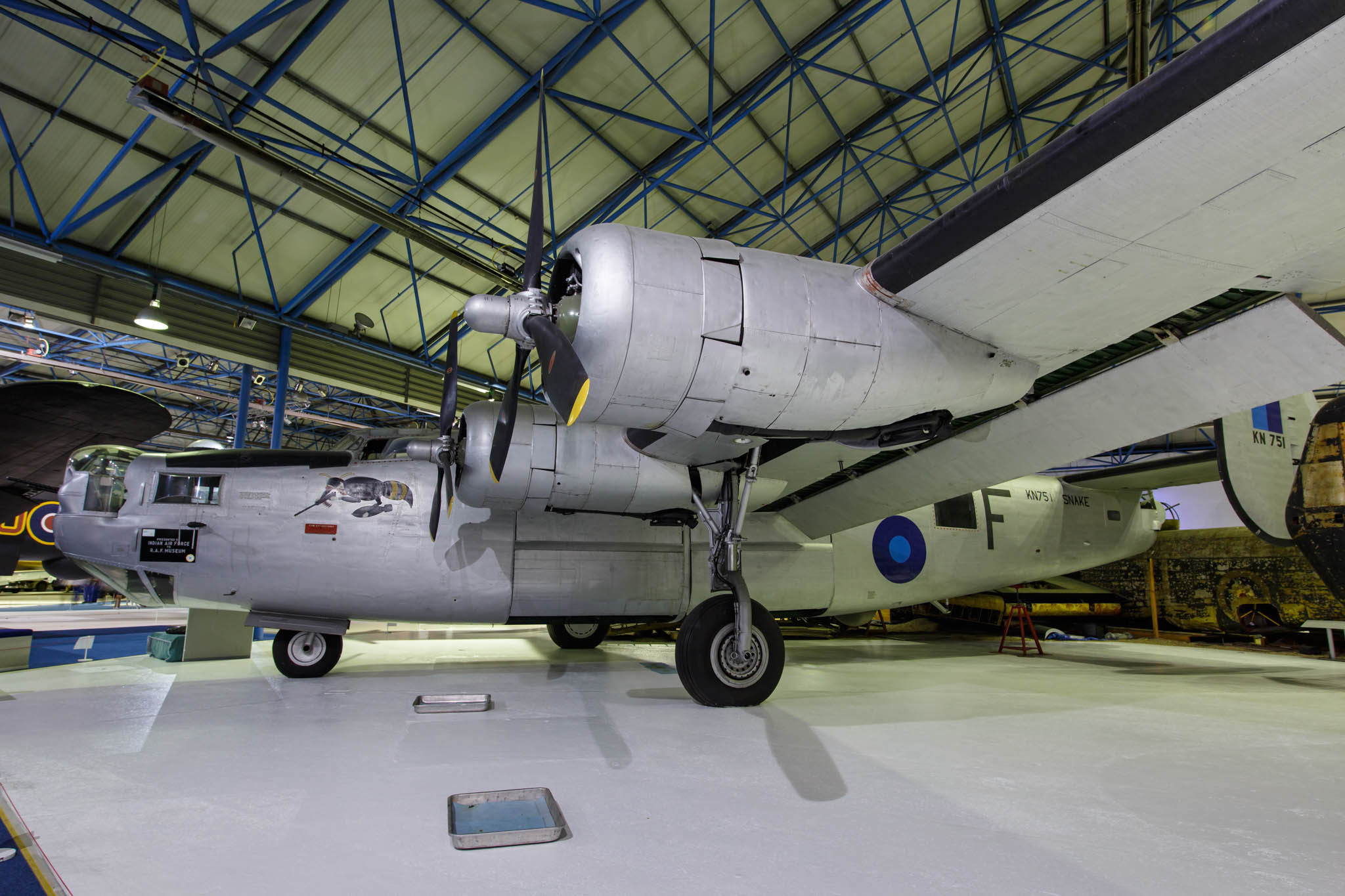
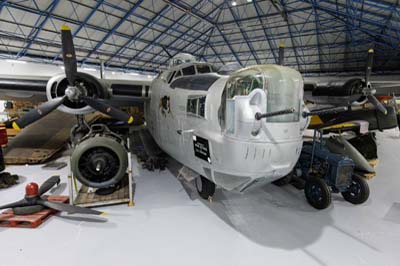
Consolidated B-24L Liberator VI (KN751 later with Indian Air Force as HE807). Designed by the Consolidated Aircraft Corporation the B-24 made its first flight on December 29, 1939. By the time production ended in 1945 19,257 Liberators had been built by Consolidated, Douglas, North American and Ford. Compared with the B-17 it had a longer range and could carry a greater payload. 1,900 aircraft were delivered to the RAF, with over 100 more being transferred during operations. The final Liberators in service were flown by the Indian Air Force until December 1968.
The example on display was built in 1944 at Ford's Willow Run factory which had attained a production rate of one aircraft per hour. It was flown via the Middle East to 99 (Madras Presidency) Squadron at Dhubalia. It was then detached to Cocos (Keeling) Islands until the Squadron was disbanded in November 1945. KN751 was struck off charge in April 1946. Transferred to the Royal Indian Air Force as HE807, in 1948 it was converted to the maritime patrol role with 6 Squadron. It served with 15 other Liberators at Poona until 1968, when they were replaced by eight Super Constellations. Following an overhaul it was handed over to the Royal Air Force Museum and flown to the UK in July 1974. In 1976 it was put on display at Cosford, where it stayed until it was moved to Hendon in 2005. As photographed at Cosford in 1989. |
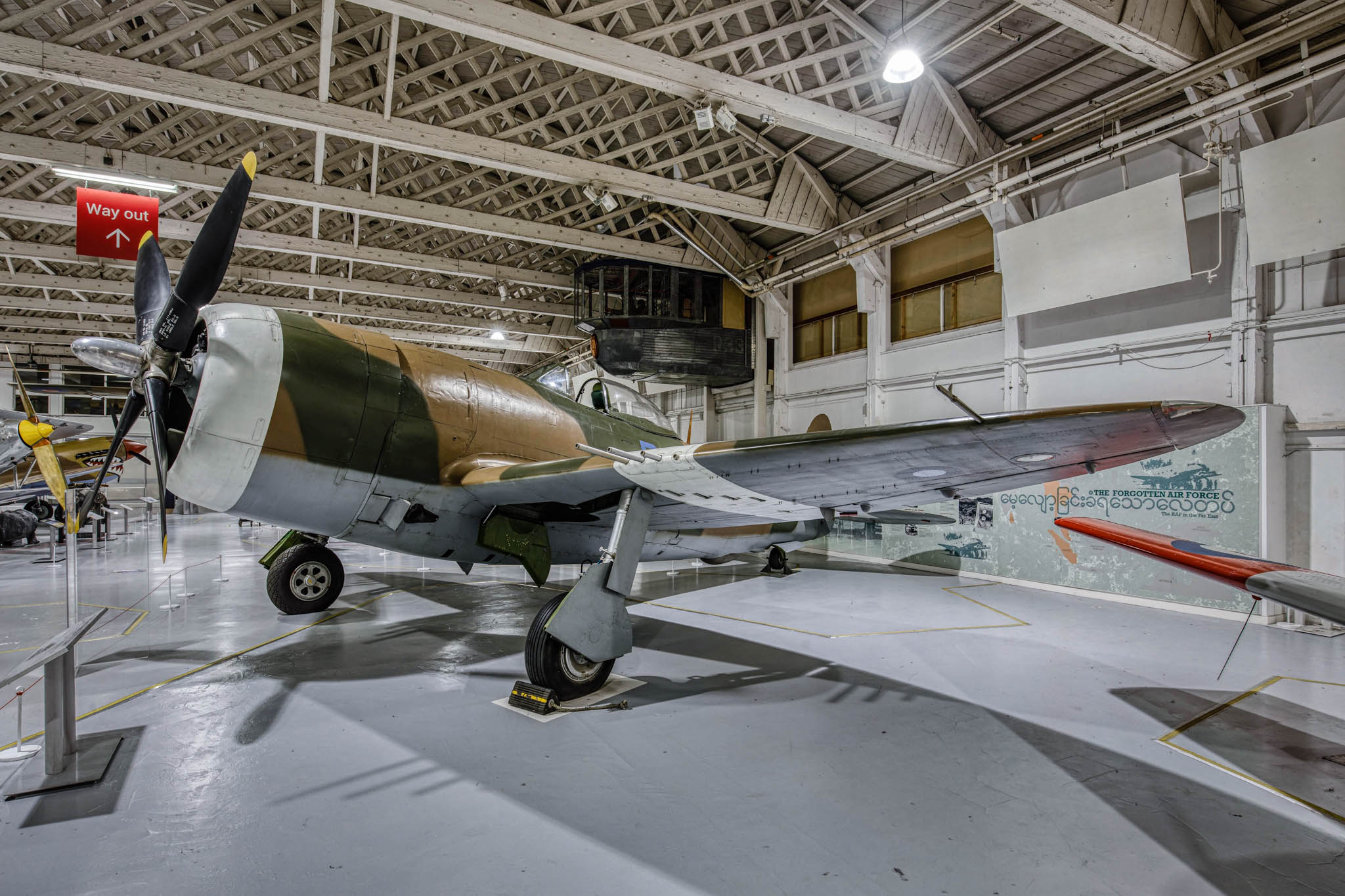 |
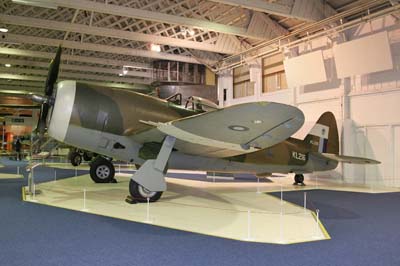
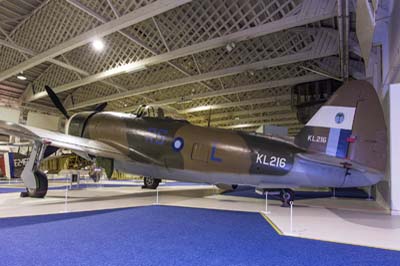
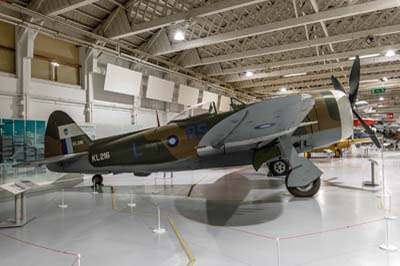
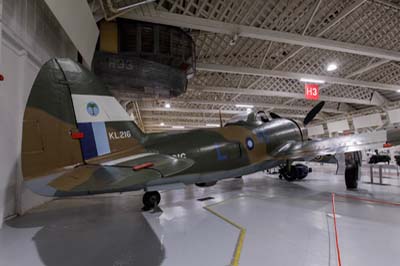
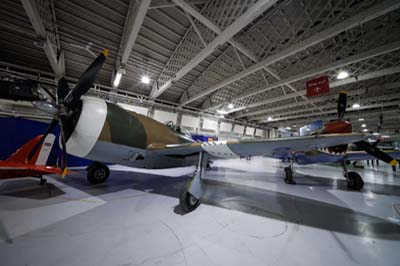
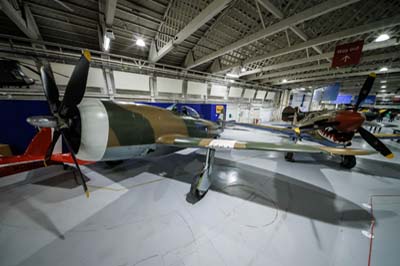
Republic P-47D-40-RA Thunderbolt ('KL216' 'RS-L' also 9212M). The P-47 Thunderbolt did not enter service with the RAF till 1944 for use with South East Asia Command. They were used to attack Japanese ground forces as well as for escorts of RAF Liberators. By the end of 1945 they were replaced by Hawker Typhoons.
This particular aircraft was built in 1945 and did not see operational service, passing to the US Air National Guard (as 45-49295). Later it was supplied to the Yugoslavian Air Force (as 13064). The RAF Museum acquired the aircraft in 1986. It is painted in 30 Squadron markings representing the period when they operated the Thunderbolt from June 1944 to May 1945 in Burma. |
 |
 |
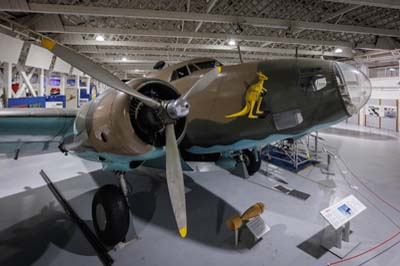 |
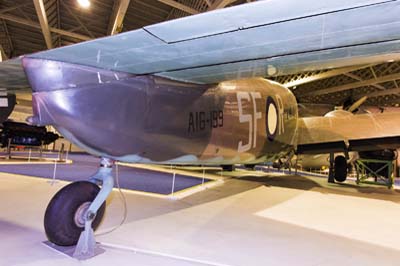
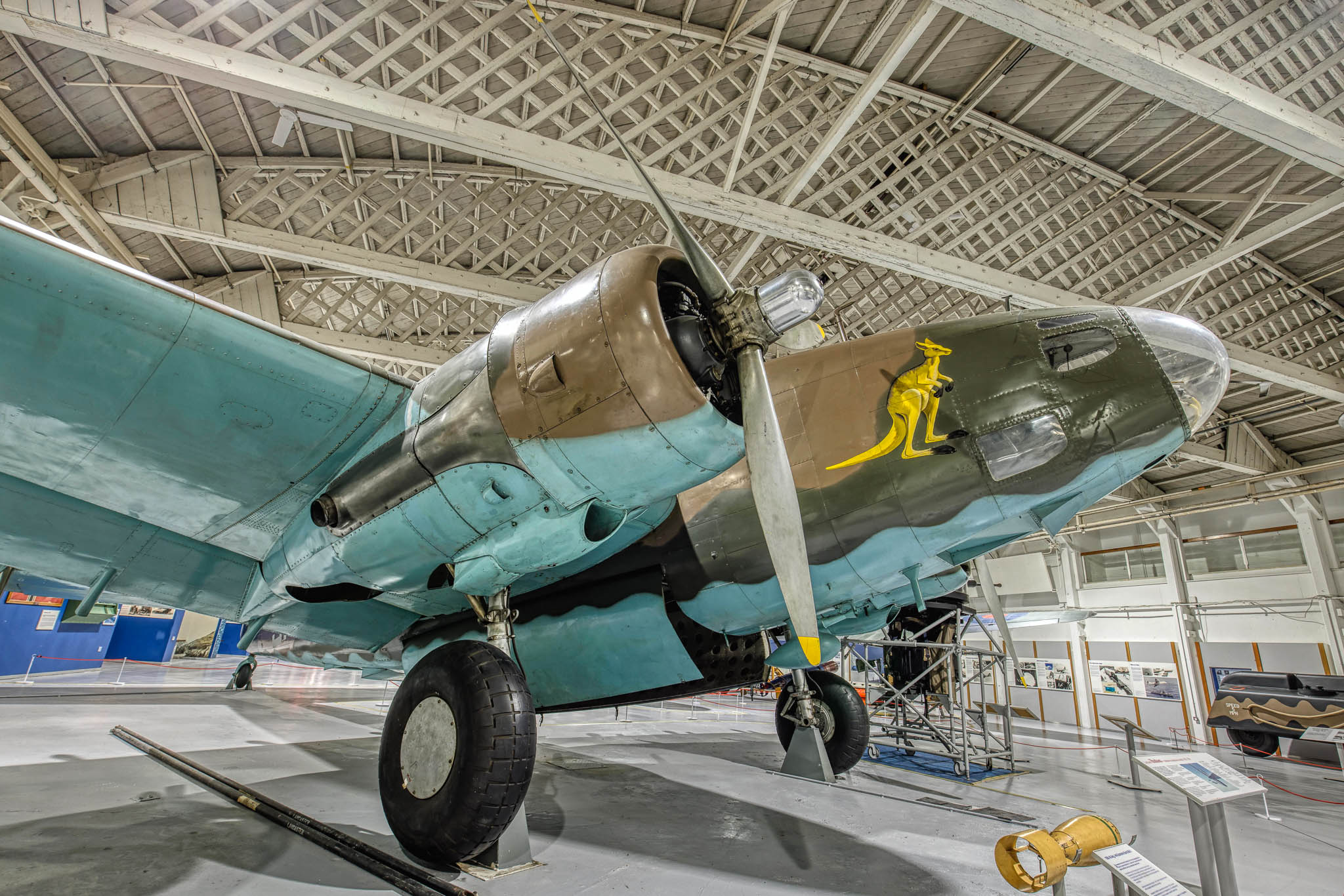
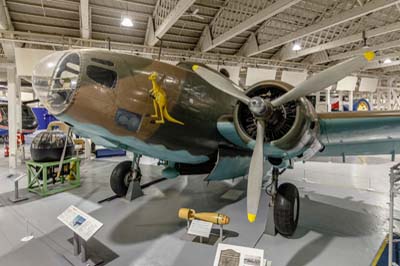
Lockheed Hudson (A16-199). The Hudson was based on the Lockheed 14 Super Electra civil airliner and 2,942 were built. The first of over 2,000 Hudsons ordered by the RAF in 1938, entered service with Coastal Command in 1939 on anti-submarine and general reconnaissance duties. When they became obsolete they were switched to the transport role which included the dropping of Allied agents in Nazi-occupied Europe. Other impressive actions attributed to the Hudson, was being the first Allied aircraft flying from the UK, to shoot down an enemy aircraft. Also it was the first aircraft to capture a U-boat, when U-570 surrendered to a 269 Squadron Hudson in August 1941.
A16-199 was ordered as FH174 but was in 1942 one of 247 diverted to the RAAF before delivery to the RAF. The RAAF operated the Hudson until the remaining 48 were sold in 1946 and 1947. A16-199 became VH-SMM in 1950 and was owned by the Sydney Morning Herald Newspaper but was withdrawn from service in 1953. Following a period of aerial survey work it was put on display with Lancaster NX611 at Bankstown by 1964. In 1966 it was re-registered VH-AGJ by Adastra Aerial Surveys and later operated by Adastra Aerial Spraying in 1969. Operated by Adastra Airways in 1973 it was flown to the Strathallen Collection in Scotland where it was repainted in the colours of 13 Squadron RAAF and registered G-BEOX. In 1981 it was sold for £16,000 to the RAFM and moved to Hendon. As photographed in 1989. |
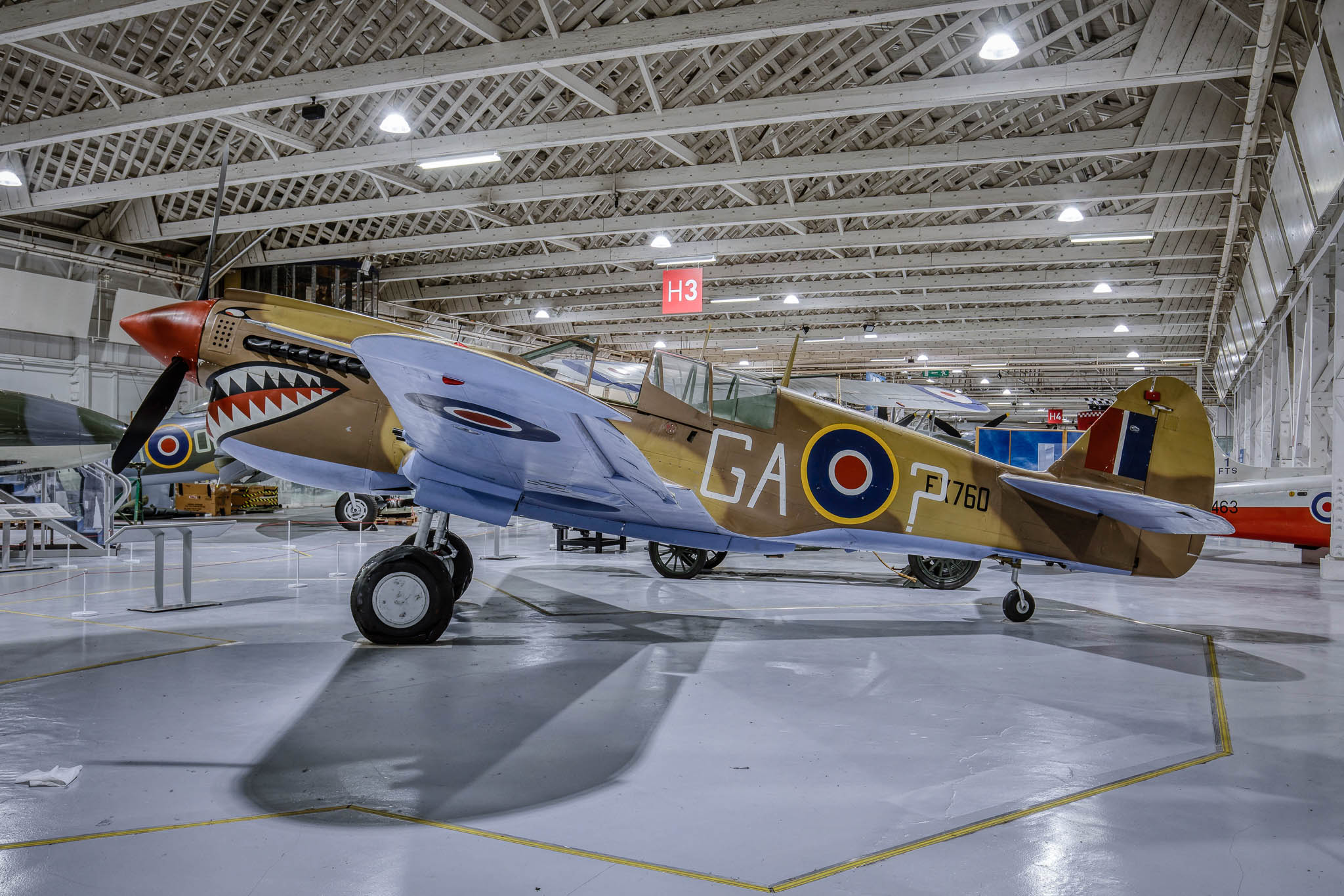 |
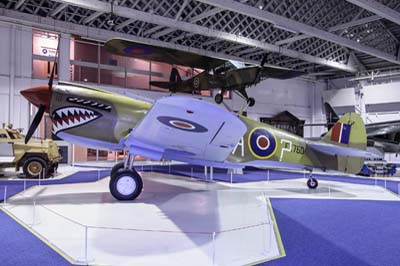
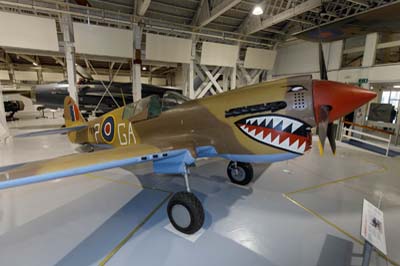
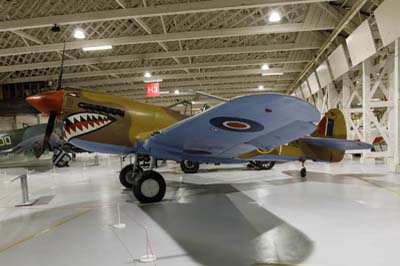
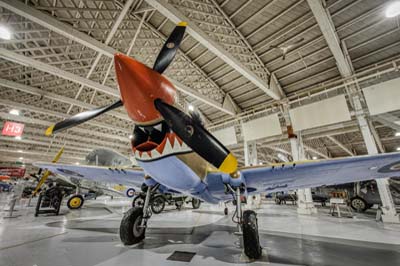
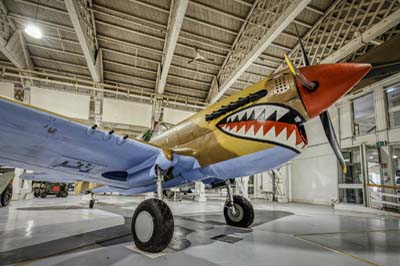
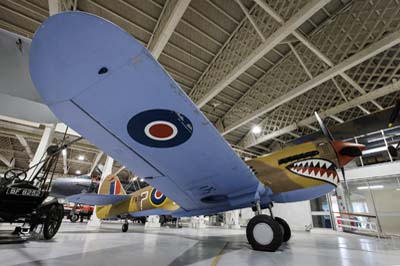
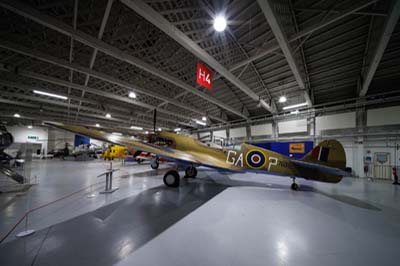
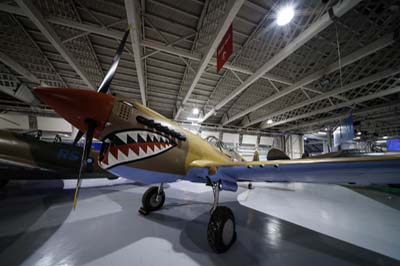
Curtis Kittyhawk IV (A29-556 painted as 'FX760' coded 'GA-?' ex 42-106101). The P-40 was developed as a ground attack fighter, in US service the P-40 was known as Warhawks. Over 3,000 P-40s entered service with Commonwealth Air Forces from 1942. In RAF service P40A, B and C variants were named Tomahawks. The more powerful P-40Ds were named Kittyhawks. The Kittyhawk served in Italy till 1945 and in the Far East.
The aircraft on display is a composite, made up of parts from wrecks found in New Guinea. It is painted in authentic markings of an aircraft serving with 112 Squadron in 1941 in the Mediterranean. |
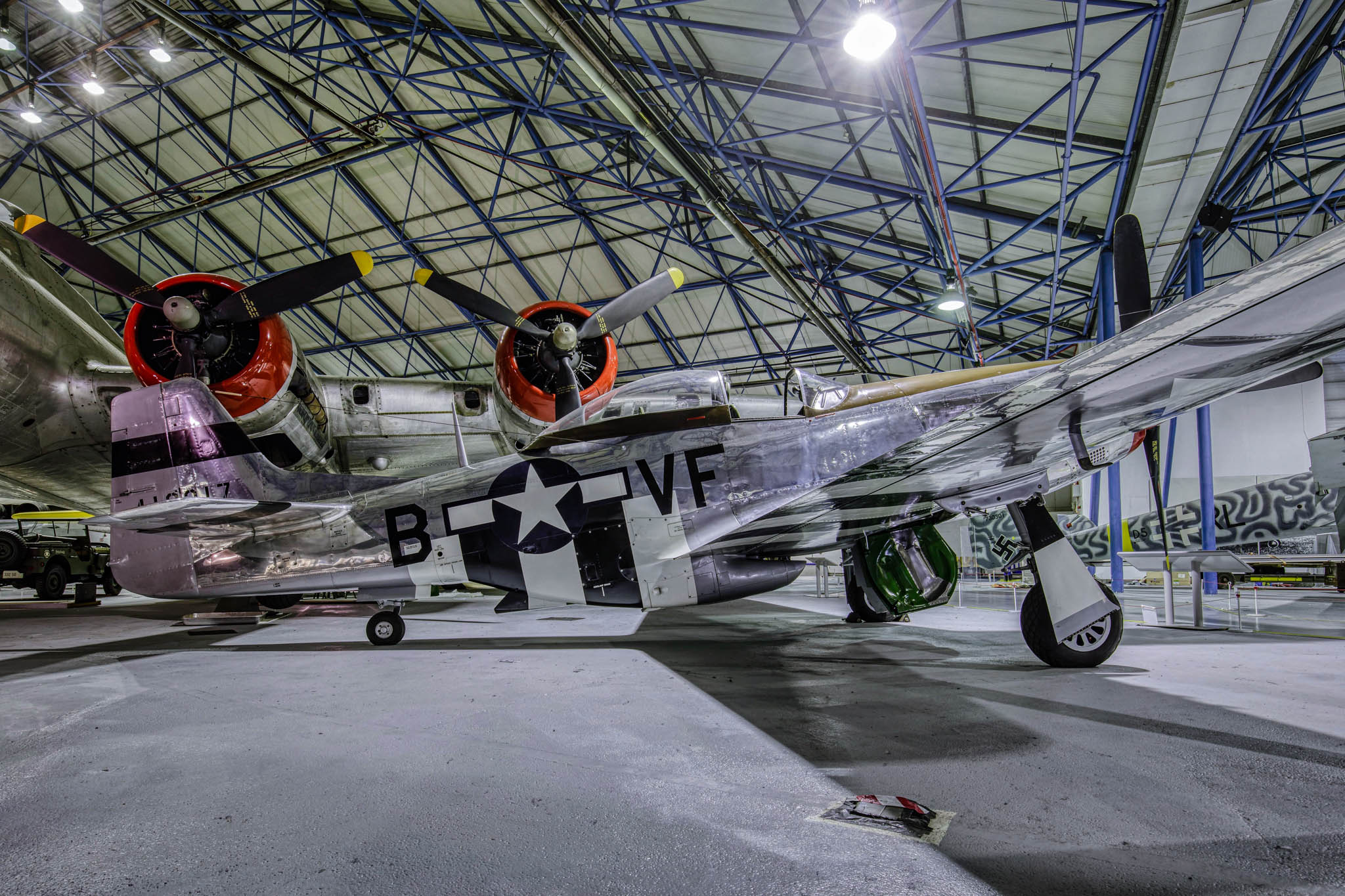 |
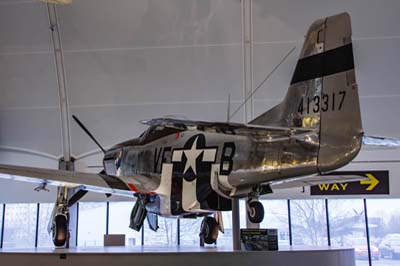
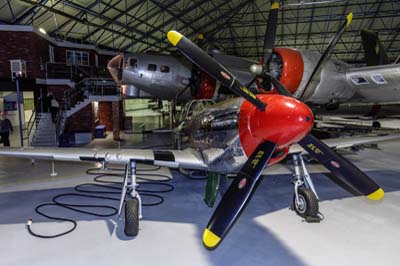
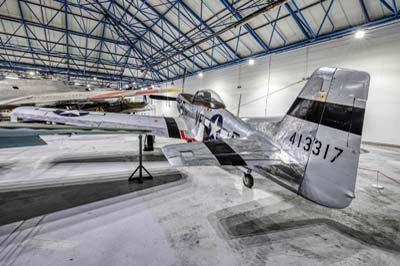
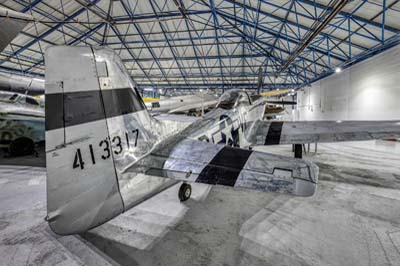
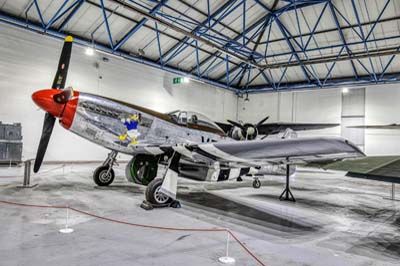
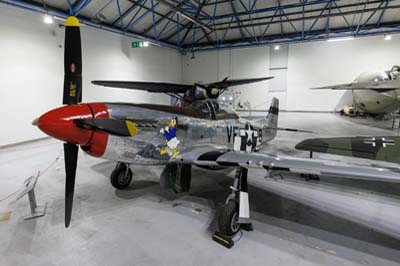
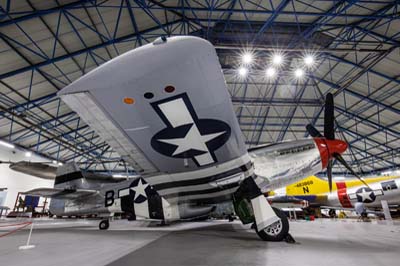
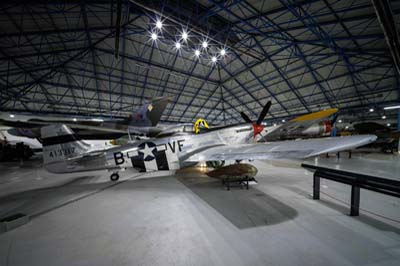
| North American P-51D-30-NA Mustang ('41-3317' 'VF-B' really 44-74409 later NL51RT). Perhaps the best fighter of World War Two, the P-51 Mustang was built from 1940 by North American Aviation to a British specification. By 1941 the first Mustang was delivered to the RAF for testing. In 1942 a Rolls-Royce Merlin engine was fitted to the P-51B giving the aircraft at 30,000 feet an extra 100 mph to 440 mph over the Allison engine. In June 1944 the first of 8,000 P-51Ds with the British designed bubble canopy were produced. It had now become a vital long-range fighter escort, equipped with drop tanks, which could be jettisoned when empty of fuel, to improve the aircraft's performance. Over 2,600 Mustangs were supplied to the RAF flying with 31 squadrons during the war. They were all withdrawn from RAF service by November 1946. |
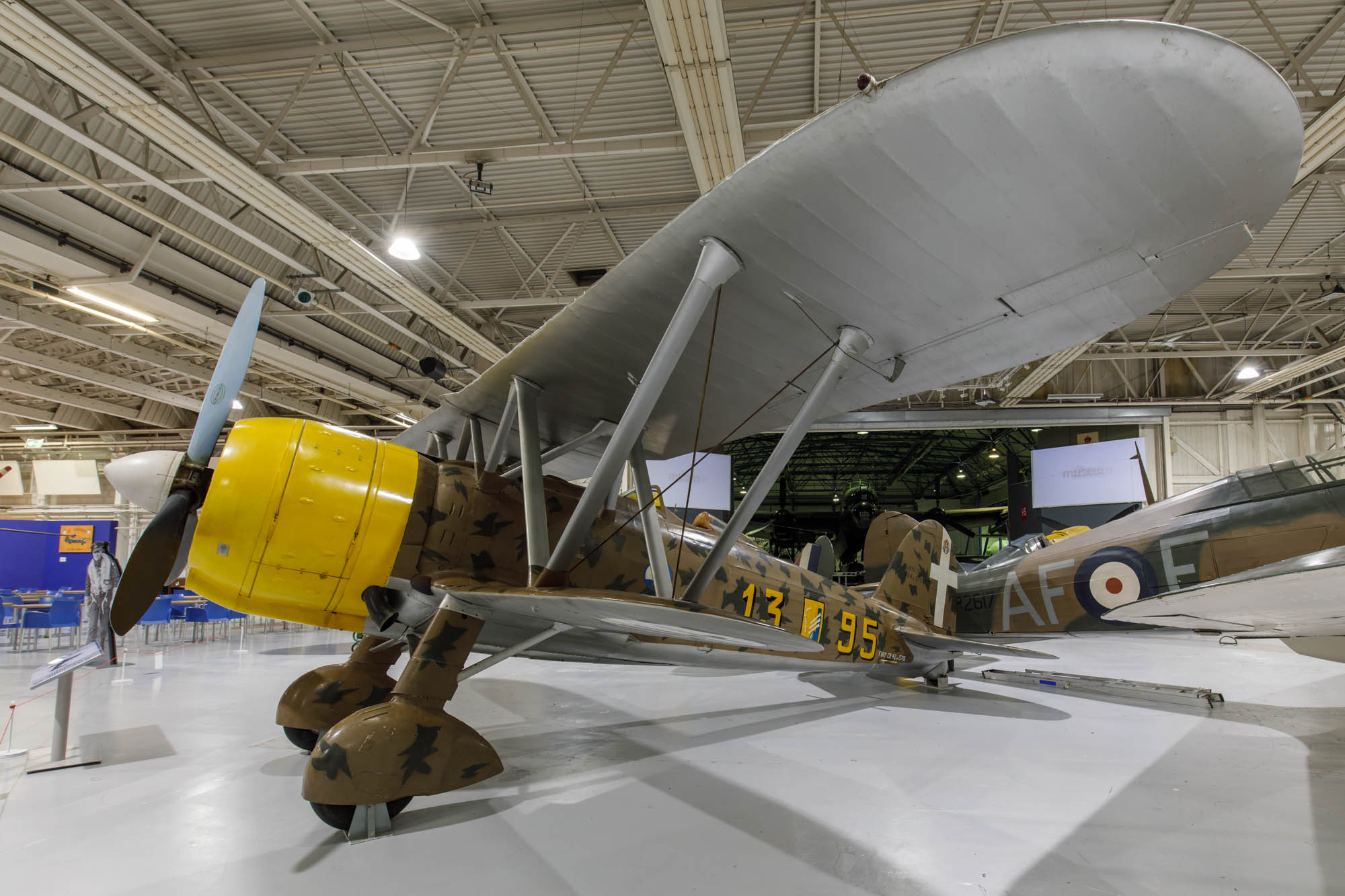 |
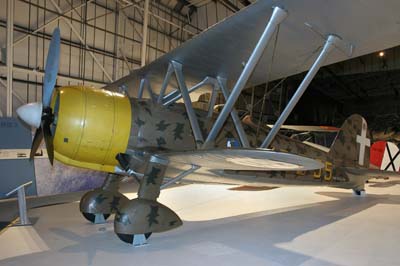
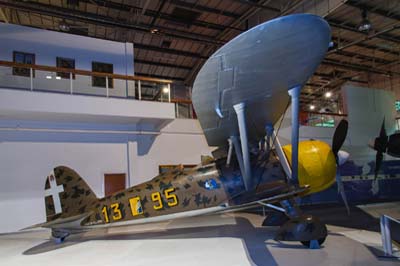
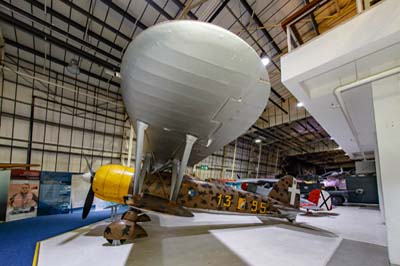
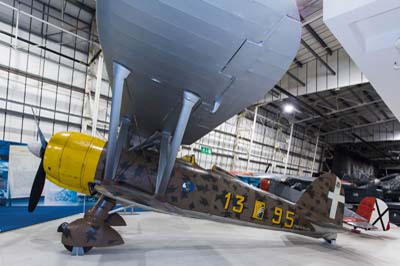
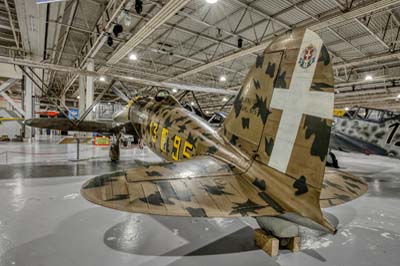
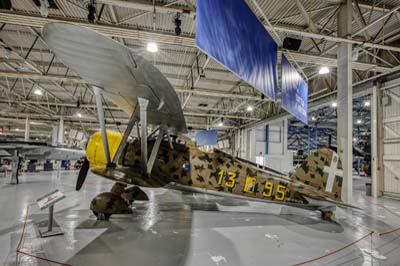
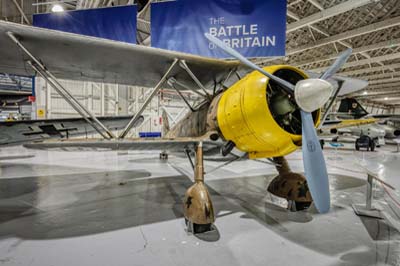
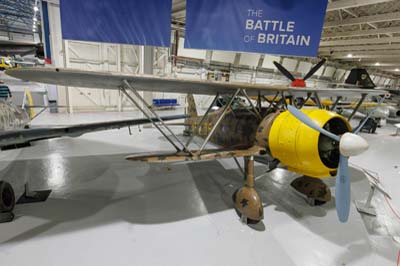
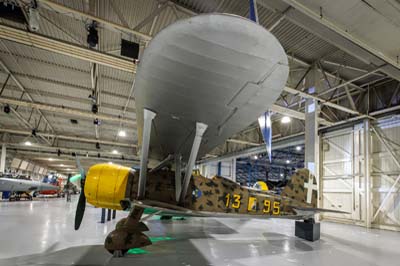
| Fiat CR.42 Falco (MM5701 '13-95' and BT474 later 8468M). The Italian Air Force originally ordered 200 examples as primary fighters, which entered service in 1939. They were later used as night fighters and trainers ending their service career in 1950. They first saw action in southern France and were sent by Mussolini to assist the Germans in the aerial fight against Britain in 1940. The CR.42 was no match for the far superior RAF fighters and saw little action. The aircraft on display moved to Maldegan in Belgium with the 18° Gruppo, 56° Stormo, 95° Squadriglia Caccia Terrestre in October 1940. One month later it was forced to land on the beach at Orfordness in Suffolk, as a result of a broken oil pipe. It was flight tested at RAE Farnborough before going into storage in 1943. Following a number of moves it ended up at St Athan in 1968 where it was restored before its move to Hendon in 1978. |
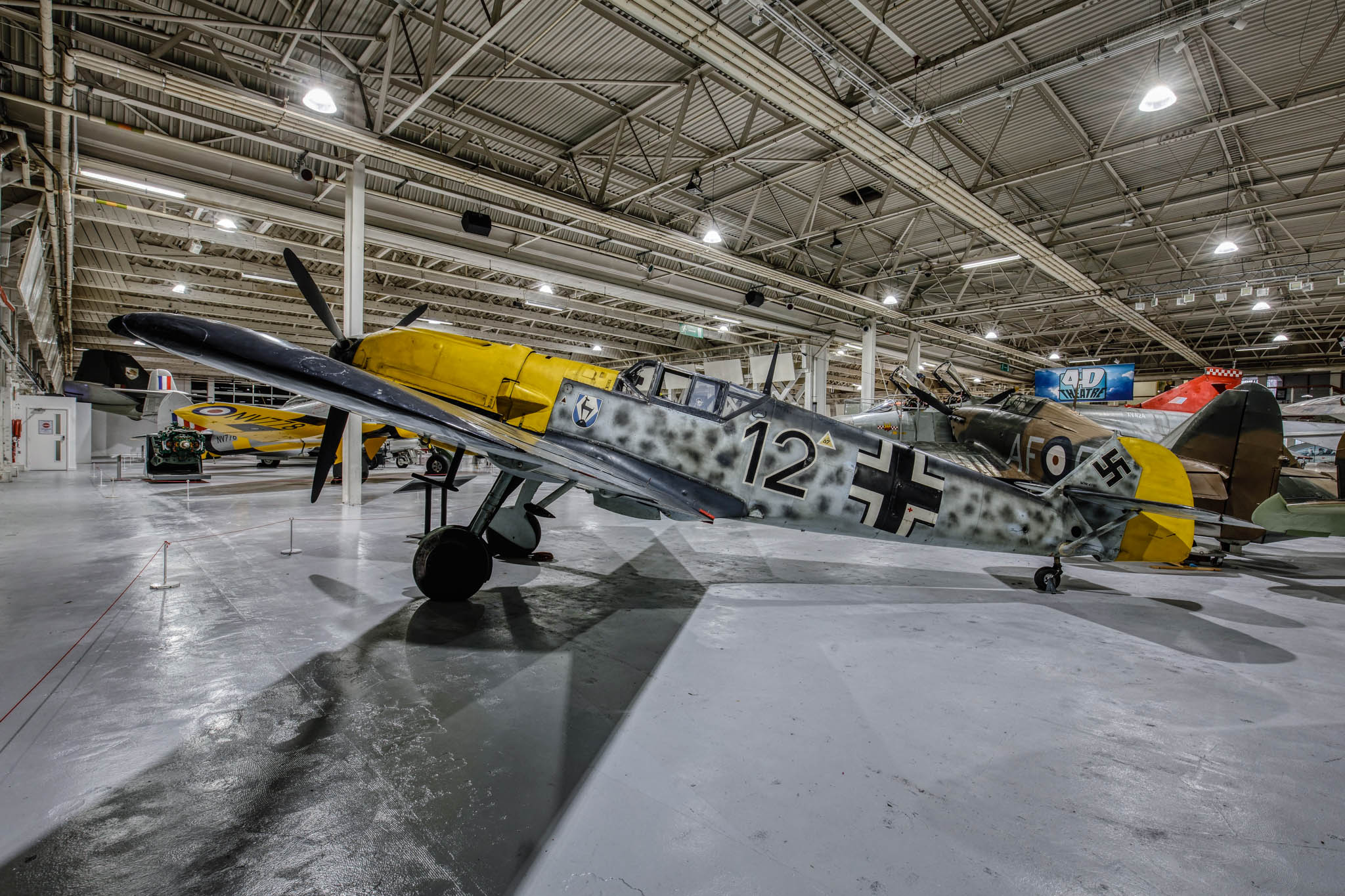 |
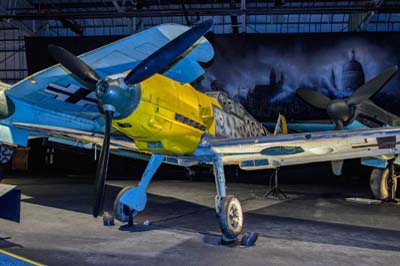
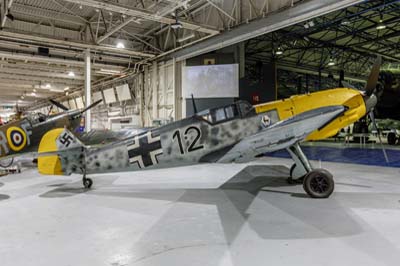
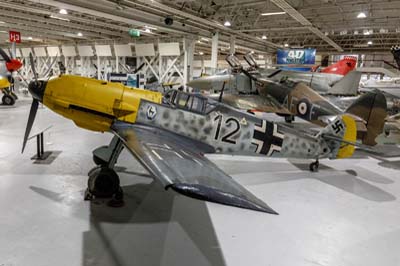
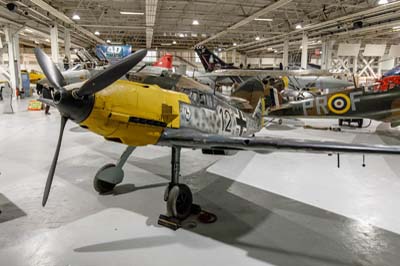
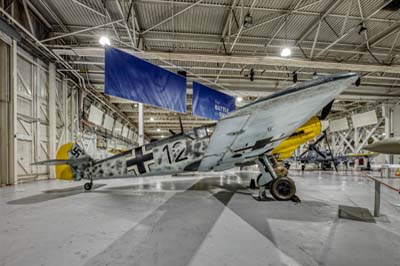
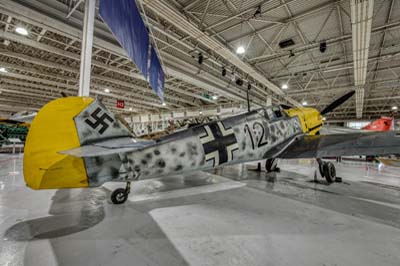
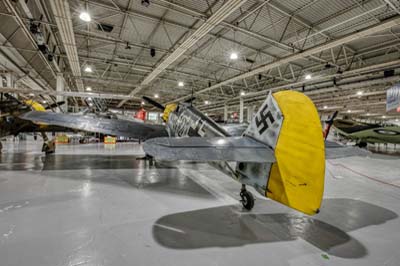
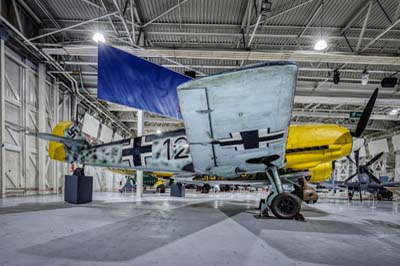
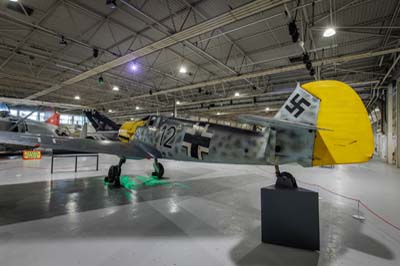
| Messerschmitt Bf 109E-3 (4101 'Black 12' later DG200 then 8477M) on display in the former Battle of Britain Experience Hall in 2007. |
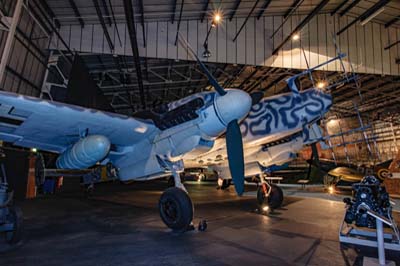
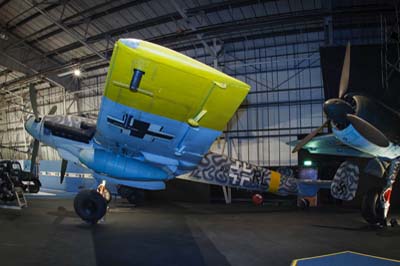
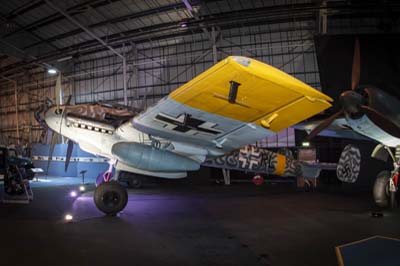
Messerschmitt Bf 109E (4101 'Black 12' later DG200 and 8477M). The Bf 109 was one of the most effective single seat fighters of the Second World War, with more than 33,000 produced. Designed in 1935, it proved its capabilities during the Spanish Civil War. During the Battle of Britain it was closely matched with the Spitfire and Hurricane. The Bf 109 could out climb both aircraft and was faster than the Hurricane, though slightly slower than the Spitfire. Its main limitation was its short endurance, allowing only a few minutes of combat over southern England before it had to return to base.
The aircraft on display, Black 12, was built in 1940 and delivered to Jagdgeschwader 51, based at Pihen in France. In November 1940 it was shot down over Kent by a Spitfire of No. 66 Squadron and belly landed at RAF Manston. The pilot was captured and remained a prisoner of war until 1946.
After recovery, the aircraft was sent to Rolls Royce at Hucknall for repair and evaluation on behalf of the Director General of Research and Development. It was later moved to de Havilland at Hatfield for propeller testing and then to the Aeroplane and Armament Experimental Establishment at Boscombe Down in 1942. The aircraft subsequently joined 1426 Enemy Aircraft Flight, operating from Duxford and later Collyweston. As DG200 it provided valuable flight data on the performance and handling of the Bf 109E, helping the RAF refine tactics against it during the Battle of Britain. In 1943 the aircraft was placed in storage and eventually transferred to St Athan in 1969 for refurbishment. It moved to the RAF Museum at Hendon in 1976 and was placed on display in the Battle of Britain Hall in 1978. |
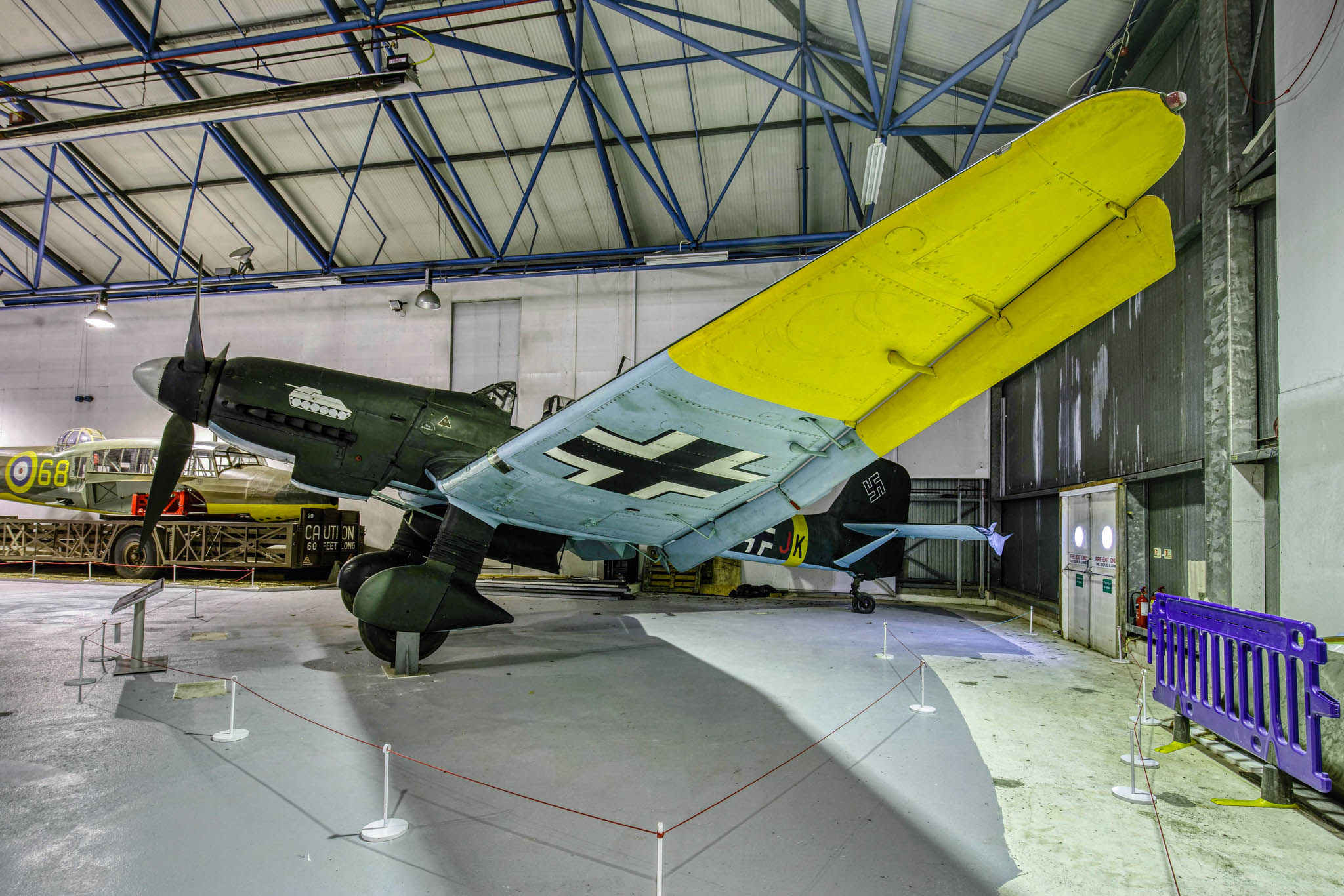 |
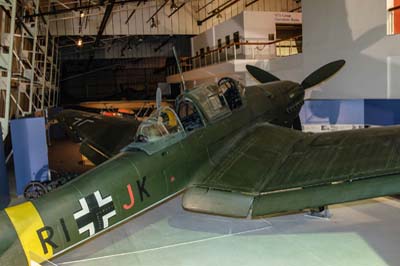
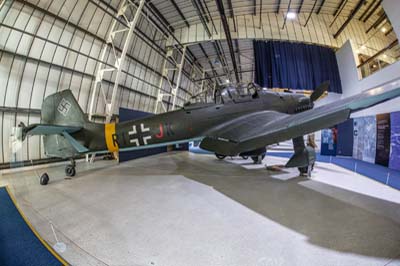
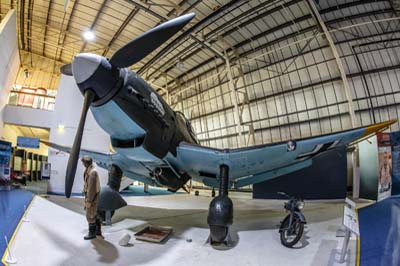
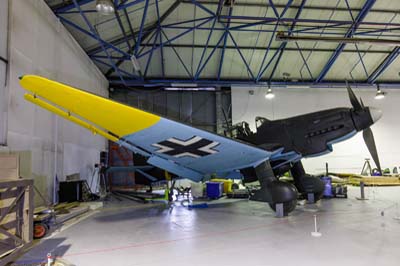
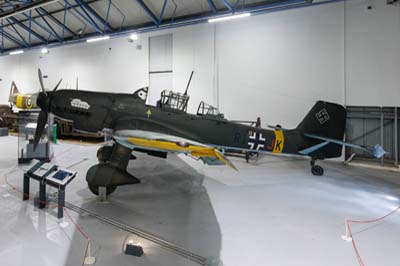
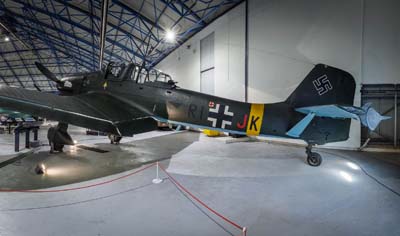
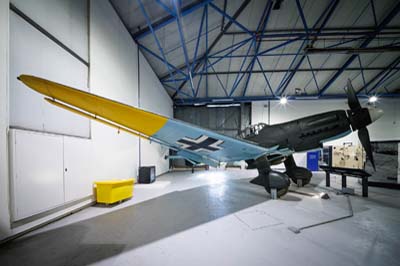
Junkers Ju 87D-3 (494083 'RI+JK' later 8474M). The Ju 87 was widely known as the 'Stuka' (German for dive-bomber) and entered service in 1938. It first saw action during the Spanish Civil War (1936 to 1939). It was very successfully used against Poland and France before being employed to attack shipping in the English Channel. It went on to destroy more ships than any other aircraft in history. After its role was switched to attacking coastal airfields and radar stations it began to suffer heavy losses due to its poor defence against enemy fighters. They were later moved to the Russian Front to attack tanks.
The aircraft on display in was built around 1943 as a Ju 87D-2 but later modified to G-2 standard by removing its dive brakes and fittings for bombs and drop tanks and installing two 37mm Bk37 cannon. It was captured in 1945 in Germany with unidentified 'RI+JK' unit markings and flown to Eggebek before being shipped to United Kingdom and storage with 47 MU at RAF Sealand. It was moved to RAF Stanmore Park, RAF Wroughton and RAF Fulbeck before arriving at RAF St Athan in 1960. It was repainted in 1975 and transferred to the Battle of Britain Hall at Hendon in 1978. |
 |
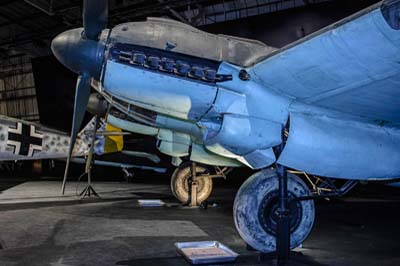
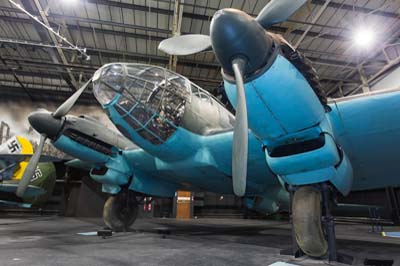
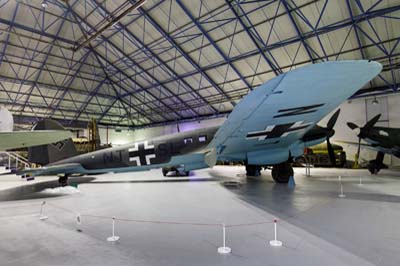
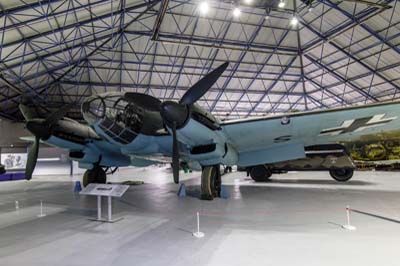
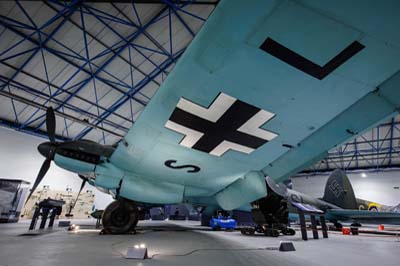
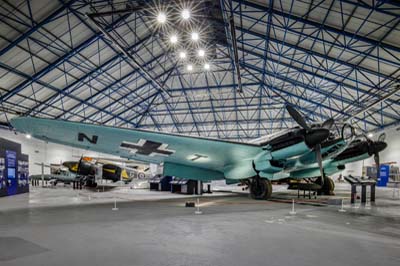
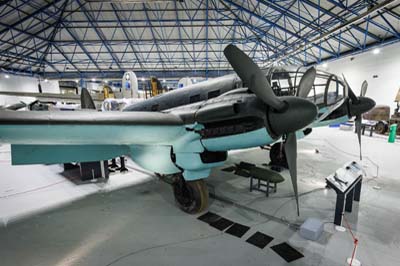
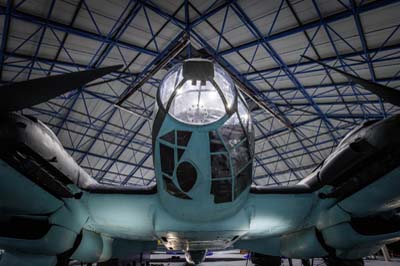
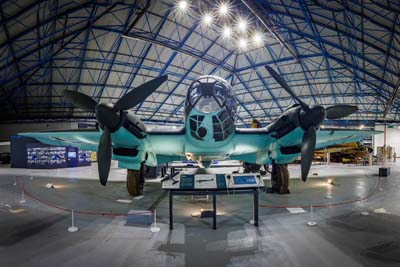
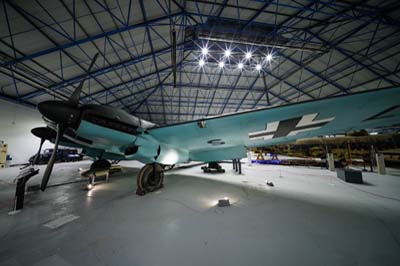
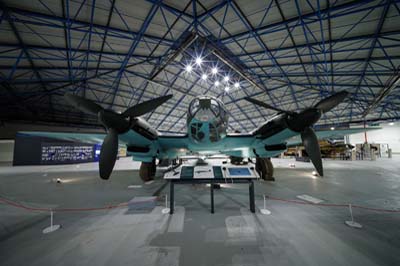
Heinkel He 111H-23 (701152 'NT+SL' later 8471M). The He 111 was designed as a high speed medium bomber and civil transport in 1934. The first bombers were delivered in 1936 and were first used as such in the following year during the Spanish Civil War by the Nationalist forces. This proved an ideal testing ground. In 1940 the fully glazed nose versions (He 111H and He 111P) were introduced. During daylight raids they were very vulnerable to fighter attack due to their poor defensive armament and their lack of speed. Following heavy losses their role was switched to night attacks against Great Britain.
The He 111H on display was delivered as a paratrooper transport in 1944 of which it could carry 16 with a crew of three. Following the German surrender it was allotted to the USAAF in 1945 and ferried to Cherbourg but not shipped. In July 1945 it was flown to RAF Boxted, home of the 56th Fighter Group, USAAF and painted in their markings. Over the next few months it was displayed at several American air bases before being transferred to RAE Farnborough to join other captured German aircraft. In 1947 it was put into storage at RAF Sealand. After a number of moves it arrived at St Athan in 1969 before going to Hendon for display in the new Battle of Britain Hall in 1978. |
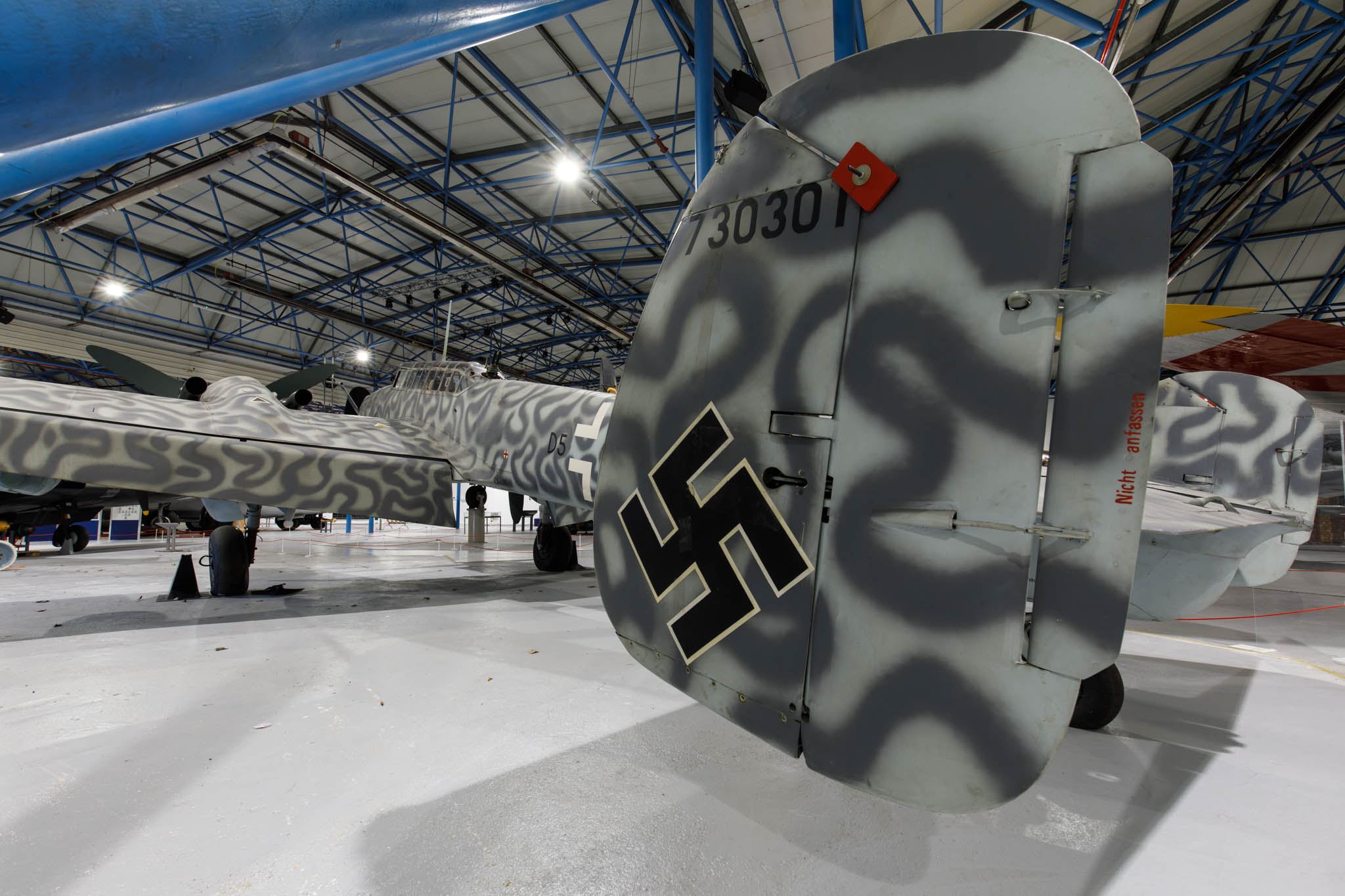 |
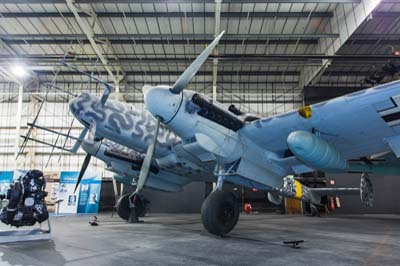
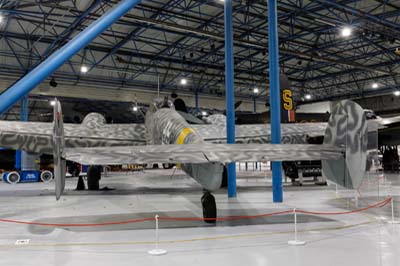
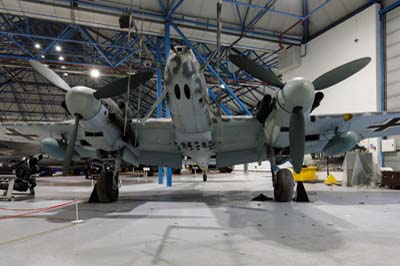
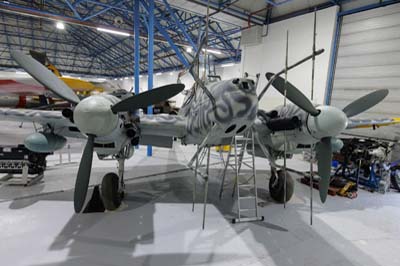
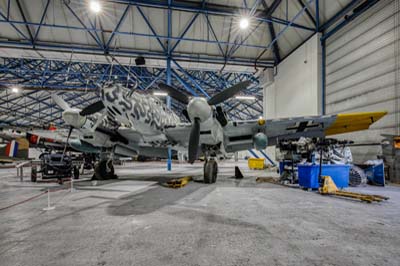
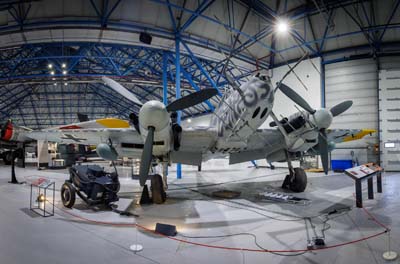
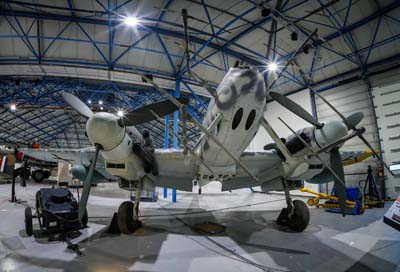
Messerschmitt Bf 110G-4/R6 (730301 'D5+RL' later 8479M). Designed in 1939 as a long-range escort fighter, it had a crew of three and could reach 342mph (550km/h). It first saw service over Poland in 1939, however in the Battle of Britain it was no match against the faster Spitfires and Hurricanes in daylight, later as a night fighter it was very successful.
The example on display was presumed built in 1944, it was seized at Grove airfield in Denmark in May 1945. Three months later it was being assessed at RAF Farnborough, but swiftly moved into storage. Moving from one storage facility to another over the next 20 years it ended up with the Historic Aircraft Collection at RAF St Athan where it was restored in 1976. It moved to the Battle of Britain Museum Hall at Hendon in 1978. |
 |
| Focke-Achgelis Fa 330 'Bachstelze' (100503). It was designed as an unpowered autogyro kite towed behind German Type IXD2 U boats to serve as an observation platform. The aircraft was designed by Heinrich Focke, with testing beginning in mid 1942. Operational deployment followed in early 1943, and around 200 examples were built by Weser Flugzeugbau. It had arrived from Cosford by November 2025. |
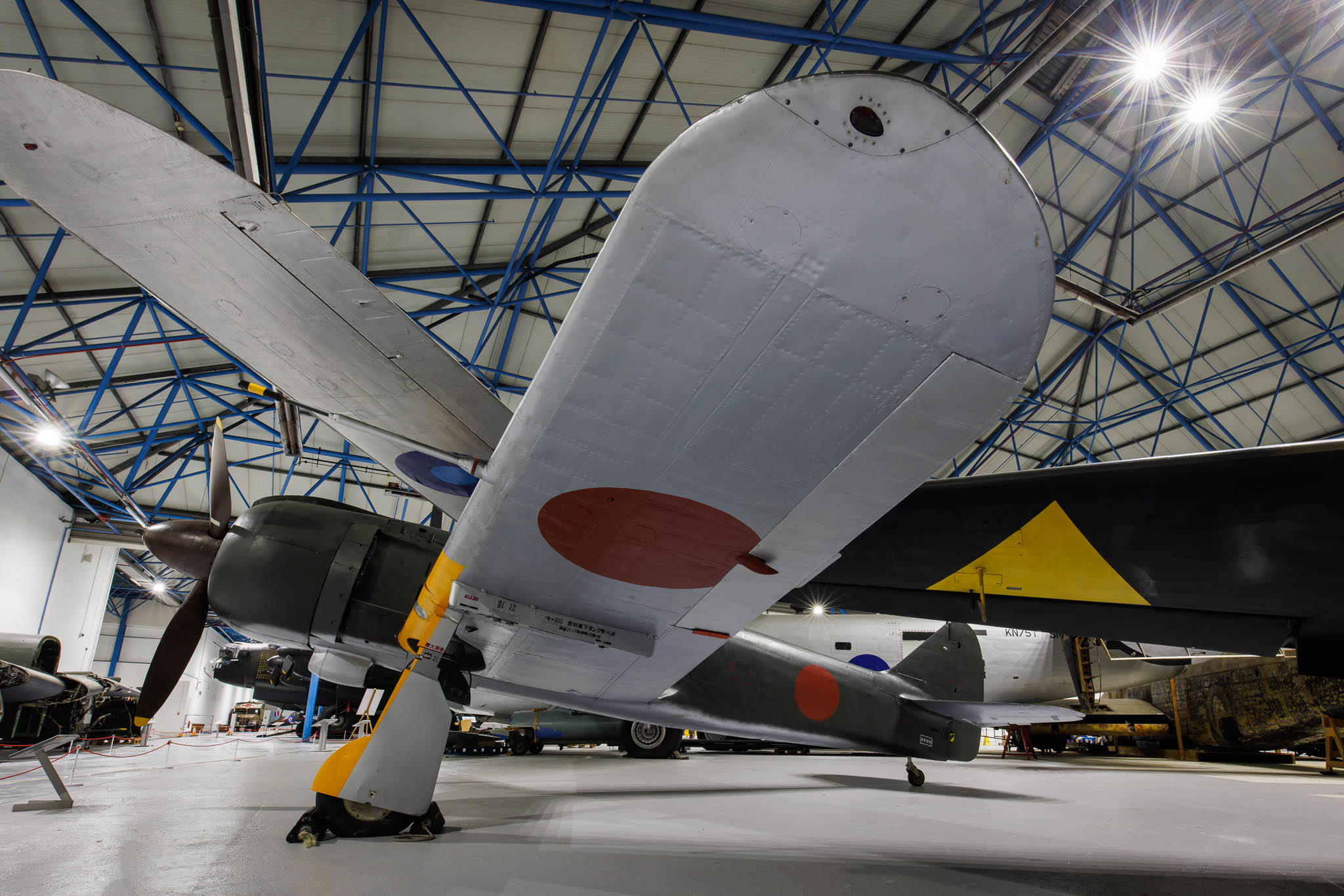
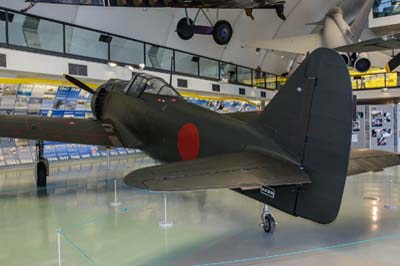
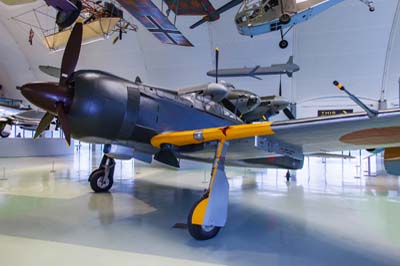
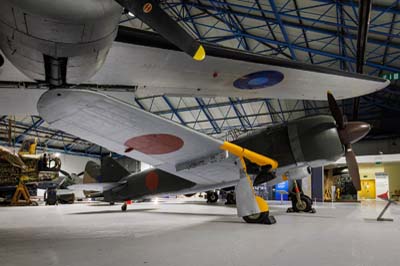
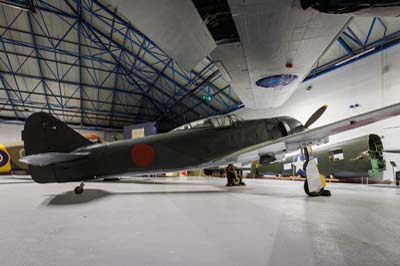
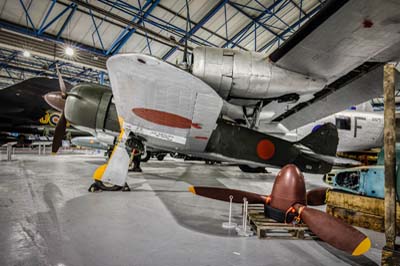
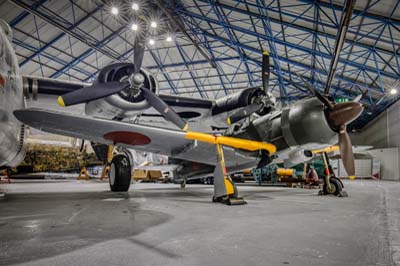
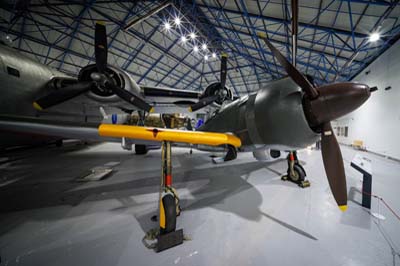
| Kawasaki Ki 100-1b ('24' later 8476M) ex Imperial Japanese Army Air Service (IJAAS). Introduced late in World War Two the Ki 100 was one of the most effective Japanese fighter aircraft. Its first flight was on February 1, 1945 272 Ki 100 1a's were produced followed by 188 Ki 100 1b's with bubble canopies. The aircraft on display is the only survivor Ki 100. It was relocated to Cosford and put on display in October 2011. By October 2022 it was back at Hendon. |
Left to right:
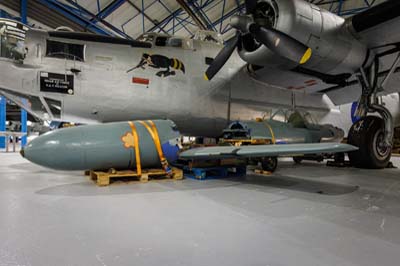
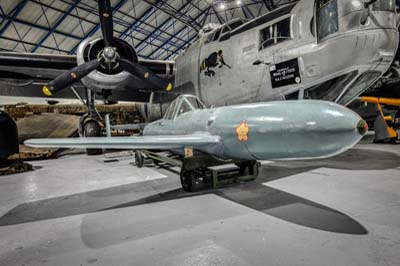
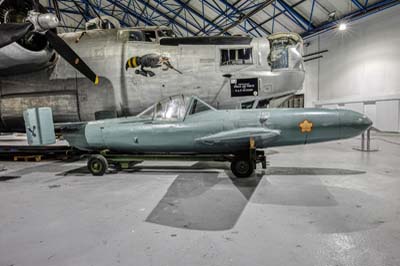
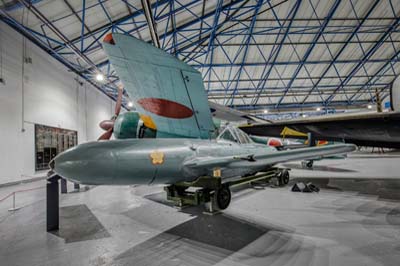
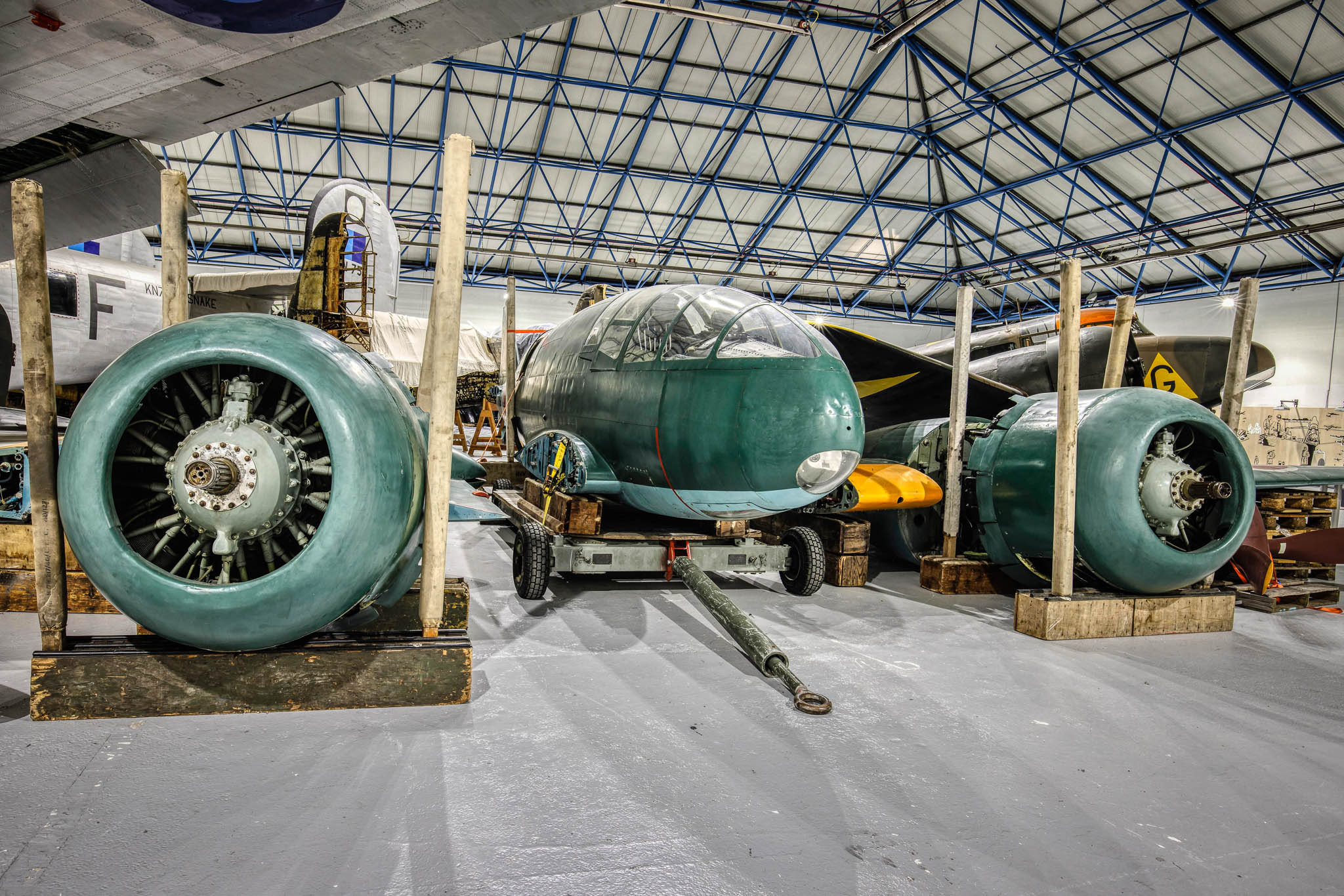
Yokosuka MXY-7 Ohka Model 11 (8486M also BAPC99). Operated by the Imperial Japanese Navy Air Service (IJNAS), 155 of these air launched rocket propelled suicide attack aircraft were designed and built at the Yokosuka Naval Air Technical Arsenal, another 600 were built at the Kasumigaura Naval Air Arsenal. They were carried to the target beneath the slow flying Mitsubishi G4M2e Model 24J 'Betty' bombers.
Four were captured in 1945 and evaluated at the Royal Aircraft Establishment - Rocket Propulsion Research at Westcot, Buckinghamshire. Transferred to Cosford in 1976 and later refurbished by the Historic Aircraft Collection at St Athan. It had moved here by October 2022 when it was waiting to be assembled.
Other examples can be found at the Museum of Science and Industry in Manchester and at the IWM Duxford under restoration in the UK, plus one at the Planes of Fame Museum and another Yanks Air Museum also at Chino. Another is at the Pima Air Museum. |
 |
Left to right:
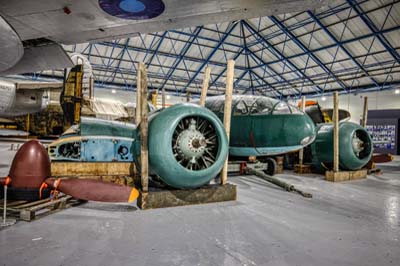
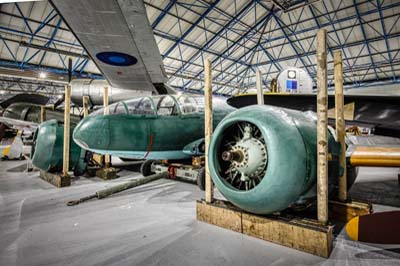
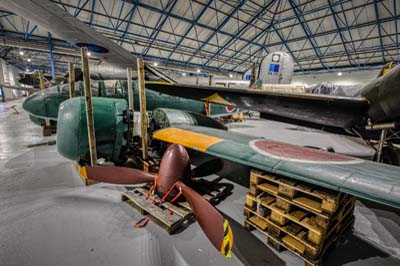
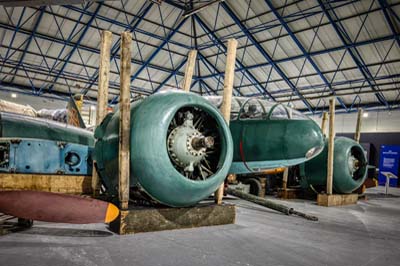
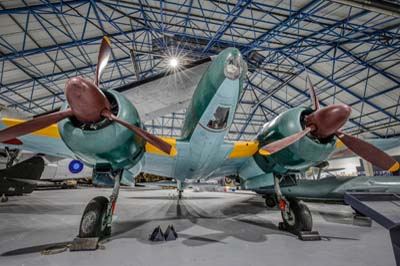
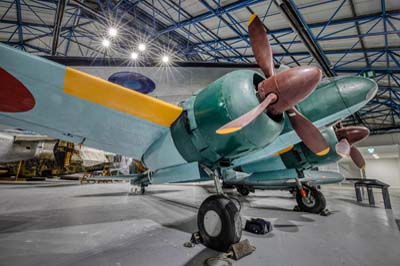
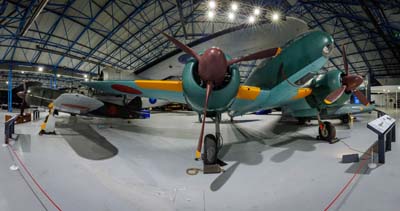
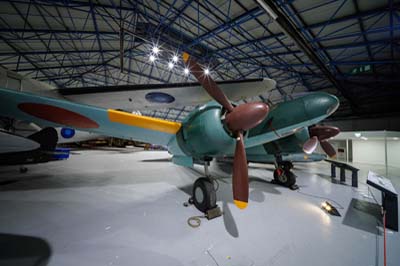
Mitsubishi Ki-46-III 'Dinah' ex Imperial Japanese Army Air Service (IJAAS). Designed as a fighter and for ground attack it later excelled as a high-altitude reconnaissance aircraft, its first flight was in 1939. This rare example was captured and passed to the Allied Technical Air Intelligence Unit in South East Asia at Tebrau along with a number of Japanese aircraft, four of which were selected for shipment to the UK. This aircraft was never to fly again, eventually leaving storage in 1989 to go to Cosford. Here it was extensively restored (1992-1994) with help from Mitsubishi of Japan and put on display.
It was moved here from RAFM Cosford in October 2022 and was still awaiting reassembly in February, which was completed in March 2023. |
Left to right:
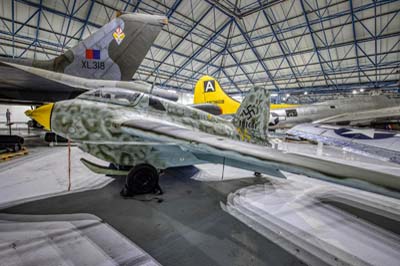
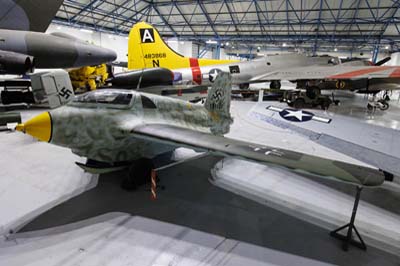
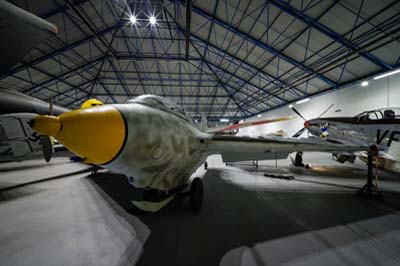
Messerschmitt Me 163B-1a Komet (191461 later became 'Yellow 14' after restoration). The only rocket propelled aircraft to enter service. Flying the very fast but volatile Me 163, Luftwaffe pilots of Jagdgeschwader (JG) 400 managed to shoot down nine allied aircraft from August 1944. This Me 163 was found at Husum airfield on May 8, 1945 and transported back to Farnborough. By July 1945 it was in store at Brize Norton eventually finding its way to Cosford in 1975. It had arrived from RAFM Cosford by April 2022. |
Left to right:
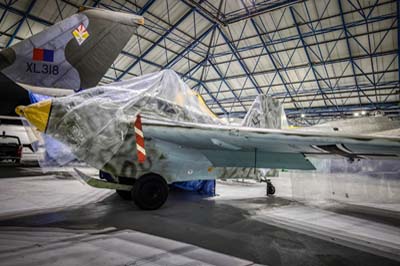
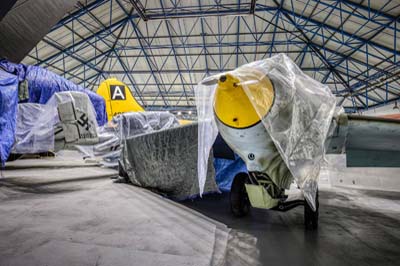
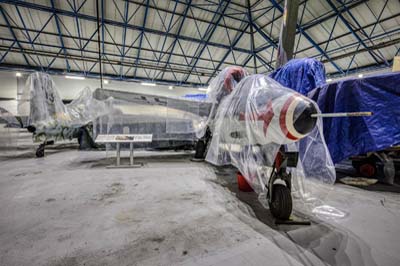
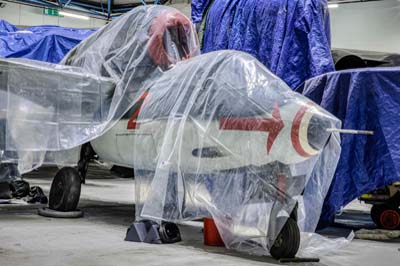
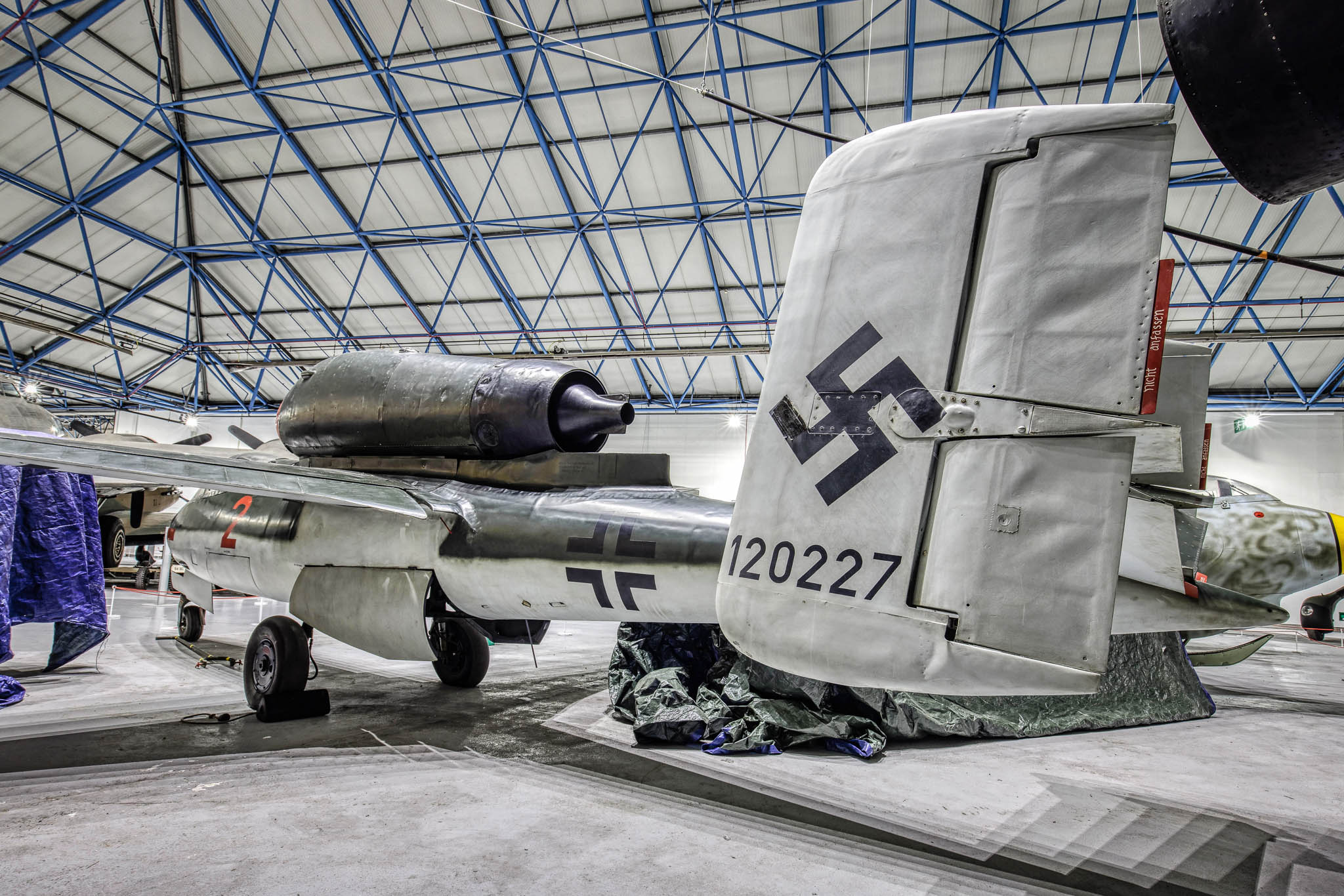
The Messerschmitt Me 163B-1a Komet and Heinkel He 162A-2 Volksjäger are covered up due to a long standing roof leak. |
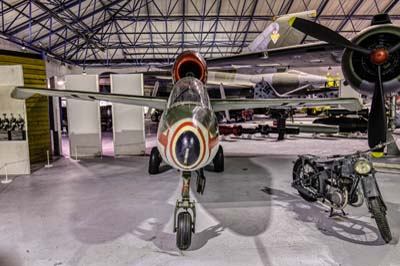
Heinkel He 162A-2 Volksjäger (120227 'Red 2' later Air Min 65, VN679 and 8472M). The German aircraft industry were pushed towards the end of the war to produce aircraft designs that could reverse an ever increasingly desperate situation. The He 162 jet fighter took just 69 days from initial design to its first flight. It was the first aircraft to be fitted with an ejection seat. Deliveries began in February 1945, with 200 only being delivered. Due to a shortage of supplies it was mostly built of wood.
This aircraft was captured at Leck in Northern Germany and brought back to Great Britain for evaluation. It flew 26 sorties before being put into storage. |
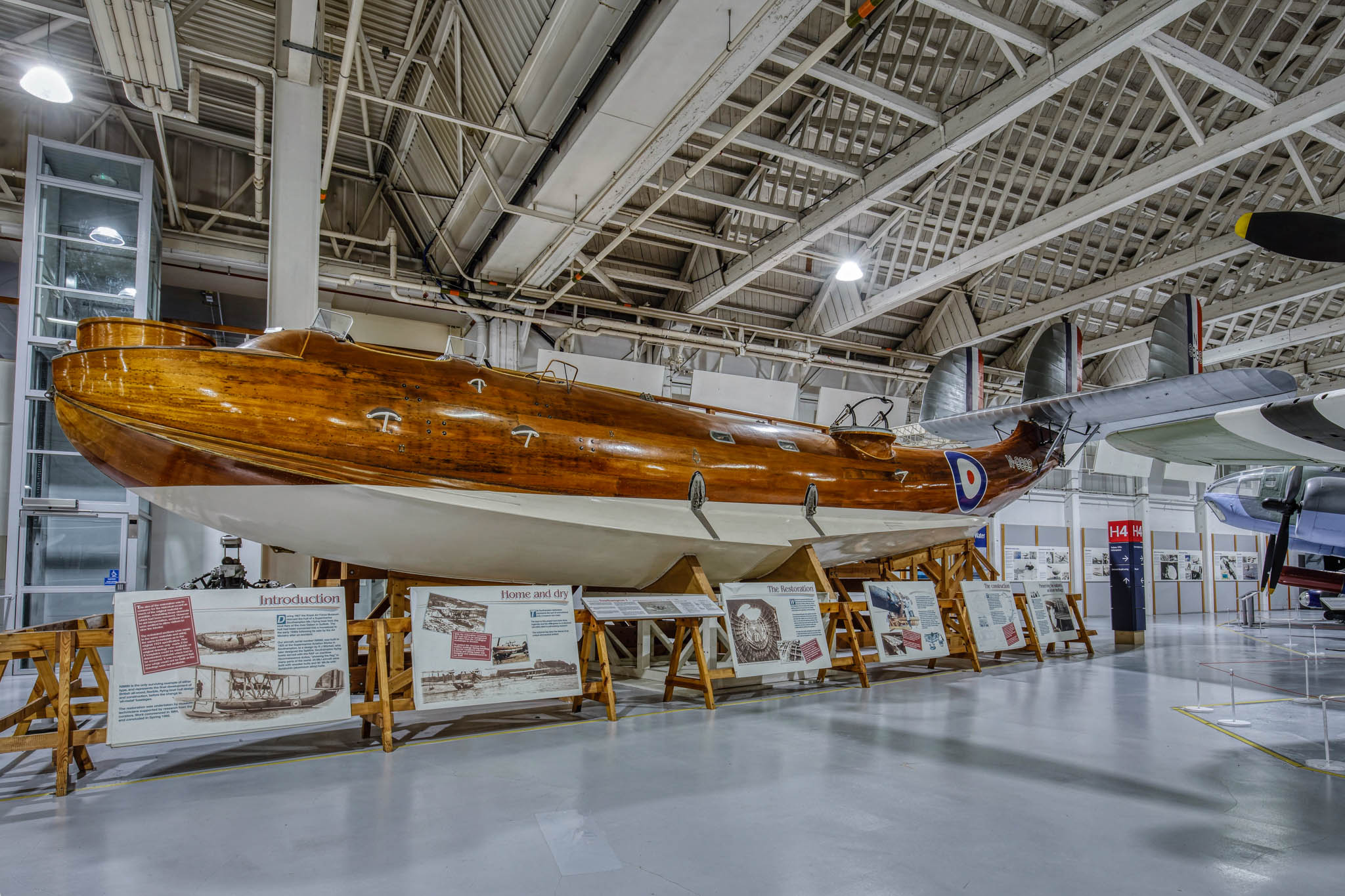
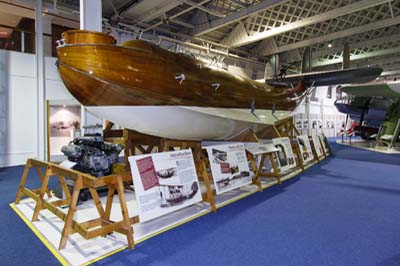
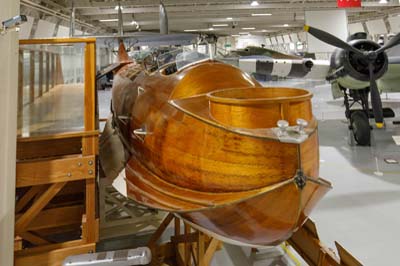
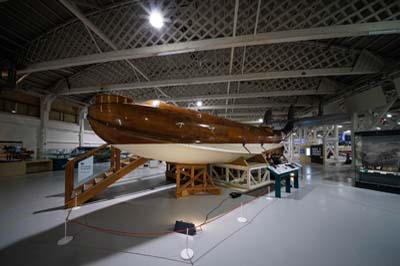
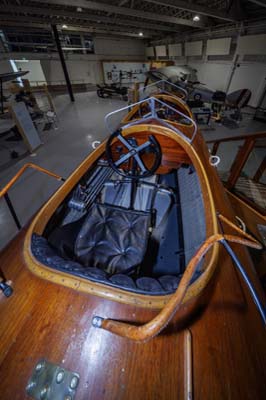
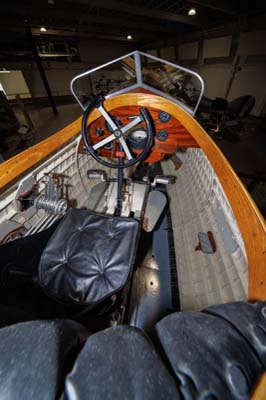
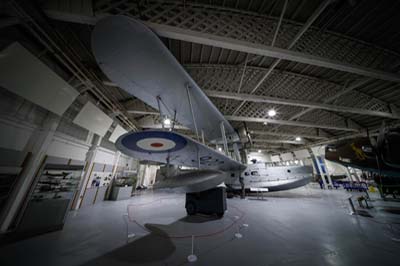
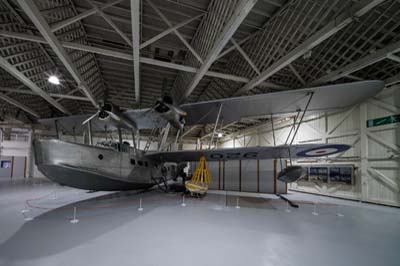
Supermarine Southampton I (N-9899). The Southampton flying boat was designed by RJ Mitchel for reconnaissance duties the 24 Mk.1s built were of wooden construction (cedar and mahogany) followed by 40 Mk.2s with hulls of aluminium alloy. Entering service in 1925 the reliable aircraft remained in service for eleven years, flying all over the world.
The Southampton Mk.1 flying boat N9899 was built in 1925 at the Supermarine Aviation works in Southampton. It entered service with 480 (Coastal Reconnaissance) unfortunately it was damaged beyond repair at Portland in a Gale and the hull was sold in 1929. In 1930 the hull was converted to a houseboat. Recovered in 1967 the hull only had been found on the mud flats of Debden river in Suffolk. The all wooden hull was the subject of extensive restoration starting in 1984 at Cardington and completed nearly eleven years later. The wings could not be rebuilt as the drawings no longer exist. |
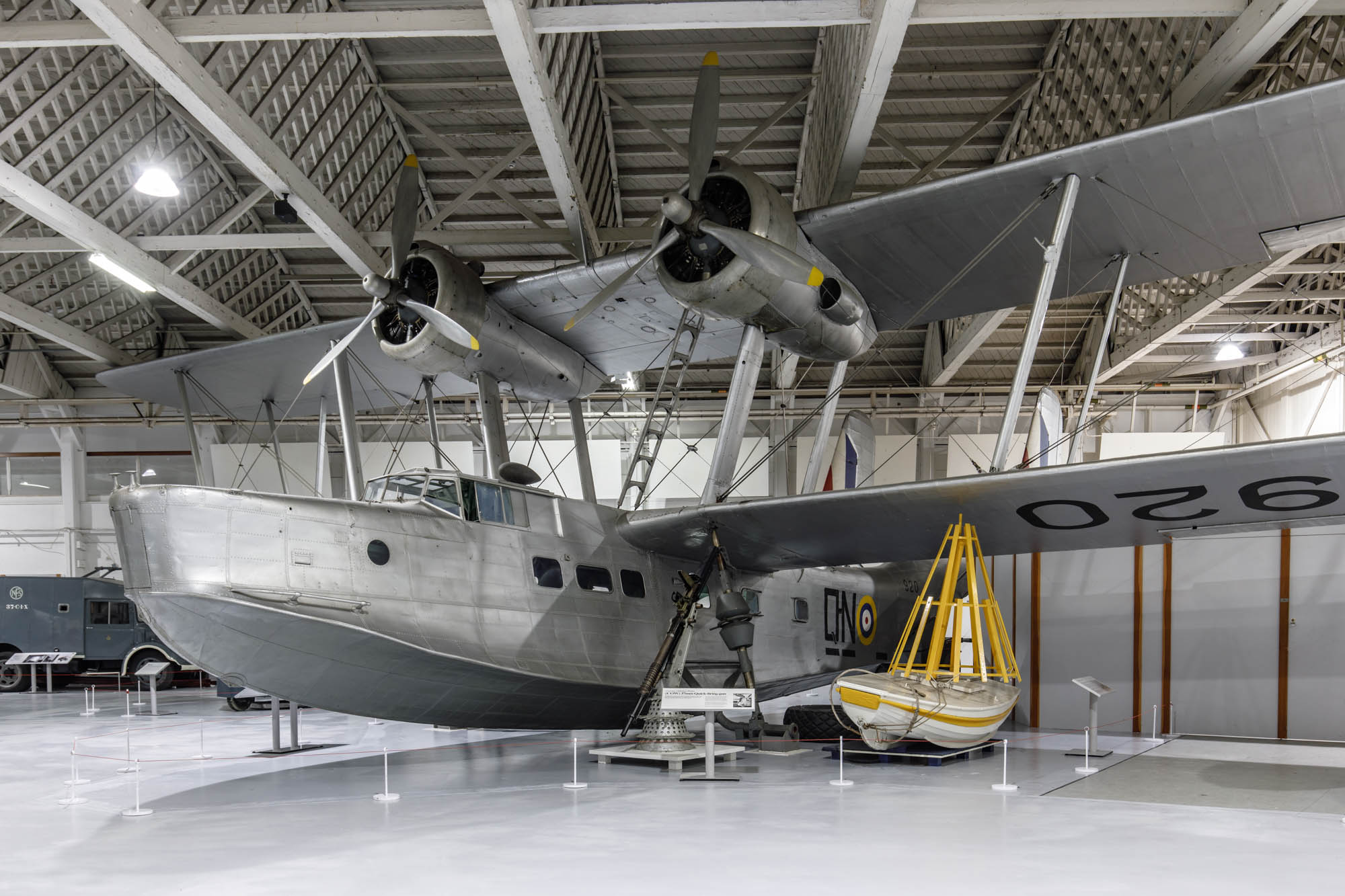 |
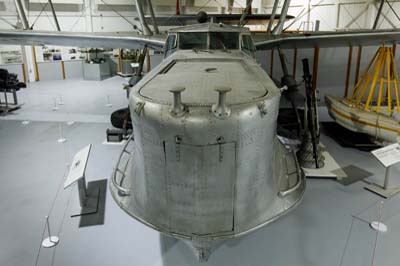
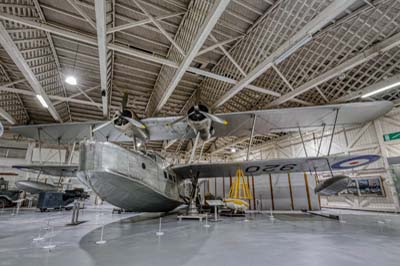
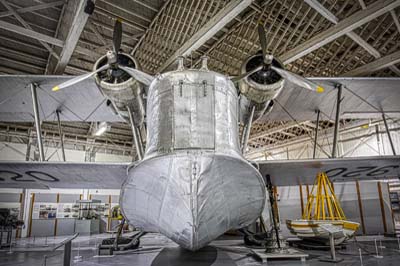
Supermarine 304 Stranraer (RCAF 920 'QN-' and CF-BXO). The Stranraer was developed from the Southampton flying boat (the hull of a Southampton is also at Hendon). It had a speed of 165 mph (266 km/h) and an endurance of over nine hours. The hull is constructed from anodised Alcad sheeting with wings and tail of duralumin and fabric covering. 17 aircraft were manufactured by Supermarine Aviation Works (Vickers Ltd) and delivered to 228 Squadron at Pembroke Dock in 1937. They served with the RAF until they were withdrawn in 1942. Vickers (Canada) built 40 Stranraers for the Royal Canadian Air Force. The RCAF used the flying boats to patrol their coastlines until they were withdrawn in 1945. Queen Charlotte Airlines of Vancouver continued to fly their aircraft until the 1950s.
The aircraft on display was delivered to 5 (Bomber Reconnaissance) Squadron at Dartford, Nova Scotia in 1940. In the following year it was transferred to 9 (Bomber Reconnaissance) Squadron who operated from Prince Rupert and later Bella Bella in British Columbia. It was withdrawn from service in 1944 and sold to Labrador Mining and Exploration Co., registering it as CF-BXO. As a civilian carrier it continued with several owners till it was purchased from Fortune Films in 1969 by the RAF Museum. It was collected in two RAF Belfast transport aircraft in 1970. Following extensive restoration work in was put on display at RAF Hendon, resplendent in its former RCAF, 5 (BR) Squadron markings. Unfortunately its code of 'QN-' could not be completed with the aircraft's individual letter, due to a lack of information. |
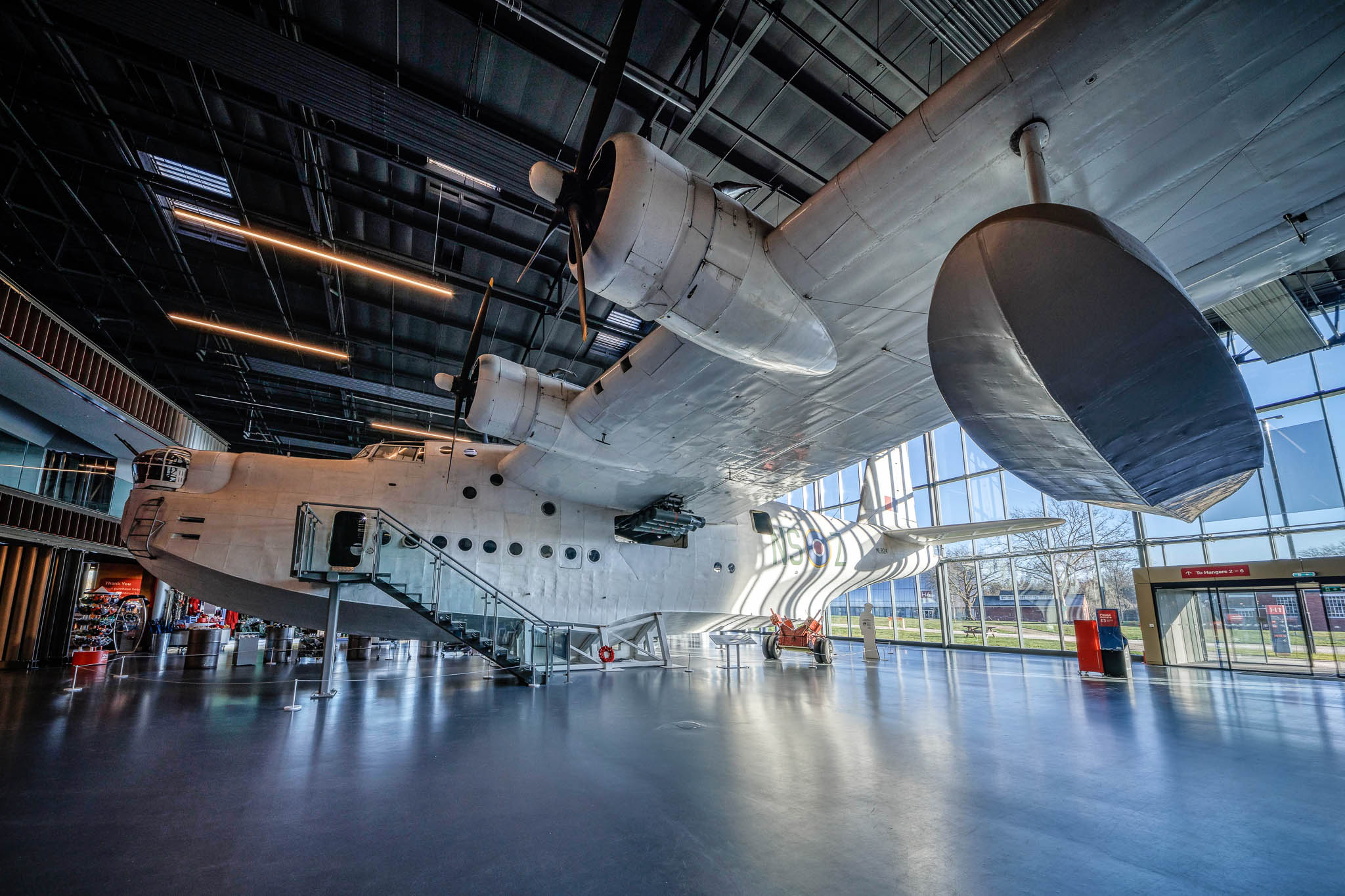 |
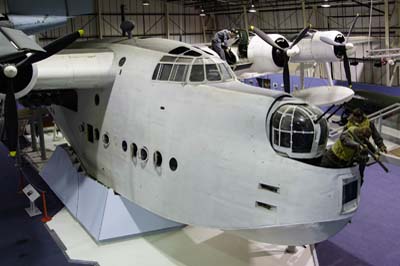
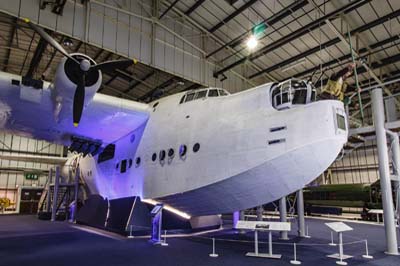
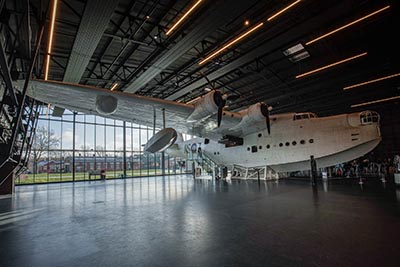
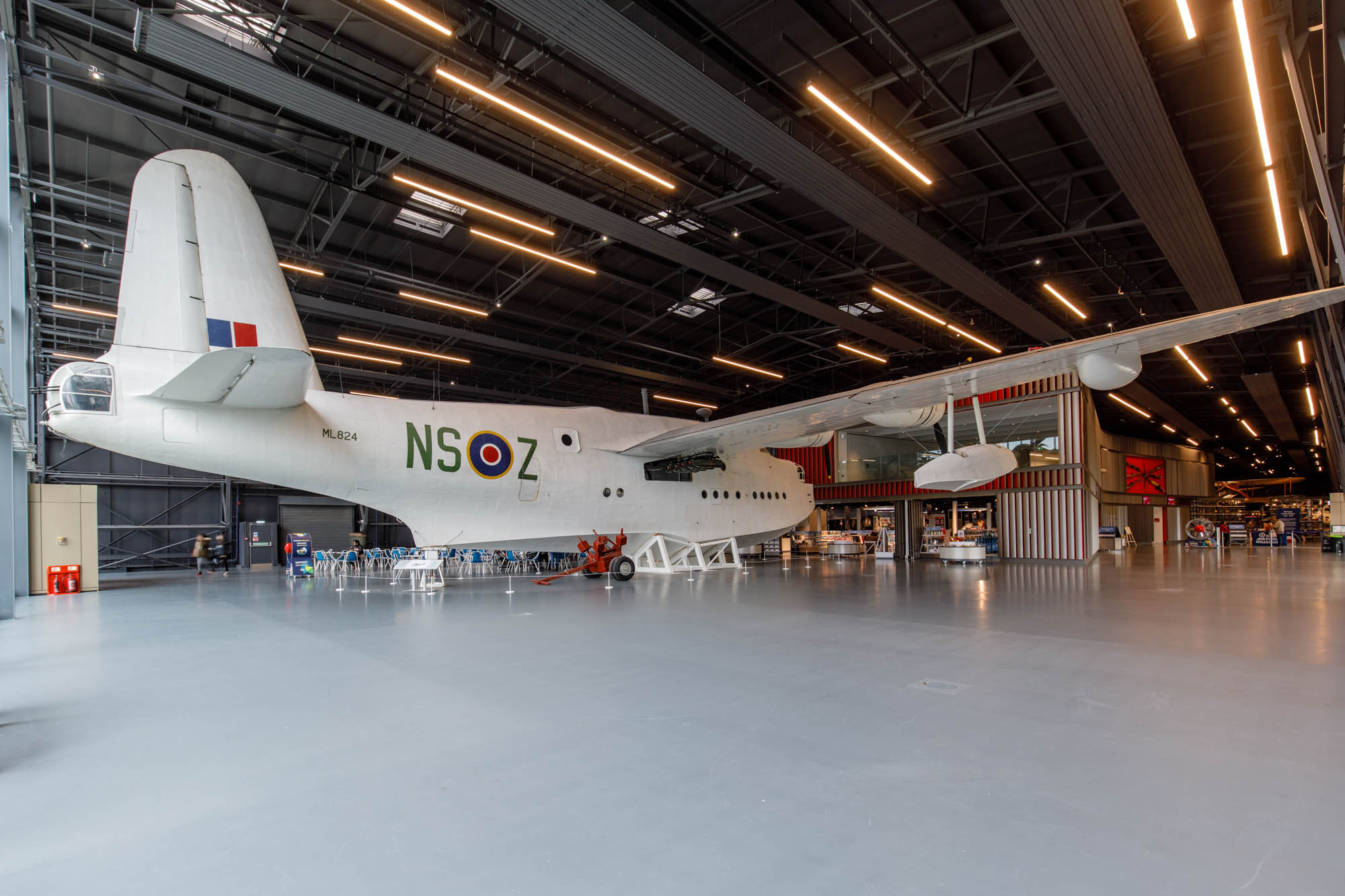
Short Sunderland V (ML824 'NS-Z'). The Sunderland entered service in 1938 and was based on the 'C' class Empire flying-boat operated by Imperial Airways. It was the first British flying-boat to have power-operated gun turrets for its defence and was also the last flying-boat to be operated by the Royal Air Force after 20 years of service. At the start of World War Two there were three squadrons operating the Sunderland. Eventually 749 were built serving with Coastal Command till 1945 and continued to its retirement in 1959, after operating from the United Kingdom, Africa and the Far East.
The Sunderland on display was launched as a Mk.III in 1944 from Short's factory at Belfast and was immediately converted to a Mk.V. It served with 201 Squadron at Castle Archdale and 330 (Norwegian) Squadron at Sullom Voe. After a period with 57 MU at the end of the war it was transferred to the French Aeronavale with 13 others in 1951. It was donated to the Short Sunderland Trust at Pembroke Dock in 1961. In 1968 it passed to the RAF Museum and was stored in the Graham White Hangar from 1971. In 1976 is was painted in its original 201 Squadron markings at St Athan before moving to Hendon in 1978. |
 |

|
 |