Flieger Flab Museum
(Air Force Center)
Dübendorf, Switzerland
May 2026
|
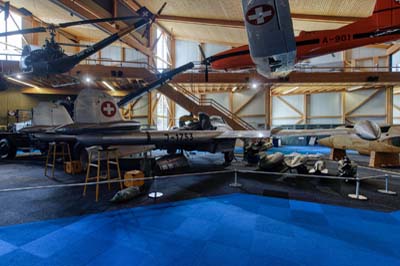
| A very good museum for photography, with elevated walkways. Hall 1 contains older pre-jet age aircraft, while Hall 2 focuses mostly on jets and helicopters. Confusingly, the other hall is Hall 8, split by a curtain but with a door into each section, the second of which I struggled to find. As usual, the very nice replica aircraft are not included on the webpage. |
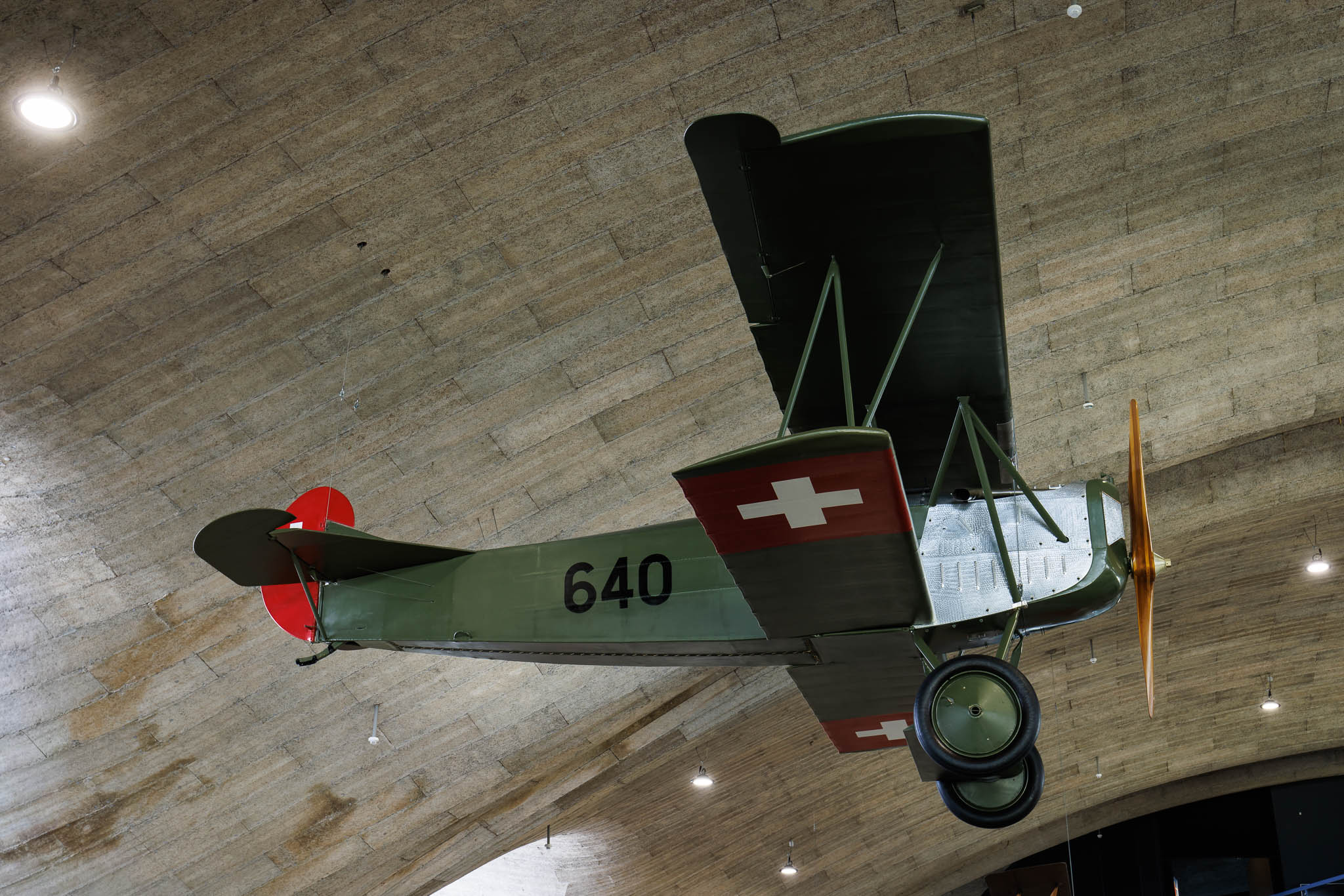 |
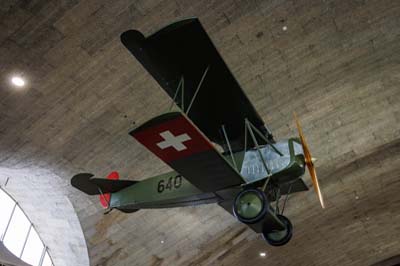
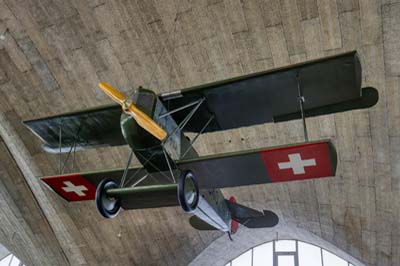
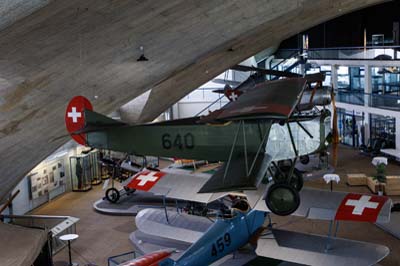
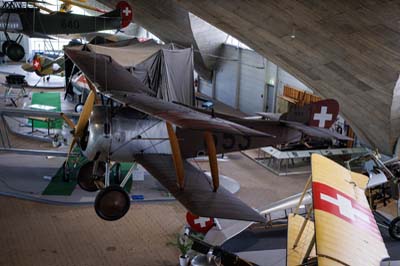
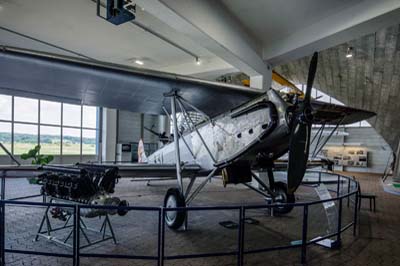
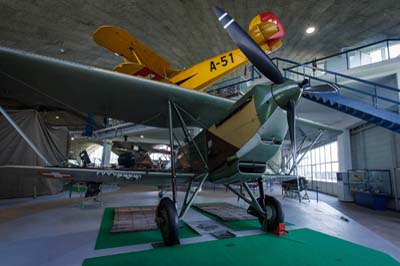
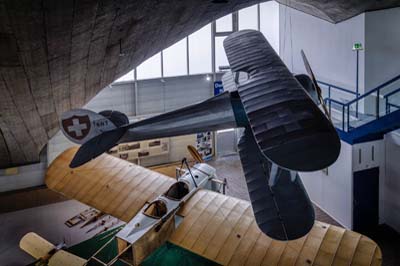
Left to right: Fokker D.VII (640) ex Swiss Air Force. The Fokker D.VII was a German fighter aircraft designed by Reinhold Platz and introduced during World War One. Around 3,300 were built in 1918, with the type quickly earning a formidable reputation in combat. By the war's end in November 1918, 775 aircraft were in service across 46 German fighter squadrons.
The D.VII proved so effective that the Armistice specifically required Germany to surrender all surviving examples to the Allies. Captured aircraft were widely evaluated and operated after the war, including by the United States, France, Great Britain, Canada, the Netherlands, Belgium and Switzerland.
In Switzerland, the D.VII remained popular enough for new aircraft to be built under licence by Alfred Comte as late as 1929. Swiss operated examples carried registrations 625 to 639. The aircraft displayed today combines an original engine and fuselage, the latter originating from an unbuilt Swiss licence-built D.VII produced by Alfred Comte in Oberrieden. |
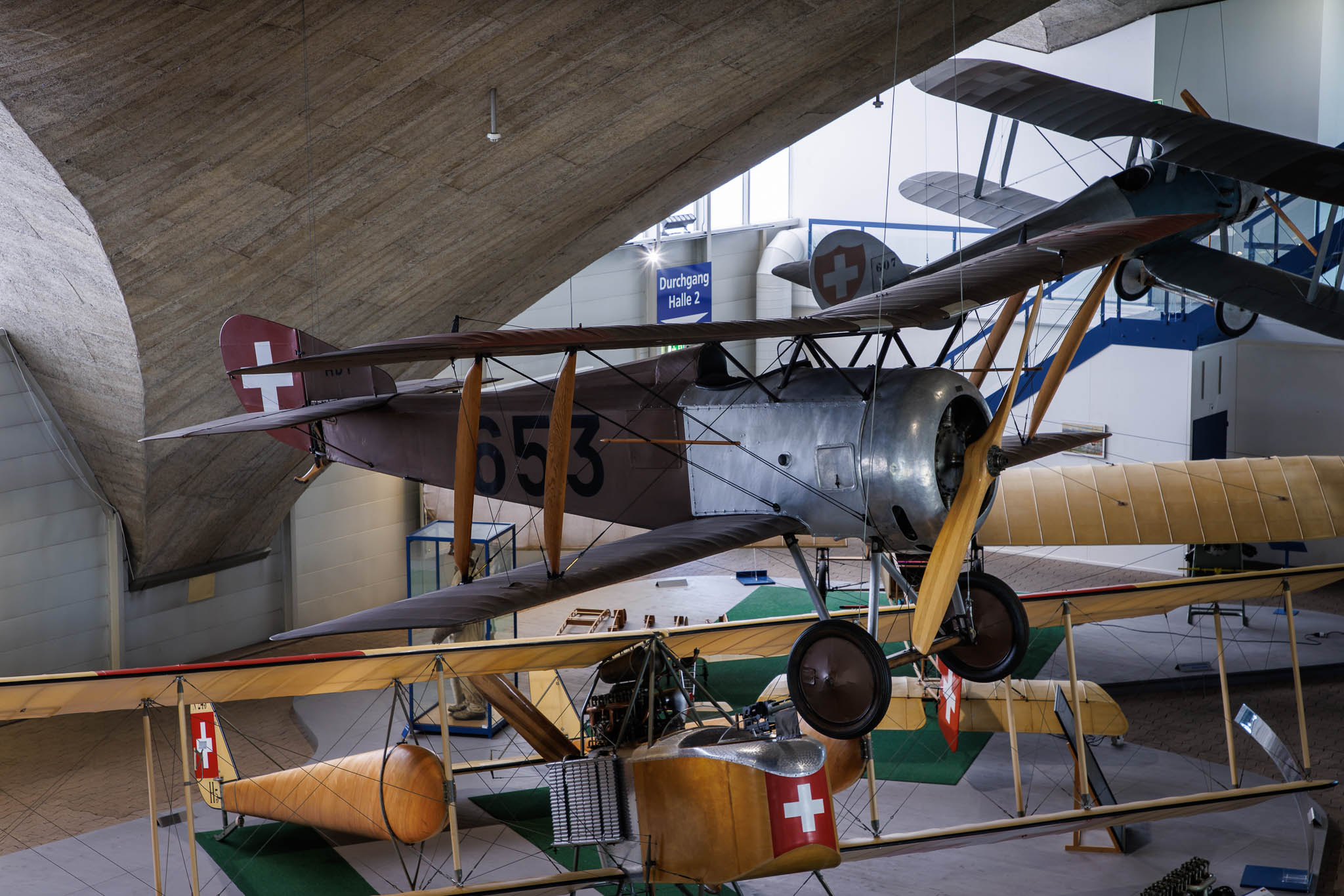 |
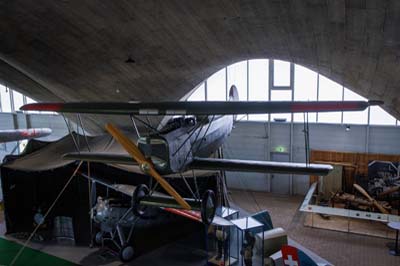
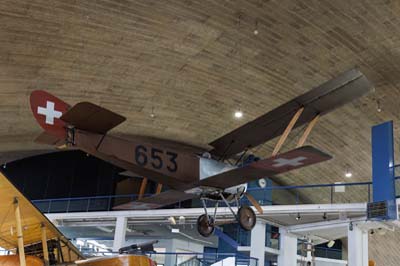
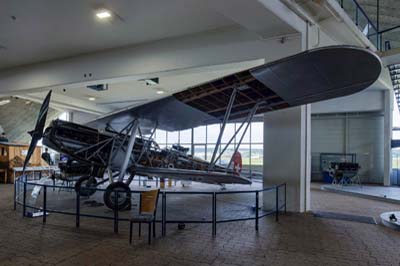
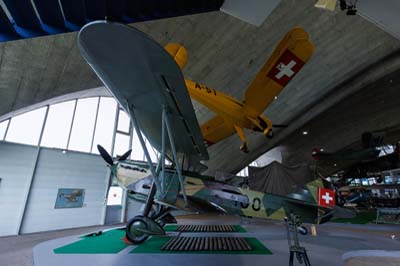
| Left to right: Hanriot HD.1 (653) ex Swiss Air Force. The Hanriot-Dupont HD.1 was designed by Pierre Dupont and built at the Hanriot factory in Billancourt, France, from 1916. Although rejected for service with French squadrons in favour of the SPAD S.VII in World War One, 16 Hanriot HD.1 aircraft later served as trainers with the Swiss Fliegertruppe between 1921 and 1930. |
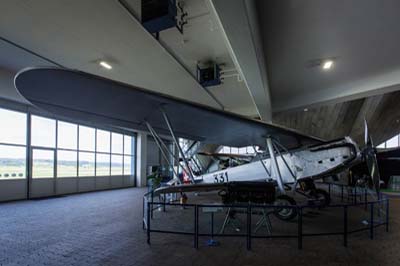
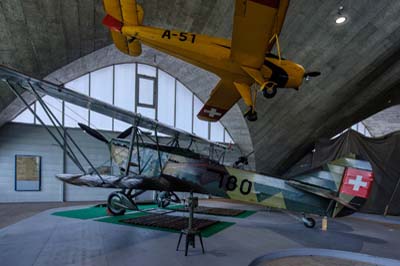
Left to right: Fokker C.V-E (C-331). The Fokker C.V was a Dutch light reconnaissance and bomber biplane designed by Anthony Fokker and manufactured by Fokker in Amsterdam. Series production began in 1924, with the aircraft intended as a versatile two seat reconnaissance and bomber platform.
When introduced to the public in 1924, the C.V was offered in a range of configurations, allowing customers to choose from five different wing and engine combinations. The landing gear could also be adapted, with wheels interchangeable for pontoons. The aircraft proved a major export success and was sold or licence built in Bolivia, China, Denmark, Finland, Hungary, Italy, Japan, the Netherlands, Norway, Switzerland, the Soviet Union and the United States.
In Switzerland, following comparative trials in 1927, the authorities ordered 48 licence built C.V-E aircraft for service with the Swiss Air Force, then known as the Swiss Army Air Corps. Of these, 24 were produced by K+W at Thun and 24 by Doflug at Altenrhein. Entering service from 1933, the aircraft were armed with bombs, two pilot mounted machine guns and a twin machine gun installation for the observer. Following retirement from front line duties in 1940, Swiss Air Force C.Vs continued in service as target tugs until 1954. |
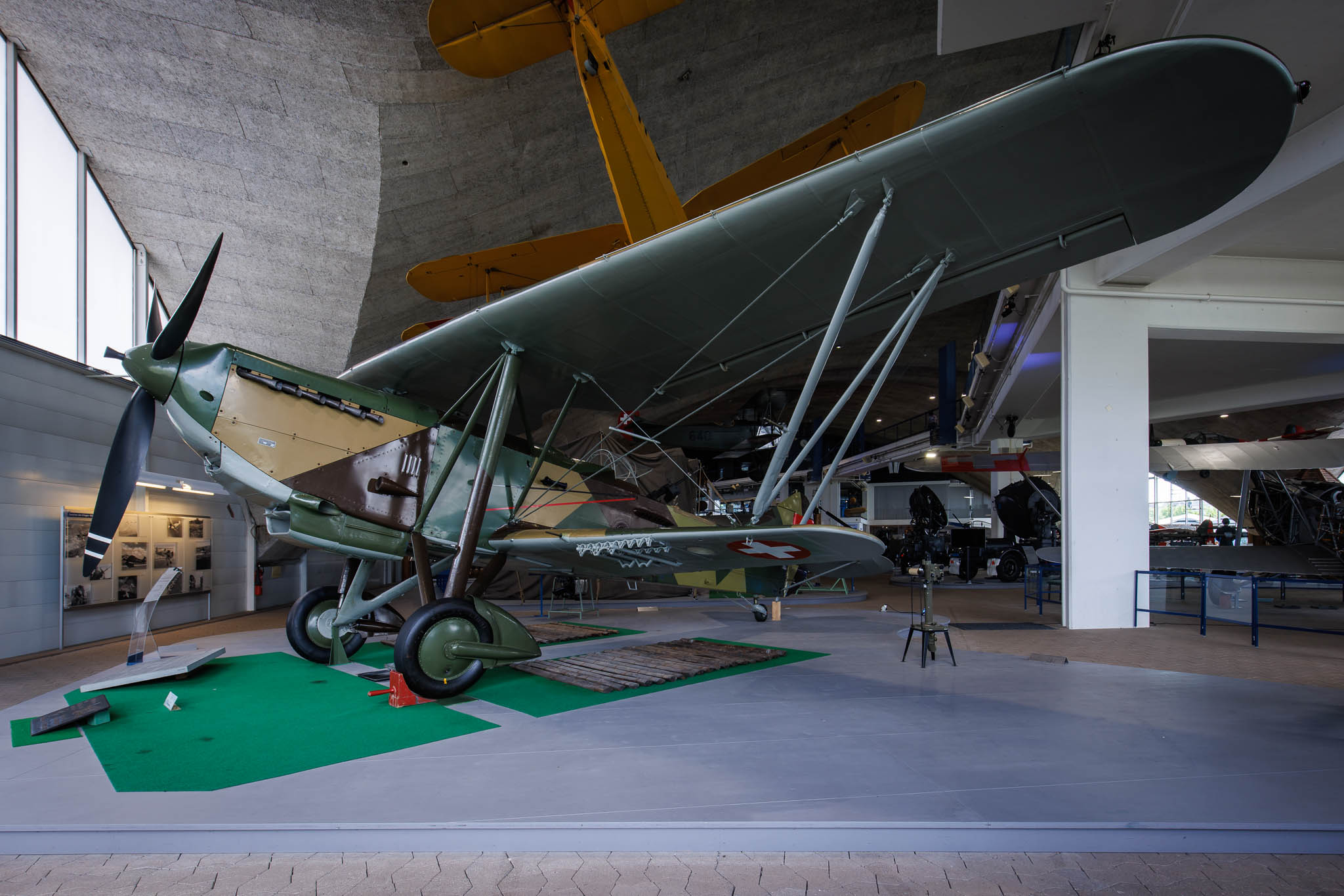 |
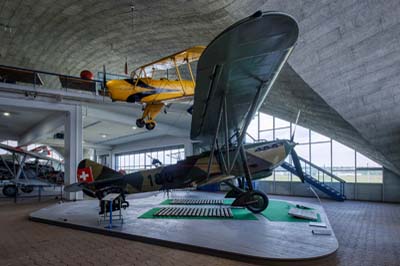
Left to right: EKW C-35 (C-180) ex Swiss Air Force. The C-35 was a two seat reconnaissance biplane of the 1930s, built by the Swiss Federal Construction Works (Eidgenoessische Konstruktionswerkstaette, K+W) at Thun. It was developed by the Eidgenössische Konstruktions Werkstätte as one of two designs intended to replace the Fokker C.VE in Swiss Air Force service, the other being the EKW C-36 monoplane.
Following evaluation, the Swiss Air Force ordered 40 C-35 aircraft in 1936. The first was delivered in May 1937, with all aircraft entering service by the end of 1938. To supplement the operational fleet, a further eight aircraft were assembled from spare parts between 1941 and 1942. The C-35 was withdrawn from front line duties in 1943 after being replaced by the F&W C-3603 and transferred to night flying units. It remained in service until final retirement in 1954.
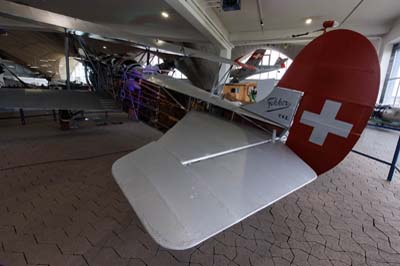
C-331 on display is distinctively modified with a cutaway section to showcase the internal wood-and-fabric structure, as well as the observer's station. |
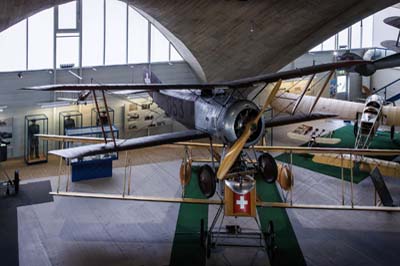
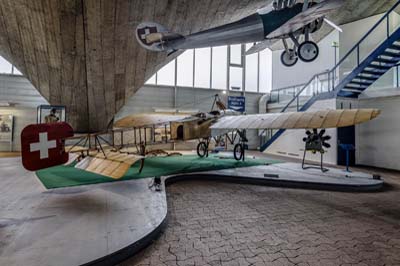
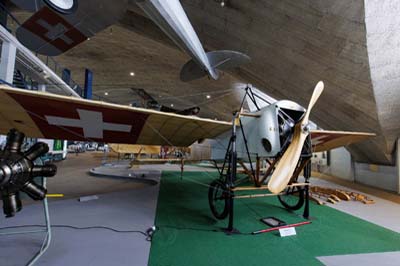
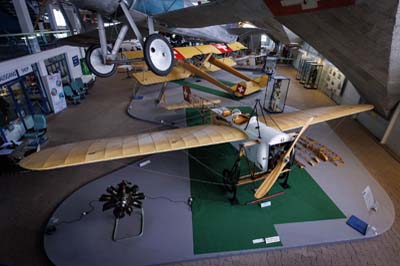
Left to right: Blériot XIb. Built in France in 1914, this two seat Blériot XIb was powered by a 100 hp Gnome rotary engine and became the first powered aircraft acquired by the Swiss Air Force. Purchased second hand before World War One, it marked the beginning of Swiss military aviation.
A tandem seat development of the famous Blériot XI monoplane, the aircraft was used for pilot training and border patrol duties between 1914 and 1917. It was normally unarmed, although the observer could carry a side mounted Type 11 carbine rifle. The aircraft was withdrawn from service in late 1917 after fatigue was discovered in its wooden airframe. |
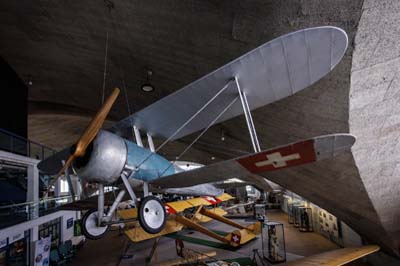
Left to right: Nieuport 28C.1 (607 previously N.6212) ex Swiss Air Force. The French built Nieuport 28C-1 was the first aircraft to see service with an American fighter squadron.
This aircraft was flown by American pilot Second Lieutenant James Ashinden of the 147th Aero Squadron, a Nieuport 28 carrying serial number N.6212. On June 25, 1918, Ashinden crash landed near Derendingen, Switzerland, 20 miles north of Bern and 130 miles south west of the squadron's base at Toul in France. Ashinden escaped unhurt and the aircraft suffered only minor damage.
The Swiss rebuilt the aircraft, redesignated it Nr. 607, and placed it into service as a Swiss Air Force trainer from 1918. It remained in use until 1925 before being retired and stored at Thun, Switzerland.
14 additional aircraft were acquired and used as a trainer by the Swiss Army Air Corps from 1923 to 1930.
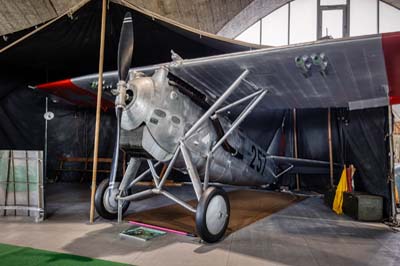
Dewoitine D.27 III (J-257) ex Swiss Air Force. The Dewoitine D.27 was a single seat light fighter developed between World War One and World War Two. Designed by Émile Dewoitine in response to a French Air Force requirement for fighter aircraft, it retained many structural features of earlier Dewoitine designs while introducing aerodynamic refinements. Power came from a Hispano-Suiza HS-12Mb engine.
Development faced disruption when Émile Dewoitine's company collapsed in February 1927. Work on the aircraft transferred to the Swiss Federal Construction Workshop (K+W) in Thun, where the first prototype made its maiden flight on June 3, 1928. Following Dewoitine's return to the aviation industry with Société Aéronautique Française-Avions Dewoitine in March 1928, the programme continued.
At the end of 1929, the Swiss Air Force selected the D.27 to equip its fighter squadrons. Five pre-production aircraft, designated D-27 III, were delivered to K+W ahead of production, which began in 1931. They were followed by 15 further pre-production aircraft and 45 production examples, bringing total deliveries to 66 aircraft.
The D.27 served with Swiss fighter squadrons until 1940 before being reassigned to training duties, remaining in use until final withdrawal from service in 1944. |
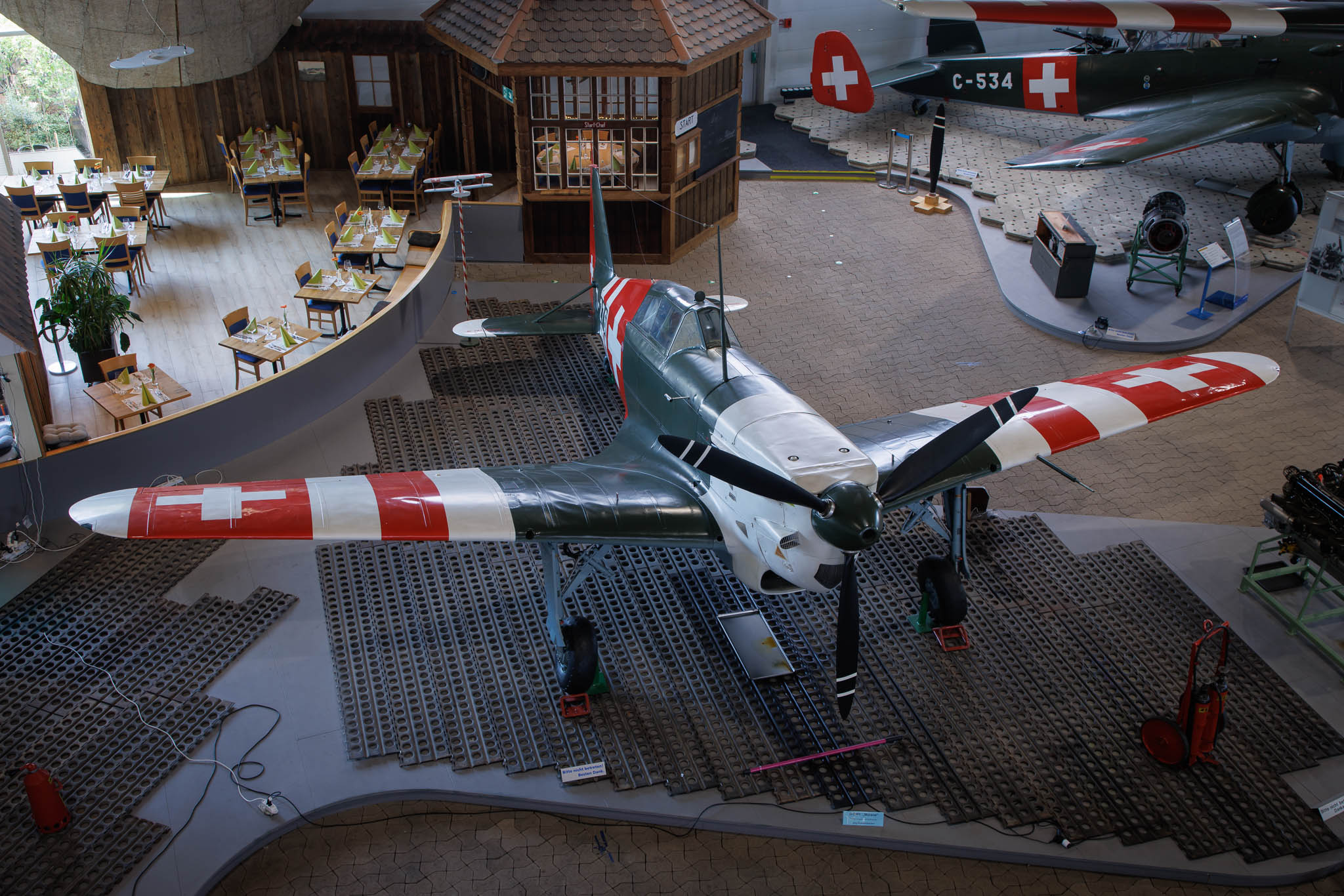 |
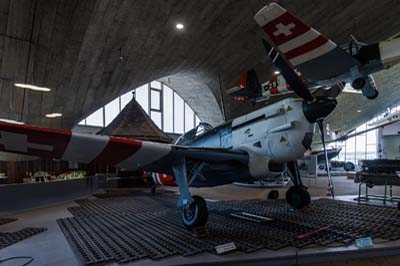
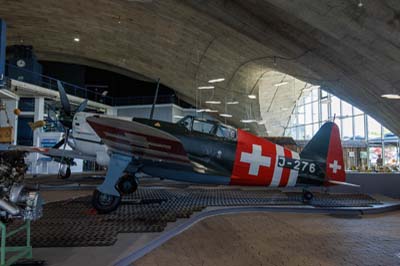
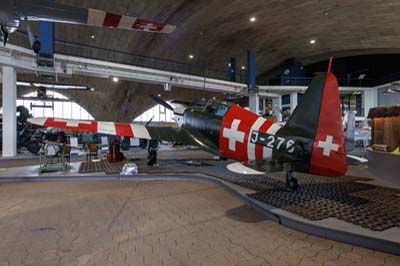
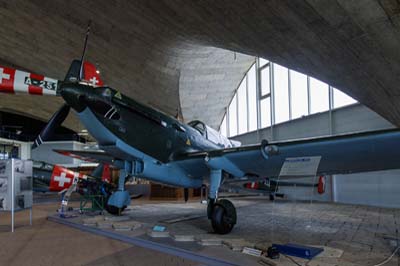
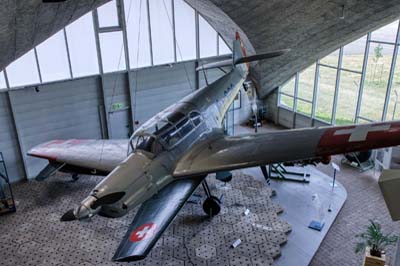
Left to right: Morane Saulnier MS.406/D-3801 (J-276) ex Swiss Air Force. The Morane-Saulnier MS.406 was a French fighter introduced in 1938 and the company's first low wing monoplane with an enclosed cockpit and retractable undercarriage. Entering French Air Force service in early 1939, it became France's most widely used fighter during World War Two and marked the country's first modern frontline fighter.
Switzerland became the first major export customer, securing a production licence in September 1938. Two M.S.406H aircraft were delivered as pattern examples, leading to Swiss production of the D-3800. Pre-production began with eight EKW built aircraft featuring Swiss engines, updated instruments and improved locally designed machine guns. A further 74 entered service by August 29, 1940, with two more assembled in 1942. Surviving aircraft were upgraded in 1944 to near D-3801 standard and later served as trainers.
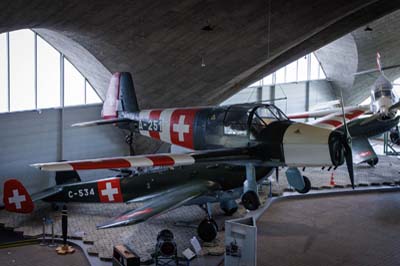
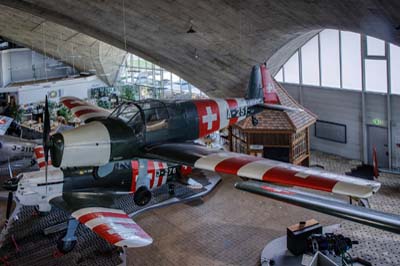
J-276 was delivered in 1945, it served in front-line and training duties until 1959. Following orders to protect Swiss neutrality, this aircraft was painted with highly visible red-and-white stripes on the wings and fuselage to prevent friendly-fire shootdowns by both Allied and Axis pilots. In 1972, J-276 was transferred to the Swiss Museum of Transport in Lucerne. In 1988, it was moved to the Flieger Flab Museum. |
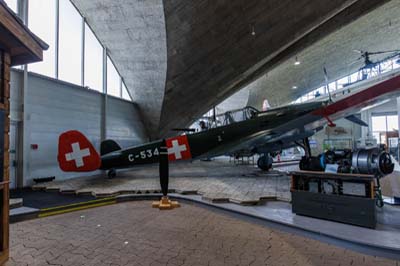
| Left to right: EKW (Eidgenösschische Konstruktionswerkstätten) C-3603-1 (C-534). The EKW C-36 was a multi-purpose fighter-bomber designed in 1939 by the Swiss Federal Constructions Works (EKW). In later life they were used extensively for target towing duties by the Swiss Air Force. |
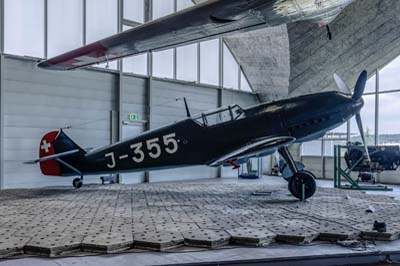
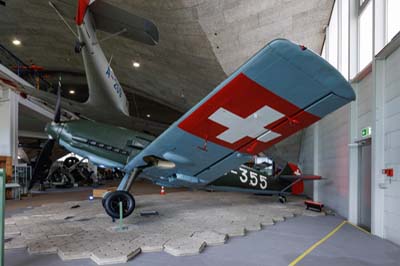
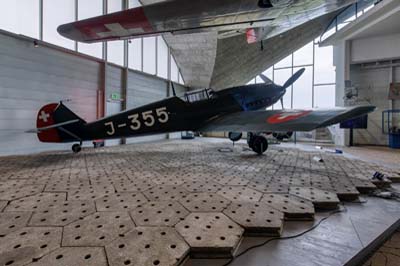
Left to right: Messerschmitt Bf 109E-3a (Nr.2242, J-355). The Bf 109 was designed and initially produced by the German aircraft manufacturer Bayerische Flugzeugwerke (BFW). Together with the Focke-Wulf Fw 190, it formed the backbone of the Luftwaffe's fighter force during World War Two. A total of 33,984 Bf 109s were built.
The Swiss Air Force operated several variants, including 10 D-1s, 89 E-3a aircraft, two F-4s and 14 G-6s. J-355 was built in Regensburg, Germany, accepted into Luftwaffe service in 1939 and later sold to the Swiss Air Force. After active service during World War Two, it was retired in 1949 and placed on display at the Swiss Museum of Transport (Verkehrshaus der Schweiz) in Lucerne between 1959 and 1979, before being transferred to Dübendorf.
Messerschmitt Bf 108B-2 Taifun (A-209) ex Swiss Air Force. A German liaison aircraft, Switzerland purchased a fleet of 16 Bf 108 aircraft, including A-209, in 1938 and 1939. These aircraft primarily served as advanced trainers for aspiring Bf 109 pilots while also carrying out a variety of liaison duties. They remained in active service with the Swiss Air Force from 1939 to 1959.
After being decommissioned in the early 1950s and finally withdrawn from service, A-209 was transferred to the museum in 1981. |
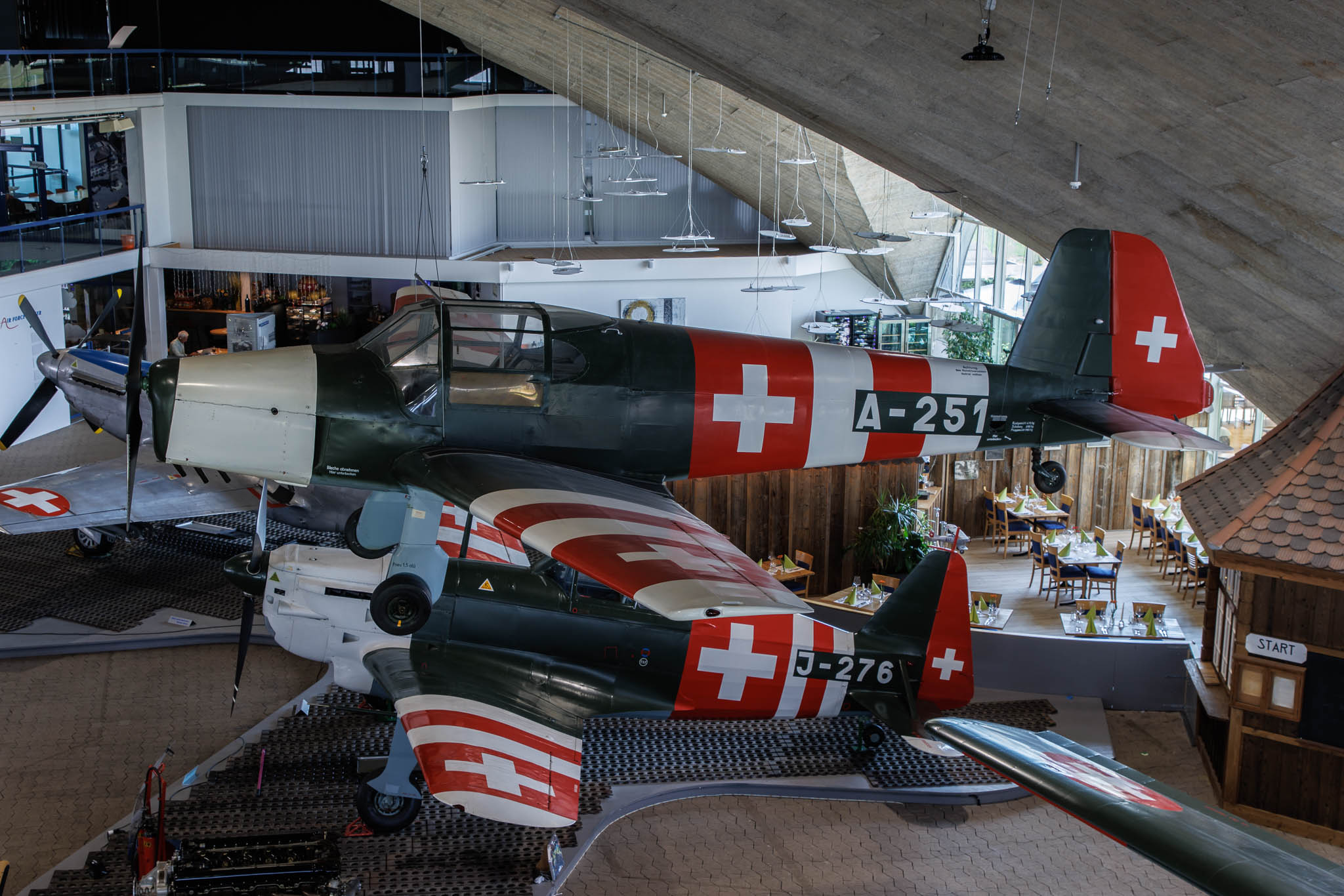 |
Left to right: Bücker Bestmann Bü 181B-1 (25027 registered D-EDOC displayed as 'A-251') ex Swedish Air Force. The Bücker Bü 181 Bestmann was the most widely produced aircraft built by Bücker Flugzeugbau and introduced a new approach to pilot training. Unlike earlier trainers with open tandem cockpits and limited communication, the Bestmann featured an enclosed cockpit with side by side seating, allowing instructors and students to communicate more effectively. Developed by Carl Clemens Bücker and Swedish designer Anders Anderson, it became a successful sport and training aircraft during World War Two.
In June 1942, a Bü 181 was imported into Switzerland for evaluation but failed to impress, with the Swiss preferring the older Bü 131 Jungmann and Bü 133 Jungmeister. Towards the end of World War Two, however, seven former Luftwaffe aircraft that had entered Switzerland were confiscated and taken into service.
Sweden proved more enthusiastic. After successful testing in 1942, the Swedish Air Force acquired production rights and built 120 aircraft as the Sk 25 between March 1944 and 1946. The type remained in service until 1954 before passing to flying clubs and private owners. |
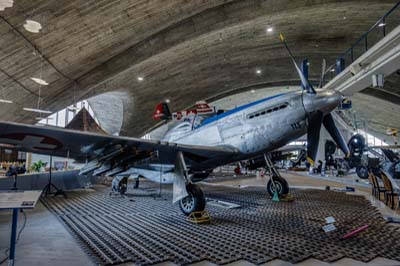
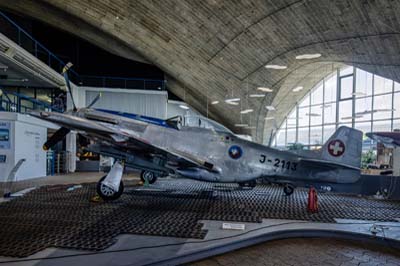
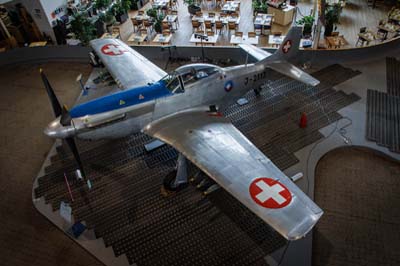
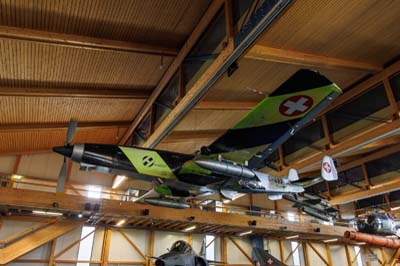
Left to right: North American P-51D Mustang (J-2113 previously 44-73349). The Mustang was an American long range, single seat fighter and fighter-bomber widely used during World War Two. After the war, surplus P-51s entered service with several countries, including Canada, Sweden, Switzerland, China, New Zealand and Australia.
J-2113 is the only surviving complete Swiss Air Force P-51D from the 130 Mustangs operated by Switzerland between 1948 and 1958. The Mustang became the Swiss Air Force's last frontline piston engine fighter and today J-2113 is preserved in the historic bare metal colours of Fliegerstaffel 21. |
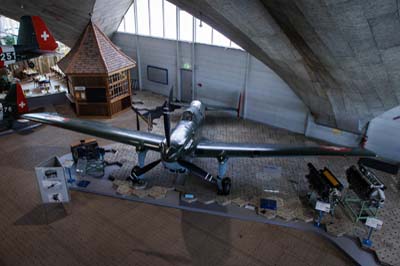
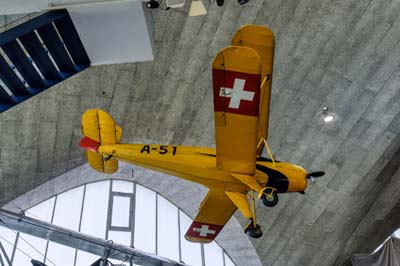
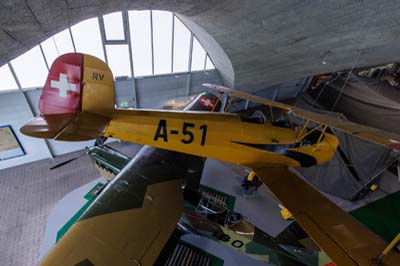
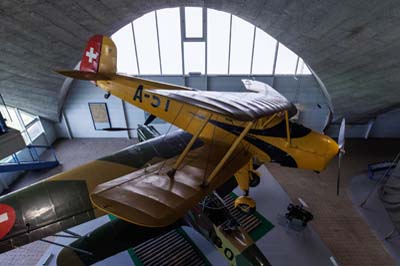
| Left to right: Bücker Bü 131B Jungmann (A-51) ex Swiss Air Force. The Jungmann is a basic biplane trainer designed and produced by the German manufacturer Bücker Flugzeugbau. It was the company's first aircraft and the last biplane produced in Germany. Designed for aerobatic manoeuvres and pilot training, the Jungmann made its maiden flight on April 27, 1934. In 1936, production shifted to the improved Bü 131B, equipped with a more powerful Hirth 504A-2 engine. This model became the primary basic trainer for the German Luftwaffe. Several companies were licensed to produce the Bü 131, including Dornier, which built 88 of the 94 aircraft ultimately operated by Switzerland. |
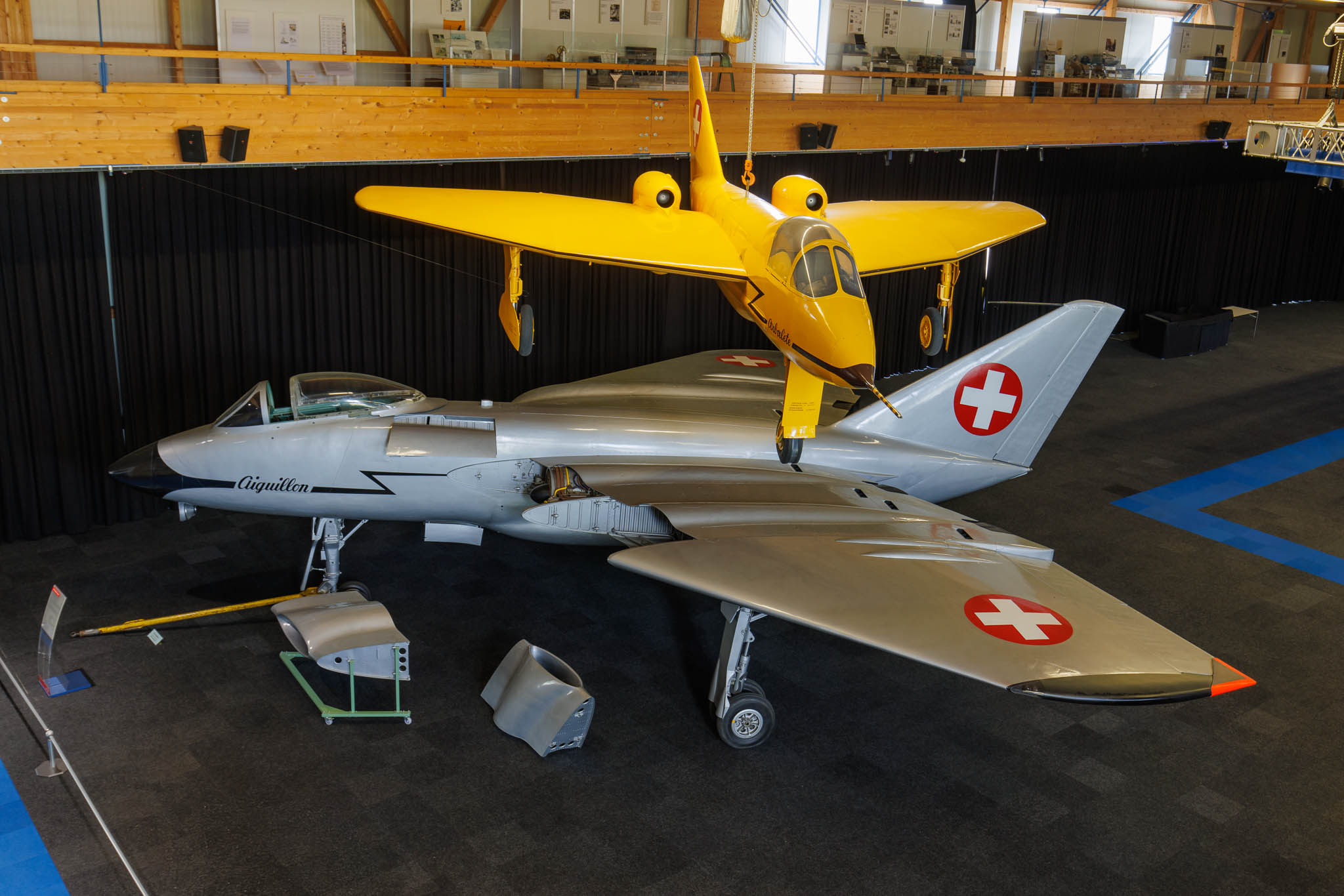 |
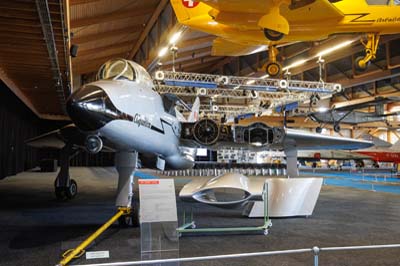
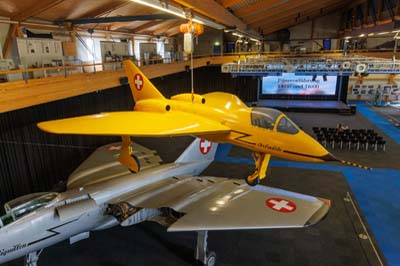
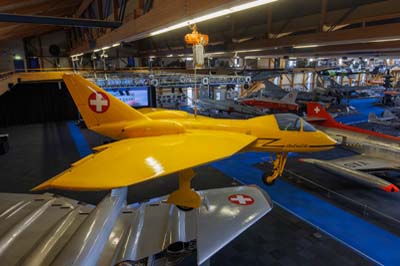
Left to right: Eidgenössische Flugzeugwerke (EFW) N-20.10 Aiguillon (N20-01). Designed by the Swiss Federal Aircraft Factory (EFW/F+W), the N-20 program was Switzerland's ambitious attempt to build its own supersonic-capable fighter jet in the late 1940s and early 1950s.
The prototype was completed in 1952 and, fitted with four SM-1 engines, flew briefly during a taxi test on 8 April 1952 but development of the engine and the N-20 aircraft was cancelled due to engine development issues, though the research was later applied to the FFA P-16 and Learjet. |
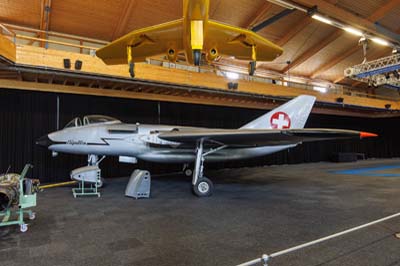
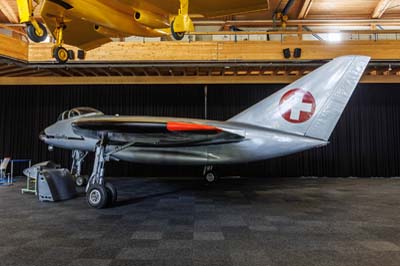
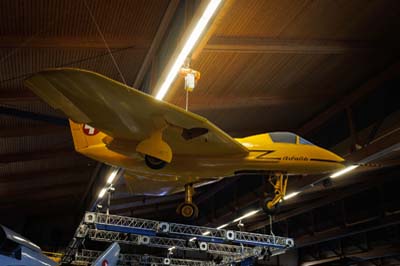
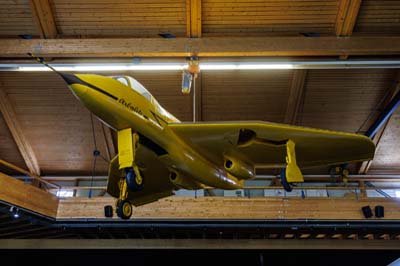
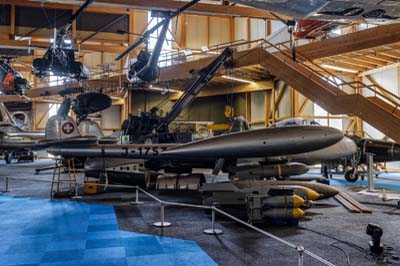
| Left to right: Eidgenössische Flugzeugwerke (EFW) Emmen N-20 Arbalète (N20-001). This is a scale test aircraft. The EFW N-20 Aiguillon was Switzerland's first indigenous jet fighter project, developed by the Swiss Federal Aircraft Factory in the years following the second World War. Designed as a four engine, swept wing fighter, the programme included an unpowered sub scale glider, the N-20.01, and a powered test aircraft, the N-20.02 Arbalète. After the glider successfully validated the design, the similarly sized N-20.02 Arbalète was developed and powered by four Turboméca Piméné turbojets, mounted above and below the wings. First flown on November 16, 1951, the aircraft demonstrated good manoeuvrability and achieved a top speed of 466 mph. |
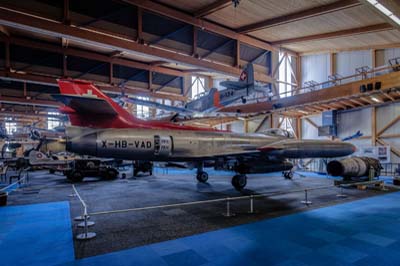
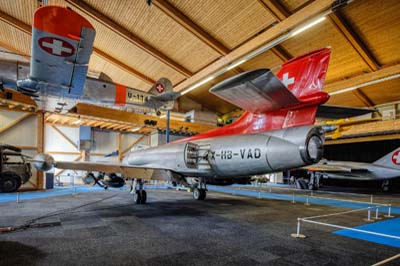
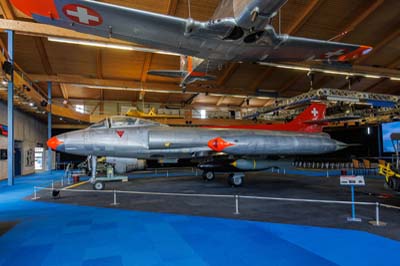
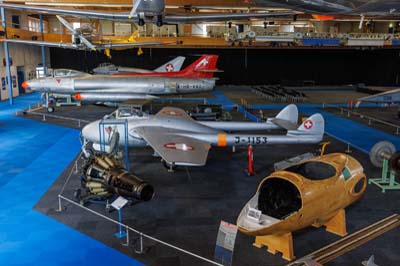
Left to right: FFA P16 (J-3005 ntu registered X-HB-VAD). The FFA P-16 was a Swiss designed jet powered ground attack aircraft developed by Flug-und Fahrzeugwerke Altenrhein (FFA) on the shores of Lake Constance from 1950 as an ambitious attempt to create a homegrown fighter bomber suited to alpine operations. Despite its promise, the aircraft was never introduced into Swiss Air Force service after development was cancelled following a series of crashes that led to the withdrawal of state funding.
X-HB-VAD, the second aircraft of the Mk.III variant, is the final experimental prototype of the P-16 programme. The aircraft's wing design was later adapted for the Learjet 23 business jet. |
 |
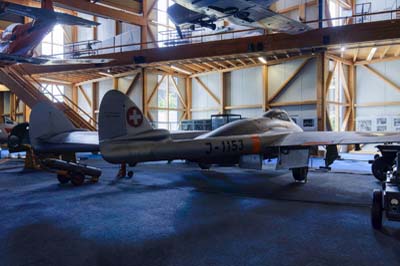 |
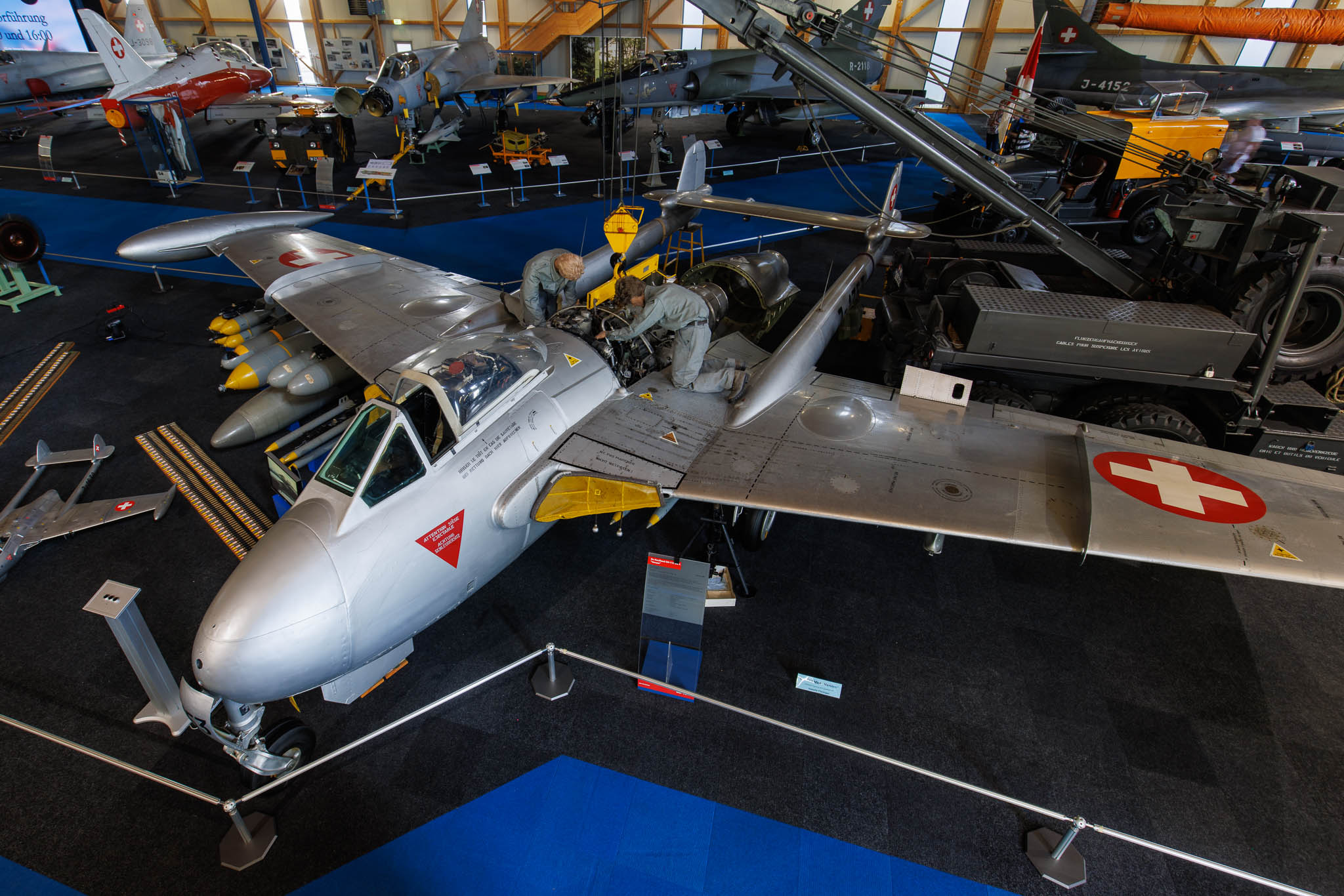
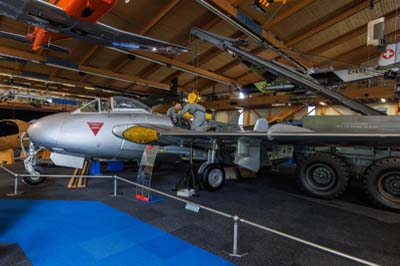
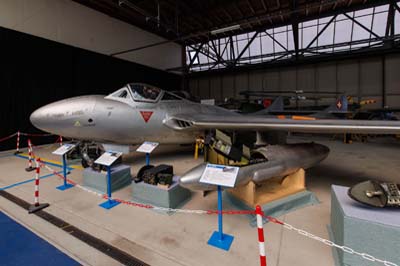
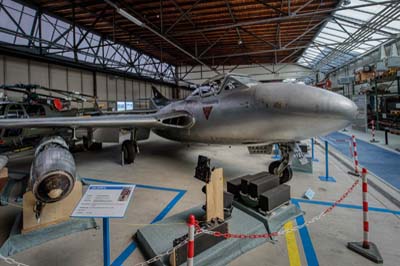
| Left to right: de Havilland Vampire Mk.6 (J-1153). The Swiss Air Force operated 175 de Havilland Vampire Mk.6 fighter-bombers, making it the backbone of the nation's early jet fleet. Acquired beginning in 1949, these aircraft served as front-line fighters until 1967 and as advanced trainers until 1990. One hundred of these planes were assembled under license in Switzerland at Emmen. |
| Left to right: de Havilland Venom Mk.4 (J-1753) ex Swiss Air Force. |
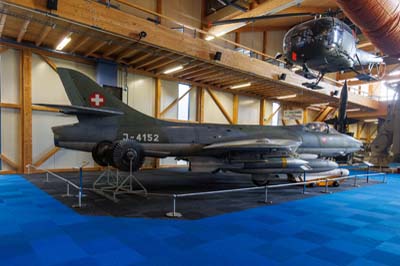
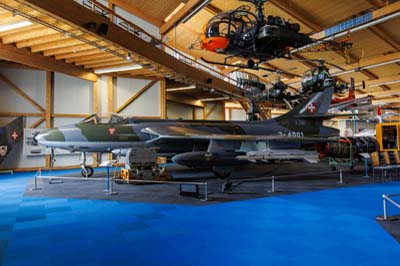
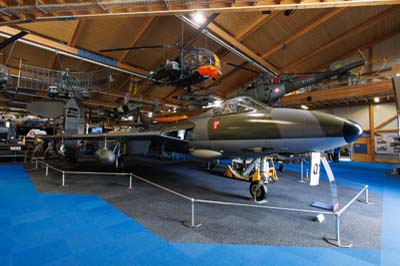
Left to right: Hawker Hunter F.58A (J-4152 previously WT716) ex RAF, ex Swiss Air Force. The Hawker Hunter served with the Swiss Air Force from the late 1950s until retirement in 1994, with 160 aircraft operated in both new and second hand form. The first 12 aircraft, delivered from April 1958, were former RAF Hunter F.6s upgraded to Swiss F.58 standard, followed by new aircraft from Hawker. Swiss modifications included updated radios, bomb carrying capability and later the addition of AIM-9 Sidewinder missiles.
Initially used as interceptors, the Hunter later became Switzerland's primary ground attack aircraft, serving with militia squadrons for much of its career. Even after the arrival of the Northrop F-5E Tiger II in the 1970s, the Hunter remained in frontline use until replaced by the McDonnell Douglas F/A-18 Hornet in the 1990s.
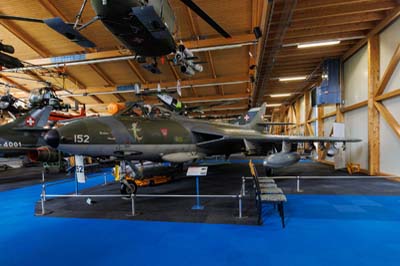
Hawker Hunter F.58 (J-4001 previously XE536) ex RAF ex Swiss Air Force. |
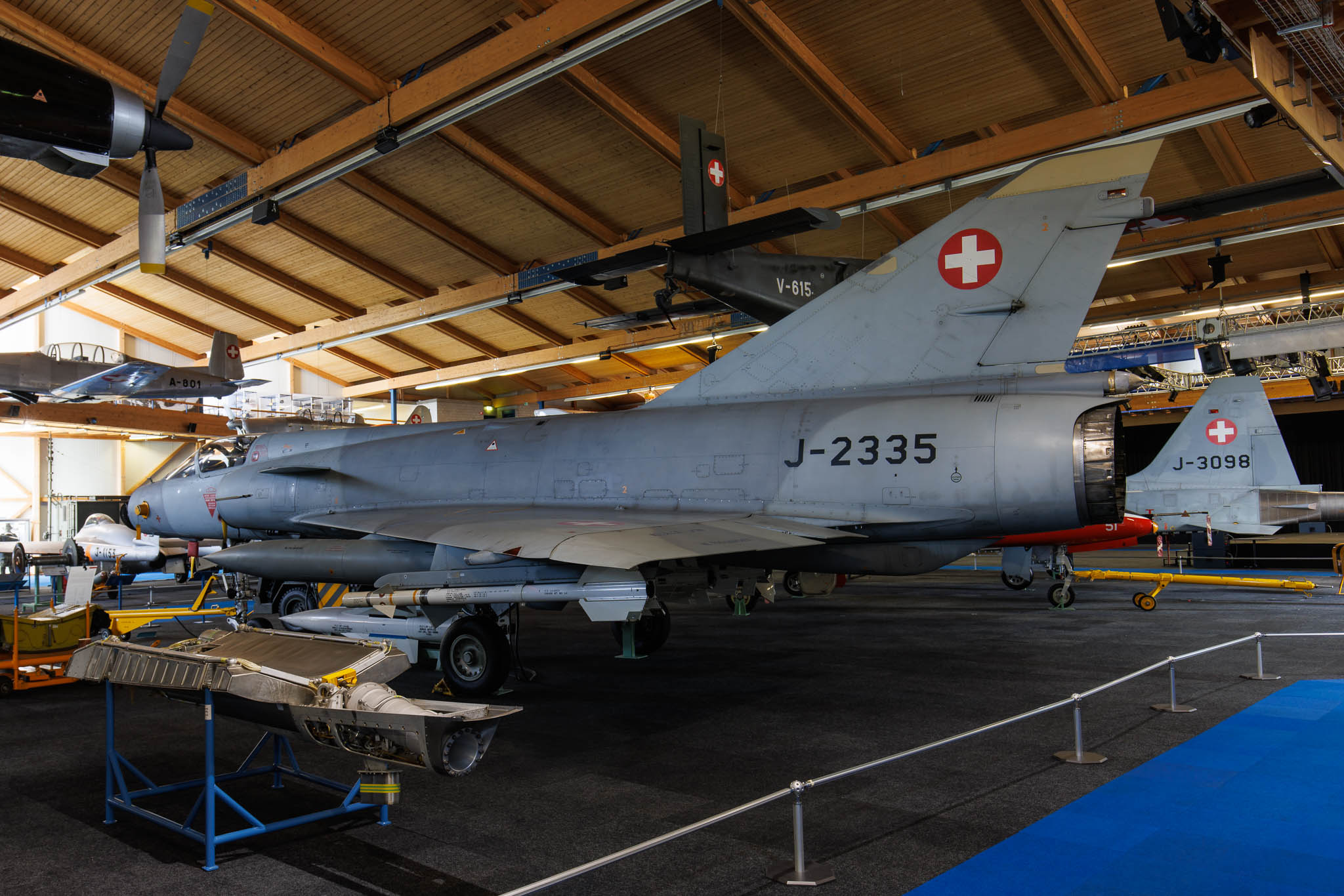 |
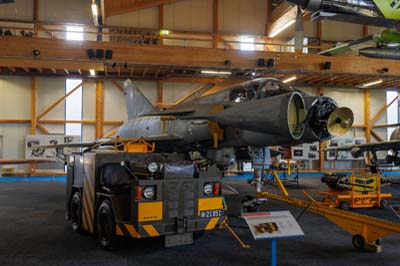
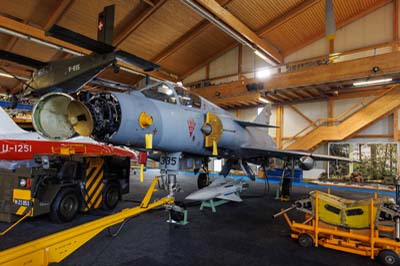
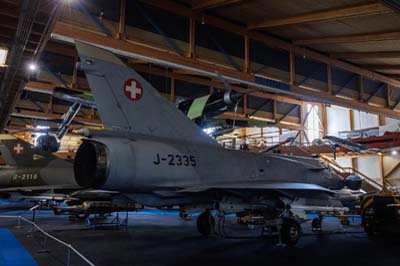
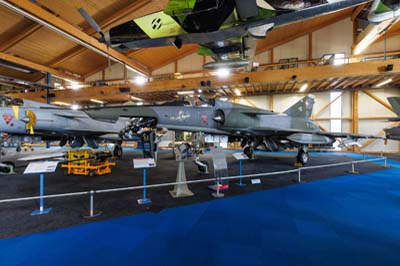
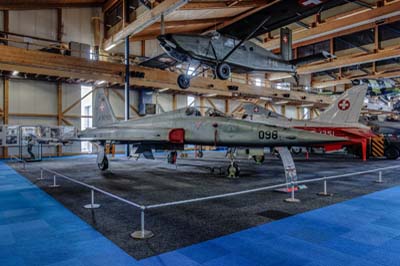
| Left to right: Dassault Mirage IIIS (J-2335) ex Swiss Air Force. The Dassault Mirage IIIS was a Mach 2 interceptor variant of the French delta-wing fighter, heavily modified for the Swiss Air Force. Delivered between 1966 and 1969, the fleet featured structural reinforcement, American avionics, and a detachable rocket booster, ultimately serving until 1999. |
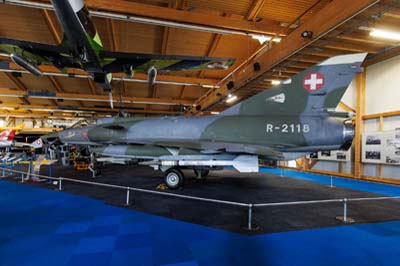
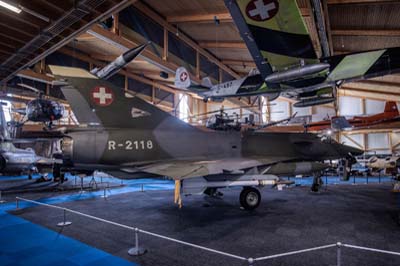
| Left to right: Dassault Mirage IIIRS (R-2118) named 'Mata Hari', ex FlSt 10, Swiss Air Force. |
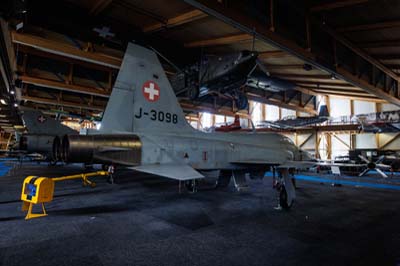
Left to right: Northrop F-5E Tiger II (J-3098) The Swiss Air Force procured 98 Northrop F-5E Tiger II and 12 F-5F variants starting in the 1970s, which served as the backbone of their air defense and deterrence operations. Praised for its low maintenance, reliability, and handling, a limited number of the fleet remains active today—primarily supporting the Patrouille Suisse aerobatic display team.
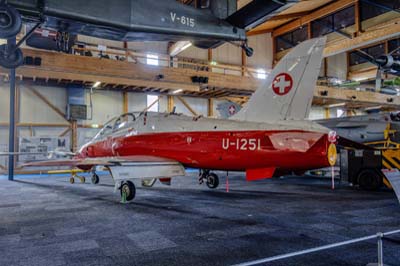
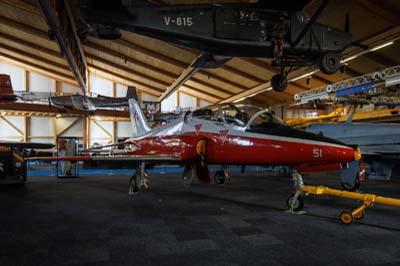
BAe Hawk Mk.66 (U-1251 previously ZG974) ex RAF, ex Swiss Air Force. |
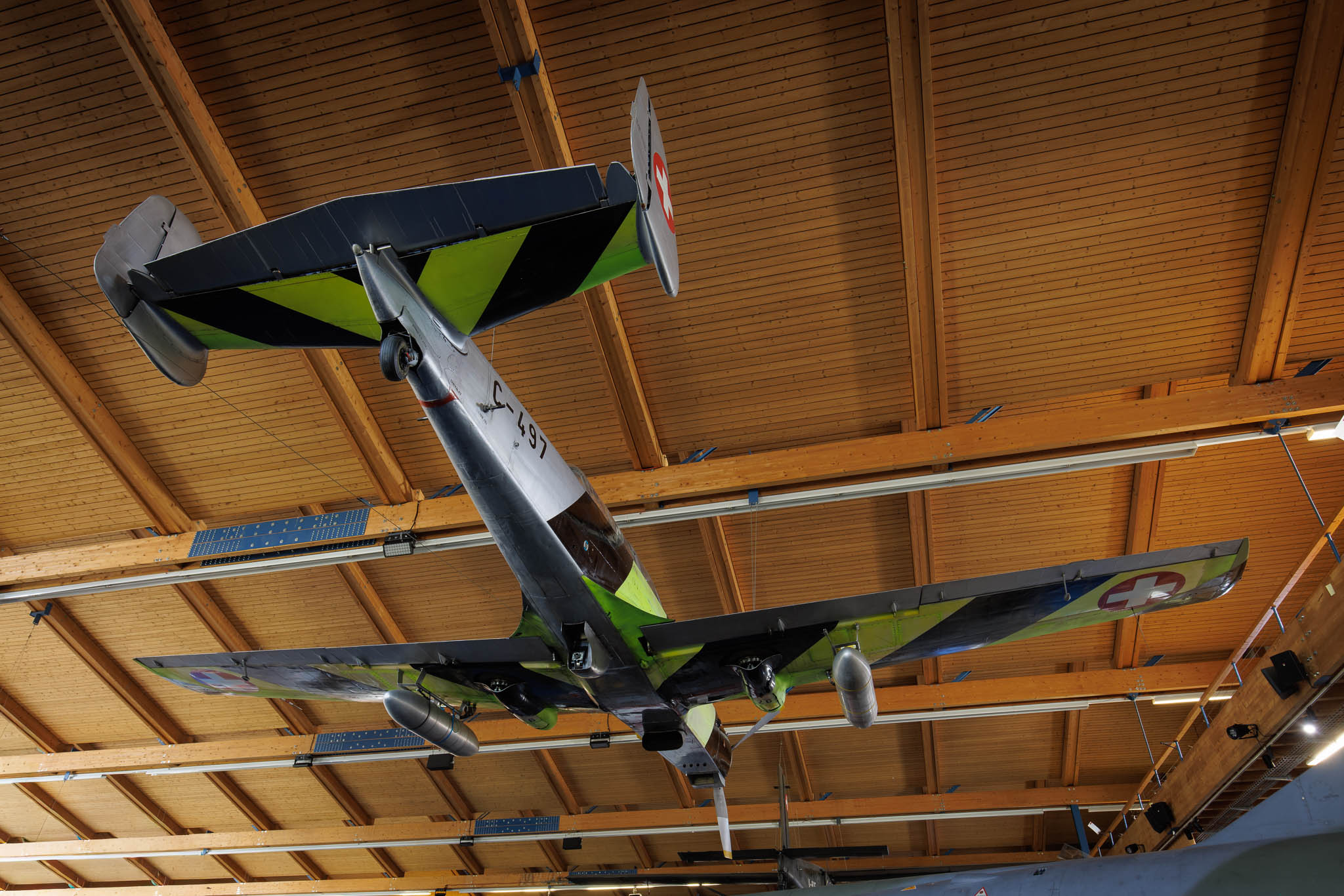
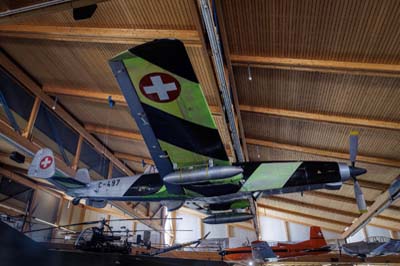
| Left to right: EKW C-3605 (C-497). The F+W C-3605, nicknamed Schlepp, is a target towing aircraft operated by the Swiss Air Force from 1971–1987. The aircraft was developed during the latter half of the 1960s by the Swiss Federal Construction Works (EKW - Eidgenoessische Konstruktionswerkstaette), renamed Farner Werke (F+W) in 1972, as a conversion of the existing C-3603 ground attack and target towing aircraft. Following a successful prototype conversion in 1968, 23 aircraft were converted between 1971 and 1973. |
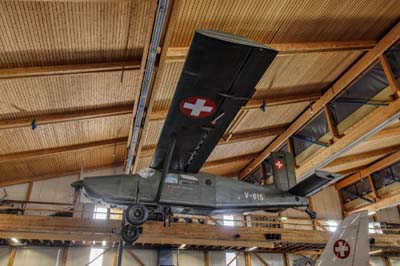
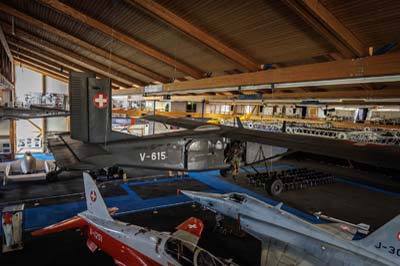
Left to right: Pilatus PC-6B1-H2 (V-615). The Swiss Air Force operated 15 Pilatus PC-6 Turbo-Porter aircraft, primarily assigned to Lufttransport Staffel 7 at Emmen Air Base and the Locarno Air Base. Renowned for their Short Take-Off and Landing (STOL) capabilities, these aircraft were used for tactical transport, paratrooper drops, search and rescue, and disaster relief. Due to airframe aging, the Swiss Air Force officially retired the iconic PC-6 from active military service at the end of 2024.
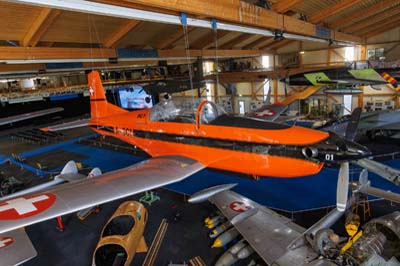
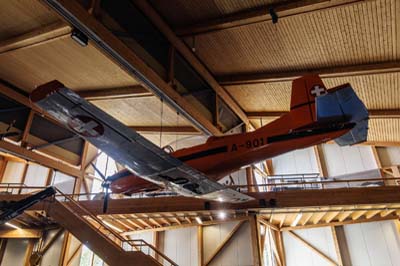
Pilatus PC-7 (A-901) ex Swiss Air Force. The Pilatus PC-7 was developed from the piston powered P-3 during the 1970s, introducing a turboprop engine, bubble canopy and redesigned wing. It became a highly successful training aircraft, adopted by more than 20 air forces and widely used for pilot instruction worldwide. More than 600 PC-7s were produced, with some operators also using armed versions in combat roles. An improved PC-7 Mk.II followed in the 1990s, combining features of the newer PC-9 with the PC-7's smaller engine. The type was later succeeded by the Pilatus PC-9 and PC-21. |
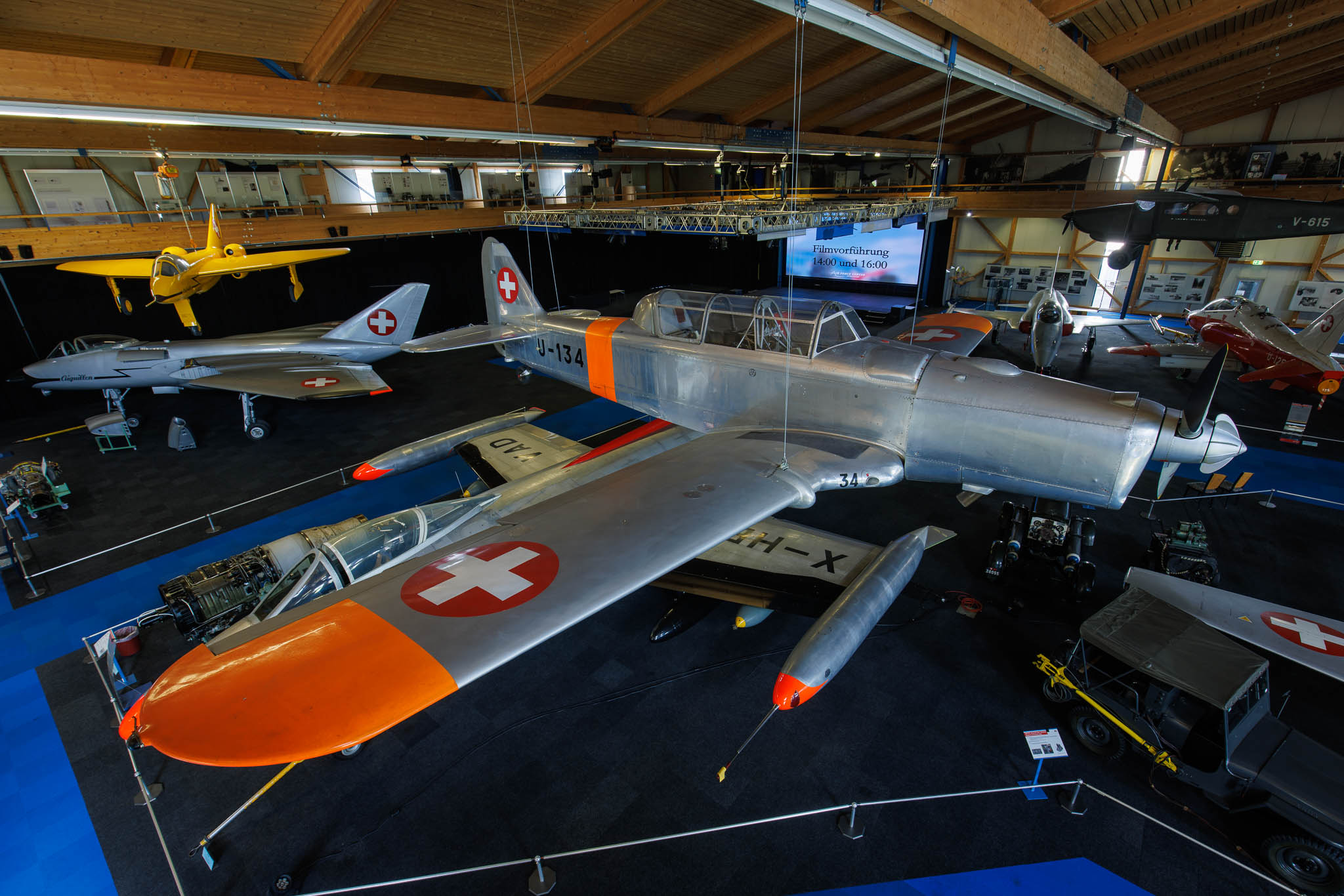 |
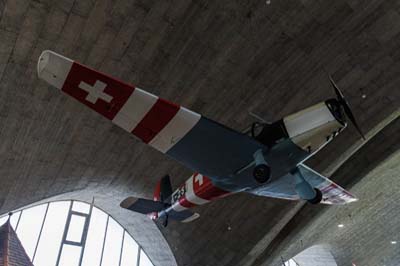
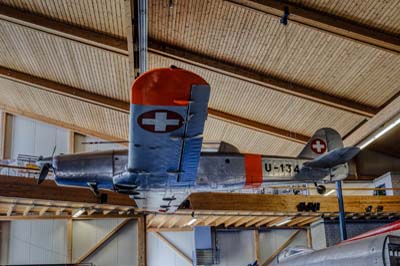
Left to right: Pilatus P-2-06 (U-134, it appears to have '104' part erased on the fuselage) ex Swiss Air Force. The Pilatus P-2 was developed during World War Two. Construction of the first prototype began in 1943, with its maiden flight taking place on April 27, 1945. Following successful evaluation by the Swiss Air Force, the aircraft entered production. The P-2 served with the Swiss Air Force from 1946 to 1981, after which most surviving aircraft were sold into civilian ownership.
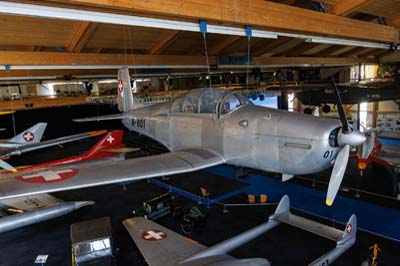
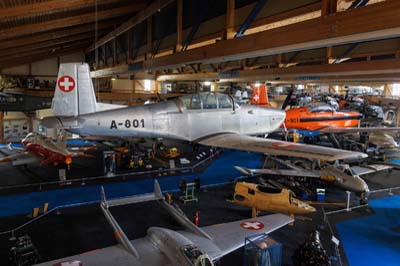
Pilatus P-3-05 (A-801) ex Swiss Air Force. The Pilatus P-3 first flew on September 3, 1953, but early testing showed its engine lacked sufficient power. A revised second prototype, fitted with a more powerful engine and three blade propeller, flew in August 1954 and successfully competed against the T-34 Mentor during Swiss Air Force evaluations.
Following acceptance, the Swiss Air Force received 12 pre-series aircraft and later ordered 60 production examples, using the P-3 as a training aircraft until 1983 and as a liaison aircraft for a further decade. Six civilian aircraft were also built and later sold to the Brazilian Navy. Between 1993 and 1995, most retired Swiss Air Force aircraft entered private ownership. |
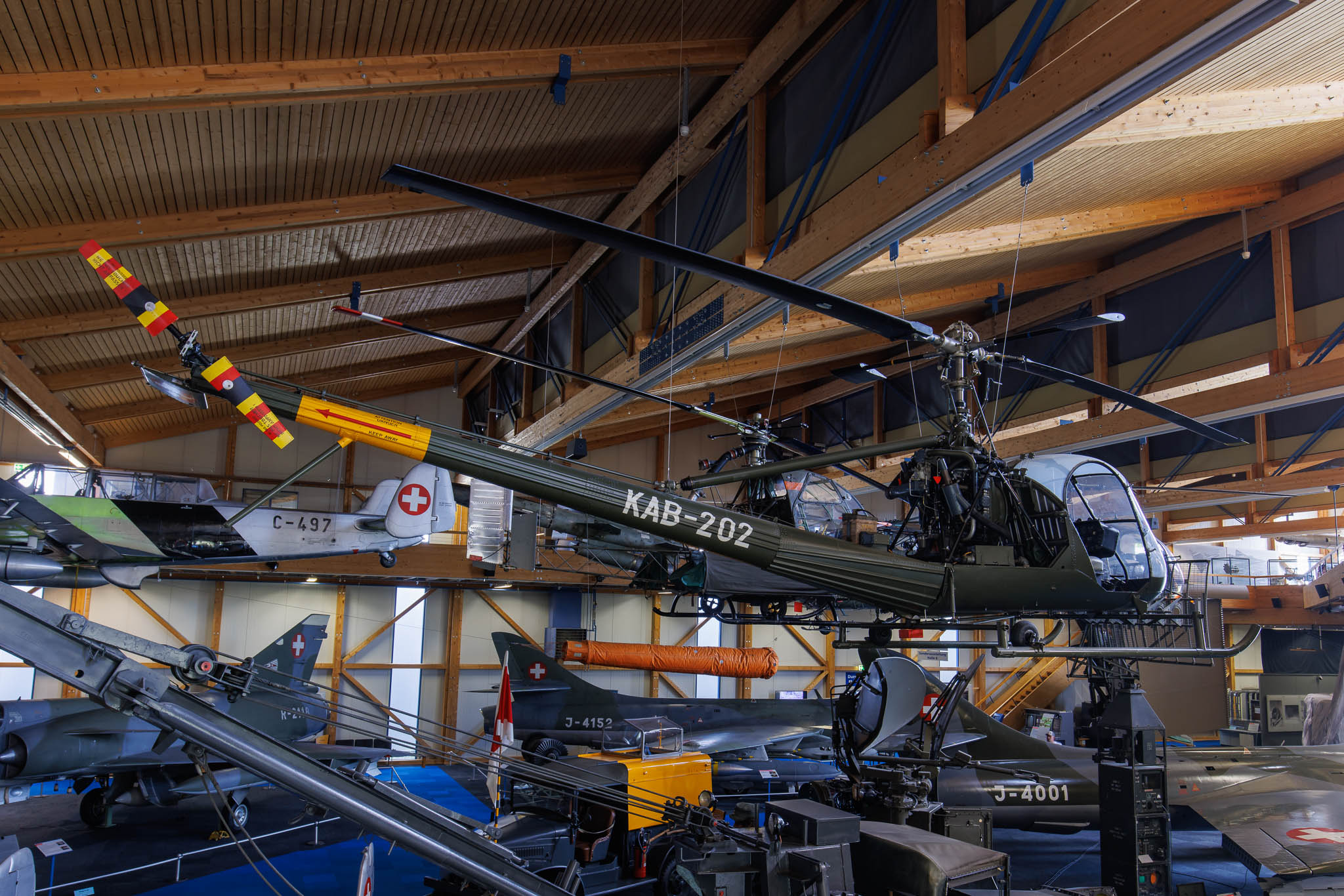 |
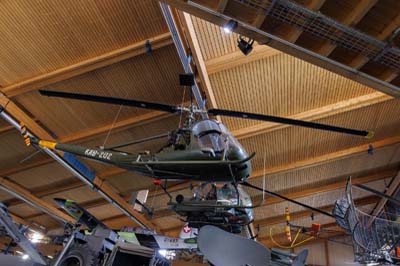
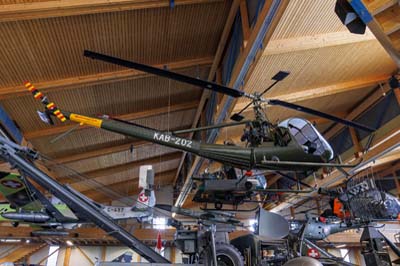
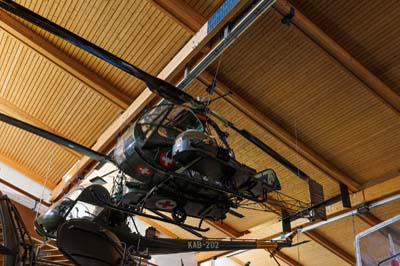
Left to right: Hiller UH-12B Raven (607 painted as 'KAB-202') ex l'Armée de terre (ALAT - French Army). The Hiller UH-12B first appeared in Switzerland in October 1952, when the army received the first aircraft, designated KAB-201 (Kampffeld und Artillerie-Beobachtung, artillery and battlefield observation), followed shortly afterwards by a second example, KAB-202. These aircraft became the first helicopters to enter service with the Swiss armed forces.
Sud Djinn SO.1221S (38 painted as 'V-23') ex l'Armée de terre (ALAT - French Army). The Sud-Ouest SO.1221 Djinn was a French two seat light helicopter and the first production helicopter built in France, as well as the first tip-jet powered rotorcraft to enter production. Developed by Sud-Ouest, later part of Sud Aviation. The French Army ordered 22 pre-production aircraft for evaluation. The first flew on September 23, 1954. The French Army later ordered 100 Djinns, using them for liaison, observation, training and casualty evacuation duties. Production ended in the mid-1960s after 178 helicopters had been built, with the Djinn eventually replaced by the more successful Aérospatiale Alouette II.
The Swiss Army operated four SO.1221S helicopters. Four entered service between February 1958 and July 1959 as V-21 to V-24 with the type remaining in Swiss service until 1966.
|
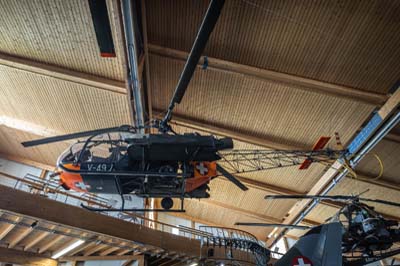
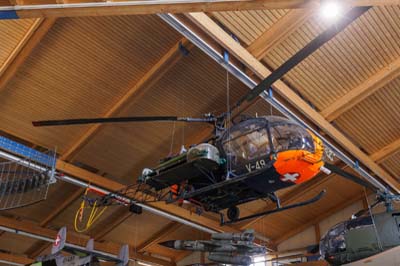
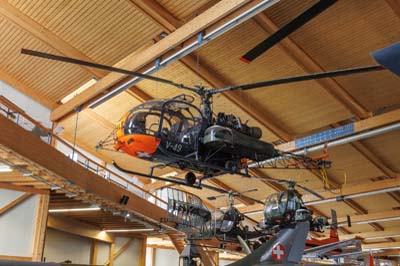
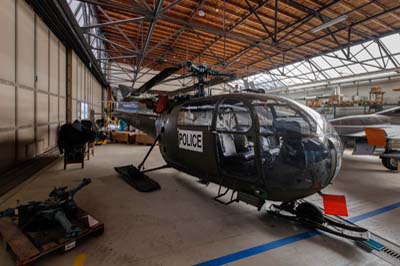
Left to right: Aerospatiale (Sud Aviation) Alouette II (V-49 registered HB-XBM) ex Swiss Air Force. The Alouette II first flew in 1955, it was the first Gas turbine powered helicopter, by 1975 1,500 had been built.
The Swiss Air Force operated a fleet of 30 Sud-Aviation SE-313B Alouette II helicopters (registrations V-41 to V-70), serving primarily in reconnaissance, liaison, and training capacities. The fleet, introduced in two procurement batches in 1958 and 1964, was phased out in the early 1990s and officially retired by 1992.
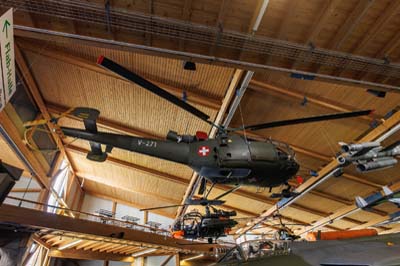
Aerospatiale (Sud Aviation) SA316B Alouette III (V-271) ex Swiss Air Force. The Alouette III was a legendary workhorse of the Swiss Air Force, serving from 1964 to 2010. Acquired for alpine rescue, troop transport, and training, the fleet totaled 84 helicopters (9 bought from France, 75 assembled under license in Emmen). |
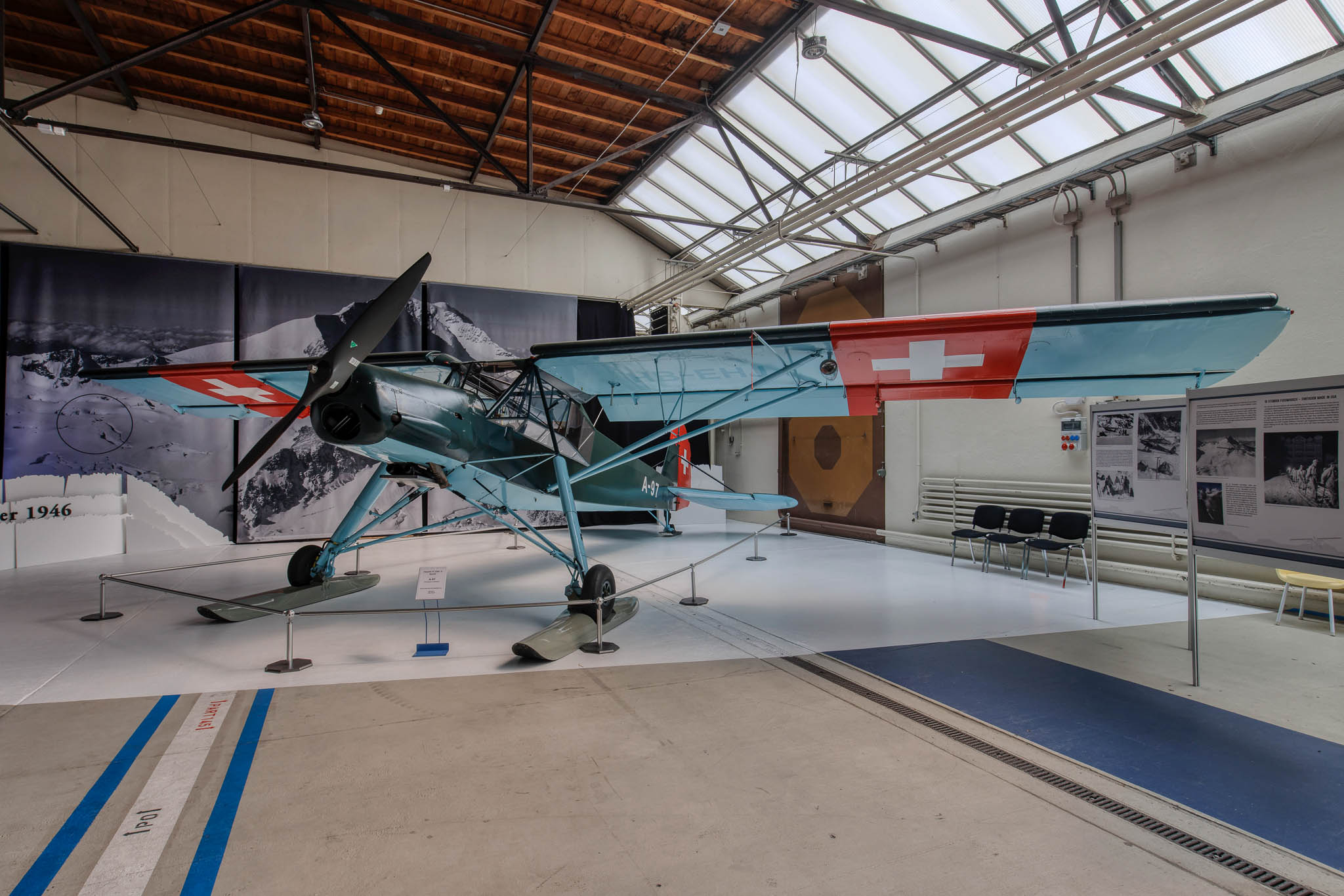 |
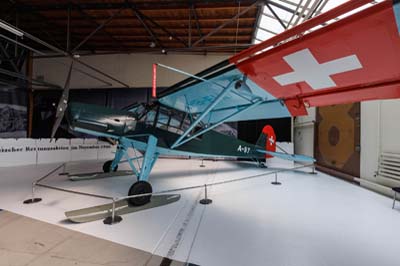
Left to right: Fieseler Fi 156C-3 Storch (A-97 registered HB-EHJ) ex Swiss Air Force and Luftwaffe. The Swiss Air Force operated five Fieseler Fi 156 Storch between 1940 and 1962, primarily using them for liaison, observation, and medical evacuations. Known for its exceptional STOL (Short Takeoff and Landing) capabilities, the aircraft provided versatile service in Switzerland's mountainous terrain before being retired.
A Luftwaffe Fi 156 was interned in 1943, following a forced landing in Samedan, which was then absorbed into the Swiss Air Force fleet as A-97. It later spent 50 years on display at the Swiss Museum of Transport (Verkehrshaus) in Lucerne. In 2016, the aircraft was restored to airworthy condition in Poland as SP-YRX and on return to Switzerland registered HB-EHJ.
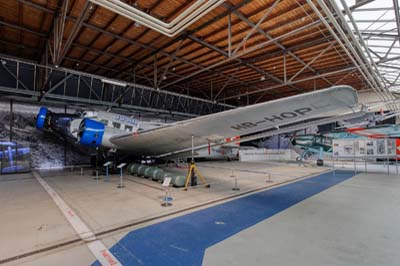
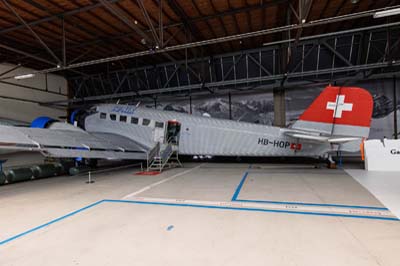
Junkers Ju 52/3mg4e (A-703 registered HB-HOP) ex Swiss Air Force. The Junkers Ju 52 was a three engine passenger and transport aircraft built by Junkers Flugzeugwerk AG in Dessau. Originally designed as a single engine cargo aircraft for operations in remote areas, it evolved into the distinctive three engine Ju 52/3m, recognised for its corrugated metal skin and robust construction. Military requirements also influenced its design, allowing it to be adapted for bomber duties. In a military role, large numbers flew with the Luftwaffe, being deployed on virtually all fronts of the World War Two as a troop and cargo transport.
In 1939, the Swiss Air Force acquired three Ju 52/3m aircraft for observer training. For over 40 years, they were the largest aircraft in Swiss service and carried out a wide range of duties before retirement in 1981. All three later passed to Ju-Air, operating sightseeing flights as A-701/HB-HOS, A-703/HB-HOP and A-702/HB-HOT. Their long safety record ended on August 4, 2018, when HB-HOT crashed on Piz Segnas, killing all 20 people on board. |
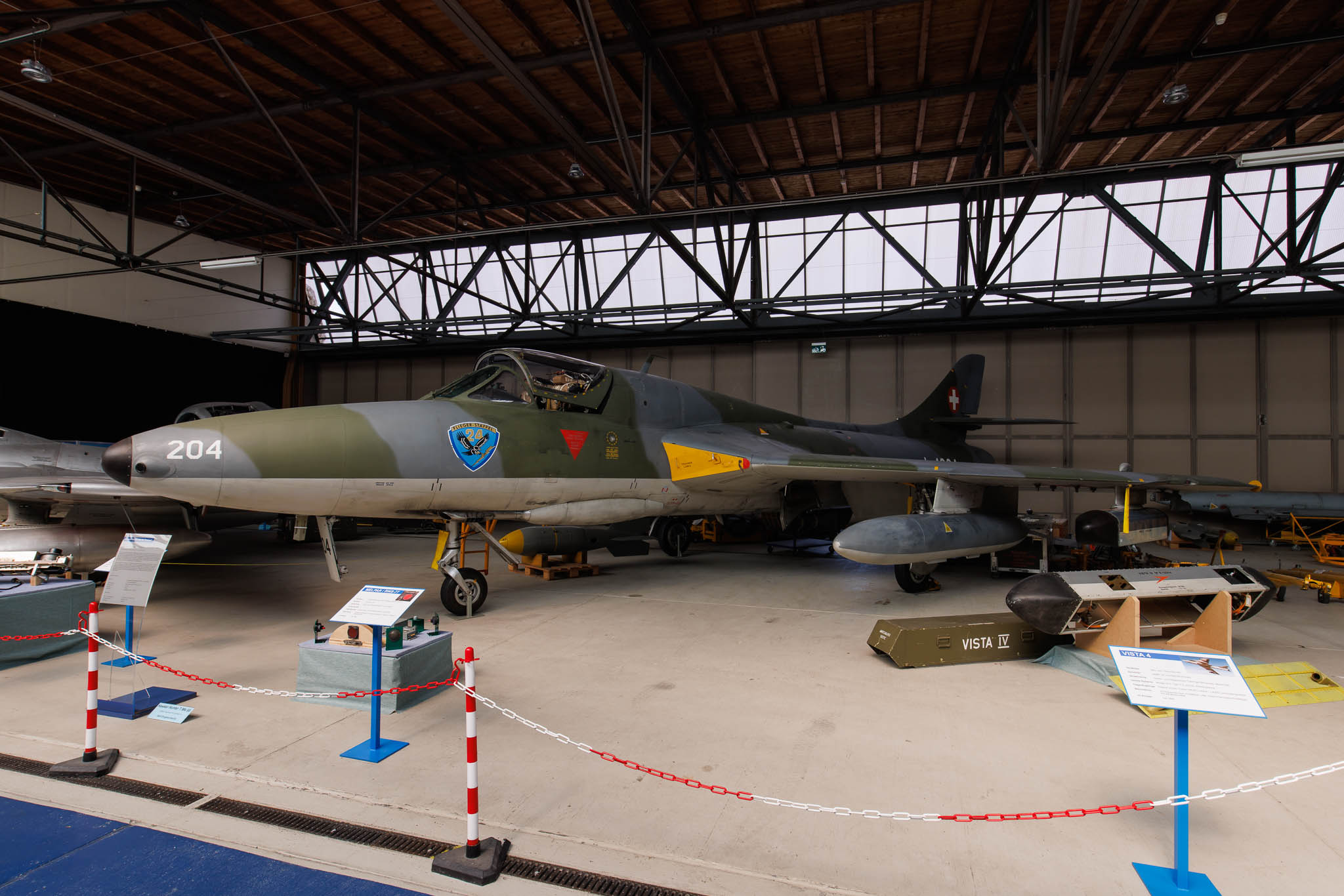 |
| Hawker Hunter T.68 (J-4204 previously XE702) ex RAF ex FlSt 24, Swiss Air Force. |
Left to right: de Havilland Vampire Mk.55 (U-1224) ex Swiss Air Force.
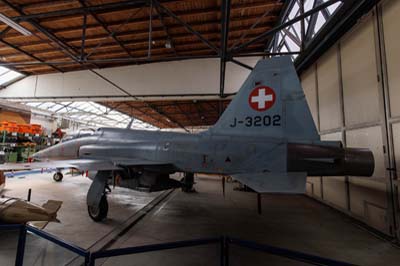
Northrop F-5E Tiger II (J-3202) ex Swiss Air Force.
Sud Alouette III (V-260) ex Swiss Air Force. |