Swiss Air Force
Payerne
2007-2010
|
Payerne has a fine aviation history going back to the beginning of flight. The first flight in Switzerland took place in 1910 at nearby Avenches followed by a further flight to Payerne itself. It was not until 1921 that the airfield at Payerne was constructed. The airfield has been expanded considerably over the years as new aircraft have been introduced. The Vampire in 1946 was joined by the P-51D Mustang in 1948. The Venom arrived in 1953 followed by the Hunter in 1958 the Mirage III in 1966 and the F-5 in 1978. Payerne is the main Swiss Air Force air base.
Units currently based at Payerne are; Instrumentenflugstaffel 14 with PC-7s, Ausbildungsstaffel (Ausb St) 16 with F-5E/F. Fliegergeschwader (FlGeschw ) 11 control Escadrille d'Aviation (EscAv) 6 with F-5Es and Fliegerstaffel (FlSt) 17 with the F/A-18C/D. FlGeschw 14 is responsible for FlSt 18 with the F/A-18C/D. Additionally LT Geschwader 1 with LT Staffel 1 and 5 operate the Alouette III, Super Puma and Cougar. |
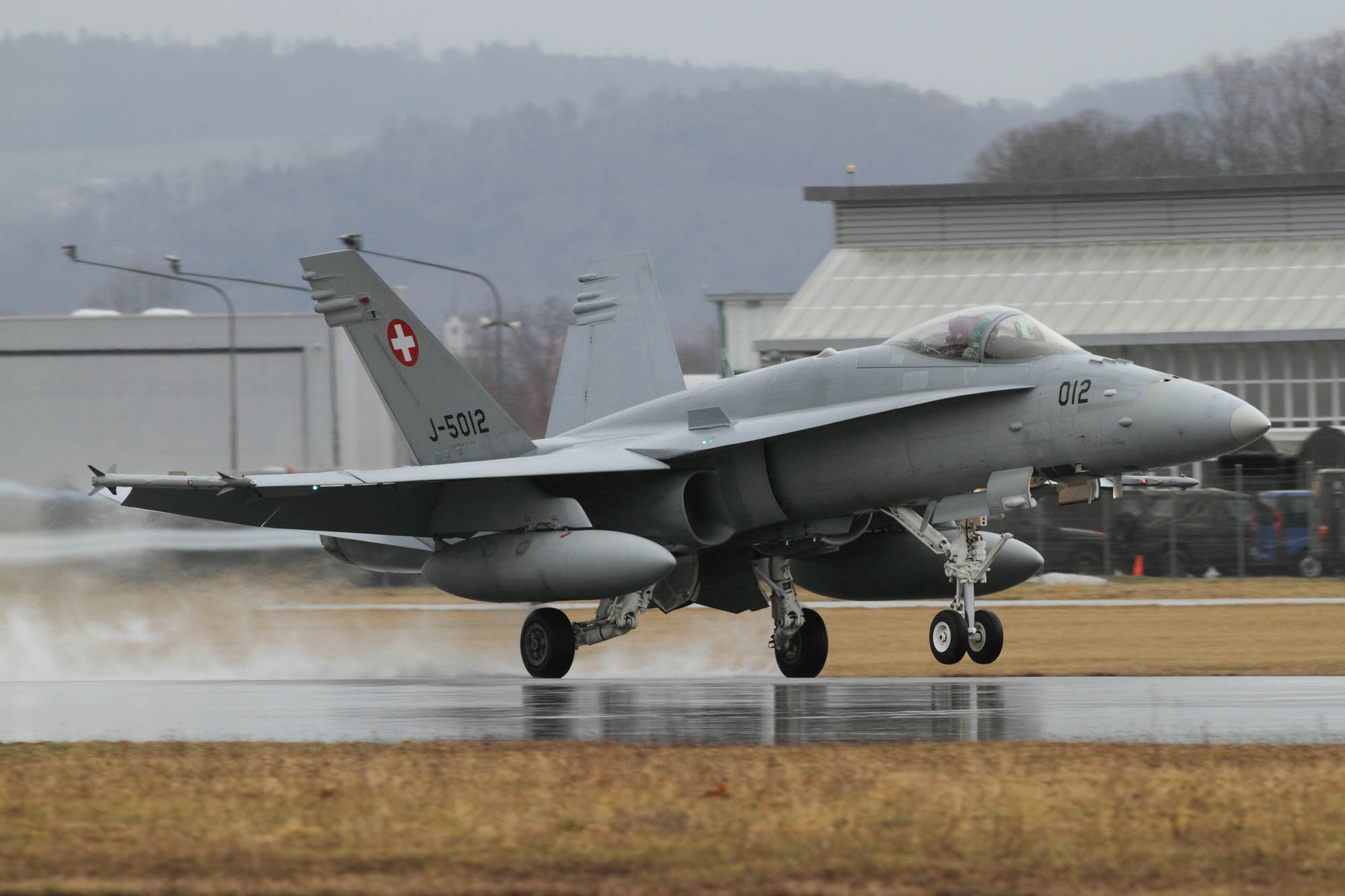 |
| McDonnell Douglas F/A-18C Hornet (J-5012) departing to the west in February 2010, image taken from the north side. |
McDonnell Douglas F/A-18 Hornet
By 1985 the Swiss Air Force was looking to replace some of its F-5Es and Mirage IIIS to improve its air defence capability. The McDonnell Douglas F/A-18 Hornet was eventually selected in June 1992. The first two were US built and delivered in 1996. The rest of the 26 Cs (J-5001 to J-5026) and eight (J-5231 to J-5238) two-seat D variants were assembled at Emmen between 1997 and 1999. Payerne was selected as the first operational base for the F/A-18. In June 1997 Escadrille d'Aviation (EscAv) 17 was the first unit to convert to the F/A-18 followed by FlSt 18 in 1998. FlSt 11 at Dubendorf followed in 1999. Together these three units formed the Überwachungsgeschwader (ÜeG or Operational Air Surveillance Wing) only to disband in 1995. The Einsatz Luftwaffe or Swiss Air Force Component Command (ACC) took over from the ÜeG on January 1, 2006. |
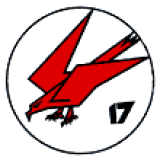
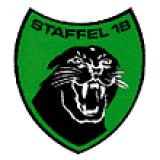
| F/A-18 unit badges, Fliegerstaffel (FlSt or Air Squadron) 11, 17 and 18. |
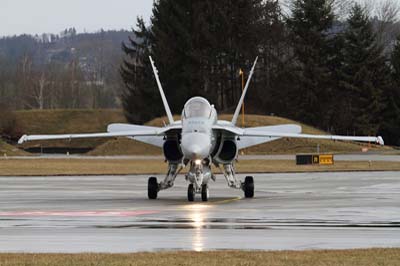
Left to right: F/A-18C (J-5013) turning off the runway at the western end of the runway.
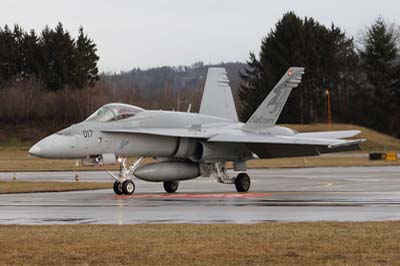
F/A-18C (J-5017) with special 'Falcon 17' markings in February 2010.
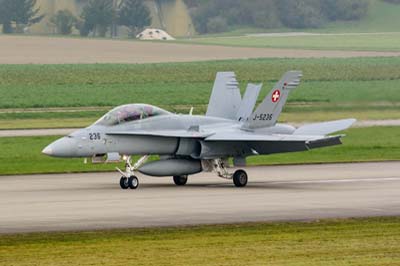
Two-seat F/A-18D (J-5236) on the runway, image from the south side HAS in October 2007.
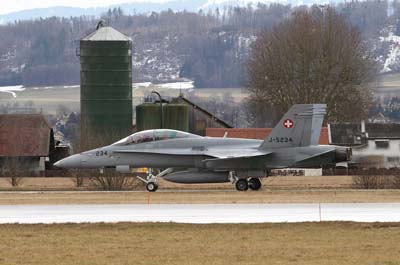
F/A-18D (J-5234) making its way back to the shelters on the south side taxiway in October 2010. |
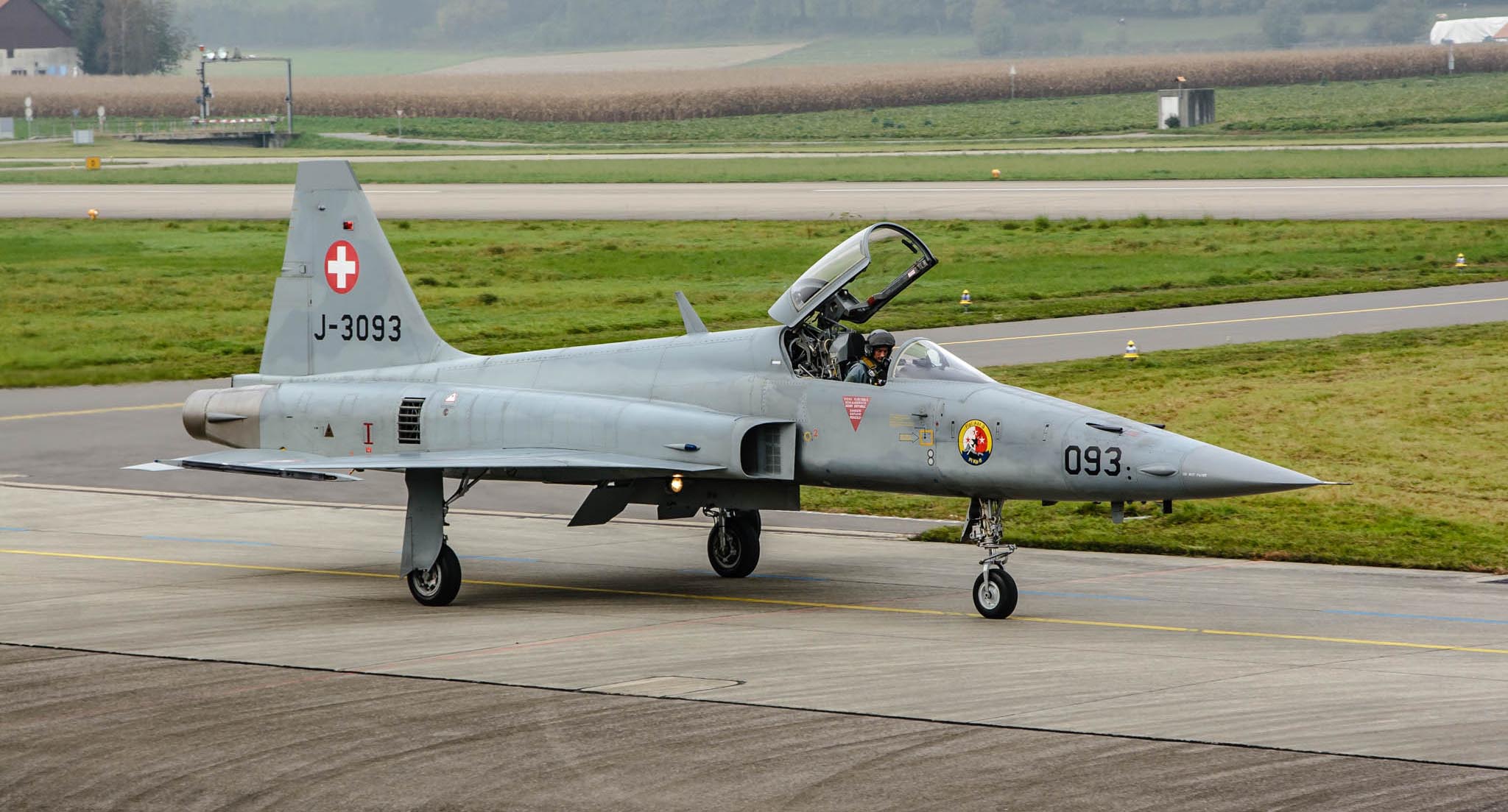
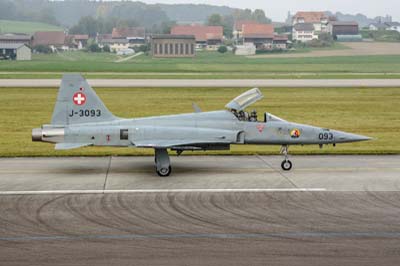
Northrop F-5E Tiger II (J-3093), the badge on the nose is Flugplatz Abteilung 3 and Fliegerkompagnie 8'
(Air Base Section 3 and Aviation Company 8) in 2007, image taken from a HAS on the south side. |
Northrop F-5E/F Tiger II
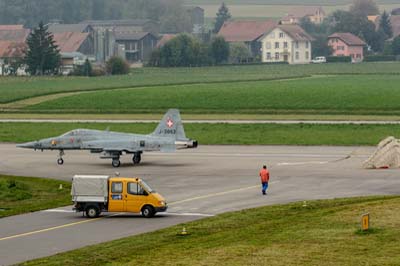
 At Payerne Escadrille d'Aviation ( EscAv) 6 operates the F-5E. Ausbildungsstaffel (Training Squadron) 16 with its F-5Es and two-seat F-5Fs is responsible for primary jet training, target-towing and Electronic warfare is also at Payerne. The F-5F is also used for Dissimilar Air combat training (DACT) with the F/A-18s. ECM training is also carried out using Ericsson Erijammer A-100 'Vista 5' electronic jamming system.
Other F-5 units include FlSt 19 at Sion, FlSt 8 at Meiringen and the Patrouille Suisse at Emmen.
The Northrop F-5E/F was originally ordered under the Foreign Military Sales (FMS) program 'Peace Alps'. 66 F-5E were supplied, 53 of which were assembled by FFA with 6 F-5F to the Swiss Air Force. Under 'Peace Alps (?)' a further 32 F-5E and 6 F-5F were supplied. Deliveries of the F-5E/F Tiger II commenced in October 1978. The 98 F-5Es given serials J-3001 to J-3098) and the twelve two-seat F-5Fs J-3201-J-3212. By 1985 the Swiss Air Force was looking to replace some of its F-5Es and Mirage IIIS to improve its air defence capability. The F/A-18 was eventually selected. The first two were US built and delivered in 1996. The rest of the 26 Cs and eight two-seat D variants were assembled at Emmen between 1997 and 1999. In 1998 FlSt 18 at Payerne converted to the F/A-18 from the F-5E, FlSt 11 at Dubendorf followed in 1999. As a result of the Arméé XXI structure to produce a leaner military that commenced on January 1, 2004, operational F-5E numbers were reduced. 32 were sold to the US Navy and 12 were leased to the Austrian Air Force. FlGeschw 3/FlSt 1 at Turtmann, FlSt 13 at Payerne and FlGeschw 10 at Buochs were all disbanded in December 2003. |
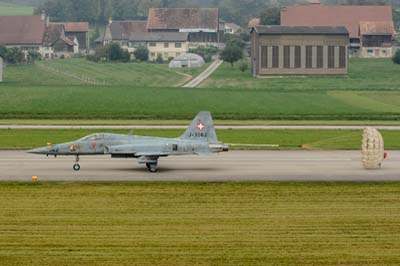
Left to right: F-5E Tiger II (J-3062) recovers, its landing chute is collected from the runway.
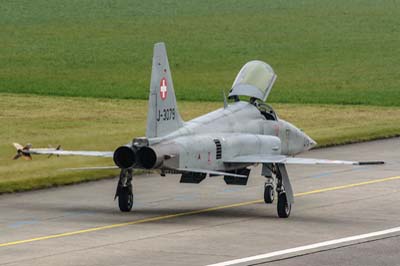
F-5Es (J-3093 and J-3079). |
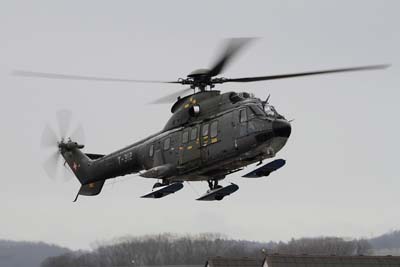
| An AS.332M-1 Super Puma (T-312) of LT Geschwader 1, LT Staffel 1 or 5 which operate the Alouette III, Super Puma and Cougar. |
Photography at Payerne:
The air base is situated in an open countryside of gently rolling hills. Public roads provide close and easy access to the single runway. Photography from on top of one of the grass covered Hardened Aircraft Shelter (HAS) in the south eastern corner of the airfield appears to be tolerated by the authorities. It was from this HAS that I took my pictures using a 300mm lens for the runway action and a 24-105mm for the taxiing aircraft which pass just below you.
Along north side of the air base is a narrow road with parking places and a large car park for the museum where photography is ideal with a 300mm lens for landing and take-off and a 70-200mm for the taxiing shots. |