|
|
|
|
| F-15E Strike Eagle Air to Air 48 FW at Red Flag 08-4 RAF Lakenheath home of 48 FW Eagles on the Round-About Low-level Photography |
| Military Low-Flying Training Lakenheath's F-15E Strike Eagles "The most potent aerial fighting force in Europe" July 2006 |
 Philip Stevens reports: The 48th Fighter Wing's F-15E Strike Eagles regularly use the UK Low-Fly System (UKLFS). during a base visit aircrew
were asked about their sorites which test their low-level flying skills in the valleys of England, Wales and Scotland. Low-level missions can be combined with air to air refuelling provided by the KC-135 tankers of 100 ARW based at Mildenhall.
Philip Stevens reports: The 48th Fighter Wing's F-15E Strike Eagles regularly use the UK Low-Fly System (UKLFS). during a base visit aircrew
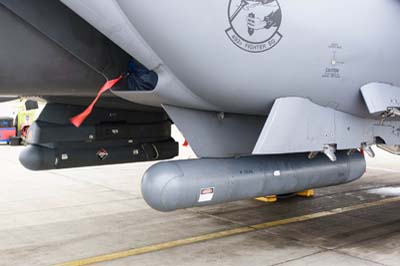
were asked about their sorites which test their low-level flying skills in the valleys of England, Wales and Scotland. Low-level missions can be combined with air to air refuelling provided by the KC-135 tankers of 100 ARW based at Mildenhall.Both 492nd Fighter Squadron (FS) and 494th FS fly the F-15E Strike Eagle and so have to train in their dual roles of air-to-air superiority and ground attack. We were told that about 50% of their training time is spent in each activity. So how is training scheduled at Lakenheath? How much training we have to do each year is dictated by Department of Defense, this is split up amongst the crews so they all have same amount of practise in each area and equal numbers of missions each week. Training for each specific task is required by number rather than by hour. Crew are required to tactical flying by night 15 times every 20 months and low altitude training 20 times every 20 months. Some missions can be logged for mutiple requirements. Again over 20 months, they have to do 20 basic ground attack and 42 ground attack tactics sorties. These sorties can be done at low-level or medium level. "Generally if the mission will allow it and the weather is good, we prefer to go low", I was told. 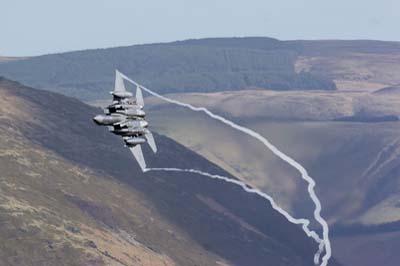 Speaking to aircrew we were told that air-to-air training such as 2v2s are carried out over the ocean, as they are worried about going supersonic over land. "We train in all sorts of different numbers (1v1, 2v2, 2v1, 2v multiple), including large forces for a broad variety, to give ourselves the best abilities for real conflicts." What equipment or procedures are specifically used for training? A NATO procedure known as 'Fighting Edge' is available to most frontline fighters. This involves using a code in the transponder to say that the fighter can be 'bounced' during the mission. "It is dependant on those who want to participate, some days there are no jets, other days there can be a few", we were told. All RAF jets use the system regularly. For training missions the F-15 will carry an Airborne Instrumentation Sub-system (AIS) Pod, this is essentially an electronic pod that transmits a package of information regarding the flight of the aircraft, such as altitude, speed, heading, 'G' and angle of attack etc. All these data are received on the 'Air Combat Manoeuvring Instrumentation' (ACMI) equipped ranges on the ground for analysis. It is possible to follow air to air combat in real time very accurately within 15 feet (4.6m) and when the flight has ended the data can be used for a debriefing. |
 |
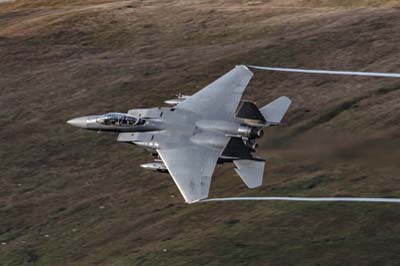
| F-15E Strike Eagle at low-level of 500 feet AGL on its way to the target. |
The targeting pod contains a high-resolution forward-looking infrared sensor which provides the Weapons System Officer (WSO) in the back seat with an infrared image of the target. A laser designator-range-finder provides precise delivery of laser guided munitions. A 'typical' low-level training mission 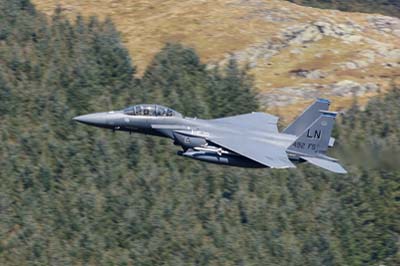 We were able to 'follow' a low-level training mission to Scotland via Cumbria with a 492nd FS crew. The pilot, Captain Schmidt started off by explaining that low-level missions take a lot longer to prepare for. Crews will get up six or seven hours before take-off time to get a good meal. "With four to six hours to go we will get over to the 492nd FS room to sort out a preliminary plan for the mission.
All low-flying in the UK is controlled by the British who regulate the amount of aircraft in a particular area of the UK low-fly System (UKLFS). Low-level flights are usually booked on the day of the mission, just of couple of hours before. "We just tell them when and where and they enter us in the system. The targets in the UK are pretty well anything that are not part of an 'avoid' area. Typical targets are; power plants, buildings in the country and bridges." "Low-level missions are dependent on the weather, so we need to see where we can get down to low-level", said Capt. Schmidt. "We have LANTIRN, an all-weather navigational and targeting system, will you be using this on your mission?" I asked. We were told that they would not use LANTIRN on this mission, as it is only really used in wintertime when it gets dark earlier. In the summer its not fully dark till 2 a.m. and so too late to fly in the UKLFS. Technically LANTIRN allows them to fly in all weathers, but training rules do not allow it. "We need 5 miles (8 km) of visibility, this is primarily to be respectful to the host nation, we don't want to disrupt anyone or have any close calls with gliders, hang gliders and civilian traffic." A couple of hours will be spent plotting the points we are going to fly to. Notice to Airmen (NOTAMs) are studied, "we need to be aware of areas to avoid and also of 'Purple' flights where the Royal family may be flying. When flying at low altitude we look for towers and other obstacles to avoid on the route, including built up areas. We will also have to avoid places where people are making movies and are filming, so that our noise does not interfere with them", she went on to say, adding, "pilots are responsible for looking outside to make sure they don't hit anything." |
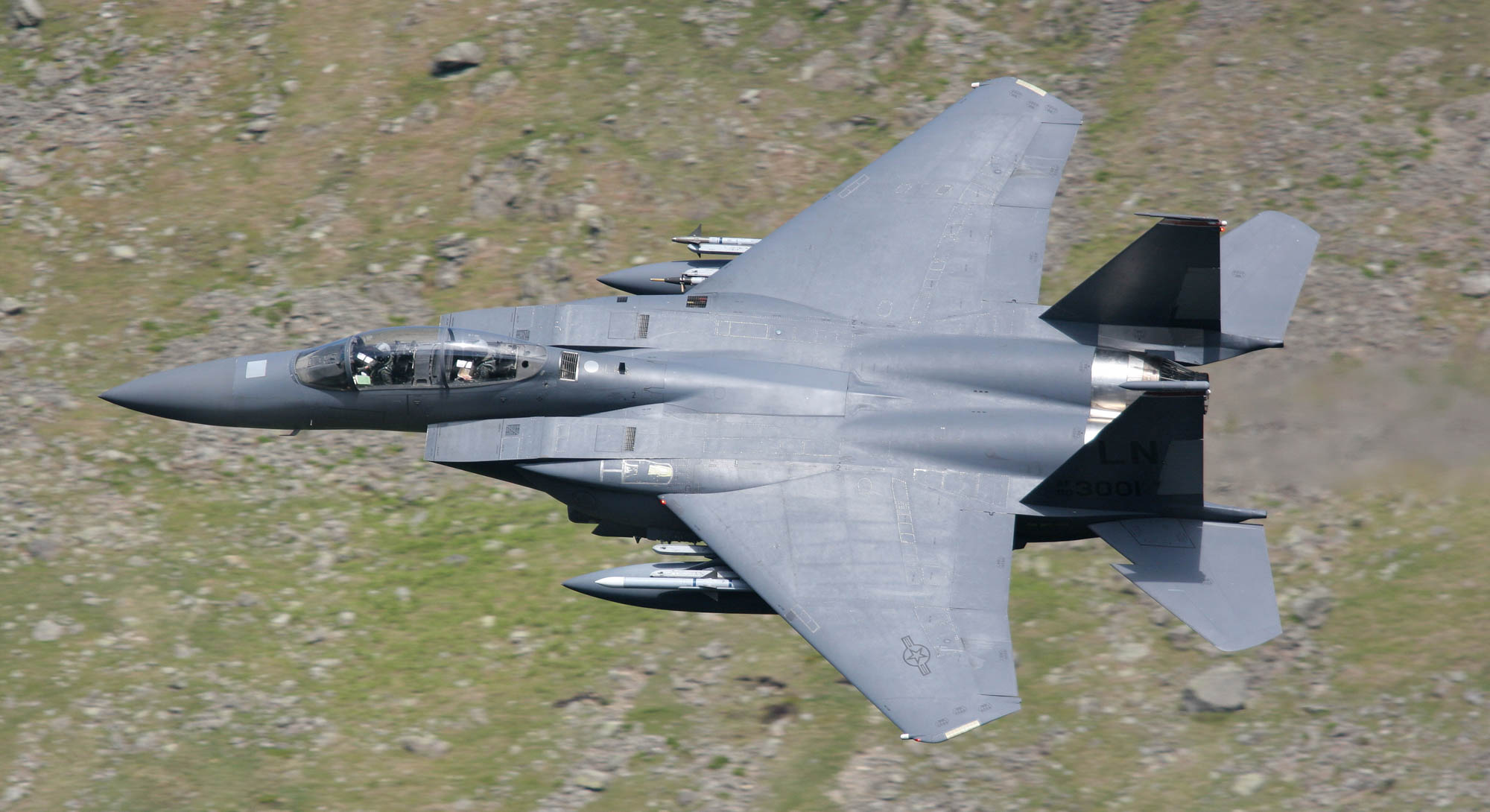 |
| F-15E Strike Eagle at low-level through the Lake District in Cumbria. |
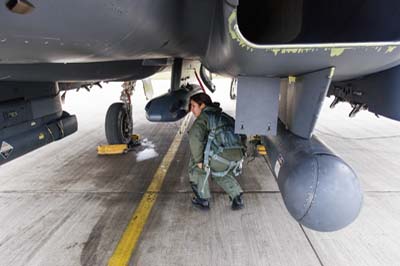
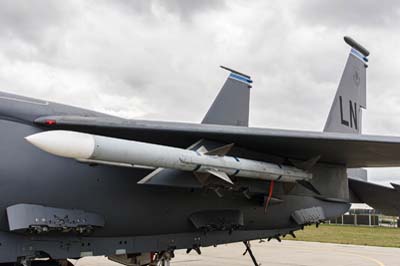 Captain Wilmic, Weapons System Officer (WSO) or 'wizzo' explained their procedures, "With all points plotted I will get everything printed out, including the paperwork on the target attacks to make sure we attack the right target to get good trade out of it. We will go over all the procedures necessary for what we are going to do that day, before going out to the aircraft for the pre-flight checks to make sure everything is working right." Captain Wilmic, Weapons System Officer (WSO) or 'wizzo' explained their procedures, "With all points plotted I will get everything printed out, including the paperwork on the target attacks to make sure we attack the right target to get good trade out of it. We will go over all the procedures necessary for what we are going to do that day, before going out to the aircraft for the pre-flight checks to make sure everything is working right."The F-15E Strike Eagle with its blue and white tail band signifies it to be from 492nd FS for today's mission was fitted with; On its main wing pylons, two 610 gallon drop tanks, On its port intake pylon the AN/AAQ-14 LANTIRN targeting pod, On its starboard intake pylon the AN/AAQ-13 navigational pod, The centre-line pylon a SUU-20 practice bomb dispenser carrying six BDU-33 practice bombs, On the wing outer missile rail was AIM-9M Sidewinder blue banded training round, On the wing inner missile rail was an AIS pod, Finally on the port outer rail was an AIM-120 AMRAAM training round. 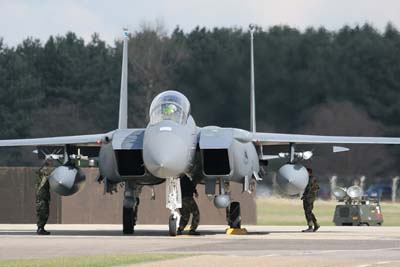
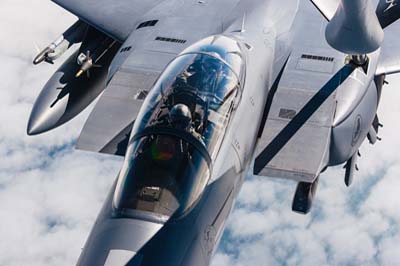 Taxiing out to the 'Last chance' point for final checks before crossing the runway the F-15E is held at the runway holding point. Cleared to depart the pair of F-15s climb out and head towards Air-to-Air Refuelling Area 8 (AARA 8) over the North Sea to meet up with "Quid 22" a KC-135 tanker from 100 ARW based at nearby RAF Mildenhall. We were told; "training requirements dictate that a certain amount of time is required for air to air refuelling and also the tankers need the training. Both benefit in this symbiotic relationship."
Having successfully received fuel from the tanker they descend into the UKLFS. The F-15E can attack at all levels but aircrew tend to practise the more difficult lower levels. In peacetime USAF pilots are cleared down to a minimum height of 500 feet (152m). F-15E pilots have to qualify the B-Course for 500 foot (152m) operations. At the Weapons School at Nellis AFB in Nevada pilots will be cleared to even lower levels. |
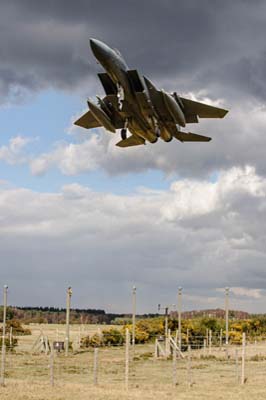
Capt. Schmidt spoke, "With a minute prior to the attack we cue our systems and make sure they meet the plan and then execute the attack." Capt. Wilmic, WSO added, "We also have to positively identify the target itself. I make sure that the pilot is flying at the proper parameters, making sure imaginary 'friendlies' are not too close to the target and get hurt by the weapons." All the weapons carried are blue banded inert training rounds, yellow bands are for live ammunition. For training they use a 'programmable armament control system', this allows the aircraft to believe that it has armed bombs onboard. It gives you all the cues for the normal programmable portions such as laser times and laser cues. Capt. Wilmic, WSO said that, "Live weapons are used occasionally, but are not specifically scheduled for training." 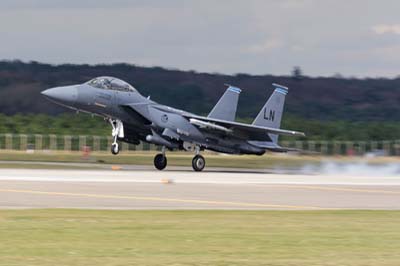 Back at Lakenheath, pilot Capt. Schmidt said, "The first thing we do is debrief maintenance, to let them know what happened to the jet and what condition it is in and say what was good and what was bad with it. After taking off our gear we then go back to the briefing room and all gather together for a group discussion. Here all rank comes off for us, the flight leader will debrief everyone on precisely what went wrong, regardless of rank and suggest what we can do next time to improve. It's a time when each person is very hard on the others in the formation" The debriefing proceedures have been perfected by generations of aircrew to make sure every point is covered and everyone involved is aware of what should have happened and what actually happened. It's a time where aircrew learn the most about their missions as it is oonly then that the instructor or mission leader can really express themselves. |
|
Photography note: To complete the story it was not possible to fly with the F-15 crews themselves and also to take pictures of them flying low-level from the ground. The images were gathered from a number of sessions in the hills in Cumbria, from aboard a KC-135 of 100ARW and of course from within and outside their base at RAF Lakenheath. A range of lenses were used from the DSLR x1.6 sensor + Canon EF 100-400mm L IS lens for the ground action shots to a EF 17-40mm L IS for the air to air shots. Many thanks to all involved at Public Affairs at Mildenhall and Lakenheath and to the crews of 48th FW and 100 ARW. |
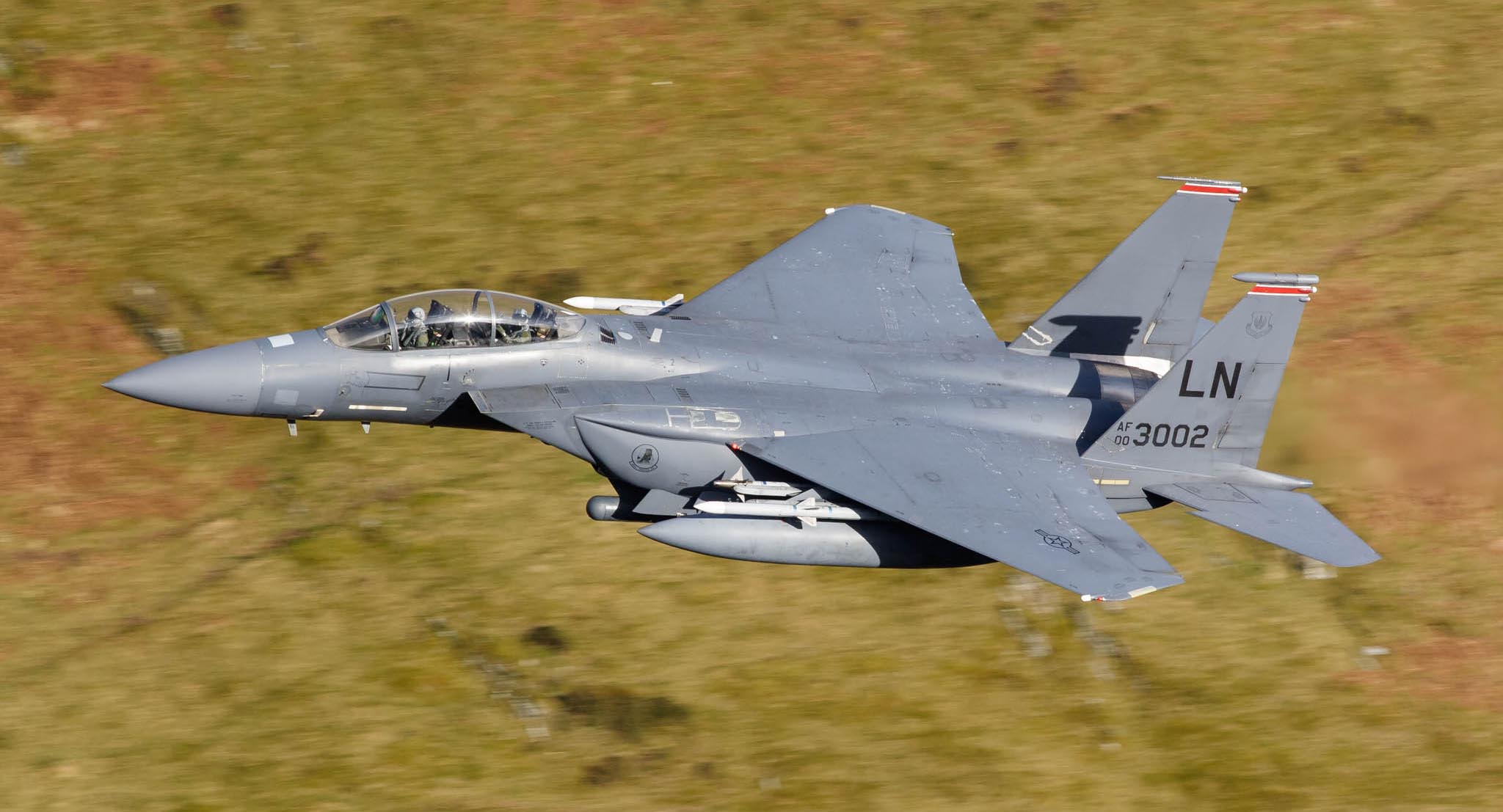 |
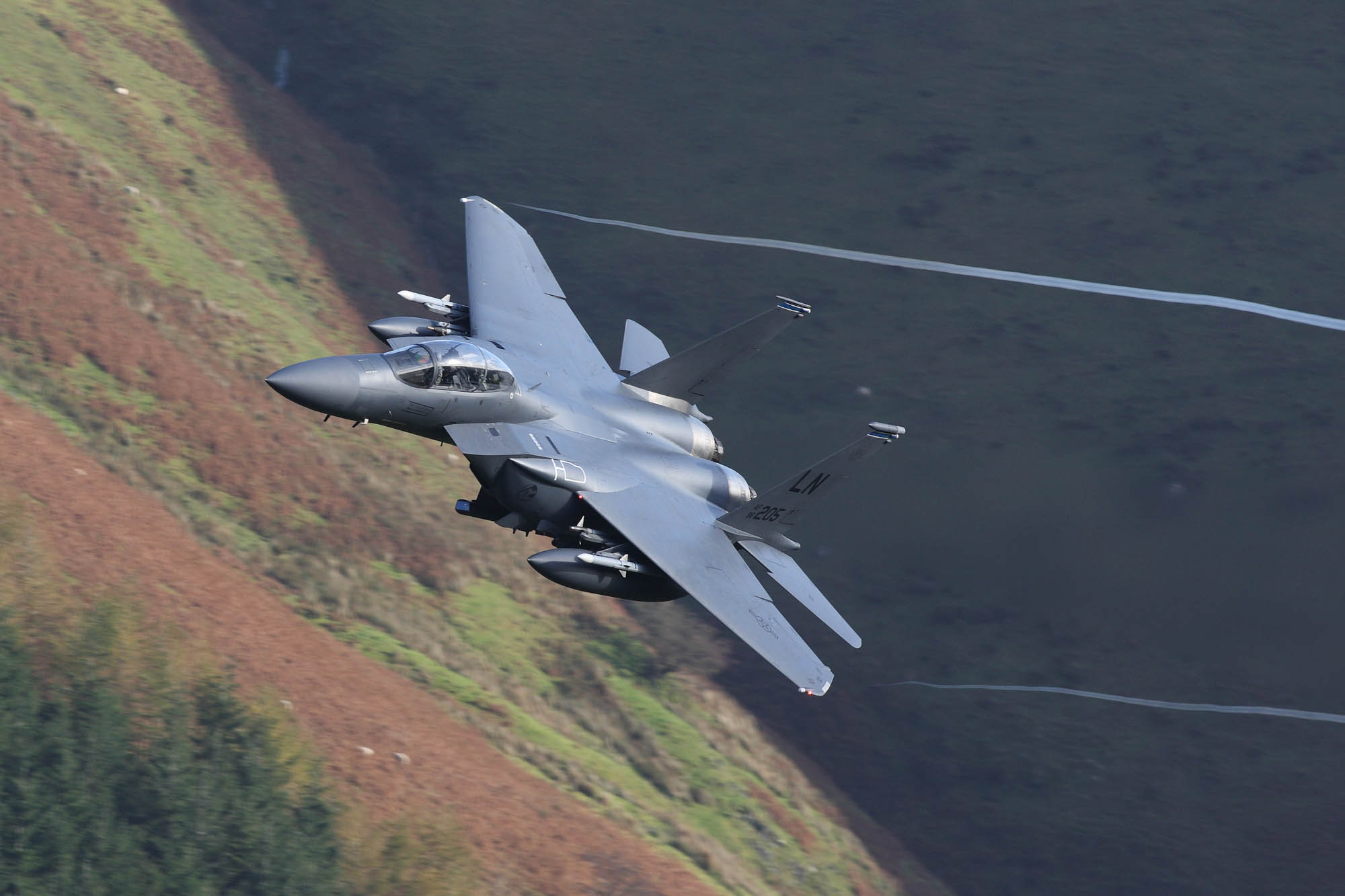
| F-15E Strike Eagle (00-3002 'LN') of the 494th Fighter Squadron, 48th Fighter Wing out for the second time today using callsign 'Strong 12' following a hot pit refuel in February 2008. |
| Hot Pit Refuelling Hot pit refuelling allows an aircraft to be turned around as quickly as possible between sorties. The operation is carried out away from the normal parking area. The jet is made safe with pins installed in missiles, bombs, chaff and flares to prevent accidental actuation on the ground. The pilot keeps the right engine running, shutting down the left engine to give the groundcrew access to the refuelling receptacle. In February 2008 F-15E Strike Eagle (91-0332 'LN') of 492nd Fighter Squadron using either callsign 'Sonic 71 or 72' passed through the Lichfield Corridor and dropping into low-level in LFA 7 (mid-Wales). At 10:03 it passed my location and continued its mission and 25 minutes later RTB'd to Lakenheath. After hot pit refuelling it was back out again following a similar pattern of calls, passing me at 12:40 this time in sun and making two passes. |
 |