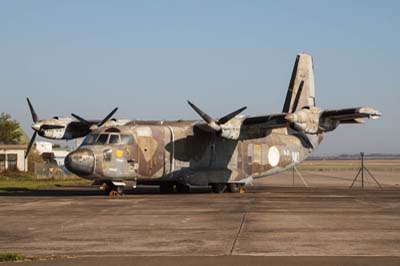
Musée de l'Air et de l'Espace
(Air and Space Museum)
Le Bourget Airport, Dugny, Paris
2011 to 2024 |
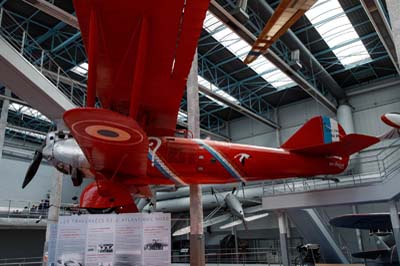
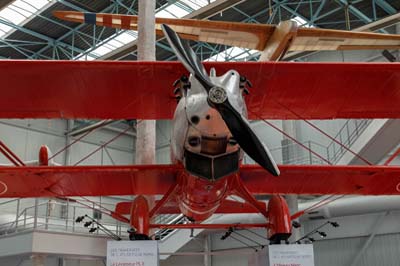
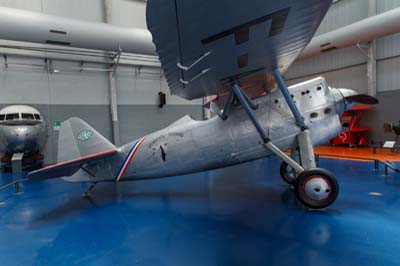
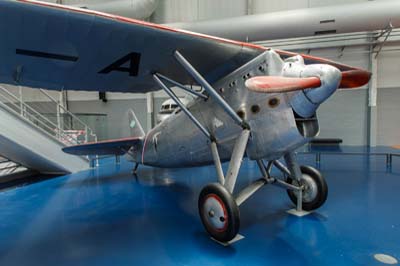
Le Bourget airport commenced commercial operations in 1919 and Charles Lindbergh completed his historic solo transatlantic crossing in 1927 when he landed at the Paris airfield. Conceived in 1919 the Musée de l'Air is one of the oldest aviation museums in the world. There is no place better for France's main aerospace museum, it houses many unique French designed aircraft displayed in numerous themed halls.
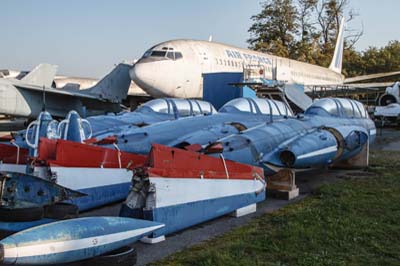
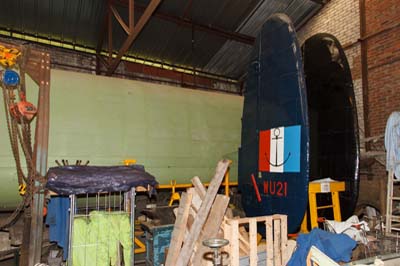
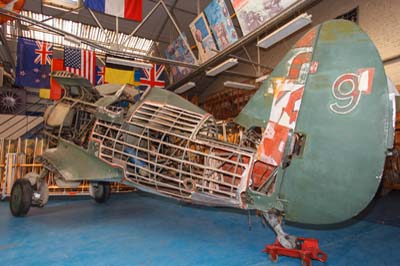
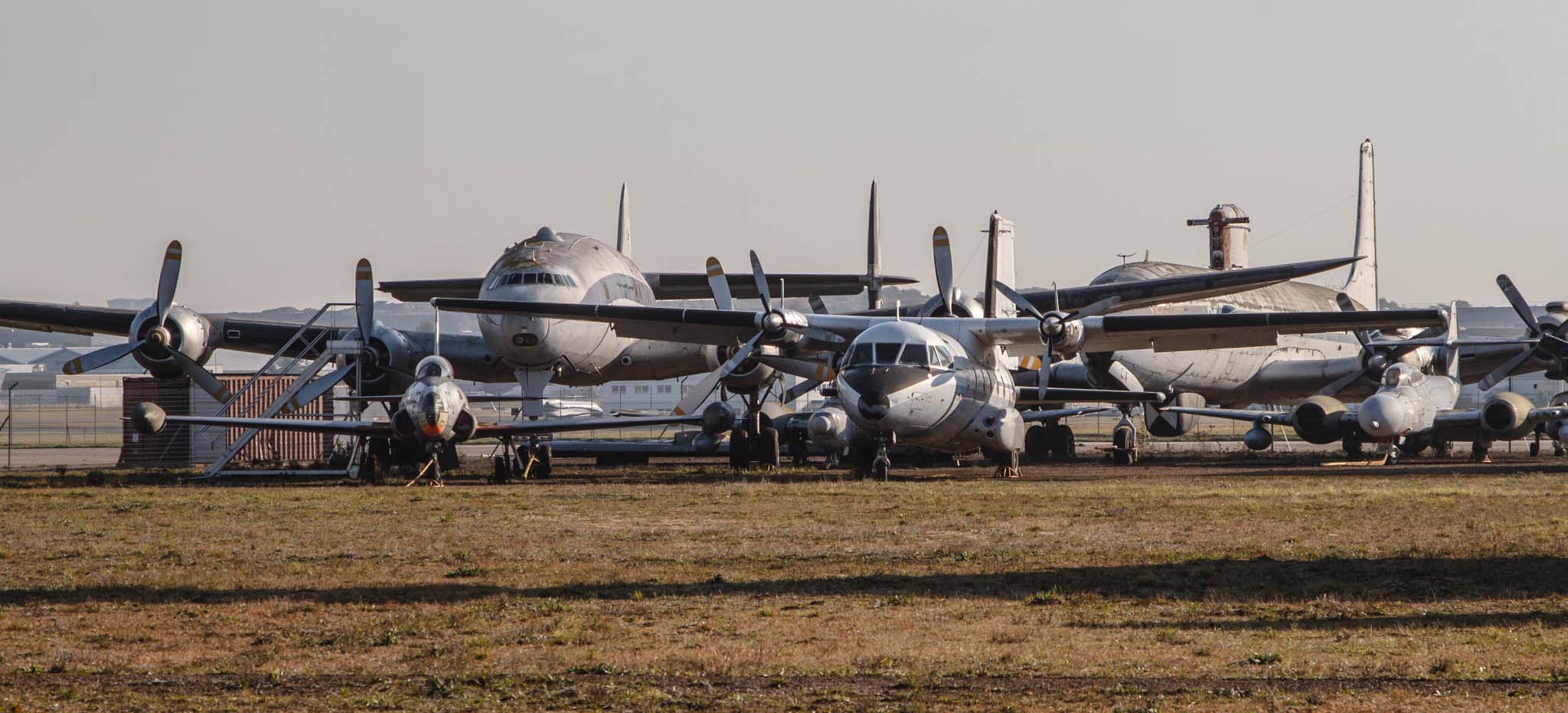
Parts of the collection are hidden away however in hangars not normally open to the public. On the far side of the airfield is the Dugny storage site where aircraft are stored or held awaiting restoration. The store is usually open over one weekend for the 'journée de la patrimoine' (day of the inheritance) every September. |
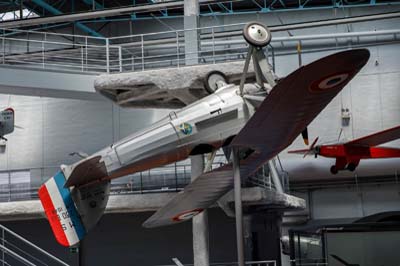
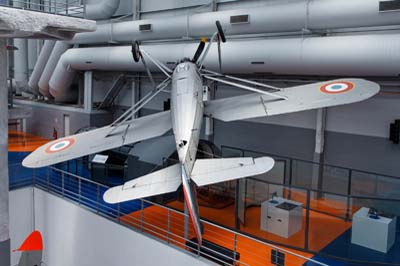
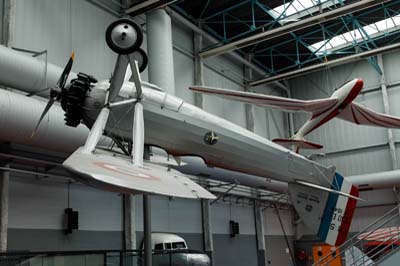
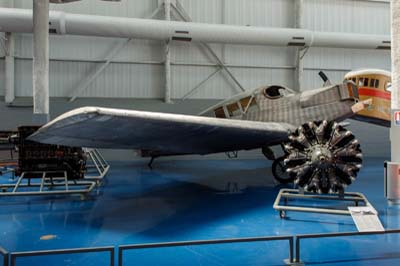
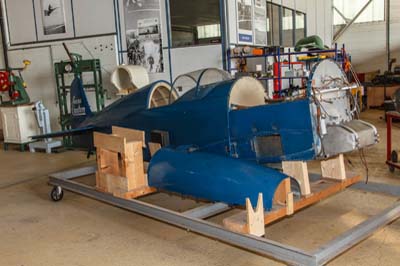
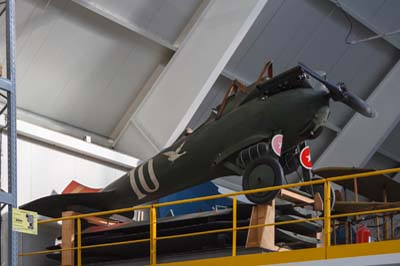
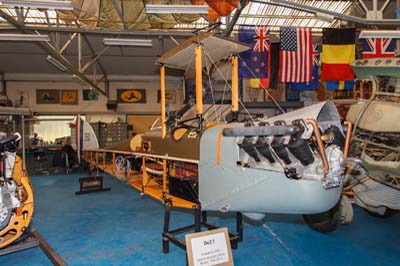
| Deperdussin Monocoque designed for air racing it probably never flew. |
Left to right:
Blériot XI-2 (686) This two-seater derived from the XI was built in numbers for the civil and miliary market. Adolphe Pégoud flying a reinforced XI-2 was the second pilot to perform an acrobatic loop. He also became the world's first flying 'Ace' after shooting down five enemy aircraft, sadly he was shot down and killed on August 31, 1915.
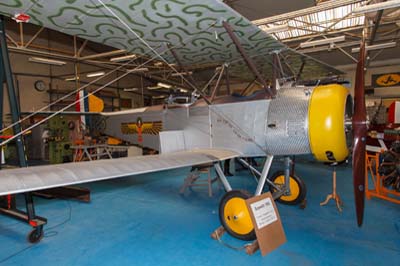
Nieuport IIN (). Built by the Société Anonyme des Établissements Nieuport between 1910 and 1914, it high performance enabled it to winning many air-races before being used as a trainer during World War One. This example was built specifcally for the museum in 1921.
|
Left to right:
Levavasseur Antoinette (). After designing an aircraft engine in 1904, Léon Levavasseur two years later worked with Louis Blériot and Jules Gastambide to build the Antoinette. Hubert Latham failed twice piloting an Antoinette in 1909 to cross the English Channel and it came second in the Grande Semaine de Champagne speed test.
The example on display has an original fuselage and engine, the wings were reconstructed after World War Two using the original plans.
Morane-Saulnier Type G () a two-seat sport and racing monoplane from 1913. There is an original survivor at Museo del Aire de Cuatrovientos in Madrid.
|
 |
Left to right:
Bréguet 14 A-2 (No.2016 registered F-WAHR), around 8,000 examples of this two-seat bomber and reconnaissance type were produced between 1916 and 1928, including civilian models. It was manufactured using a significant proportion of light alloys, rather than wood and steel, unusual for the time. Its first flight was made on November 21, 1916 flown by Louis Bréguet who declared it to be fast and agile. The A-2, powered by a 300hp Renault V-12 engine, was the standard wartime variant.
The French equipped at least 71 escadrilles deployed on both the Western Front and the Italian Front. Production continued till 1928 and the type remained in service till 1932. After the Armistice civilian Bréguet 14 conducted a number of long-distance flights to demonstrate its capabilities. In 1919 a long-distance record was achieved from Paris to Kenitra, Morocco, a distance of 1,200 miles (1,900 km) in 11 hours 15 minutes.
This genuine French example is one of only two that have survived. It's restoration has included a new fabric covering and painting, unfortunately the front machine gun missing. |
Left to right:
Fokker D.VII (5796/18). Designed by Reinhold Platz at Fokker. In a competition for the best fighter, Baron Manfred von Richthofen 'Red Baron' flew the D.VII. After he had directed improvements to be made, it was declared the winner. The first aircraft entered service in May 1918, too late for von Richthofen who had been killed just days before it was introduced. By the end of World War One this aircraft was considered to be the best German fighter. The so-called 'Lozenge' camouflage pattern, was not actually painted on the linen but the linen was actually printed with this diamond-shaped pattern.
Built under license at the Albatross factory, this example was surrendered in 1919 as part of the World War One Armistice. Today, this example is one of seven D.VII survivors. |
Left to right:
Nieuport XI Bébé (N976 painted as 'N556'). Designed by Gustave Delage, over 7,000 were built from 1915, delivered to the French Aéronautique Militaire, the British Royal Naval Air Service, the Imperial Russian Air Service, the Belgian Air Force, and Italian Corpo Aeronautico Militare, ending the German's air dominance of the Fokker Eindecker. It remained in service until the 1920s.
This example built Nieuport-Delage in 1921 for the museum is painted to represent the aircraft flown by Commandant Charles de Tricornot de Rose, known as the father of French fighter aircraft. |
Left to right:
Farman HF.20 () built from 1913 delivered initially to the French, Belgian and Serbian armies but did not perform well due to its Gnome Lambda engine's lack of power.
Farman MF.7 Longhorn (15) Produced by Maurice and Henri Farman at the Farman Aviation Works in France from 1913 it was designed for observation missions, however, in August 1914 it was utilised as a bomber with a raid on the Frescaty Zeppelin hangar, near Metz. From 1915 it was withdrawn from the frontline for instructional and liaison use.
The example on display was used by the Belgian army to transport high authorities, including King Albert 1st.
Esnault-Pelterie REP Type K (58) Built by Robert Esnault-Pelterie, it was intended for reconnaissance when introdcued in mid 1914, it had little success due to the wing blocking the pilot's view. This is the only known survivor.
|
| Morane-Saulnier MS.230 (No.1048). |
Left to right:
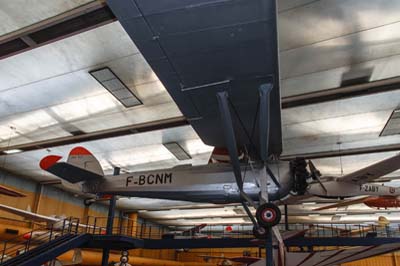
Morane-Saulnier MS.230 (No.1048). SA des Aéroplanes Morane-Saulnier was established in 1911 by Raymond Saulnier and the Morane Brothers. The MS.230 was their first (MS.315 followed) parasol-wing aircraft, it was flown first in February 1929. Designed as fighters they quickly ended up as trainers due to their lack of basic speed. Once they were disposed of by the military they became popular with civilian flying clubs.
Morane-Saulnier MS.317 (F-BCNM). The MS.301 first flew in 1931 and from 1960 40 MS.315s were upgraded to MS.317 for the French Navy. |
Left to right:
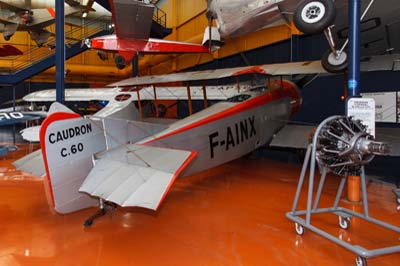
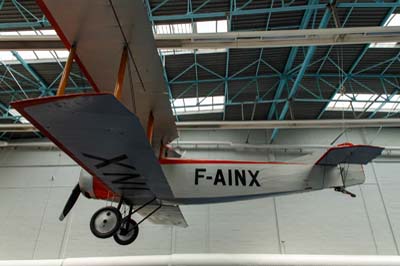
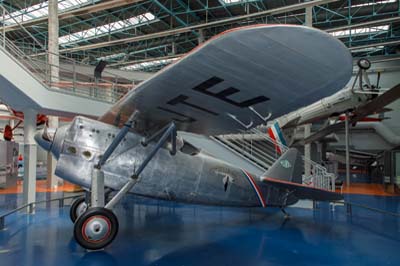
Caudron C.60 (F-AINX). The Caudron C.60 is a single-engine two-seat trainer biplane produced by the French manufacturer Société des avions Caudron from 1921.
|
Left to right:
Junkers F-13 (unknown possibly c/n 600 O-BACC). The F-13 was the world's first all-metal transport aircraft it first flew on June 25, 1919. Germany at this time under the terms of the Treaty of Versailles was banned from producing this type of aircraft and so it was initially built under license in the United States from 1921. |
Left to right:
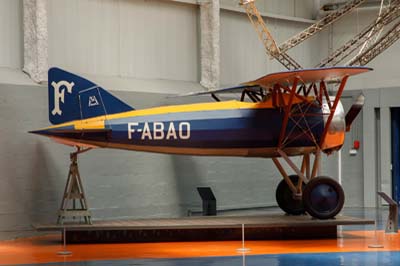
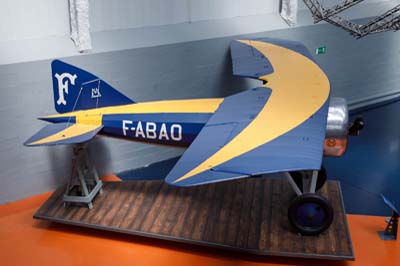
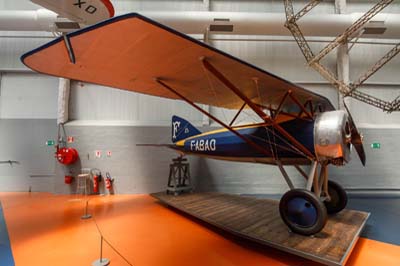
Morane-Saulnier AI (F-ABAO No.2283) Built in 1920 for aerobatics it appeared in Zurich in 1920, 1921 and 1927 when it won the aerobatic competitions. It was restored between 2013 and 2016. |
Left to right:
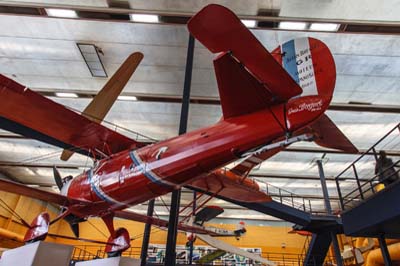
Bréguet BR.19 Super Bidon (c/n 3) Following its first flight on July 23, 1928, Bellonte Costes flying the aircraft now on display was the first to fly from Paris to New York in 1930, crossing the Atlantic from east to west in more than 37 hours. It was presented to the Museum in 1938 a restoration was completed in May 2002. |
Left to right:
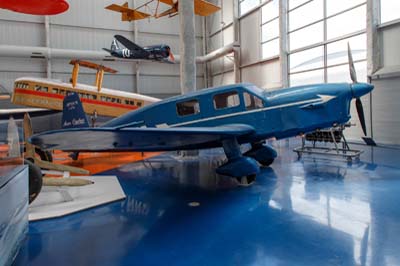
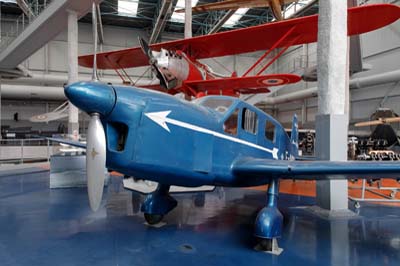
Dewoitine D.530 (F-AJTE No.6) Designed in 1937, the D.520 was a copy of the D.21 which was delivered to the French air force from 1939 performing well as a fighter in the Battle of France. This D.530 variant was built in 1937 for test pilot Marcel Doret who flew it until 1955. |
Left to right:
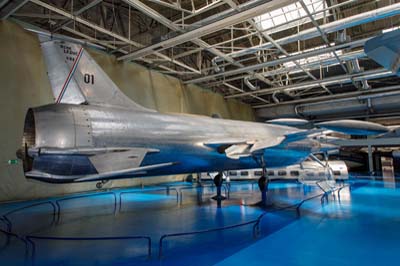
Caudron C.714R (01) ex Adl'A, another C.714 is in storage/restoration based on a fuselage and tail surfaces from Finland serial CA-553 with new-built wings.
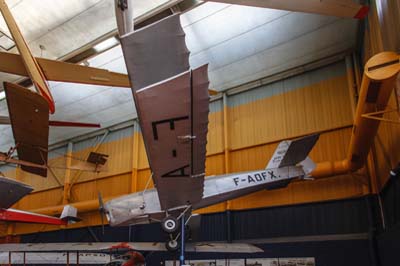
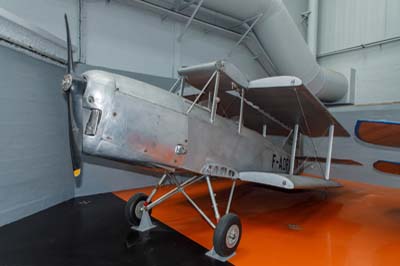
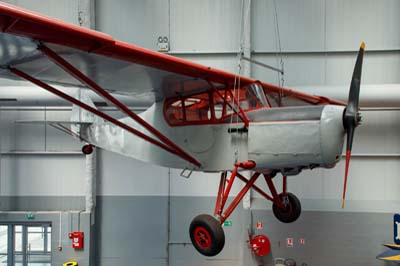
Caudron C.272/5 Luciole (F-AOFX). The Caudron C.270 Luciole ('Firefly') was a sport, touring and trainer aircraft produced in France in the 1930s, it was derived from the C.230. Over 700 machines were built in the decade leading up to World War Two. Of these, 296 were purchased by the French government for its pilot training programme, the 'Aviation Populaire'. The C.270 were fitted with Salmson engines which were replaced by a Renault engine in the C.272.
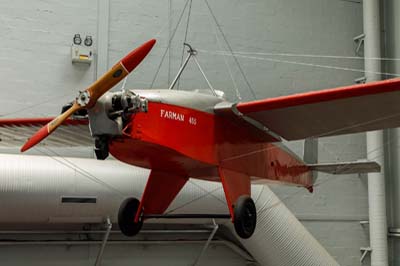
Farman 455 Moustique III (F-AYOL No.1). Bulit by Société des Aéroplanes Henry et Maurice Farman at Billancourt in 1936. Only one was built as its performance was unimpressive. |
Left to right:
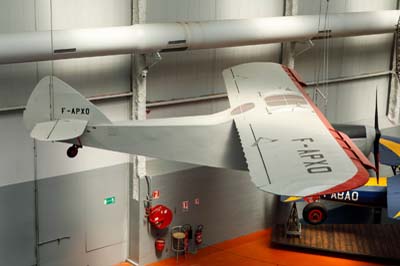
Potez 437 (F-APXO No.3588) A light utility and sports aircraft, developed in early 1930s based on the Potex 43 of which 161 were built. The 437 variant first flew in 1934. |
Left to right:
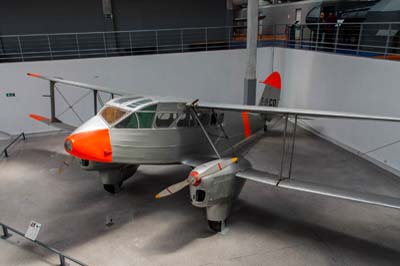
Société des avions Caudron Simoun C.630 (F-ANRO No.7017). A four-seat touring and liaison aircraft derived from the C.520 and C.620 which first flew in 1934 the 20 C.630 built featured a modified cabin. |
Left to right:
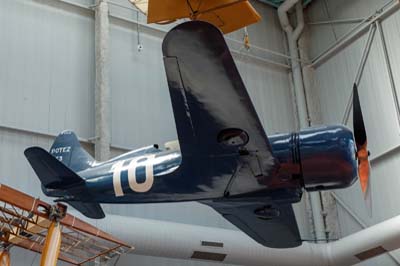
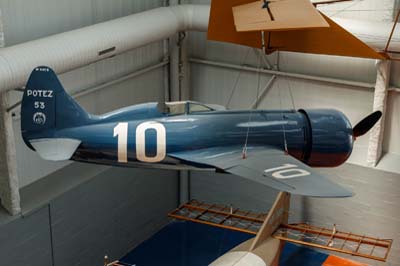
Potez 53 (No.3402 '10') A low-wing, enclosed cockpit, single-seat racing aircraft built for the Deutsch de la Meurthe Cup which it won on May 29, 1933 piloted by Georges Détré. |
Left to right:
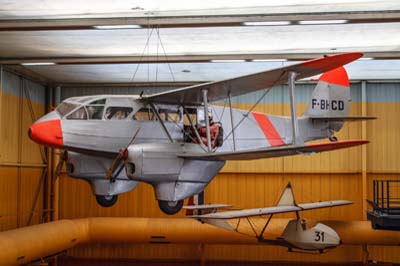
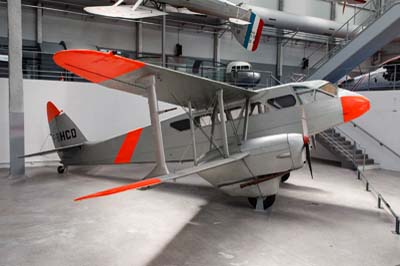
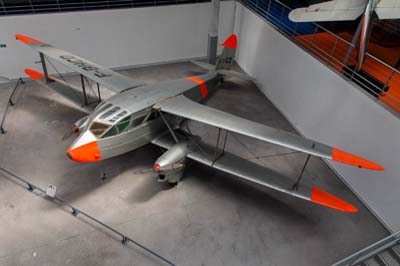
de Havilland DH.89 Dragon Rapide/Dominie (F-BHCD ex HG721). The Dominie was built by de Havilland as a military version of the DH.89 Dragon Rapide. The DH.89 was first flown in 1934 and by the time production ended about 10 years later, 728 had been built over 530 Dominies served with the Royal Air Force. |
Left to right:
Avia 41p first flight in 1932.
Avia 40p first flight in 1935, 60 were produced. The example on display was delivered to the French Air Force in 1937.
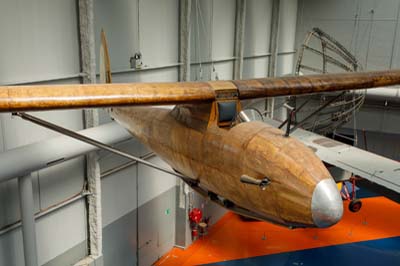
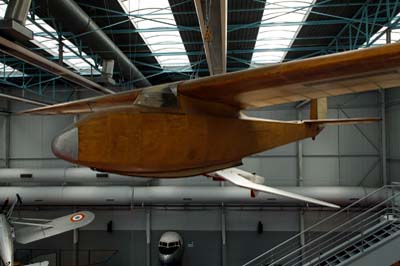
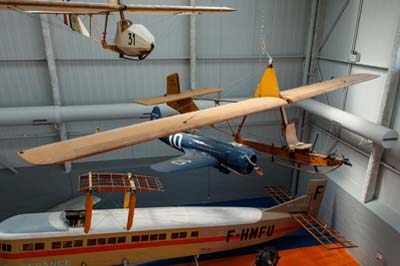
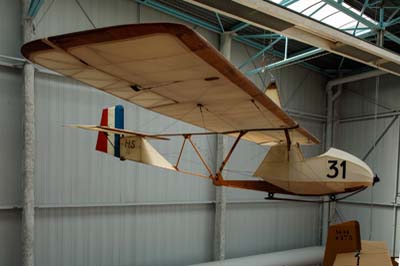
SchulGleiter (SG) 3 Training glider built in 1938, between 5,000 and 8,000 were built to train Luftwaffe pilots.
SchulGleiter (SG) 38 Carene built in 1938 for ab initio training. |
Left to right:
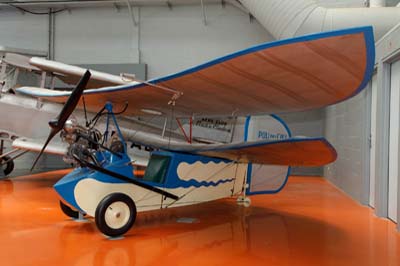
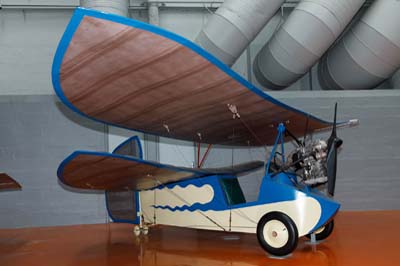
Mignet HM.14 Pou du Ciel 'Flying Flea' The HM.14, designed in 1934 by Henri Mignet was probably the first home-built to be offered to the public for home construction. Following a number of fatal accidents and the discovery of aerodynamic design errors the French authorities banned it from flying in 1936, the British authorities following suit in 1937.
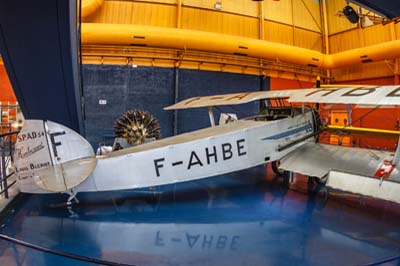
Bleriot SPAD 54 Herbemont (F-AHBE) A training and touring aircraft built from 1922.
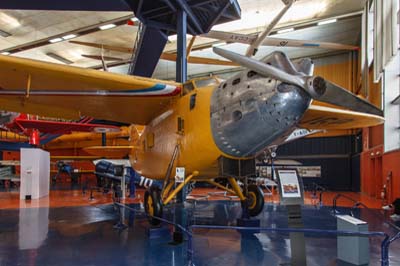
Bernard 191 Grand Raid (F-AJGP ex NC9422). The Bernard 190GR was a French built passenger aircraft which made its maiden flight in 1928. Grand Raid meant that it was designed for long range flight. The aircraft on display was the second example built. It was used in the first successful French aerial crossing of the North Atlantic, flying from Old Orchard Beach, Maine on June 13, 1929 and piloted by Jean Assolant, René Lefèvre and Armand Lotti. It completed the crossing to Oyambre, near Comillas, Cantabria, Spain, in 29 hours 52 minutes. It was no longer on display in 2024. |
Left to right:
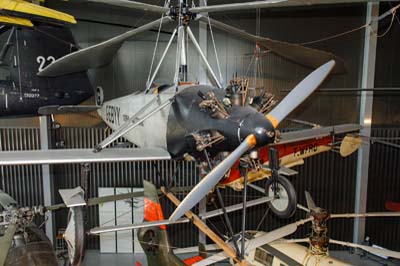
Lioré and Olivier (Cierva) C-30 Autogiro (F-BDAD). Lioré-et-Olivier built 25 examples under license of the Cierva C.30 an autogiro designed by Juan de la Cierva a Spaniard. The company was nationalized in 1936, becoming a part of SNCASE.
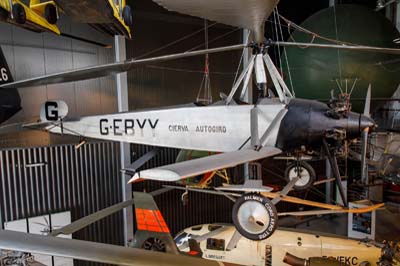
Cierva C8L-II Autogiro (G-EBYY). Juan de la Cierva, developed the unique aircraft calling it the Autogyro in 1923. The Cierva C8 on September 18, 1928 made the first rotorcraft crossing of the English Channel followed by a tour of Europe. The C8L.IV had a Wright Whirlwind engine, in the United States the autogyro was redesignated C.8W. From 1928, production of autogyros was licensed to a number of manufacturers, including the Pitcairn Autogiro Company in the US and Focke-Wulf of Germany. The Autogiro was eventually license built the C.30 series by A V Roe & Co from 1934 for the civil and military market, they subsequently built 78 examples. |
Left to right:
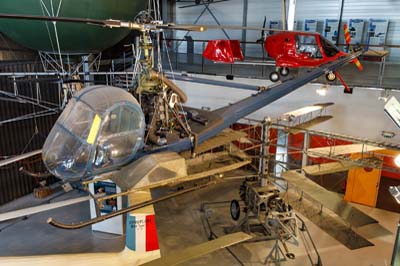
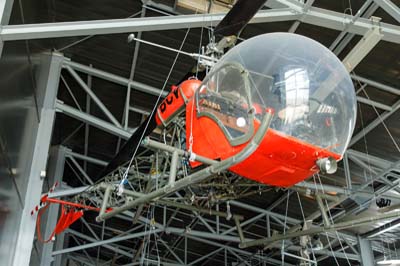
Hiller UH-12B Raven (F-BNGM c/n 699). Unmarked it was purchased by the museum in 1997.
Bell 47G (710 'BCV').
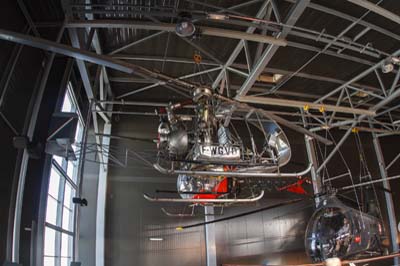
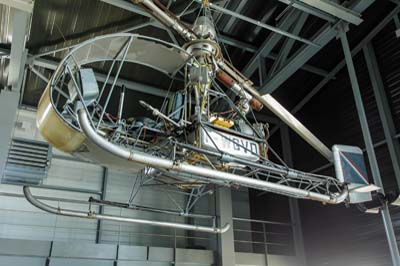
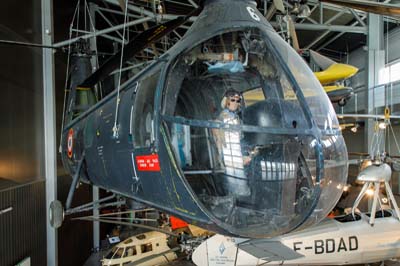
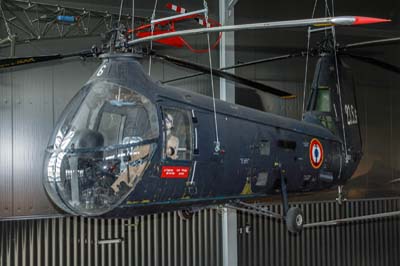
SNCASO SO 1220 Djinn (F-WGVD c/n 02) is a French two-seat light helicopter designed and built by Sud-Ouest later Sud Aviation. A prototype S.O.1220 first flew on January 2, 1953. The French Army ordered 100 helicopters for the liaison, observation and training role. Production ended in the mid-1960s after 178 Djinns had been constructed. |
Left to right:
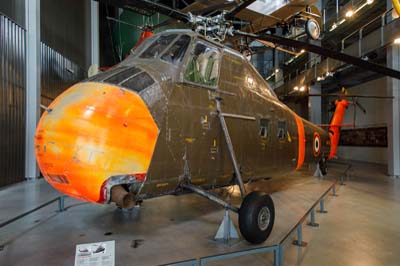
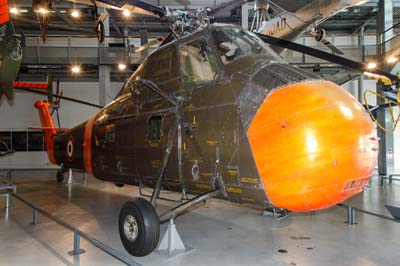
Sikorsky H-34A (SA-53 later registered F-ZAGP). It first flew in 1954. A total of 135 H-34s were built in the US and assembled by Sud-Aviation in France, 166 were produced under licence in France by Sud-Aviation for the French Air Force, Navy and Army Aviation.
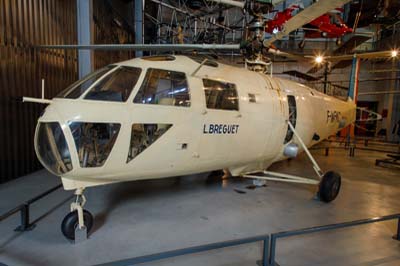
L.Bréguet 111 Gyroplane (No.0 F-WFKC).
SNCASE Sud-Est SE 3101 (01). |
Left to right:
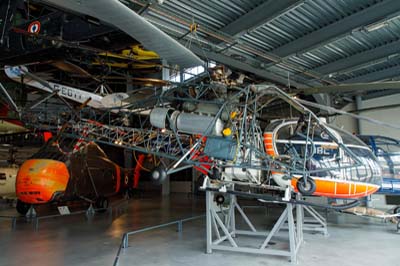
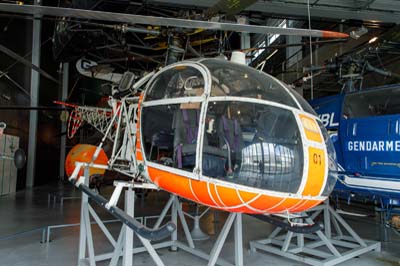
SudOuest SE3130B Alouette II (01 'AS').
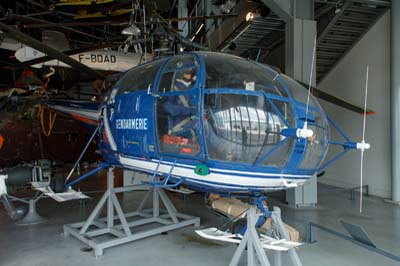
Sud Aviation later Aérospatiale SA-316B Alouette III (1115 F-ZBAN) Sécurité Civile.
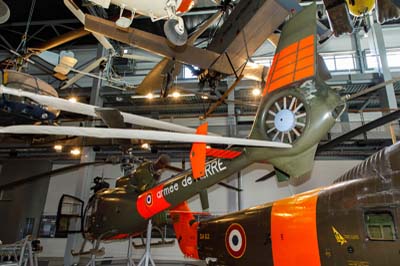
Aérospatiale SA341F Gazelle (1069 'BGD'). |
Left to right:
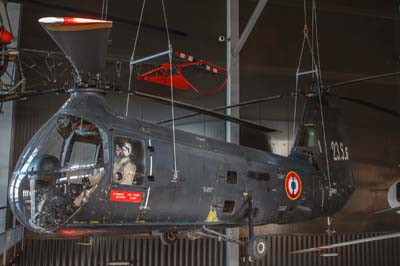
Piaseki HUP-2 Retriever (128594 painted as '130077' '23.S.6') ex French Navy. Designed as a utility transport, search and rescue helicopter for the US Navy it was built by the Piasecki Helicopter Corporation of Morton, Pennsylvania during the late 1940s and early 1950s. The company changed its name in the 1956 to Vertol Aircraft Corporation and was subsequently bought by Boeing Aircraft Company in 1960 to become Boeing-Vertol. |
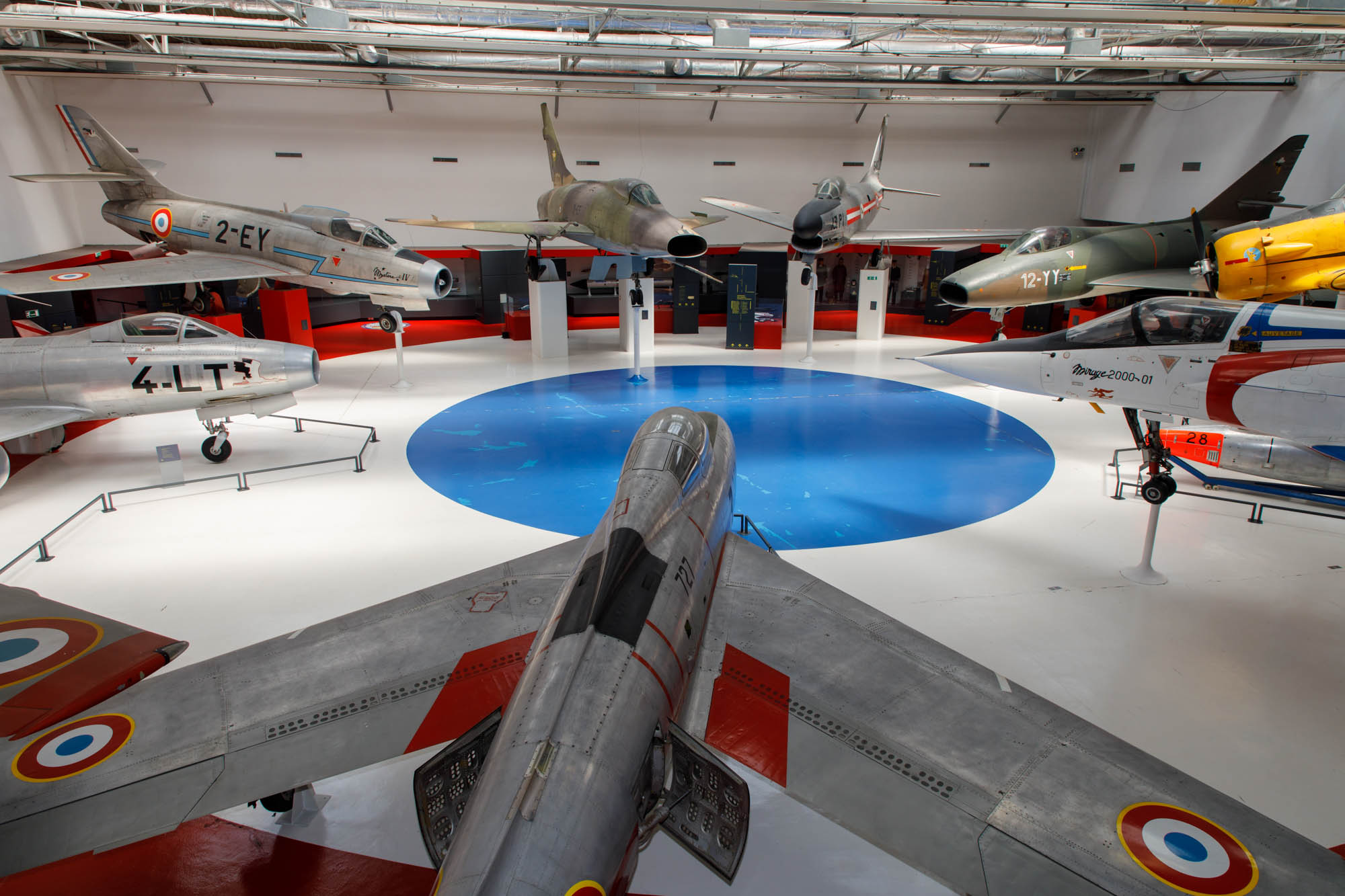
| Cocarde Hall 8 – French military aviation |
Left to right:
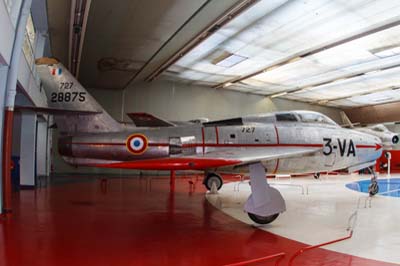
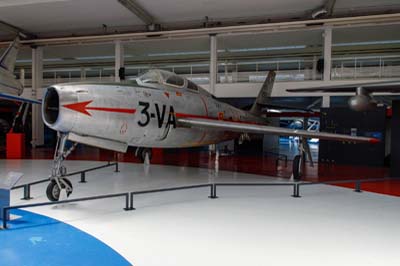
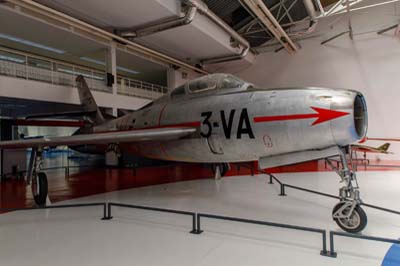
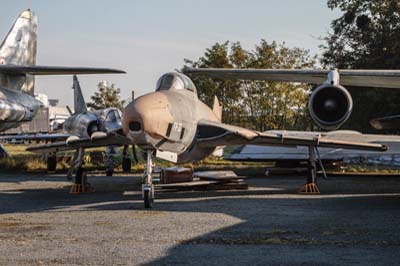
Republic F-84F Thunderstreak (52-8875 '3-VA'). The F-84F was developed after the F-84G and was a vastly different aircraft. It was originally designated the YF-96A and was capable of speeds of 695 mph. 2,711 Thunderstreaks were built, 1,301 of which were transferred to Allied air forces in Europe. The Armée de l'Air received its first Thunderstreaks in 1955 a year later they deployed the F-84F during the Suez crisis. The F-84F were replaced by the Mirage III in the mid 1960s. |
Left to right:
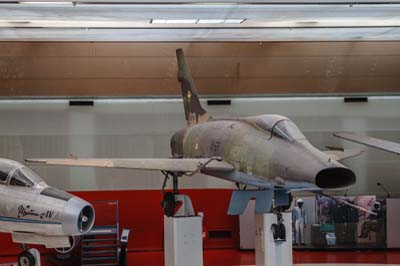
North American F-100D Super Sabre (55-2736 '11-EF') of EC 3/11. 100 F-100s, including 12 F-100F two-seats, were delivered to the Armée de l'Air between 1958-59 from the US.
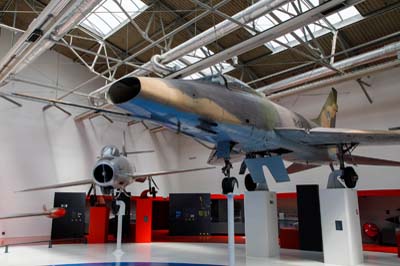
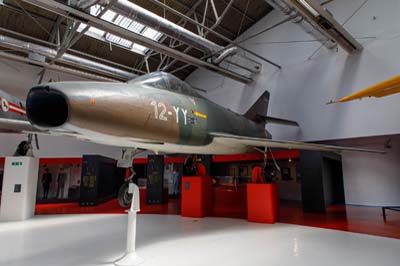
Dassault Super Mystere B2 (11 '12-YY'). Armée de l'Air. |
Left to right:
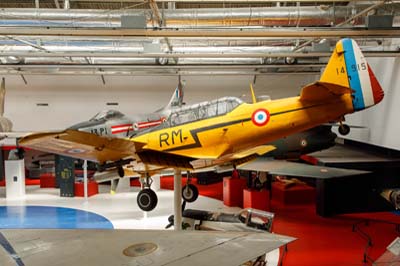
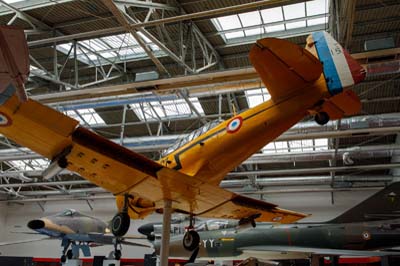
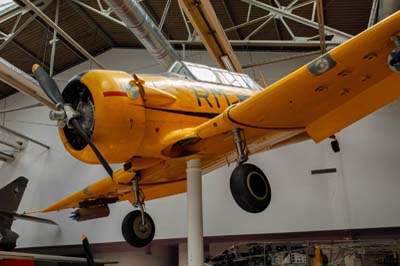
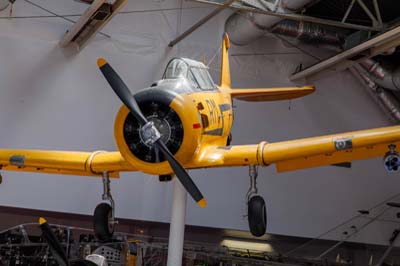
North American T-6G Texan (51-14915 'RM'). |
Left to right:
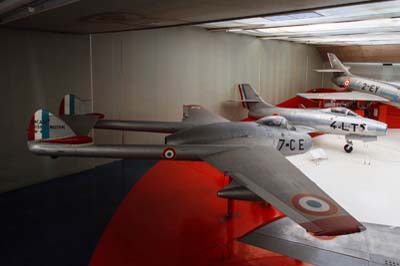
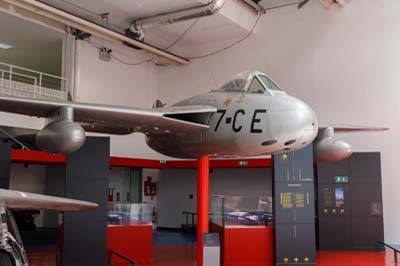
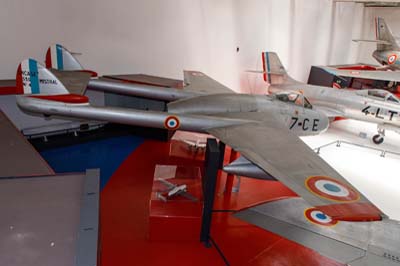
SNCASE SE-532 Mistral (4 '7-CE') Built under license from de Havilland by SNCASE (Société nationale des constructions aéronautiques du Sud-Est or more usually known as Sud-Est). The example on display used parts of SE-532 Mistral 02 for the restoration. |
Left to right:
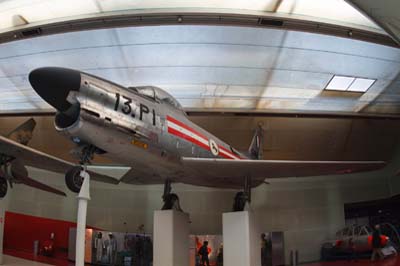
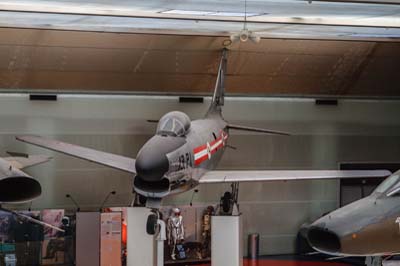
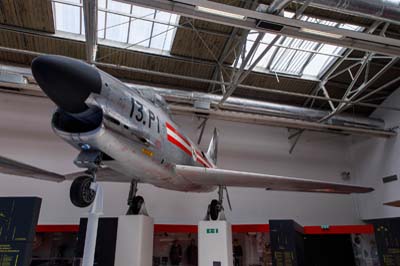
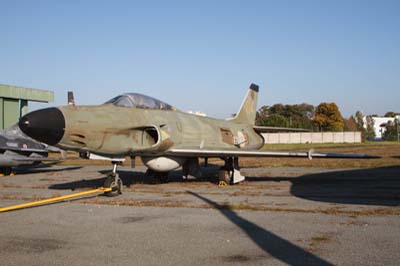
Fiat (North American) F-86K-NF Sabre (55-4841 '13-PI' F-UHPI) of EC 2/13. Derived from the F-86E the F-86K was built under licence by Fiat in Turin and first flew in May 1955. Eventually 221 were built in Italy. |
Left to right:
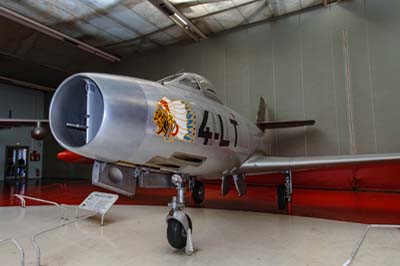
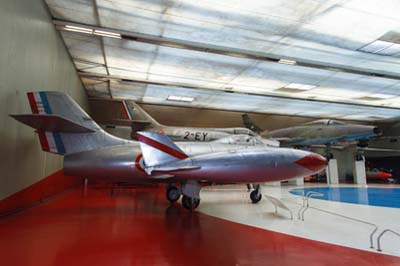
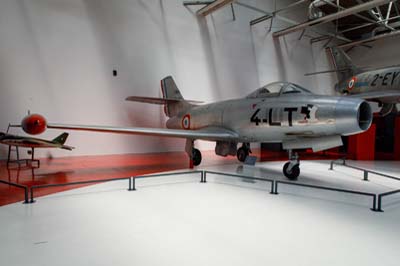
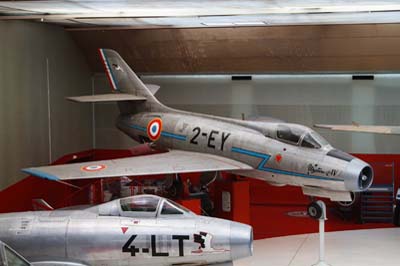
Dassault MD.450 Ouragan (154 '4-LT') of GE 314. It was the first French-designed jet fighter-bomber to enter production from April 1948. The fighter first flew on February 28, 1949. In 1950, Dassault received an order for 150 production Ouragans followed by an additional 200 aircraft. The first jet entered service with the Armée de l'Air in 1952, replacing the de Havilland Vampire. By 1961 the Ouragan had been replaced by the Dassault Mystère IV. |
Left to right:
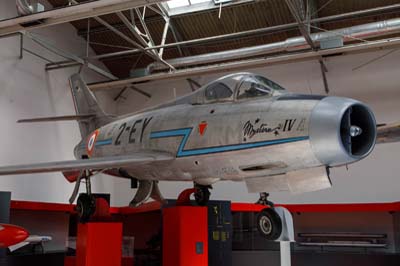
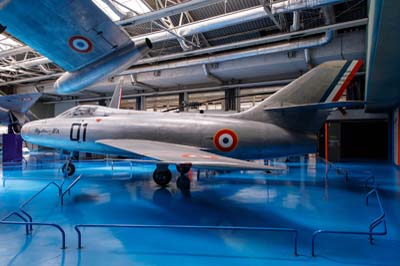
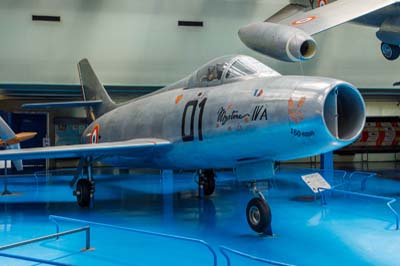
Dassault 454A Mystére IVA (286 '2-EY'). |
Left to right:
Dassault Mirage 2000 (01 F-ZWRS). Five prototypes were built the first of which made its initial flight on March 10, 1978. |
Left to right:
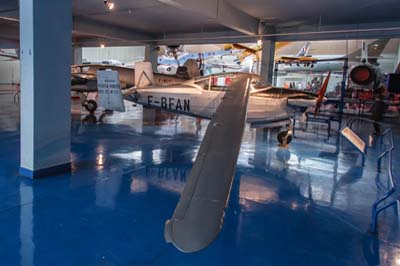
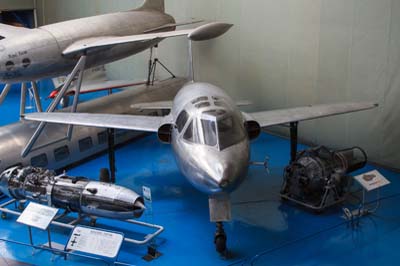
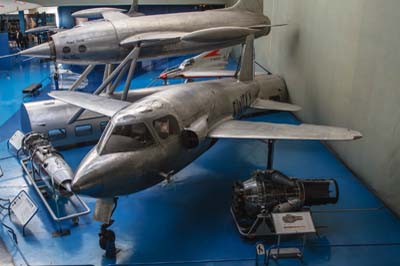
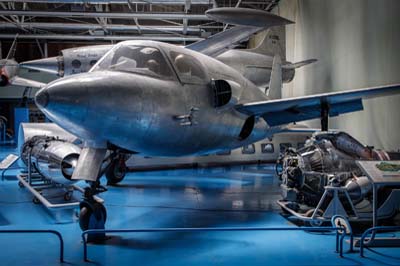
Hurel-Dubois HD-10 (F-BFAN c/n 01) was built as a research aircraft to investigate Maurice Hurel's theories about high-aspect ratio wings, it first flew in August 1948. 200 flight hours later it was retired in 1954.
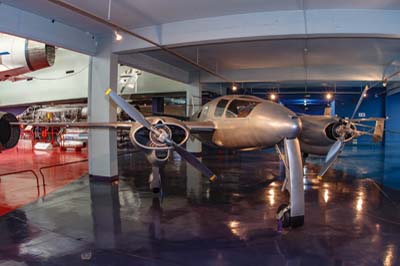
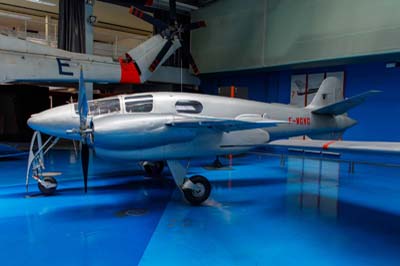
Hirsch MRA C.100 (F-WGVC c/n 01) Built by M.Aé.R.C. (Moyens Aérodynamiques de Régulation et de Controle) the three seat experimental research aircraft first flew in 1954. Designed to test an aerodynamic gust suppression system. It made its last flight on June 16, 1971, after a total of 130 flight hours it was donated to the Musée de l'Air. |
 |
 |
Left to right:
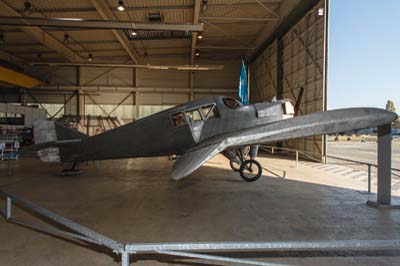
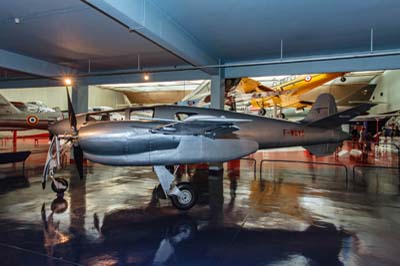
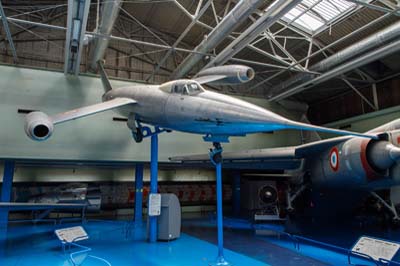
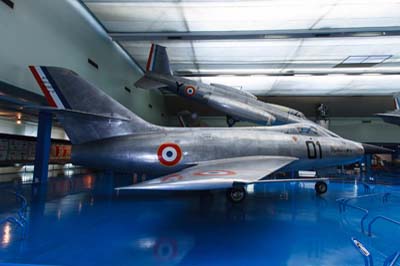
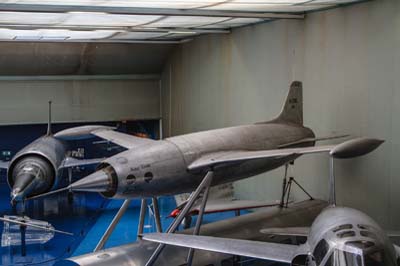
Rene LEDUC 010 (03). Ordered in 1937 by the French Air Ministry construction was almost completed by May 1940. After the War it was finally ready in December 1945 for its first flight which was made on November 19, 1946. The Ramjet design required the aircraft to be carried by the SNCASE SE.161 Languedoc and released when at a suitable height. It eventually attained a speed of Mach 0.85. Two examples were built, one was destroyed in 1951 the other flew until 1964 before it too was written off in a crash. |
Left to right:
SNCASO SO-6000 Triton (03 F-WFKY). Designed by SNCASO (Société nationale des constructions aéronautiques du sud-ouest, commonly known as Sud-Ouest) in secret in 1943, it flew for the first time on November 11, 1946. As a supersonic flight development aircraft, it made eight flights before its retirement. |
Left to right:
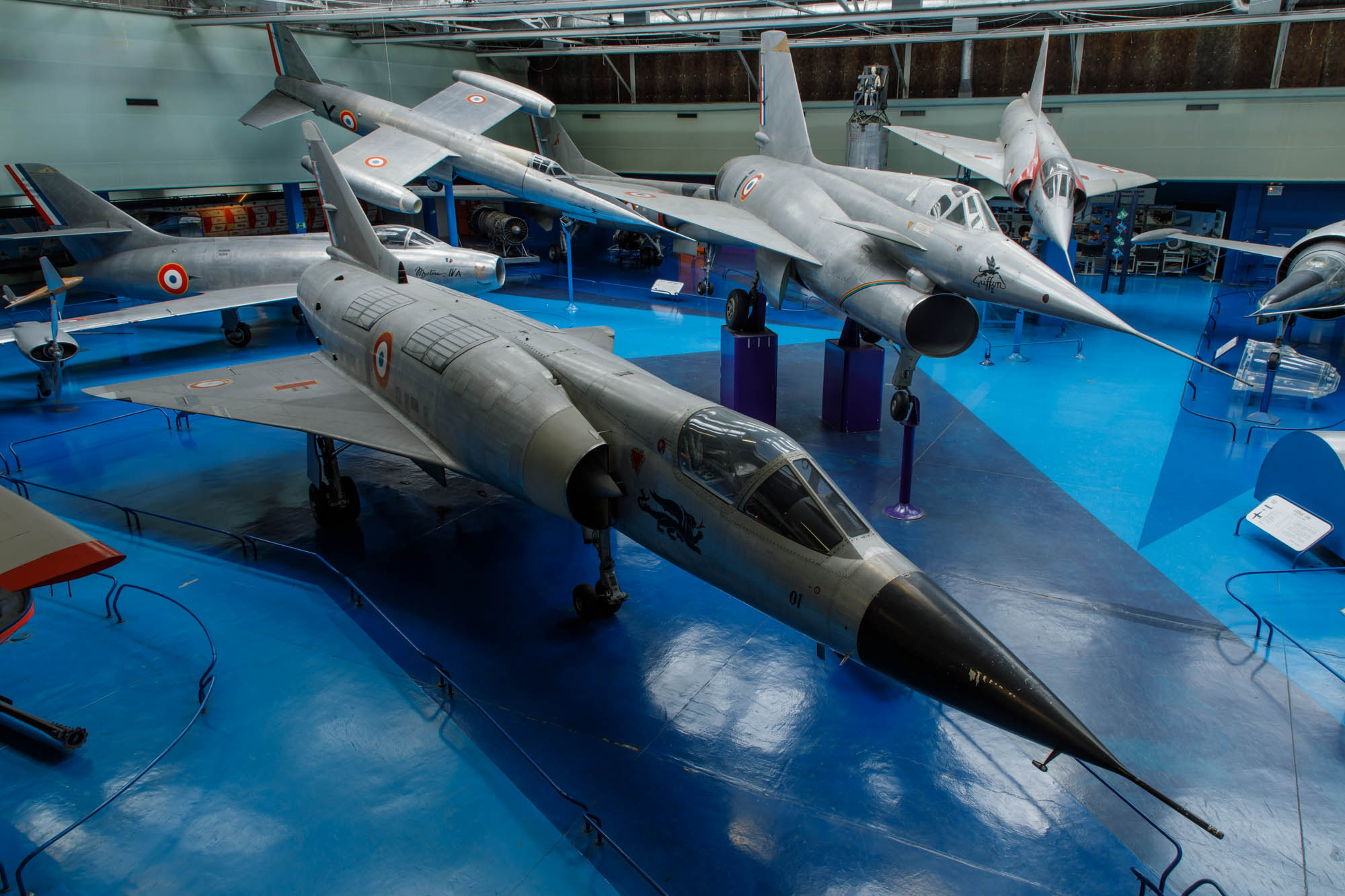
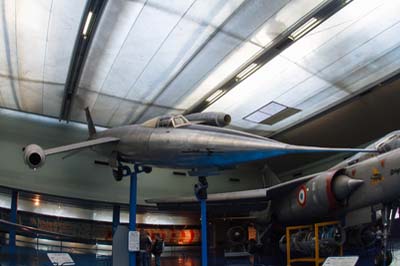
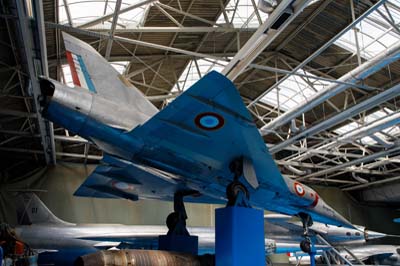
SNCASO SO-9000 Trident (01 F-ZWRY 'Y'). Designed in 1948 as a prototype interceptor aircraft capable of supersonic flight. The project was cancelled in July 1957 after only 12 examples had been built. |
Left to right:
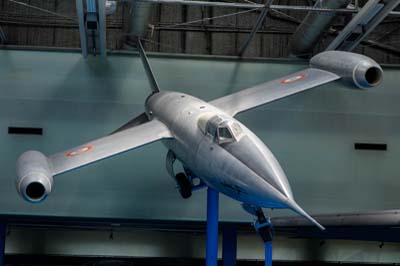
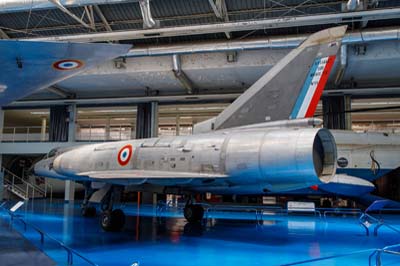
LEDUC 022 (01). Built by Rene Leduc in 1956 it flew for the first time on December 26, 1956 using turbojet power alone, the ramjet was eventually utilised, on May 18, 1957 during its 34th flight. The project was cancelled after 114 flights in favour of the Dassault Mirage III.
SNCAN Nord 1500 Griffon II (02 F-ZWUI). Built by SNCAN (Société Nationale de Constructions Aéronautiques du Nord) development followed on from the Griffon I as an experimental turbo ramjet-powered fighter aircraft, it first flew on January 23, 1957. |
Left to right:
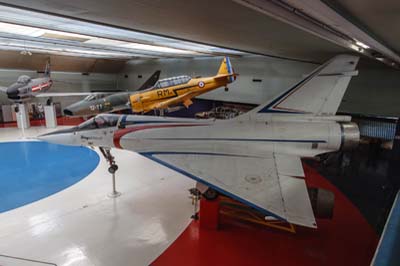
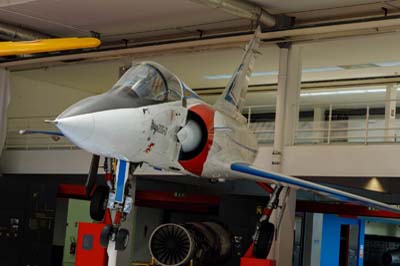
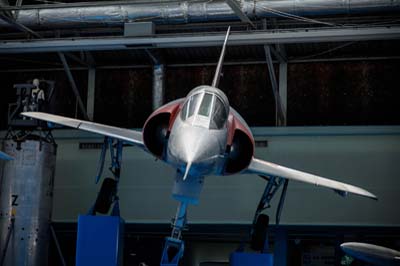
Dassault Mirage IIIA (01) of CEV. This is the first of ten pre-production aircraft which first flew on May 12, 1958. |
Left to right:
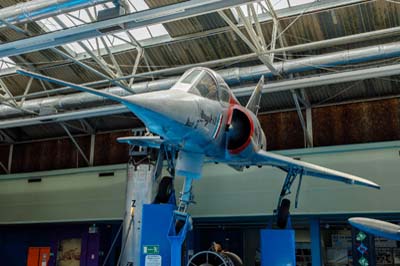
Dassault Mirage IIIV (01). A vertical take-off and landing (VTOL) prototype it featured eight small vertical lift jets alongside the main engine. It made its first VTOL transition in February 1966. Two examples were built however when prototype '02' crashed the project was abandoned. |
Left to right:
Dassault 454 Mystére IVA (01) This prototype first flew in 1952 entering service in 1953. 421 of these fighter-bombers were built. The first 50 had Rolls-Royce Tay 250 engines the rest having a French version of the Tay known as the Hispano-Suiza Verdon. |
Left to right:
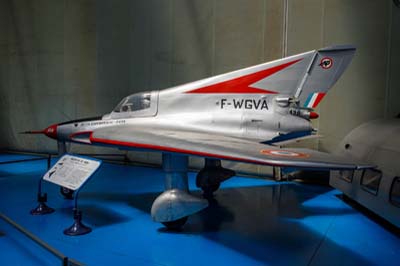
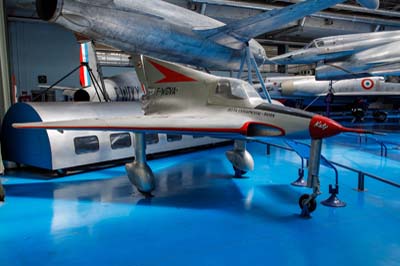
Payen Pa-49B Katy Delta (01 F-WGVA). Experimental delta.
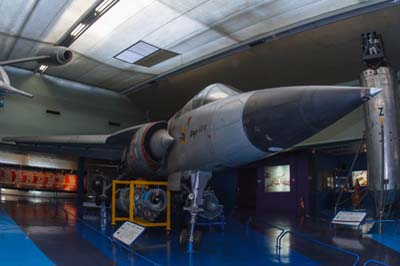
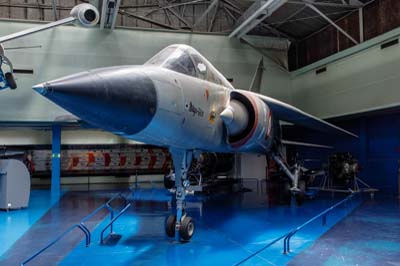
Dassault Mirage G8 (01). Studies commenced in 1963 for a variable-sweep wing aircraft for land and aircraft carrier operations. The single engine Mirage G first flight was made on November 18, 1967. The Mirage G8 a twin-engine version followed, prototype '01' flying for the first time on May 8, 1971. Failing to get orders and further funding the project was cancelled. |
Left to right:
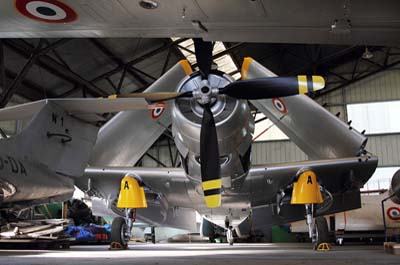
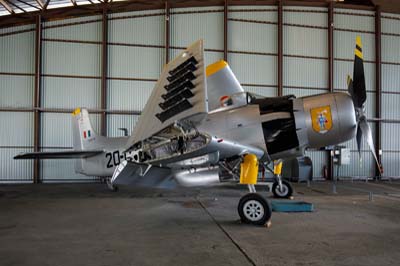
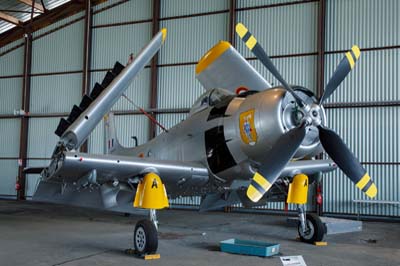
Douglas AD-4N Skyraider (126979 '20-QA'). From 1960 to 1962 EC 20 of the Armée de l'Air received 113 Skyraiders for service in Algeria. They were later operated in Madagascar and Djibouti until 1973 when the aircraft returned to Chateaudun for storage and disposal to the US and the Chad Air Force. |
Left to right:
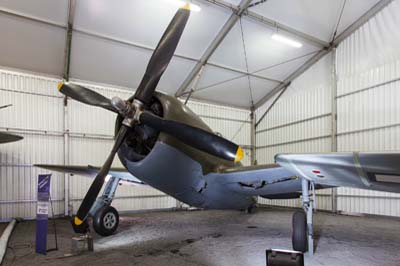
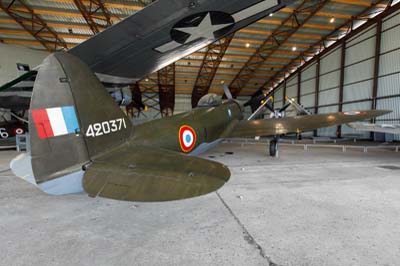
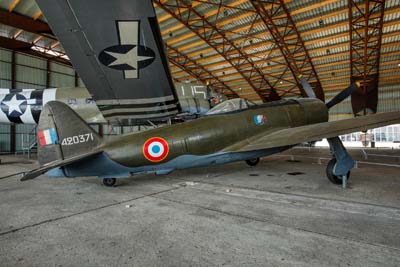
Republic P-47D-30-RE Thunderbolt (44-20371). The prototype flew in May 1941 entering service the following year. Eventually 12,956 were constructed, around 670 examples were supplied to France from 1944 which were operated until 1960. The 'Jug' on display served with the Armée de l'Air until 1960, it was given to the museum in 1963. |
Left to right:
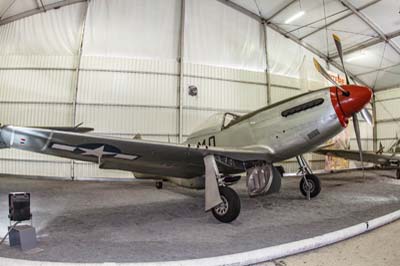
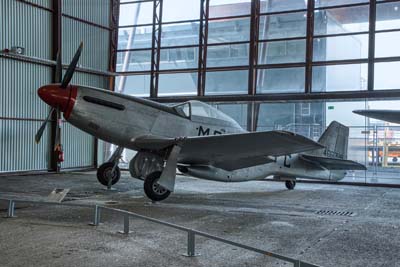
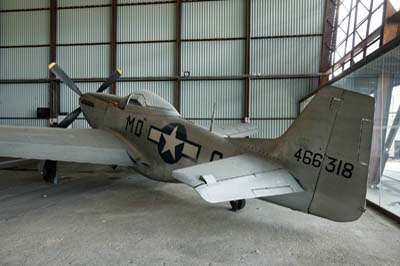
North American P-51D-20NA Mustang ('44-63871 MO-C' previously N9772F) 7,966 P-51Ds were built from 1943 they flew succesfully against German aircraft over Europe. The reconnaissance version (F-6C/D) served with the Armée de l'Air from 1944 until the early 1950s. The example on display was bought by the museum in 1968 and subsequently painted in spurious false markings. |
Left to right:
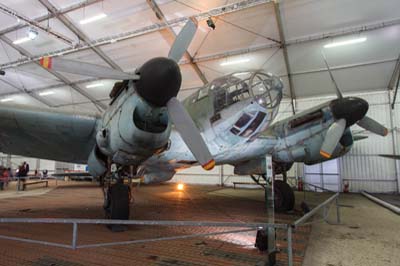
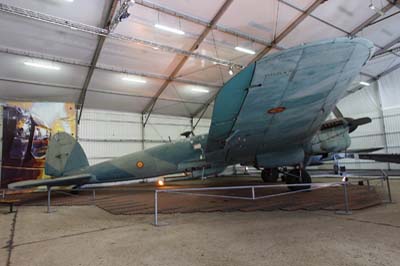
Casa 2.111D BR.21 Pedro (BR.21-129 painted as 'BR2-I-129') ex Spanish Air Force serving until 1975. The Spanish built CASA 2.111 was a medium bomber derived from the Heinkel He 111 but powered by Rolls Royce Merlin engines, the prototype first flew February 24, 1935. The He 111 was designed as a high speed medium bomber and civil transport in 1934. The first bombers were delivered in 1936 and were first used in the following year during the Spanish Civil War by the Nationalist forces.
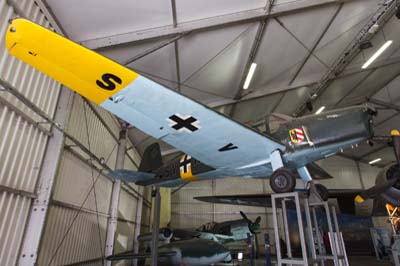
Bücker Bü181-C3 Bestmann (F-BBNA 'SV+NJ') The prototype made its first flight in February 1939 and was later used by the Luftwaffe as a primary trainer. The Bücker factory at Rangsdorf built most of the Bü181, supplemented by the Fokker factory which built 708 aircraft of which 373 were delivered to Germany from 1942 to 1943. Hägglund & Söner AB in Sweden built 125 Bü181s for the Swedish Air Force as the Sk.25. The Zlin plant in Czechoslovakia built 783 aircraft as the C.6 and C.106 for the Czech' Air Force and also the Zlin Z.281 and Z.381 which were for civilian use. 154 examples were seized with the Liberation of France, 130 of those joined the civilian register.
|
Left to right:
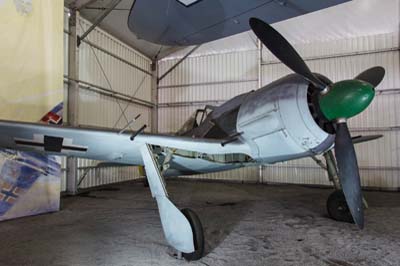
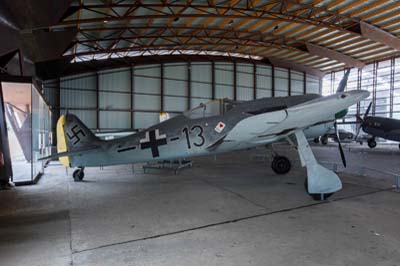
SNCAC NC.900 A8 (Focke-Wulf 190) (7298 '13'). Built by SNCAC (Société Nationale de Construction Aéronautiques du Centre) at Cravant in France in 1945 and 1946 for the Armée de l'Air using parts seized by the Allies in 1944. The final flight by a French NC.900 was made on June 22, 1949. |
Left to right:
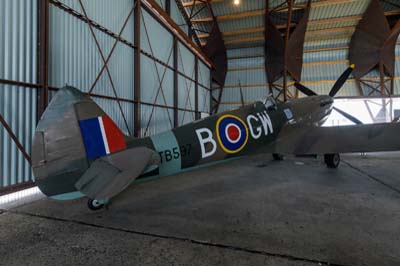
Supermarine Spitfire LF.XVIe (TB597 'GW-B') built in 1944.
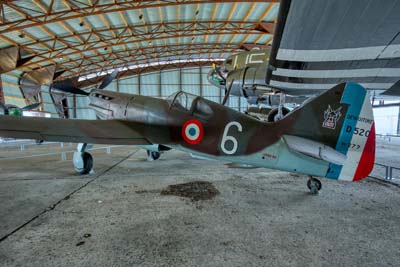
Dewoitine D.520 (No.277 '6') Designed in 1937, the D.520 was a 1938 copy of the D.21 which was delivered to the French air force from 1939 performing well as a fighter in the Battle of France. |
| Canadair CL-215 (23 F-ZBAY) ex Securite Civile. |
Left to right:
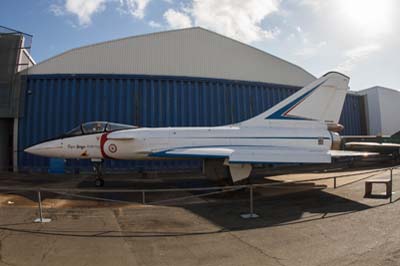
Dassault Super Mirage 4000 (01 F-ZWRM). Built by Dassault as a private venture it first flew on March 9, 1979. The aircraft was unfortunately rejected by the Armée de l'Air.
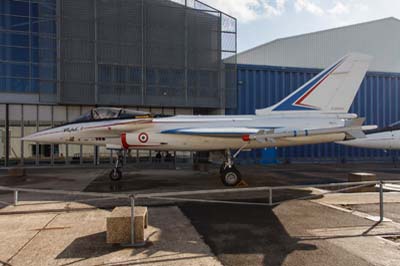
Dassault Rafale A (1). The first flight of the Rafale A prototype (F-ZJRE) was made on July 4, 1986, its testing program was completed in January 1994. Production had commenced from December 1992. |
Left to right:
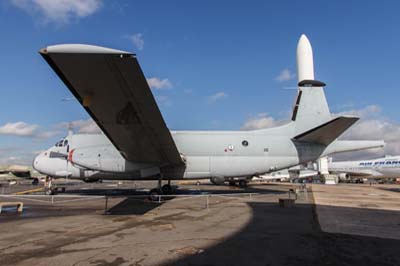
Bréguet 1150 Atlantic (61) of 22F French Navy. The Bréguet Br.1150 Atlantic is a long-range reconnaissance aircraft, primarily designed for use over the sea. The first prototype made its maiden flight at Toulouse on October 21, 1961. An initial order for 60 Atlantics, 40 for France and 20 for Germany, was placed in 1963.
SEPECAT Jaguar E (E3 '339-WF').
SEPECAT Jaguar A (A1 'F'). |
Left to right:
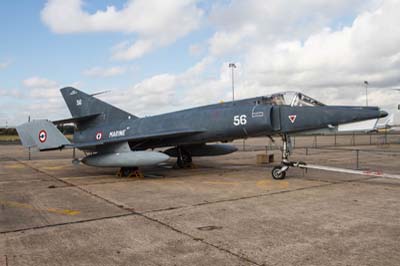
Dassault Étendard IVA (56) of 59S French Navy (Aéronavale). The Dassault Étendard IV is a supersonic carrier-borne strike fighter designed for the French Navy (Aéronavale). It was first demonstrated in 1958 resulting in an order for 69 fighter aircraft, designated Étendard IVM and 21 reconnaissance versions designated Étendard IVP.
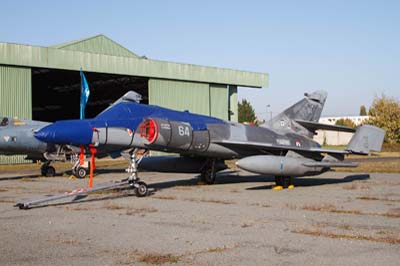
Dassault Super Étendard (64) of 17F French Navy. The Dassault Étendard IV is a supersonic carrier-borne strike fighter designed for the French Navy (Aéronavale). It was first demonstrated in 1958 resulting in an order for 69 fighter aircraft, designated Étendard IVM and 21 reconnaissance versions designated Étendard IVP. The first of three prototypes Super Étendard, a IVM modified with the new engine and some of the new avionics, made its maiden flight on 28 October 1974. 71 aircraft were purchased with deliveries starting in June 1978. |
Left to right:
Embraer EMB-312F Tucano (496 '312-UO').
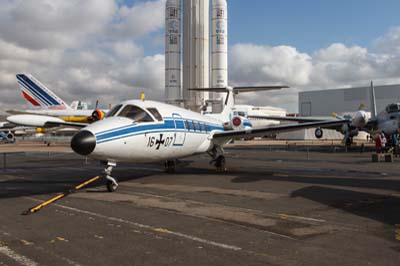
MBB HFB-320 Hansa Jet (16+07 ex F-WZIH / D-CARO). The Hamburger Flugzeugbau HFB-320 Hansa Jet is a ten-seat business jet manufacturered between 1964 and 1973. The prototype first flew on April 21, 1964. The Luftwaffe ordered 13 HFB-320s in 1963, with a further eight Hansa jets for ECM training which were delivered between August 1976 and April 1982. The ECM variant remained in service until 1994. It was no longer on display in 2024. |
Left to right:
Saab Draken J 35A (35069 '36').
Saab Viggen Sk 37E (37808 '71'). |
Left to right:
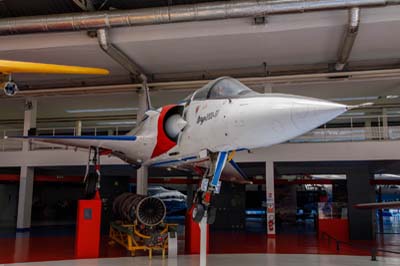
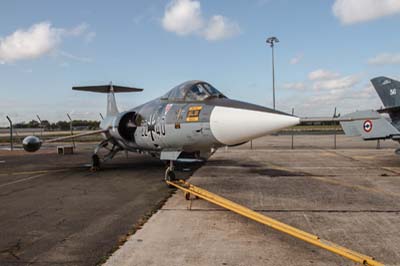
Lockheed F-104G Starfighter (22+40). The first F-104A Starfighter flew in 1954. Production of this multi-role, all-weather strike fighter was started in many of the countries which adopted this unique aircraft, such as Fokker in Holland, Fiat in Italy, Messerschmitt in Germany and SABCA in Belgium. The two-seat TF-104G Starfighter's were manufactured by Lockheed. The F-104G had a maximum speed of 1,328 mph at 35,000 feet and could climb to 90,000 feet. It was no longer on display in 2024.
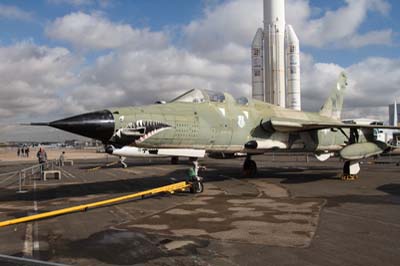
Republic F-105F Thunderchief (63-8300 'WW'). It was a Mach 2 supersonic fighter-bomber used by the United States Air Force. The YF-105A prototype first flew on 22 October 1955. The F-105 flew the majority of strike bombing missions during the early years of the Vietnam War before being withdrawn. A total of 833 F-105s were completed before production ended in 1964, 143 of which were built were the two-seat F-105F trainer variant many of which were converted into the anti-radar 'Wild Weasel' version. It was no longer on display in 2024.
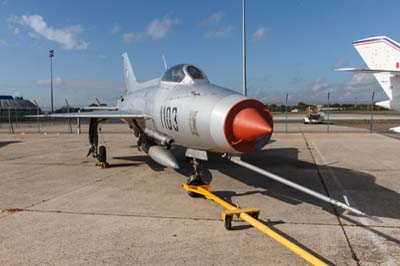
Mikoyan-Gurevich MiG-21F-13 Fishbed C (1103) ex Czech Republic Air Force. The MiG-21F-13 entered service in 1960, as a single-seat short-range day-fighter. Over the next 30 years 6,000 were built, many under license in a number of countries.
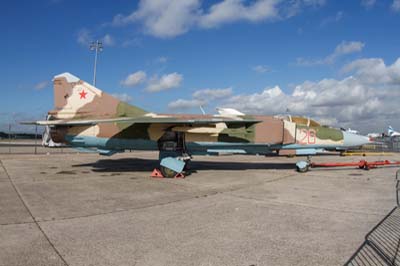
Mikoyan-Gurevich MiG-23ML Flogger G (20+30 painted as 'Red 26'). Production commenced in 1970 in the Soviet Union and reached over 5,000 aircraft built. |
| Dugny Museum Storage Facility |
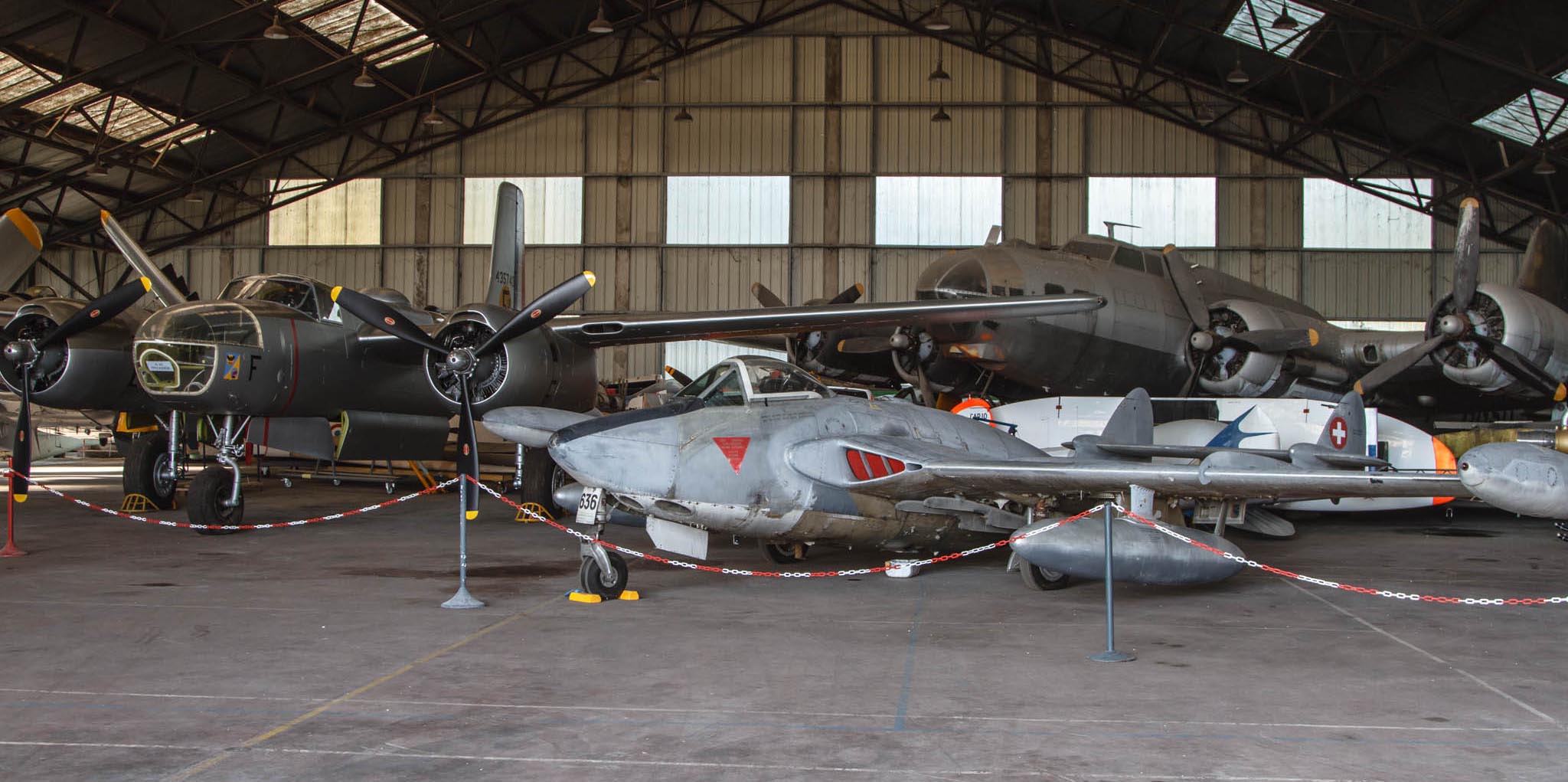
| A-26B Invader (44-34773), Venom FB.54 (J-1636) and ex IGN B-17G Flying Fortress (F-BGSO). |
Left to right:
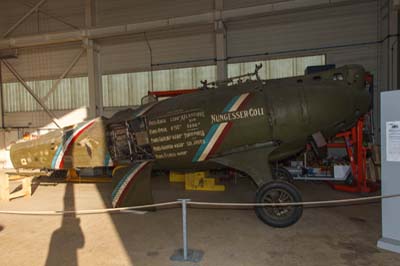
Bréguet BR.19 Grand Raid 'Nungesser-Coli' (c/n 1685). The prototype Bréguet 19 first flew in March 1922 and was ordered by the Armée de l'Air in September 1923. Over 2,000 Bréguet 19s were built in France, with around 700 license-built by CASA in Spain, SABCA in Belgium and at the Yugoslavian factory in Kraljevo. The example on display was christened 'Nungesser et Coli' after the two airmen who disappeared during a transatlantic flight attempt in May 1927.
Farman F.192 (F-BAOP painted as 'F-AJJB'). German later French (1932) pilot Lena Bernstein flew a Farman F-192 on May 2, 1930 from Le Bourget for a record breaking 35 hours and 45 minutes, breaking Charles Lindbergh's May 22, 1927 record of 33 hours 38 minutes and achieveing the women's world record endurance time previously held by French pilot Maryse Bastie.
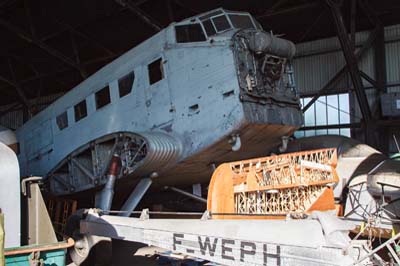
AAC.1 Toucan - Junkers Ju 52 (should be 55.S-32 334 / DG) and Bruel Duhamel Molinari (01 F-WEPH). |
Left to right:
Caudron C.366 Atalante (6808/4). Dating back to 1933 the high performance racing aircraft was built by Caudron Airplane Company (Société des Avions Caudron). The example held in the reserve collection was modified to resemble the Caudron C.450 for the movie 'Endless Horizons' released in 1953 about Hélène Boucher who became the 'quickest woman of the world' in 1934.
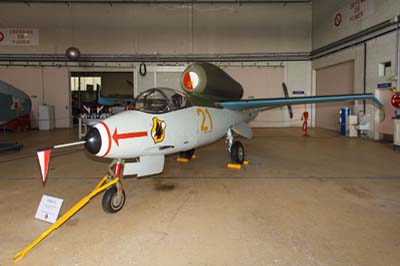
Heinkel He 162A-2 Volksjäger (120015 'Yellow 21'). The German aircraft industry was pushed towards the end of the war to produce aircraft designs that could reverse an ever increasingly desperate situation. The He 162 jet fighter took just 69 days from initial design to its first flight. It was the first aircraft to be fitted with an ejection seat. Deliveries began in February 1945, only 200 aircraft were delivered, due to a shortage of supplies it was mostly built of wood. The French evaluated three captured jets between April 1947 and July 1948 before the example on display was given to the museum in 1952.
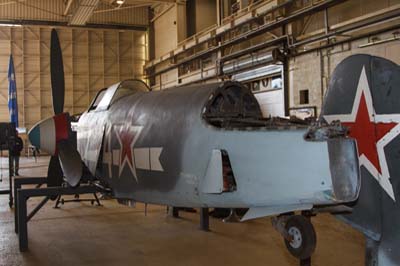
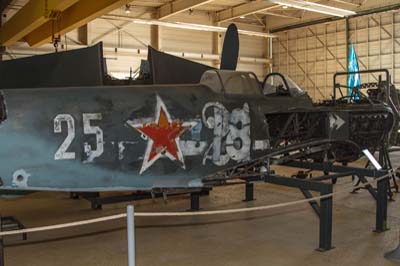
Yakovlev Yak-3 (2530). The Yak-3 entered service in 1944 with the Soviet Air Force, by 1946, 4,848 had been built. It was small and light as a fighter and its high power-to-weight ratio gave it excellent performance. Marcel Albert, France's top-scoring World War Two ace flew the Yak-3 in USSR with the Normandie-Niémen regiment GC3 (Groupe de Chasse 3 or 3rd Fighter Group) which consisted of three squadrons. The example on display was originally coded '25', it arrived at Le Bourget on June 20, 1945 with the code '18' and was transferred to the museum in 1947. In 1976 the code '4' was applied to the exhibit. |
Left to right:
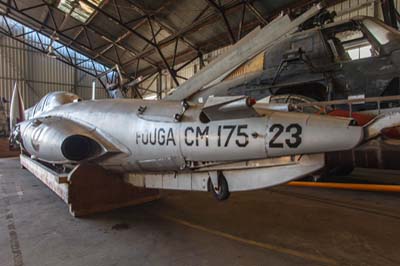
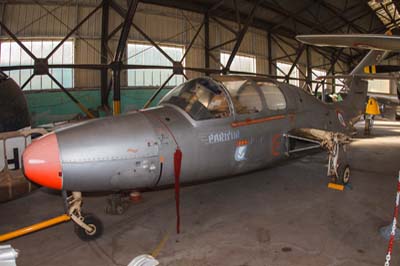
Fouga CM.170R Magisters (could be 23, 26 and 29 ex Patrouille de France). The CM.170R Magister was designed as a jet trainer to NATO specifications in the 1950s. It is fully aerobatic and served with the French 'Patrouille de France' and Belgian 'Red Devils' display teams for many years. A total of 589 Magisters were built between 1952 when the prototype first flew and December 1969. The Armée de l'Air having taken delivery of 473 examples. The Patrouille de France flew the Magister until they converted to the Alpha Jet.
Fouga CM-175 Zephyr (23) of 59S French Navy. This navalised version of the Magister first flew in July 1956
Morane-Saulnier MS.760 Paris (1 '330-DA' F-SDDA). The prototype flew for the first time on July 29, 1954 and the first production aircraft (displayed) on February 27, 1958.
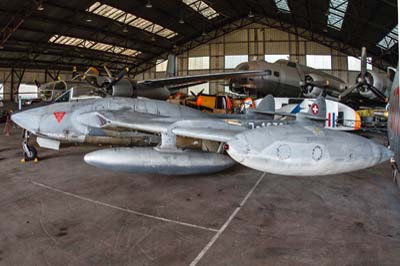
de Havilland DH-112 Venom FB.54 (J-1636) ex Swiss Air Force. The first Venom prototype flew on September 2, 1949. It served with the Royal Air Force as a single-seat fighter-bomber and two-seat night fighter. The 22 FB.54s built were purchased by Venezuela and Switzerland in the 1950s.
|
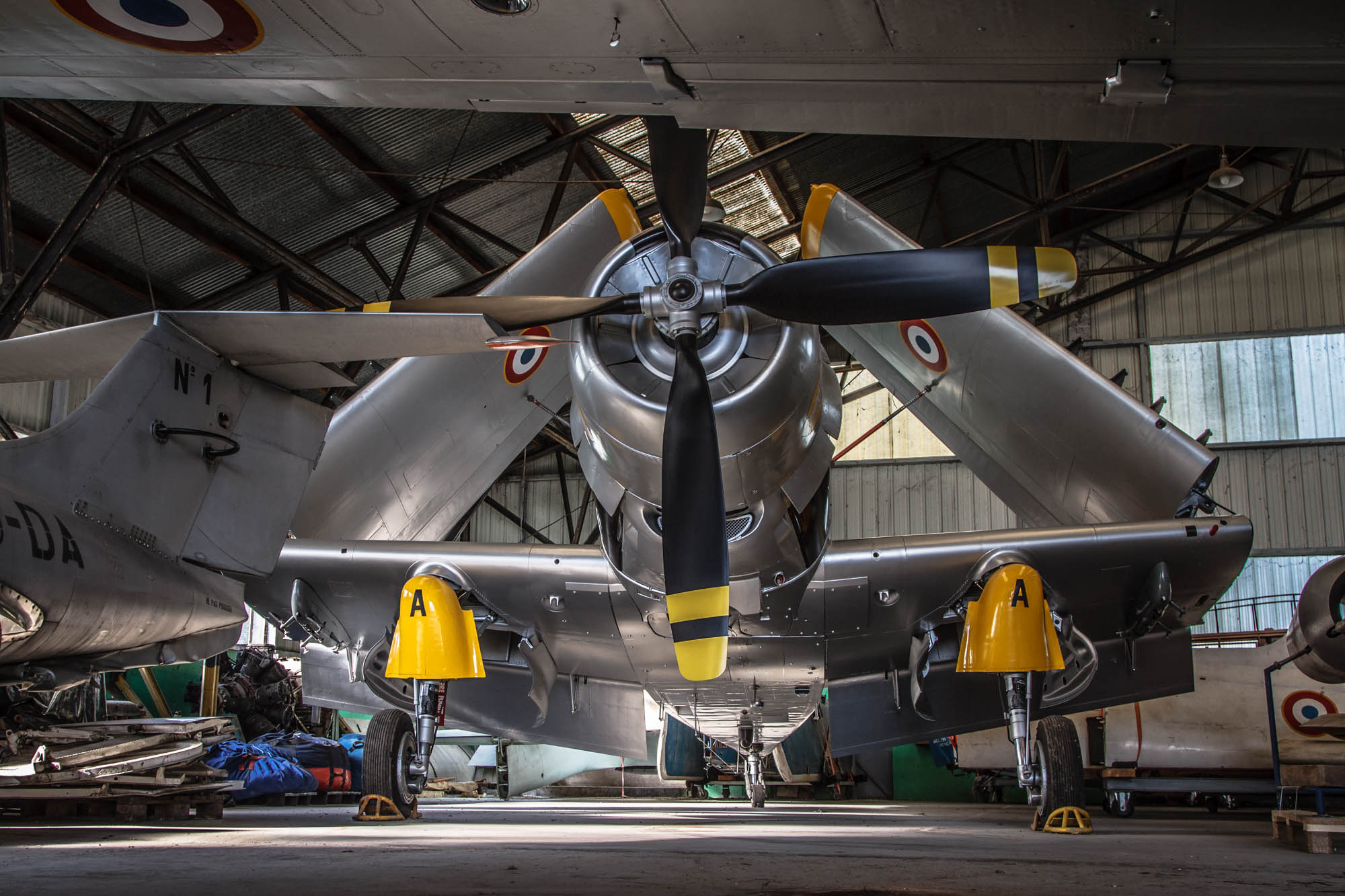 |
| Douglas AD-4N Skyraider (126979 '20-QA') |
Left to right:
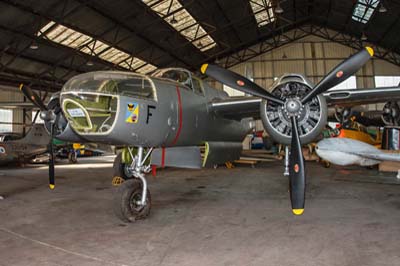
Douglas A-26B-65DL Invader (44-34773 painted as '44-35740 F'). The Douglas A-26 Invader (designated B-26 between 1948-1965) was a twin-engine light attack bomber built by Douglas Aircraft during World War Two. The Douglas XA-26 prototype first flew on July 10, 1942. The last A-26 in active US service operated by the Air National Guard retired from service in 1972. In the 1950s, the Armée de l'air utilised loaned US B-26s in Tunisia, Algeria and during the First Indochina War.
Aero Commander 680FL Grand Commander (F-BRQE) previously with IGN.
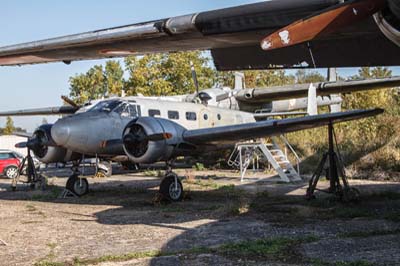
Beechcraft JRB-4 Expeditor (N61909 Bu 44676). The United States Navy JRB-4 utility variant of which 328 were built were similar SNB-1 and SNB-2P trainers, they were Beech 18s equivelent to the US Air Force C-45. Beech manufactured over 5,000 aircraft during World War Two for the US and several foreign governments.
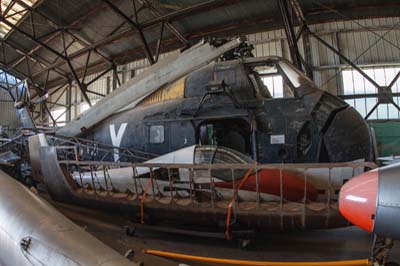
Sikorsky (Sud Aviation) HSS-1 Seabat (SA-121 'Y'). France received 135 Sikorsky built H-34s followed by 130 Sud Aviation built helicopters in the c/n range SA51 to SA185, six of which were sold to Belgium.
|
Left to right:
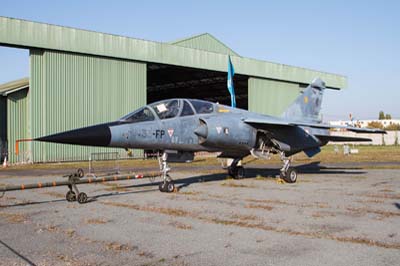
Dassault Mirage F.1B (501 '33-FP'). The Dassault Mirage F1 was designed as a air-superiority fighter and ground attack aircraft, designed as a successor of the Mirage III. The first prototype made its maiden flight on December 23, 1966. The Mirage F1 entered service in the Armée de l'Air in the early seventies.
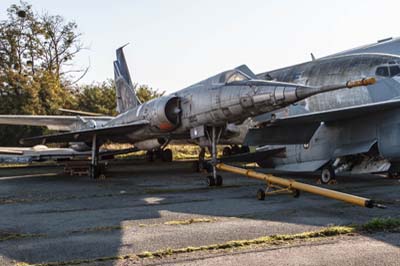
Dassault Mirage IVA (02) of CEV. Designed as a supersonic strategic bomber and reconnaissance aircraft the prototype '01' took to the air for the first time on June 17, 1959. Prototype '02' was flown on October 12, 1961 and was accepted for production. The first production Mirage IVA was flown in December 1963. 62 Mirage IVA were built and entered service between 1964 and 1968.
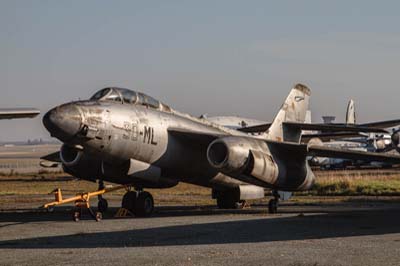
Sud-Ouest Aviation (SNCASO) SO.4050 Vautour IIN (330 '30-ML' F-UIML). The Vautour was designed as a bomber, interceptor and attack aircraft. 112 examples (IIA, IIB and IIN variants) entered service with the Armée de l'Air in 1958 and was not withdrawn from frontline service until 1979. The IIA was a single-seat, long-range attack aircraft, the IIN a two-seat, all-weather interceptor and the IIB was a two-seat bomber with glazed nose position for bombardier/observer. Of the 149 aircraft built 28 were supplied to Israel.
|
Left to right:
SAAB J-32B Lansen (32515) formally of F13 Squadron. The J32 was a two-seat, high transsonic attack aircraft manufactured by SAAB from 1955 to 1960 for the Swedish Air Force (Flygvapnet). A Lansen broke the sound barrier on October 25, 1953 when it exceeded Mach 1 in a shallow dive. 287 A32A Lansens entered service from 1955-1978, 118 J32B from 1958-1973, 8 J32B from 1997-1999, 44 S32C Lansens from 1958-1978, 6 J32D from 1972-1997 and 15 J32E from 1972-1997.
Republic RF-84F Thunderflash (FR-30 ex 51-17015) of Belgian Air Force. The RF-84F was the first jet aircraft to be designed solely for photo-reconnaissance, which could be achieved both day and night. The Belgian Air Force took delivery of 34 of these innovative aircraft (serials FR-1 to FR-34). They entered service in 1955, operating with 42 Squadron until there final retirement in 1972.
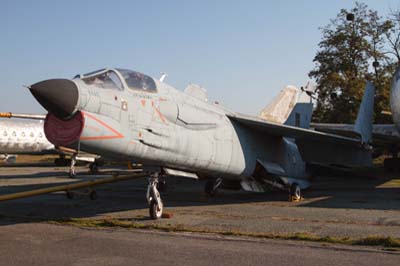
Vought F-8E Crusader (10 ex 151741) of 12F French Navy. The Crusader was a single-engine, supersonic, carrier-based air superiority jet aircraft built by Vought for the United States Navy and the US Marine Corps. The prototype flew in February 1955. Deliveries to the Aéronavale (Flotille 12F) started in October 1964 and continued until February 1965, the Crusader was eventually replaced by the Rafale M in 2000.
|
Left to right:
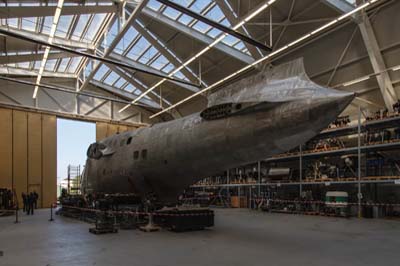
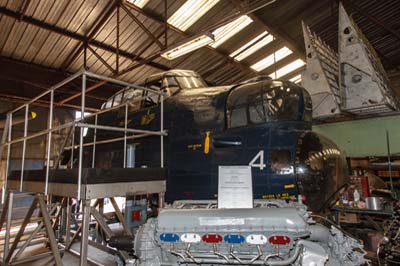
Short Sunderland III (F-OBIP). The Sunderland entered service in 1938 and was based on the 'C' class Empire flying-boat operated by Imperial Airways. It was the first British flying-boat to have power-operated gun turrets for its defence and was also the last flying-boat to be operated by the Royal Air Force after 20 years of service. At the start of World War Two there were three squadrons operating the Sunderland. Eventually 749 were built serving with Coastal Command till 1945 and continued to its retirement in 1959, after operating from the United Kingdom, Africa and the Far East.
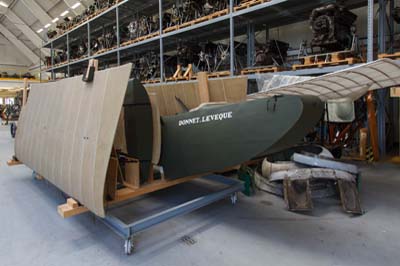
Donnet Leveque A (01). Built as a reconnaissance seaplane and trainer by French manufacturer Donnet-Lévêque it was first demonstrated to the French Navy in 1912.
Nieuport-Delage NiD.29C.1 (010 '10'). The Nieuport-Delage NiD.29 was a single-seat biplane fighter designed and built by Nieuport-Delage for the Armée de l'Air. The prototype's maiden flight was on August 21, 1918 and the first of 250 deliveries were made during 1922.
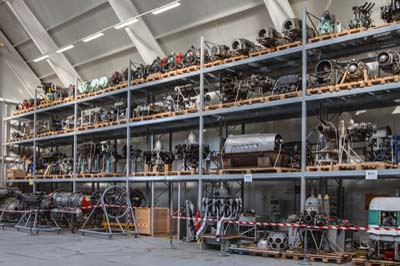
The aero engine storage.
|
Left to right:
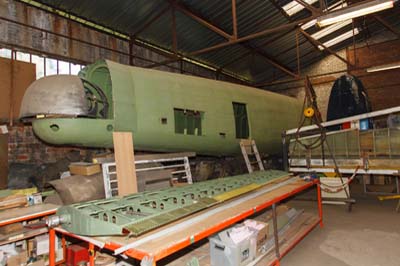
Avro Lancaster Mk.VII (WU-21 '4' ex NX661) under restoration with Ailes Anciennes. The Lancaster was based on the twin engine Avro Manchester and made its first flight on January 9, 1941. It employed four Rolls-Royce Merlin engines. By the time production had ended 7,377 aircraft had been built by six major companies. During the last three years of the War it was a very successful night bomber and continued in service until 1954. |
Left to right:
Polikarpov I-153 Chaika (21 '9'). Russian built it was derived from the Polikarpov I-15 which first flew in 1933, the I-15b aka I-153 Chaika made its maiden flight in 1938. It featured extensively in the Spanish Civil War from 1936 to 1939. It was the last Soviet bi-plane.
Royal Aircraft Factory BE.2f (2560) of the Memorial Flight. The RAF BE.2 (Blériot Experimental) was a British single-engine two-seat biplane which was in service with the Royal Flying Corps (RFC) from 1912 until the end of World War One. The 'Blériot' in its designation is due to Blériot types having a tractor configuration, that is having a propeller in front. Around BE.2s 3,500 were built.
Sopwith 1½ B2 Strutter (2897 '3214') of the Memorial Flight. It was the first allied fighter aircraft to be equipped with a synchronised machine gun whiich was mounted above the engine and designed to fire between the propeller blades. It was designed and built by Sopwith Aviation Company in Kingston on Thames, England, it's first flight was made in 1916. Called the 1½ Strutter, because the upper and lower wings on each side of the aircraft were connected by a pair of full struts near the wing tip with a pair of half struts connected the upper wing to the fuselage. 6000 were built by 1920 when the Sopwith Company was wound up and the 1½ Strutter had been declared obsolete by the military.
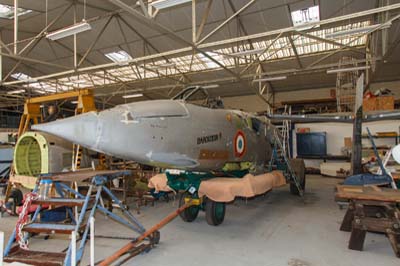
SNCASE SE-5003 Baroudeur (3 F-ZWTV composite, it has the wings from No.2). The Baroudeur was a lightweight fighter, designed to operate from grass airfields or snow or ice-covered surfaces. It used a wheeled trolley with three retractable skids, the third at the tail for landing. Two S.E.5000 Baroudeur prototypes, the first of which flew for the first time on August 1, 1953 and three pre-production S.E.5003 Baroudeur were built, however the Baroudeur did not enter production. |
Left to right:
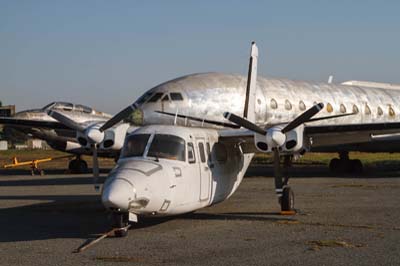
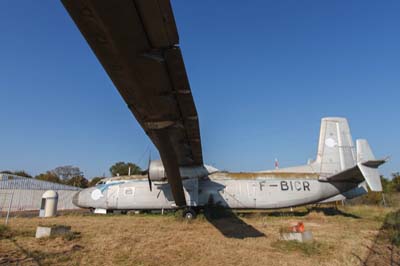
Hurel-Dubois HD-34 (F-BICR c/n 4) The Hurel-Dubois HD.31, HD.32 and HD.34 were a family of civil aircraft produced in France in the 1950s, based on Maurice Hurel's high aspect ratio wing designs. The HD.34 was an aerial survey version eight of which were ordered by IGN (Institut Géographique National).
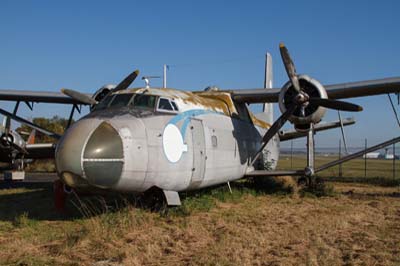
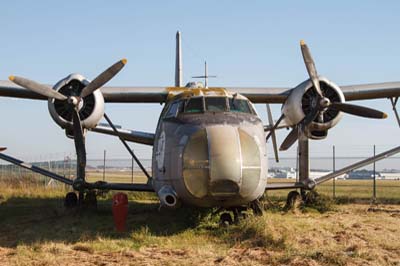
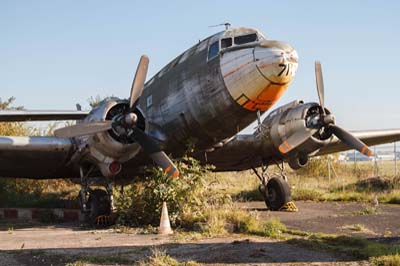
Douglas C-47A Dakota (71 ex 42-92647 ex KG436) ex 56S French Navy. |
Left to right:
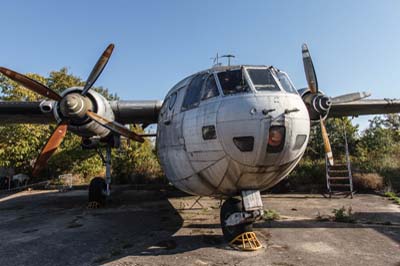
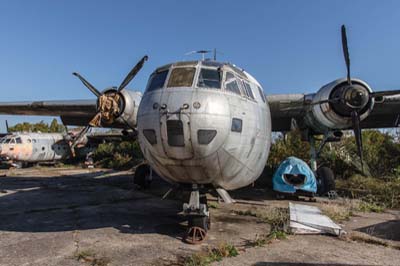
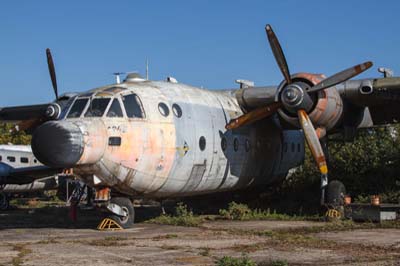
Nord Aviation N2501F Noratlas (162 'F' '63-VP'). The prototype flew for the first time on September 10, 1949, followed by the first of five pre-production aircraft on November 20, 1950. Following the first flight of the first production aircraft on September 10, 1952 425 examples were built in France and West Germany.
Nord Aviation N2501F Noratlas (44 '64-BI' / F-BZCK) of Ailes Anciennes.
Nord Aviation N2501F Noratlas (194 '316-FP').
Bréguet 941S (4 '62-ND'). The prototype Bréguet 941 first flew in 1961, followed by the first of only four 941S production aircraft in 1967. |
| Lockheed T-33, L-749 Constellation (F-ZVMV), Nord 262 (72), Douglas DC-7C (F-ZBCA) and Meteor NF.14 (NF-14-747) in open storage. |
Croses LC.6 Criquet (F-PYFT) as photographed at La Ferté-Alais in 1980 is now on display here.
Notes:
Following the 1936 general strike, the French government introduced an act to nationalise the French war industry. Six nationalised aeronautical manufacturing companies; SNCASE, SNCASO, SNCAN, SNCAO, SNCAM and SNCAC were subsequently created.
SNCASE (Société Nationale des Constructions Aéronautiques du Sud-Est or more usually Sud-Est)
SNCASO (Société Nationale des Constructions Aéronautiques du Sud-Ouest, or Sud-Ouest)
SNCAN (Société Nationale des Constructions Aéronautiques du Nord or Nord)
SNCAO (Société Nationale des Constructions Aéronautiques du l'Ouest)
SNCAM (Société Nationale des Constructions Aéronautiques du Midi)
SNCAC (Société Nationale des Constructions Aéronautiques du Centre, sometimes known as Aérocentre). |
The Dugny museum storage site is open to the public annually described as the 'journée de la patrimoine' (day of the inheritance). It is usually on the weekend of the third week in September, due to a clash with another local event in 2011 it was moved to an October weekend.
Museum Address:
Musée de l’Air et de l'Espace
Aéroport de Paris-Le Bourget
93352 Le Bourget
Paris. |