
|
|
|
|
| RAF Waddington's E-3Ds KC-135 is 50 NATO E-3A air to air |
| NATO E-3As Celebrate 25 years Geilenkirchen NATO Air Base, Germany June, 2007 |
 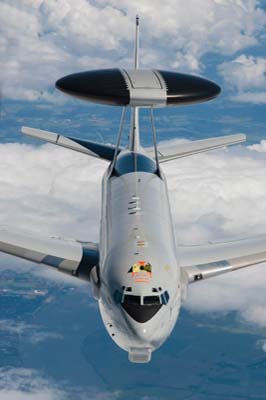 Geilenkirchen in Germany is the Main Operating Base (MOB) for the NATO E-3A Component and in June 2007 celebrated 25 years of supporting NATO operations. The first aircraft arrived at MOB Geilenkirchen on February 24, 1982, but it was not until June 28, that NATO
took operational control of the base.
Geilenkirchen in Germany is the Main Operating Base (MOB) for the NATO E-3A Component and in June 2007 celebrated 25 years of supporting NATO operations. The first aircraft arrived at MOB Geilenkirchen on February 24, 1982, but it was not until June 28, that NATO
took operational control of the base. Today a fleet of 17 Boeing E-3A Sentry Airborne Warning and Control Systems (AWACS) aircraft and three Boeing 707TCA (Training and Cargo Aircraft) comprise the NATO E-3A Component. Additional forward operating locations have since been setup. The first Forward Operating Base (FOB) to be activated was in October 1983 at Konya in Turkey, the second followed a month later at Oerland in Norway. By January 1986 Trapani in Italy was in operation with Aktion in Greece following in March 1986. Combined with the seven RAF E-3Ds based at RAF Waddington, both components report to NATO Airborne Early Warning and Control (NAEW&C) force headquarters, located at the Supreme Headquarters Allied Powers Europe (SHAPE) at Mons in Belgium. |
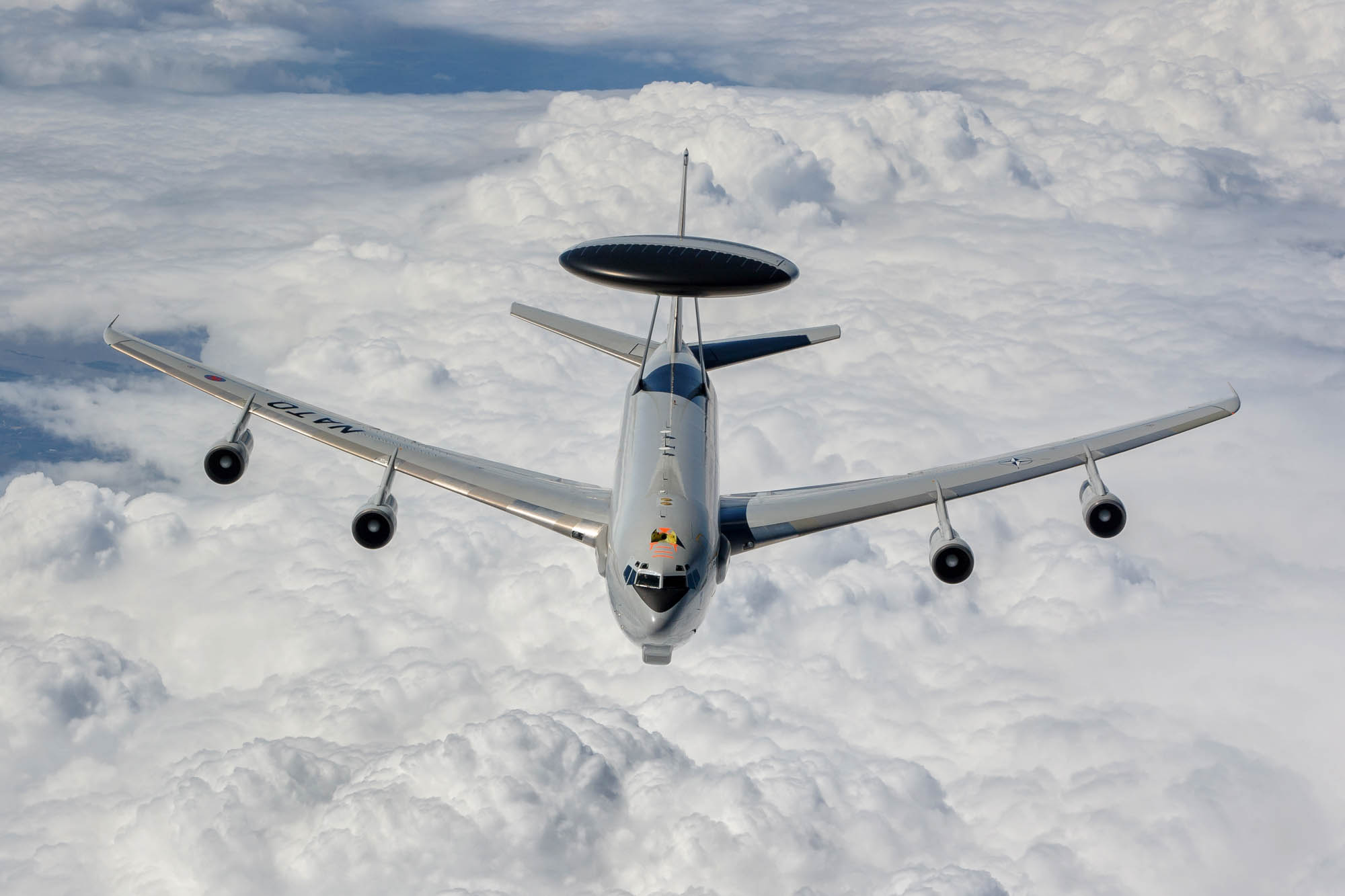 |
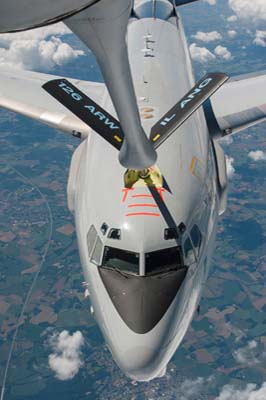
| Boeing E-3A (LX-N90458) callsign 'NATO14' drops away from the KC-135 air refuelling tanker in June 2007 Canon 24-105mm L (58mm) 1/500 f.11 ISO100 and -2/3 exposure compensation to keep detail in bright clouds. |
| It was back in 1978 when the concept was first conceived to improve allied air defence against the Warsaw Pact. It is one of the few military assets owned and operated by NATO itself. The common funded project is a testimony to what can be achieved by pooling resources. From the 1990s the role expanded to include command and control, airspace management, air policing, close air support, combat search and rescue, maritime support and threat warning. Following the 9/11 terrorist attacks in 2001, NATO invoked the 'mutual clause' of the NATO charter and deployed to the NATO AWACS aircraft to the United States. In 2003 Turkey requested help in response to the threat from the Iraqi war. Then 100 missions totalling 950 hours were flown between February and May 2003. Other events in addition to Summit meetings that required additional airborne security included; the Greek Olympics in 2004 and the World Cup in Germany in 2006. On October 1, 2006 the NATO Response Force (NRF) became fully operational to provide a swift response to any global threat. 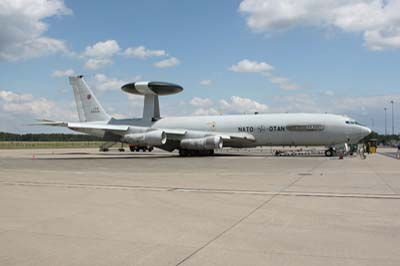 The Boeing E-3 was built as a replacement for the Lockheed EC-121 Warning Star and 2007 marked the 30th year of the E-3 in operational service. The E-3A/D normally operates at 30,000 feet (9,150m) and can survey the surrounding airspace within a radius of 162nm (300km). Using advanced digital data links information can be rapidly shared between ground, air and sea-based commanders. Three aircraft with over-lapping orbits can effectively cover the whole of Central Europe. A sorties usually lasts between 12 and 17 hours.
In August 2005 the E-3As began a NATO mid-term (NMT) update its computer systems, to improve communications, navigation and target identification. As a result of NMT the E-3A now requires 16 crew members, a reduction of one member, to complete more tasks. NMT software is similar to Microsoft Windows, employing drop-down menus and is installed on 14 consoles, which is an expansion of five consoles. The NMT package is expected to be installed and operational throughout the fleet by the end of 2008. Additionally the fleet should have Large Aircraft Infrared Counter-Measures (LAIRCM) fully operational by May 2008. The new onboard sensors and laser system is designed to detect and destroy inbound missiles. With NATO members being added to the E-3A Component, Poland joined the E-3A Component in September 2007, following Hungary in 2006, now 16 of NATO's 26 nations are involved directly with E-3 operations with 14 nations providing aircraft crews. With over 3,000 military and civilian personnel and the many languages spoken on base, integrating all nationalities is a constant challenge. A challenge that the team are more than able to embrace. The air base at Geilenkirchen was built by the British after World War Two and was used by a number of fighter squadrons from 1953 to 1968, when it was handed to the West German Air Force and all flying ceased till when the E-3s arrived in 1982. |
 |
 |
 |
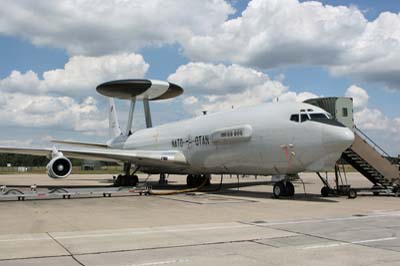 |
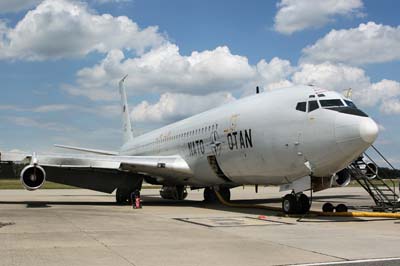
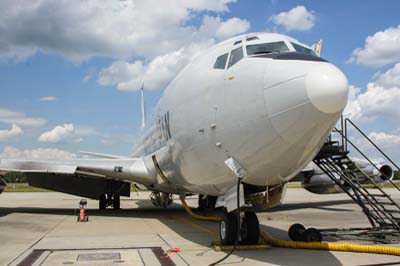
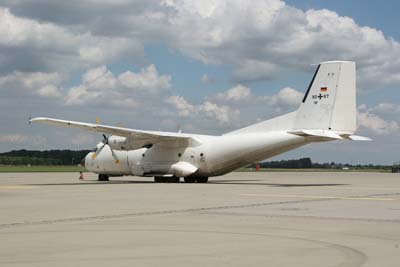
| The Boeing 707TCA is a modified Boeing 707-320C and has a cockpit almost identical to the E-3A. It utilised as an training aircraft and is capable of AAR training but cannot actually receive fuel. It is easily converted from all-passenger to all-cargo configuration, but is usually setup as a combination of the two. Left to right: Boeing 707TCA 'Trainer Cargo Aircraft' (CT-49A) (LX-N20199) delivered May 2005. Visiting German Air Force C-160 Transall (50+87) bound for Sarajevo as usual. Boeing E-3A Sentry (LX-N90448) being readied for its next mission. |
Keeping the E-3 AWACS in the air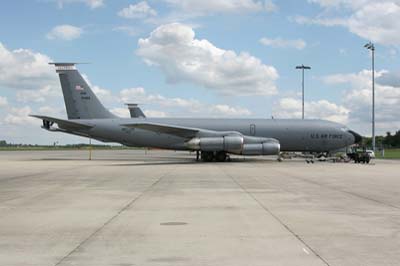
 The NATO E-3s missions by their nature are long up to ten hours in duration and can require Air to Air Refuelling (AAR).
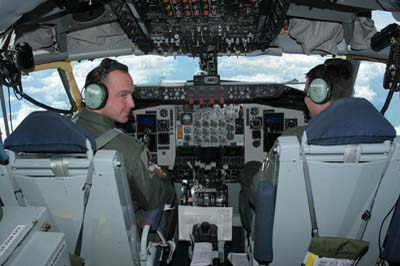
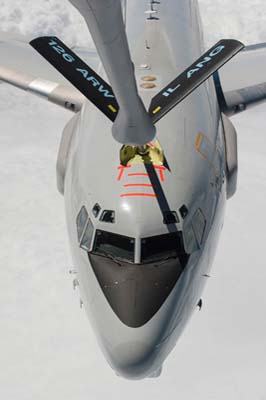
A NATO contract is in place for the provision of AAR, the current providers are the Air National Guard (ANG) flying Boeing KC-135E/R Stratotankers. The contract runs over two years and is for 44 weeks of AAR per year. The ANG Liason Officer (ANG/LO) based at Geilenkirchen is responsible for negotiating a fair deal with NATO, by taking into account all mission costs incurred over the previous two years. The current ANG/LO first came over to Geilenkirchen in 1993 when flying with the first ANG tankers. In those days LO's were posted for only 120 days and so there was little continuity. These days LO's are on four year postings, their day to day duties include; mission planning, scheduling and ground logistics. The various ANG KC-135s deploy to Geilenkirchen for two weeks, during my visit it was the turn of 126th Air Refuelling Wing, 108th Air Refuelling Squadron (126ARW/108ARS) of the Illinois ANG with two KC-135Es. Three crews fly are assigned to the two tankers, the aircraft fly two missions per day, except on Fridays when one mission is flown, to allow one crew to be rotated with the United States. For Lt Col Dale Dortch, Navigator on the KC-135E, "We like the deployment, it enables us to come out to Europe and participate with NATO aircrew as in any other peacetime training operation." Normally flying from Scott Air Force Base in the US mid-west, it is flat and relatively uncongested as compared with European skies. "It is different out here, it is much more crowded making flying our missions more difficult. It is a great opportunity for training to work in different air space." 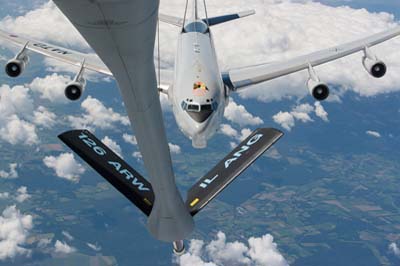 Today's mission in KC-135E (59-1489) callsign 'ESSO 76' was to AAR two NATO E-3As. After spooling up the four CFM56 engines, pilot Capt. Nick Babiak made his way to the end of Geilenkirchen's 10,009 foot (3,050m) runway before throttling up to full power for take-off. Departing to the north we made our way to the narrow AAR track known as 'Kim' which just touches the coast of Germany one of three for AAR tracks in use by the tankers. The co-pilot Capt. Gary Bodony, who described himself as a 'Guard bum', at first make radio contact before maintaining a visual lookout for the receiving E-3. They also have available the Traffic alert and Collision Avoidance System (TACS) which locates the aircraft. The E-3 approaches from 1,000 feet below the tankers altitude, before clearance is given by the Boom Operator, today SmSgt Matt Glover, to come forward to the lowered and extended boom. The 'boomer' maintains radio contact with the receiver throughout the refuelling exercise and is responsible for informing regularly the pilots of the current situation. The first E-3A (LX-N90458) to require gas and using callsign 'NATO 14' took 20,000lbs (9,072kgs) of fuel followed by a second E-3A (LX-N90459) using callsign 'NATO 13' it received 10,000lbs (4,536kgs) of fuel. For this AAR mission the second E-3A requested numerous practice hook-ups with the KC-135, swapping pilots over once the required number had been successfully completed. With both E-3s topped up with gas we return to base.
The KC-135 and the E-3 are derived from the Boeing 707, a 1950s design that is still effectively serving NATO over half a century later and will continue to do so for many years to come. |
 |
 |
 |
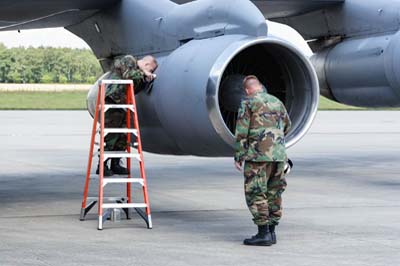 |
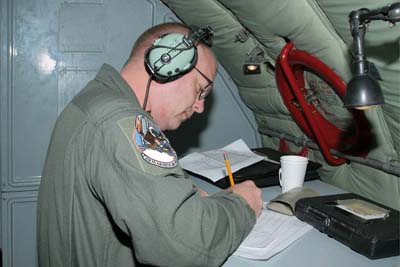
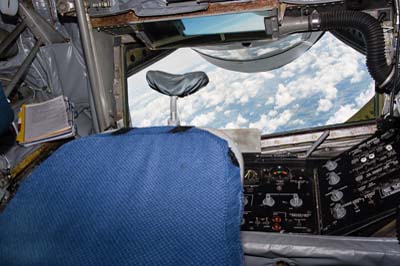
| Some people who keep the tanker flying KC-135E (59-1489) of 126 ARW, 108 ARS Illinois Air National Guard, callsign 'Esso 76'. Left to right: Pilot Capt. Nick Babiak and co-pilot Capt. Gary Bodony at the controls. Boom Operator, SmSgt Matt Glover completing the mission's paperwork. The boomer's position groundcrew check the engines after the flight. |
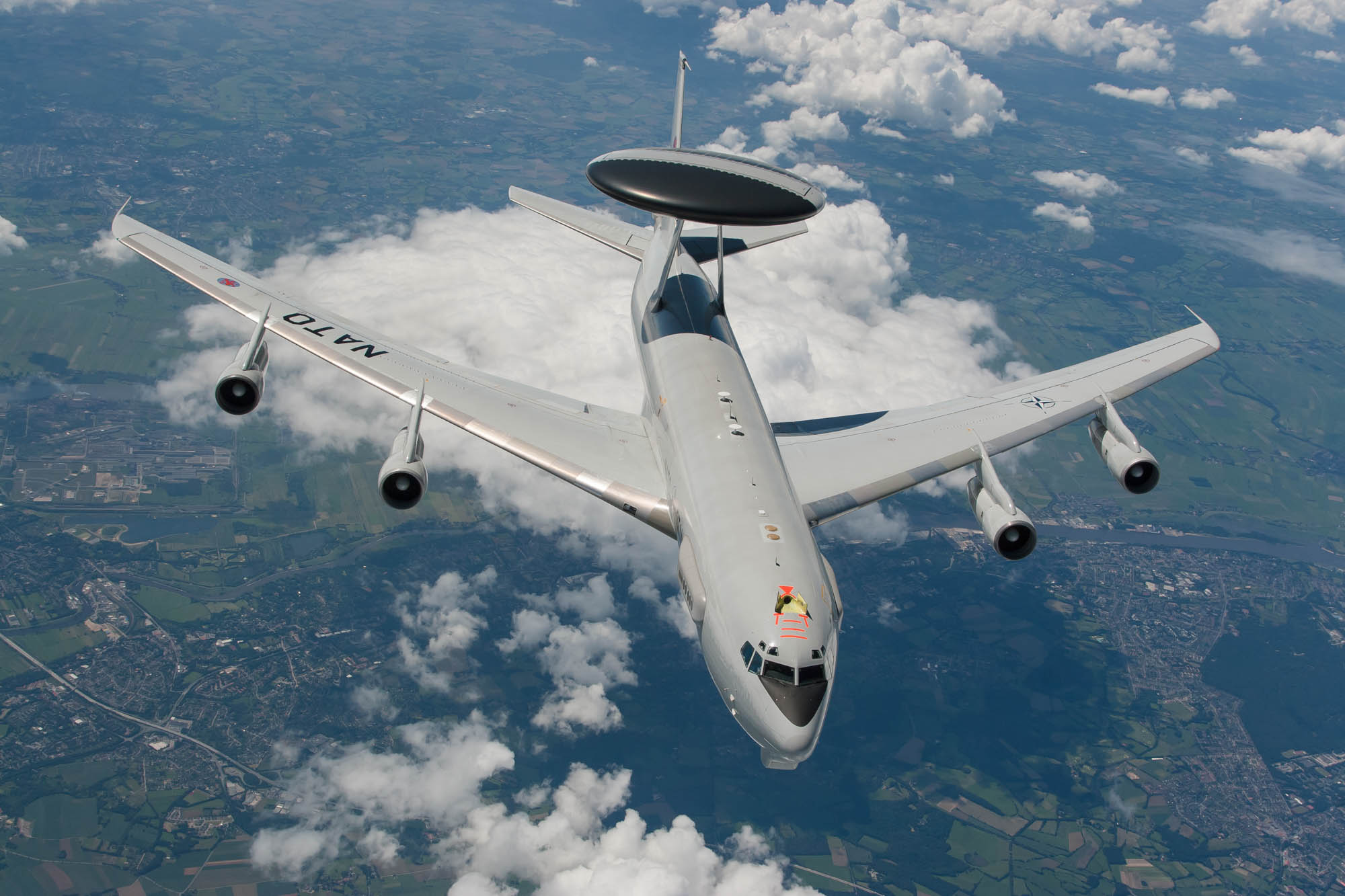 |
| Boeing E-3A (LX-N90459) callsign 'NATO13' breaks off from refuelling. |
Eighty years of history The 108th ARS was originally activated on 1 July 1927 as the 108th Observation Squadron and flying the PT-1 aircraft. In 1942 the unit assigned to the 72nd Observation Group before deploying to Panama. The squadron was tasked with anti-submarine, photographic and liaison missions, primarily using the O-47 aircraft. At the end of the war the 108th was reassigned to the Illinois National Guard re-designated as the 108th Bombardment Squadron (Light) and were based at Chicago Municipal Airport. Following the Korean War and deployments to Europe the squadron became the 108th Fighter-Bomber Squadron and by 1955 the 108th Fighter Interceptor Squadron. On 1 July 1961, the 108th's mission was changed to AAR and they were assigned the KC-97 aircraft. The unit converted to the KC-135A in 1976, later upgrading to the KC-135E version. The KC-135 celebrated its 50th birthday in 2006. In all 808 KC-135s were built and around 500 are still flying today, 250 of which are assigned to the ANG. With numerous upgrades over the years including the re-skinning of the wing surfaces from 1975 and installing re-designed engines it is believed that some of the fleet can fly on till 2040, in reality it is expected that only 65% will be flying by 2023 with the rest being retired before 2030. |
 |