D-Day 60th Anniversary Air Show, Duxford
"More than just an air show"
June 6, 2004
|
On Sunday June 6, 2004, Duxford played host to the 60th Anniversary of the D-Day landings, air show. It was billed as an 'exhilarating and poignant tribute to the courage and tenacity displayed on D-Day and after'. Well that's exactly what it was. It was more than just another air show.
The organisers must be praised for putting together an event that was filled with atmosphere, fit for the occasion. A modest collection of World War Two aircraft were already lined up on my arrival. Numerous 'staff' were dressed up in period uniforms in front of the aircraft posing for photographs with the music of Glenn Miller playing in the background. World War Two veterans were invited and were proudly displaying their medals and British Legion regalia. A minute silence was asked for at 2:00 p.m. and was well respected. A reading of 'We will remember them', accompanied these solemn moments. |
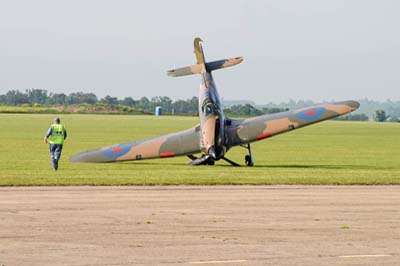
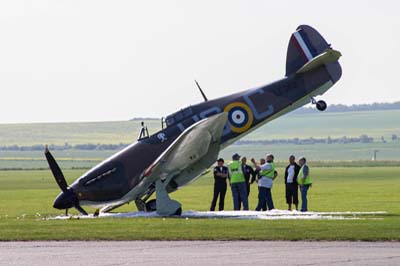
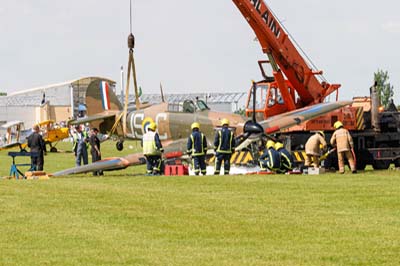
| The recovery of the unfortunate Hurricane 2C (LF363 'US-C') |
Unfortunately the event got off to a very bad start. At precisely 8:59 a.m., as recorded on my digital camera, the Battle of Britain Memorial Flight's Hurricane, flying from RAF Coningsby, had an under-carriage collapse on landing. I had previously checked in at the media centre and was just beginning to walk along the flight line when the Hurricane 2C (LF363 'US-C') over flew the field and turned left to come into land. Everything looked quite normal. It was only after touching down, did the pilot realise that his starboard under carriage was not locked in position. He appeared to skillfully bring the much-loved World War Two fighter to rest with the minimum amount of damage. The right wing only dropped to the grass field as it curved towards, but some 100 yards short of the crowd line. The propeller was almost stopped at this time and only the propeller's tips struck the ground as it came to rest with a cracking noise. The pilot was swiftly out of the cockpit and away to safety in seconds, already assisted by an alert member of the Duxford ground staff. Numerous fire engines arrived within seconds. But only a small amount of foam was sprayed initially as a precaution. Over the next few hours the Fire Service and a heavy lift crane which was already on site, was used with the aid of air bags to lift the sorry looking plane to its 'feet'.
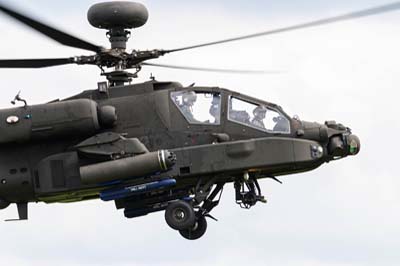
As usual at Duxford, for those who want to pay a little extra, are allowed to go right up to, but not touch, the display aircraft on the flight line. The modest flight line contained the 'usual suspects' of a handful of Spitfires, a Grumman Avenger and Wildcat, a P-47 Thunderbolt, L-4 Cubs and five Yak 50s and a YAK 52. The Royal Navy flew in a Sea King and Lynx, which were displayed at the end of the line. Other more modern aircraft parked along the crowd line were two or three RAF Tucanos. Later a rather fierce looking Westland WAH-64 Apache AH.1 (ZJ218) from 673 (AH Training) Squadron, joined them.
The B-17 Flying Fortress 'Sally B', took-off and performed its typical and hugely appreciated routine before disappearing off to Normandy. There it dropped 500,000 poppies over the gathered veterans. A pair of DH.89A Dragon Rapides G-AKIF and G-AIYR/HG691) of Classic Wings flew eager members of the public on pleasure flights throughout the morning, giving them the experience of luxury travel from the 1930s. |
Left to right:
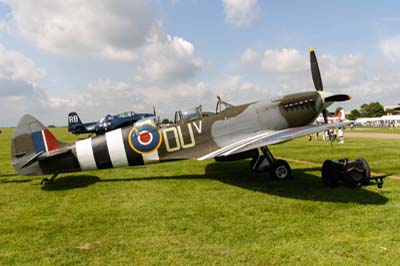
The most notable Spitfire, a mark IX, was ML407 'OU-V' registered (G-LFIX) based at Duxford. During the D-Day invasion, this actual aircraft flew into the history books, when piloted by Johnnie Houlton from New Zealand. The 21 year old was credited in shooting down 2 Ju 88s over 'Omaha' beach on D-Day. ML407 the 'Grace Spitfire' displayed at Duxford before darting off to the South coast for another D-Day event.
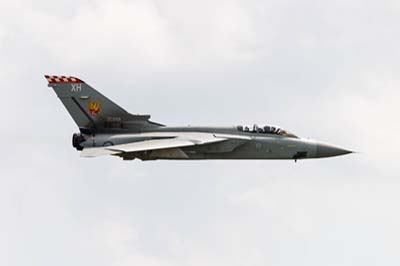
The flying display started with on schedule arrival of and RAF E3-D (AWACS) Sentry on its way back to RAF Waddington. An RAF Tornado F3 (ZE889 'XH') of 56(R) squadron based at RAF Leuchars, followed, roaring around the field finishing with a near vertical climb out to 15,000 feet, in complete contrast, to the Shuttleworth Trust's Miles Messenger (RG333). The Messenger, as with many others in the display were resplendent in the D-Day black and white stripe markings. As with the Tornado, the Harrier GR.7 flew from Cambridge airport just down the road, but disappointingly arrived at just 120 knots. Surely after a slow quiet display the frontline jet should have ripped over the field taking the unsuspecting crowd by surprise. Instead the Harrier's arrival was announced in advance and so we had to wait for ages as it laboriously approached.
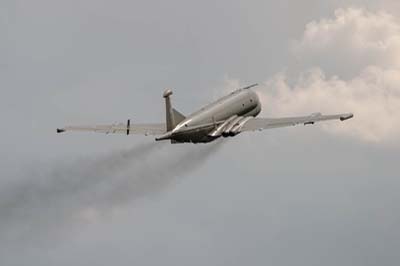
A Nimrod (XV248) was put through its paces with bomb bay open and closed, which has all been seen before, but never the less with the sun, made for good photographs, particularly with its steep climb out at the end of its display. |
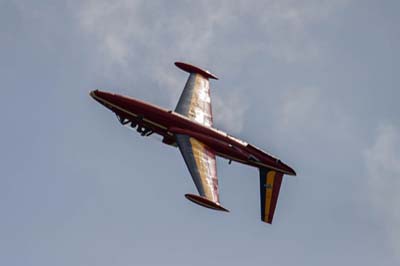
Left to right: Fouga CM.170 Magister (MT-13) of the Belgian Air Force gave an impressive display.
WAH-64 AH.1 Apache (ZJ218) looking menacing as it out stares spectators along the crowd line.
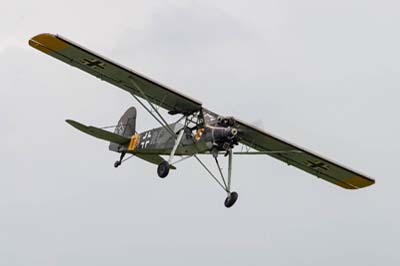
MS 505 Criquet (G-BPHZ / Nr.1827 TA+RC) in German World War Two markings, performed in near slow motion.
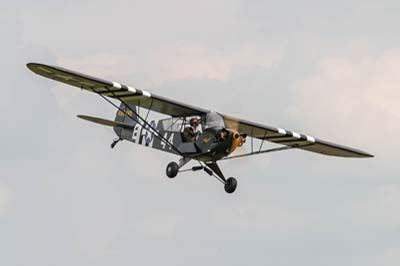
The 'Grasshopper' display team, consisting of a pair of Piper L-4 Grasshoppers in D-Day markings including Piper L-4J 480480 / 44-E (G-BECN). |
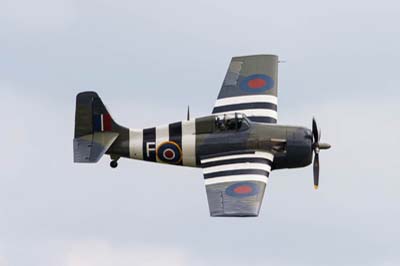
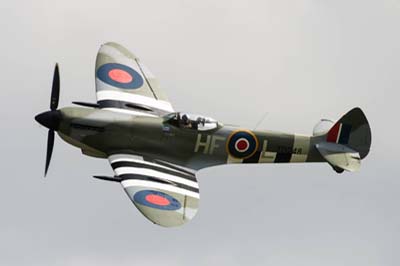
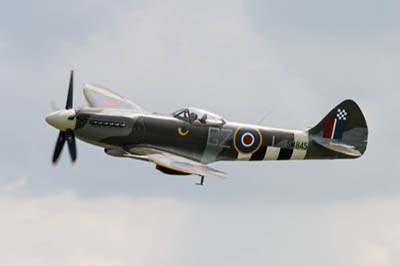
| Naturally D-Day marked aircraft were prevelent throughout the show. Above Grumman FM-2 Wildcat JV579 'F' (G-RUMW), Spitfire Mk.16 (TD248 'HF-L') and Spitfire Mk.18 (SM845 'GZ-'I). |
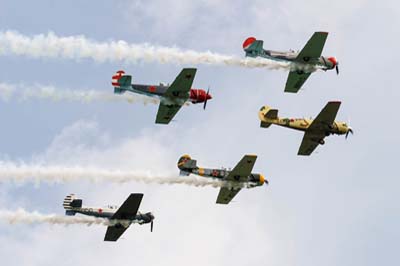
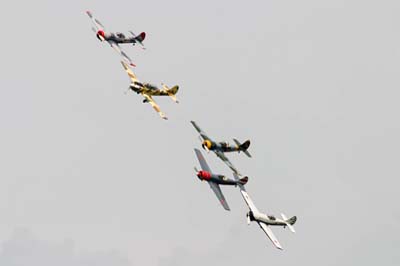
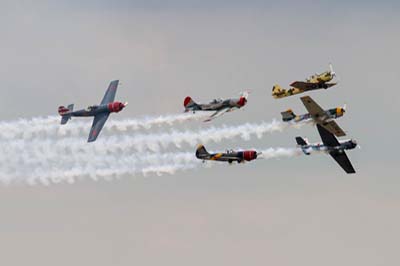
| The YAK team from North Weald, just down the road, gave one of the best displays of the day for me. Not because I had not seen them before, but because it was really entertaining. Six of 'Aerostar' team's Yak 50/52s, resplendent in Russian markings, were flying in constantly changing formations of 6, 5 and 1 and 3,2 and 1. There was never a dull moment. You did not know where to look (or photograph), as they flew around in every direction with trailing smoke |
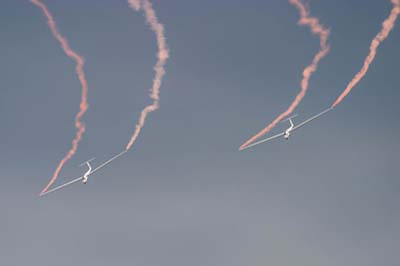
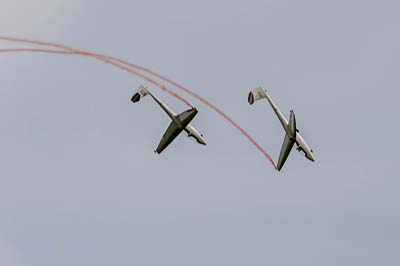
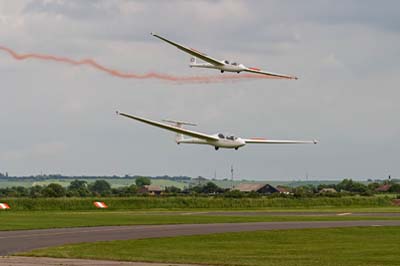
The other revelation for me was and what I would never have guessed could be entertaining, was 'Team Condor', comprising of two RAF GSA K21 gliders, flying as a synchronised duo. They were towed into position above the field, by two Chipmunks and released simultaneously. As they slowly lost height, we were treated to a series of elegant manoeuvres. I had not seen this before and was captivated throughout. To keep them in keeping with the D-Day theme we were told that they represented the many gliders used in the D-Day landings 60 years earlier.
As I said before, this was not just an air show, it was a fitting tribute to those who lost their lives and were involved in the D-Day landings of 1944 on the Normandy coast of France. |