The Final Day of the Harrier
RAF Cottesmore
December 15, 2010
|
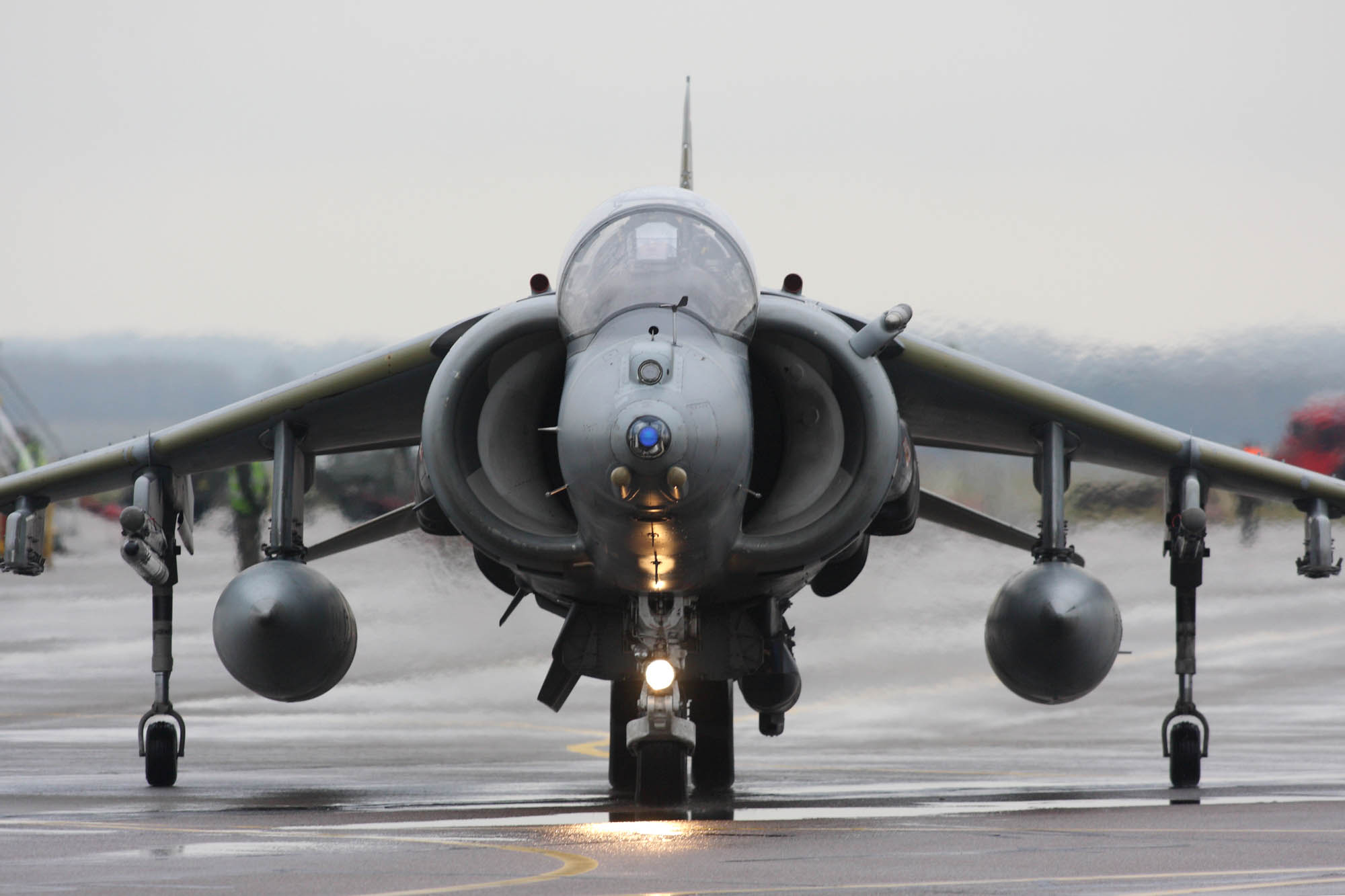
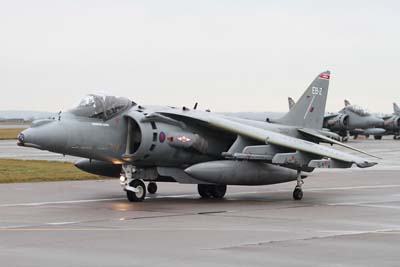
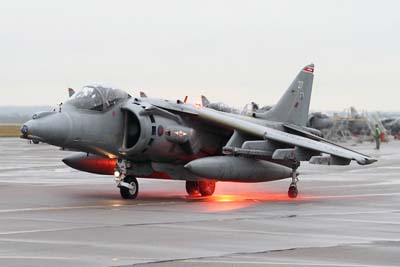
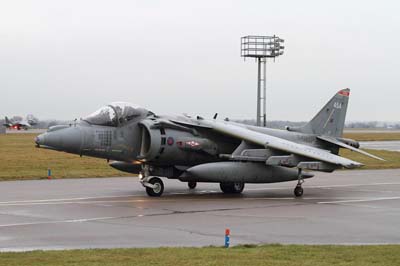
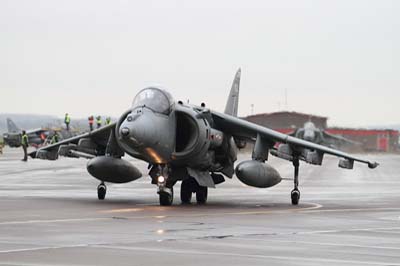
It’s hard to believe that today was the last time I would see the Harrier fly. With 41 years of service it’s has been around for nearly the entire time I have been watching and later photographing jet aircraft. This particular aircraft is special, it could land vertically, it could hover, go backwards and at the end of its public displays it would bow to acknowledge the crowds which meant so much to so many people at air shows. RAF Cottesmore was and has always been the nearest air base to my home, here photography was so accessible and the base personnel so friendly. No longer will I see the Harrier land and take off in huge amounts spray on the wet days and hover against the setting sun. Low-level photography for me will never be the same as I can no longer hope to see a Harrier coming around the corner at 250 feet with vortices flowing from its wings.
|
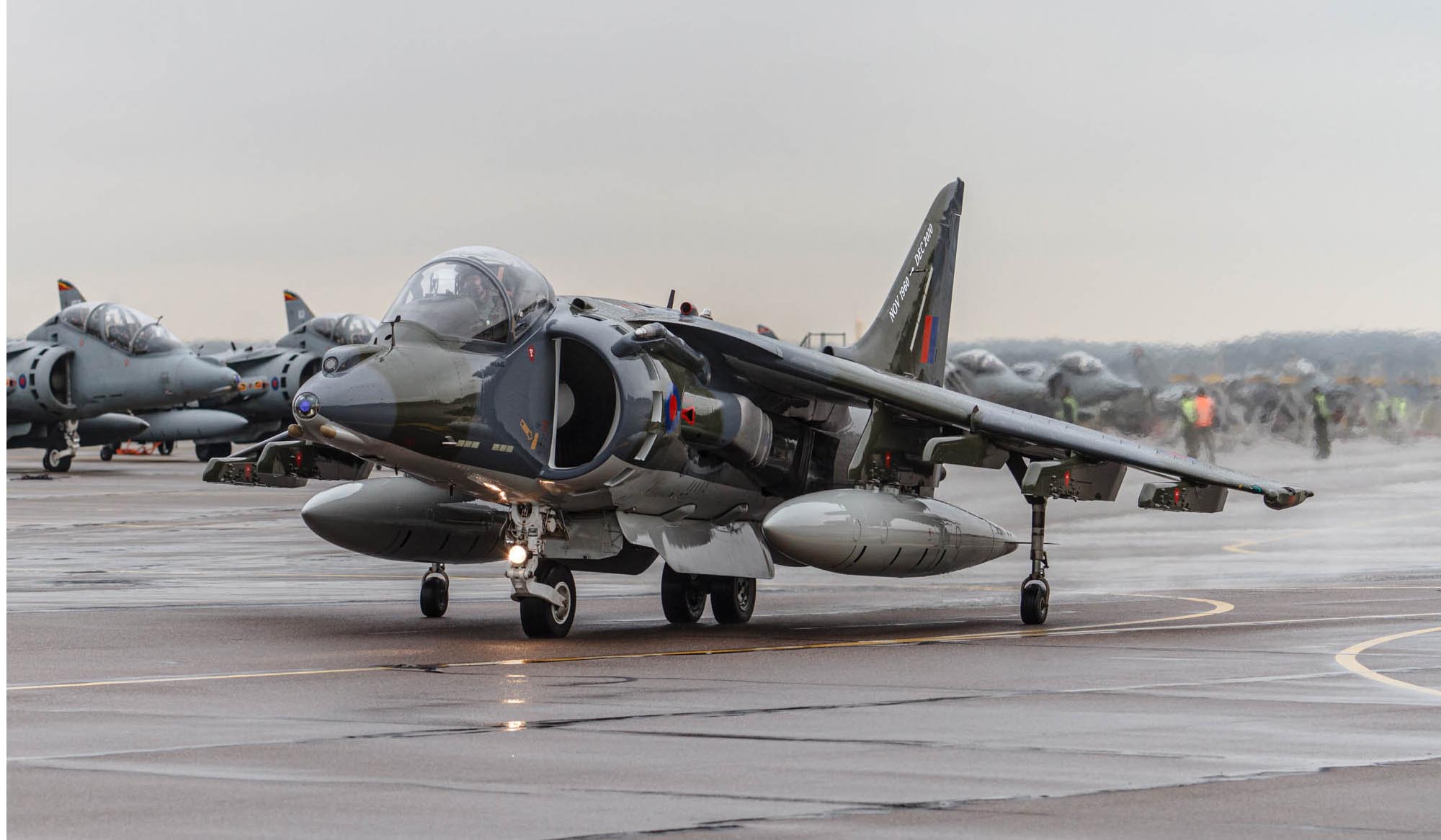 |
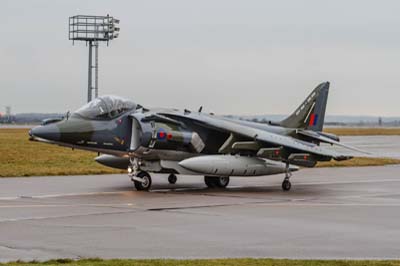
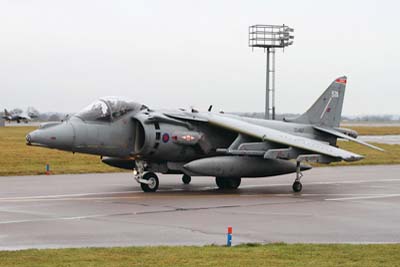
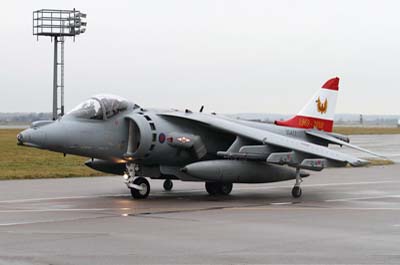
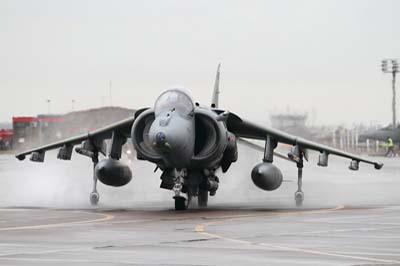
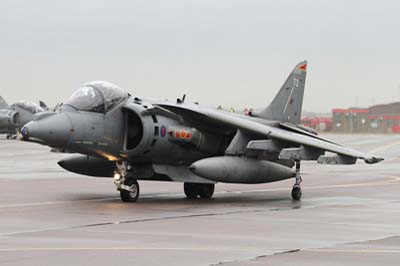
'Ninja 1' Harrier GR.9A (ZG506) in a retro GR.1 camouflage scheme it was first to leave for the final formation flight. It was piloted by
Group Captain Gary Waterfall OBE Joint Force Harrier (JFH) Commander and Cottesmore Station Commander who was as formation leader. |
Premature retirement
It was a total shock to all at Cottesmore and Wittering the Harrier’s home bases when the results of the Government’s Strategic Defence and Security Review (SDSR) were read out in Parliament on October 19, 2010. The SDSR detailed two priorities; to ensure that the mission in Afghanistan is protected and to make sure of a coherent defence capability by 2020. In effect it has meant there will be drastic cuts across Britain’s military forces to save money, 8% being the Government’s target over four years. The RAF’s Tornado GR.4 fleet is to be reduced and the Harrier fleet retired, originally by April 2011 but later it was changed to December 2010. The Nimrod MRA.4 project was cancelled and the Sentinel R.1 is to be mothballed when it is no longer required for operations in Afghanistan. The Royal Navy under SDSR are to lose the aircraft carrier Ark Royal and with the loss of the Harrier our maritime strike capability for at least ten years when the 65,000 ton aircraft carrier Queen Elizabeth will be available for the F-35C Joint Strike Fighter. The F-35B STOVL (short take-off and vertical landing) version was also cancelled as part of the SDSR in favour of the conventional F-35C variant which requires a catapult and arrestor wire for carrier operations.
The draw down
On November 4, the three former 41(Test and Evaluation) Squadron Harrier GR.9’s at Coningsby were transferred to 1(Fighter) Squadron at Cottesmore where pilots continued to fly missions along with 800 Naval Air Squadron (NAS). At Cottesmore training flights appeared to carry on as normal, however after November 23 they were not seen at low-level. Four Harriers using callsign ‘Jedi 1-4’ were perhaps the last low-level sortie flying at 250 feet through low-flying Area 7 in mid-Wales.
Instructor pilots with IV(Reserve) Squadron the Harrier Operational Conversion Unit based at Wittering, the jet’s spiritual home for 41 years, continued to fly to stay current with just two flights a day being the average until they were transferred to Cottesmore on December 10. During their final week they flew sorties to various air bases around the country as a final good bye.
From December 2 poor weather had hampered the Harriers plunge into its shocking early retirement. Unprecedented extreme cold weather with snow had iced up the taxiways and runway had prevented all flying from Cottesmore. To save money it was not until December 9 that the go ahead was given to clear the ice and snow in readiness for the IV(R) Squadron jets arriving from Wittering. During the Harrier’s final full week of flying operations fog and low cloud caused the planned farewell formation flypast practises to be postponed. In the last few days some sorties were flown to prepare aircraft and practise for the final event the 16 ship diamond formation which was finally achieved on the day before the closing ceremony. |
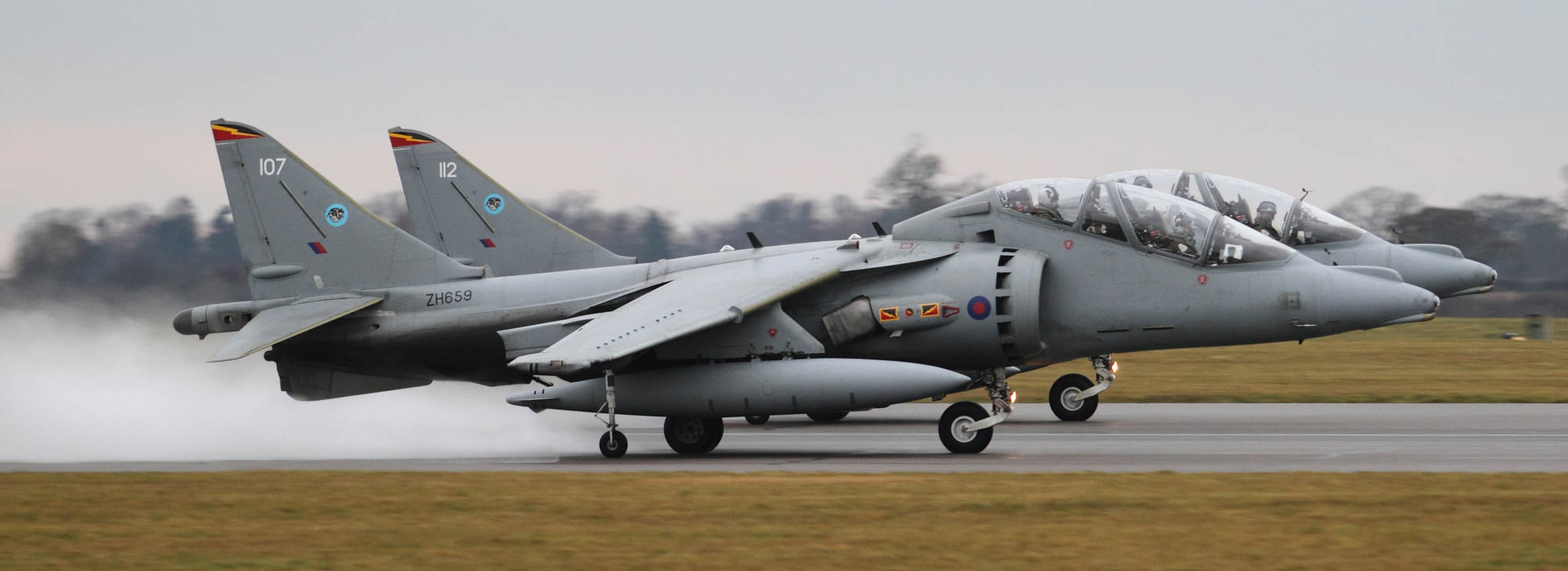 |
| Harrier T.12 pair in 4(R) Squadron colours accelerate down the runway as part of 'Poison Flight'. |
The final flypast
Today at Cottesmore where almost all serviceable Harriers are now in residence, 16 Harriers took off for a final formation flypast planned to pass at 1,000 feet over the air bases of Marham, Wittering, Cranwell, Waddington, Scampton and Coningsby before returning home. With only 16 pilots picked to make the flypast it must have left many pilots bitterly disappointed unable to fly on the Harrier’s final day. During the previous few days of poor weather flying was extremely limited, a few pilots were able to flight test some aircraft and practise the grand formation. When one pilot returned and dropped his Harrier down on the concrete the air traffic controller said, “You are now an ex Harrier pilot”.
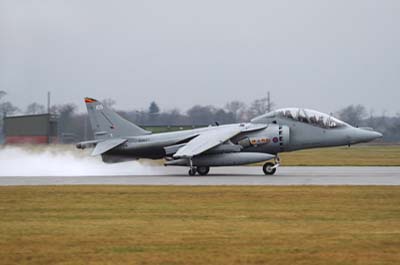 First to take to the air at 13:05 was a two-seat Harrier T.12 which was acting as weather-ship (callsign ‘Satan 1’). It was followed by the departure of the four groups of four Harriers which had pushed back 30 minutes to 13:30 to allow for better weather which in the end did not really materialise. In plumes of spray the 16 Harriers took off in pairs. The first four, callsign ‘Ninja 1-4’ comprised of Harrier GR.9/A’s lead by the Joint Force Harrier (JFH) Commander and Cottesmore Station Commander, Group Captain Gary Waterfall OBE in Harrier GR.9A (ZG506). His aircraft was painted in a splendid retro GR.1 gloss camouflage paint scheme applied just days earlier.
In the second wave of four using callsigns ‘Jedi 1-4’ were Harrier GR.9/A’s lead by a GR.9AS (ZG477) which had freshly painted special tail in the red and white colours of 1(F) Squadron, the RAF’s oldest squadron.
‘Cougar 1-4’ were next, four Harrier GR.9/A’s flown by Royal Navy Fleet Air Arm pilots of 800 NAS and lead by Harrier GR.9A (ZD351) with another freshly painted tail in the red and yellow colours of their squadron.
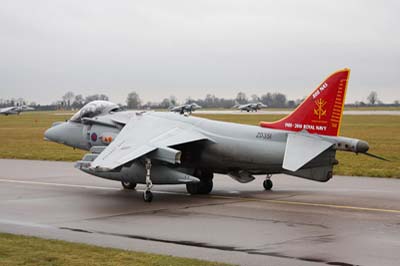
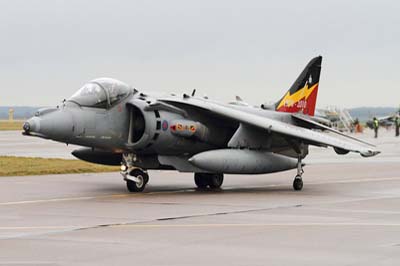
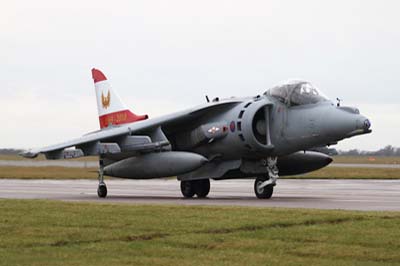
Finally four Harriers from IV (Reserve) Squadron took to the air as ‘Poison 1-4’, three two-seat Harrier T.12’s were lead by one of their specially painted aircraft (GR.9 ZG858) which has recently had the inscription ‘1970-2010’ added to the colourful red, yellow and black tail.
 The combined 16 ship diamond formation once formed, were using the callsign ‘Kestrel Formation’ the name of the original Harrier prototype. They flew the route as planned but sadly for the thousands of Cottesmore personnel, families and invited friends gathered at the Harrier’s final resting place, low cloud put paid to any chance of seeing the complete formation. However in waves of four they came in from the west a minute apart flying in close formation across the airfield before breaking left and landing. The leader of each formation hovered while facing the crowd before Gp Cpt Waterfall, a former Harrier display pilot, gave his final Harrier display which included the famous Harrier bow before pulling up and away before making the Harrier’s last landing, it was 14:40. The twelve Harriers had taxied back to the ramp past hundred of enthusiasts which had gathered around the base. The four specials came in last coming to rest to form a crescent in front. With typical precise and thoughtful planning all 16 jets shut down their engines simultaneously and Cottesmore was hushed.
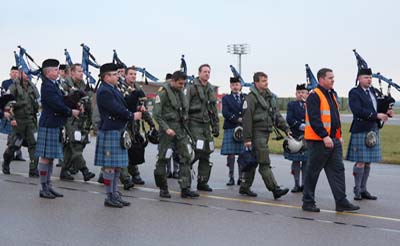
In a very moving tribute a band of Scottish pipers formed a guard of honour for the JFH Commander, his pilots and groundcrew who walked back together to be embraced by their families and friends. As a final tribute three Red Arrows Hawk jets (callsign ‘Harrier Salute Formation’) were flown low over the air base by three former Harrier GR.9 pilots.
A rich history
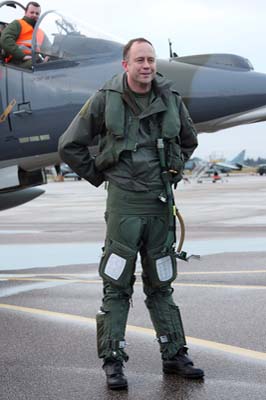 Gp Cpt Waterfall almost immediately was available for interview by local and national media. Moving swiftly from one television camera to another he remained upbeat when answering the same questions about how he felt. “It’s been an emotional and poignant day. It’s a fitting retirement for the aircraft after 41 years of history. We’re closing a chapter in military aviation. It’s sad, obviously, but I’m actually feeling happy, as we’ve done what we wanted to do, we’ve got as many people together here as we could who were part of the very rich story of the Harrier. I personally walk away with a sense of pride that I did as much as I could to make sure the Harrier has been retired from service with all of the respect and dignity deserved.”
The British designed Harrier entered service in 1969 it was unique in being able to take off and land both vertically and on a short runway. It excelled during the Falklands War, before going on to serve in many other conflicts including in Bosnia and Iraq in the 1990s. In 2000 the RAF and Royal Navy Harrier squadrons joined forces to form JFH, based at Cottesmore. The combined Harrier squadrons served in Sierra Leone, the second Gulf War and most recently in Afghanistan where it performed well for five years. Everyone involved with the Harrier both past and present is full of praise for this famous aircraft. Officer Commanding 800 NAS, Commander Dave Lindsay, said: “The Harrier leaves UK service after an illustrious career that has seen it contribute to every major conflict in the last 30 years. It has been an enormous personal privilege and honour to have been involved with this wonderful aircraft for nearly 20 years, at sea and over land, at peace and in conflict. I will forever be immensely proud to be able to say I have been a Royal Navy Harrier Squadron Commander.”
Numerous upgrades
The current fleet of Harriers are based on the GR.5 variant which entered service in May 1987 and introduced with full night time capability, a digital moving map, an Inertial Navigation System (INS) and a Hands-On-Throttle-And-Stick (HOTAS) system. From September 1990 to March 2010 the GR.5’s were upgraded to GR.7 standard. From 2003 some of them were upgraded GR.7A standard which featured a more powerful Rolls-Royce Pegasus 107 engine. Under the Integrated Weapons Program the GR.7’s were further upgraded to allow them to carry smart weapons, including Paveway laser guided bombs. Later the Lockheed Martin Sniper target pod was added to improve its effectiveness. From 2004 61 GR.7’s were converted to GR.9 and 30 GR.7A’s to GR.9A standard. More upgrades were apparently planned for the GR.9 including a data link-16 capability. The Harrier was very capable and could have unquestionably remained as such for some years to come. The two-seat Harrier T.10 version went into service from 1994 nine of the 13 built were upgraded to T.12 standard and two were upgraded to T.12A standard.
End of an era
 On this final day it appeared that instructors, pilots and mid-course students had been told of the fate just two weeks earlier, I am sure everyone was hugely disappointed although none wished to express it. All 135 former RAF Harrier pilots had apparently been found jobs, the 53 pilots of the Royal Navy Fleet Air Arm weren’t quite so fortunate their careers seem to be in jeopardy as very little is available, some may go on to helicopters and some pilots will transfer to the US Navy Pilot School to commence carrier training in readiness for the introduction of the F-35C Joint Strike Fighter. It has been suggested that British pilots will be flying French Navy Rafale from their own aircraft carriers as a result of a recent mutual agreement signed by the French and British Government to share certain resources.
There were no shortages of glowing praises from the many serving Harrier pilots; Squadron Leader D Mason, of 4(R) Squadron and a Qualified Flying Instructor said; “The Harrier is undoubtedly the most flexible fighter in the world, operating from wooded strips and pads, aircraft carriers and austere locations since the late 1960’s. It has served with distinction around the Globe and saved countless lives in numerous conflicts. It has been an honour and privilege to serve on this incredible aircraft”.
The final Harrier squadrons 1(F), 4(R) and 800 NAS will formally disband on January 31, 2011 and Cottesmore air base will close on March 31, 2011. The fate of the 79 Harriers currently at Cottesmore has not been decided they will remain in store until a decision is made by the Ministry of Defence. Aircraft engineers at Cottesmore reported that they will be working on the aircraft over the coming weeks to get as many flyable as possible.
Gp Cpt Waterfall achieved his wish to give the Harrier a well deserved send off it was a very moving and memorable occasion. It is with huge sadness that this report was written, I wish everyone associated with the Harrier all the best for the future. |
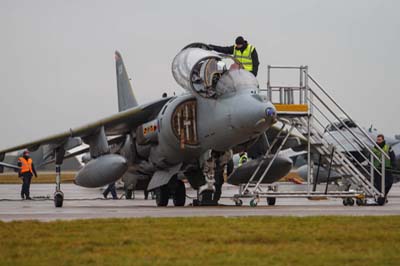
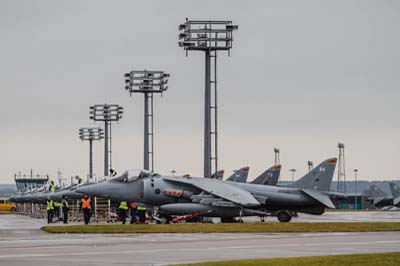
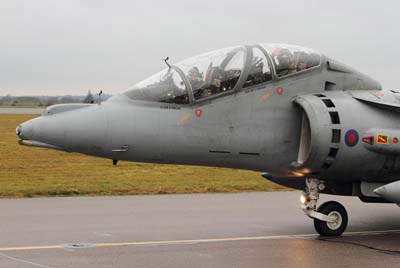
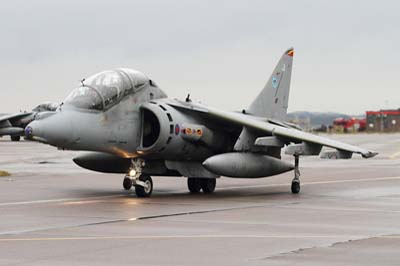
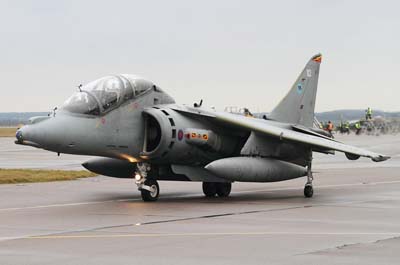
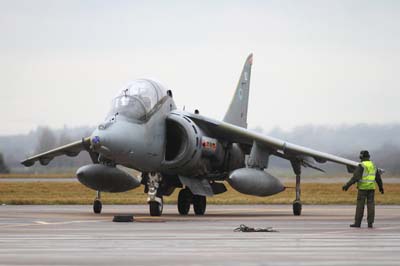
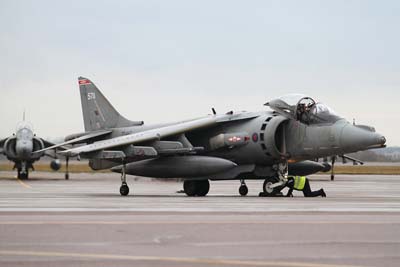
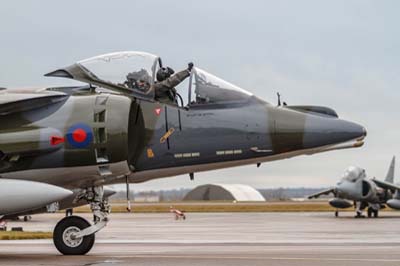
| Groundcrew are preparing the Harriers for the 16 ship formation flypast. In fact around 30 Harriers were available, the additional aircraft were air spares. The previous day three Harriers taxied out for the rehersal and three had to return and the pilots had to swap aircraft. The crew of Harrier T.12 (ZH664 '112') taxi out, the back-seat is happy to ackowledge the photographers. |
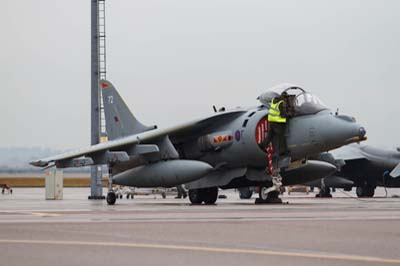
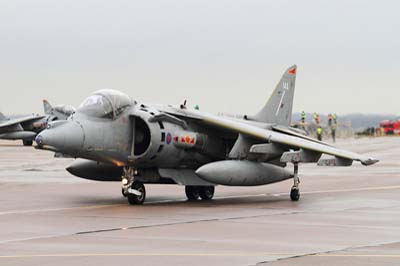
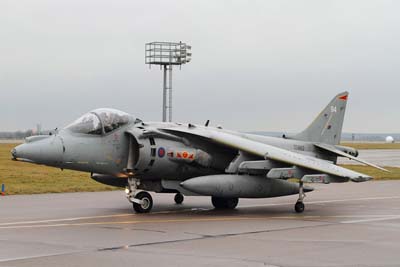
| The distinctive Harrier with wings more drooping than normal will be sadly missed - GR.9A (ZD433 '45A'). |
| The 16 ship 'Kestrel Flight' a diamond formation for the final flypast |
| Left to right: 'Ninja 1-4' flight lead by Harrier GR.9A (ZG506) in a retro GR.1 camouflage scheme with Harrier GR.9 (ZG857 'EB-Z'), Harrier GR.9 (ZD379 '27') and Harrier GR.9A (ZD467 '57A') in 1(F) Squadron markings. |
| Left to right: 'Jedi 1-4' flight lead by Harrier GR.9AS (ZG477) with a 1(F) Squadron special tail with Harrier GR.9A (ZD433 '45A'), Harrier GR.9A (ZG472 '62A') and Harrier GR.9A (ZG479 '69A') in 1(F) Squadron markings. |
| Left to right: 'Cougar 1-4' flight lead by Harrier GR.9A (ZD351) with a 800 NAS special tail with Harrier GR.9A (ZD347 '14A'), Harrier GR.9 (ZG862 '94') and Harrier GR.9 (ZG502 '73') in 800 NAS markings. |
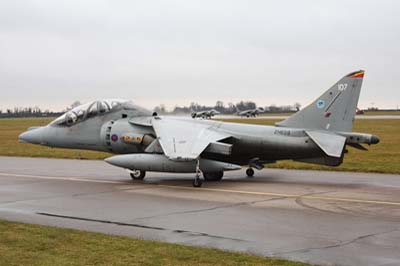
| Left to right: 'Poison 1-4' flight lead by Harrier GR.9 (ZG858) with a 4(R) Squadron special tail with Harrier T.12A (ZH665 '113'), Harrier T.12 (ZH659 '107') and Harrier T.12 (ZH664 '112') in 4(R) Squadron markings. |
| The Harriers return after their final fypast over six air bases across Lincolnshire and Norfolk. |