
|
|
|
|
| Spanish Air Force Mirage F.1s Reach 30 A day with Ala 14 of the Ejército Del Aire at Los Llanos Albacete and their ageing Mirage F.1Ms. June 2004 |
| With the RAF retiring it's Jaguars after over 30 years of service, due in part to the advent of the Typhoon, I was interested to see what the Spanish Air Force (EdA) were doing with their 30+ year old Mirage F.1s. The EdA are also currently introducing their own Typhoons (or Tifón in Spanish). |
| It was an early start in fact it was still dark, as I drove north on the relatively new two-lane motorway to Albacete, the home of the Ejército Del Aire (Spanish Air Force) Mirage F.1Ms. As the sun came up over the barren hills, it revealed a barren landscape, which could easily have been mistaken for Arizona. As I pondered over the beauty of this wilderness, I realised I was in 'Spaghetti Western' country and the only thing missing was Clint Eastwood on his horse! The Spanish coastline has changed considerably over recent years, there is hardly an area in sight that has not been developed for hotels and villas. Travelling up through the heart of this beautiful country, I could see what Spain was really like. The arid hills eventually gave way to irrigated green fields and windmill farms, as I approached Albacete. I was expected at the Los Llanos air base at 8:00 a.m. Following my invitation from the Spanish Air Force, I chose the early start, to make sure that I could make the most of the early clear light, free from heat haze. |
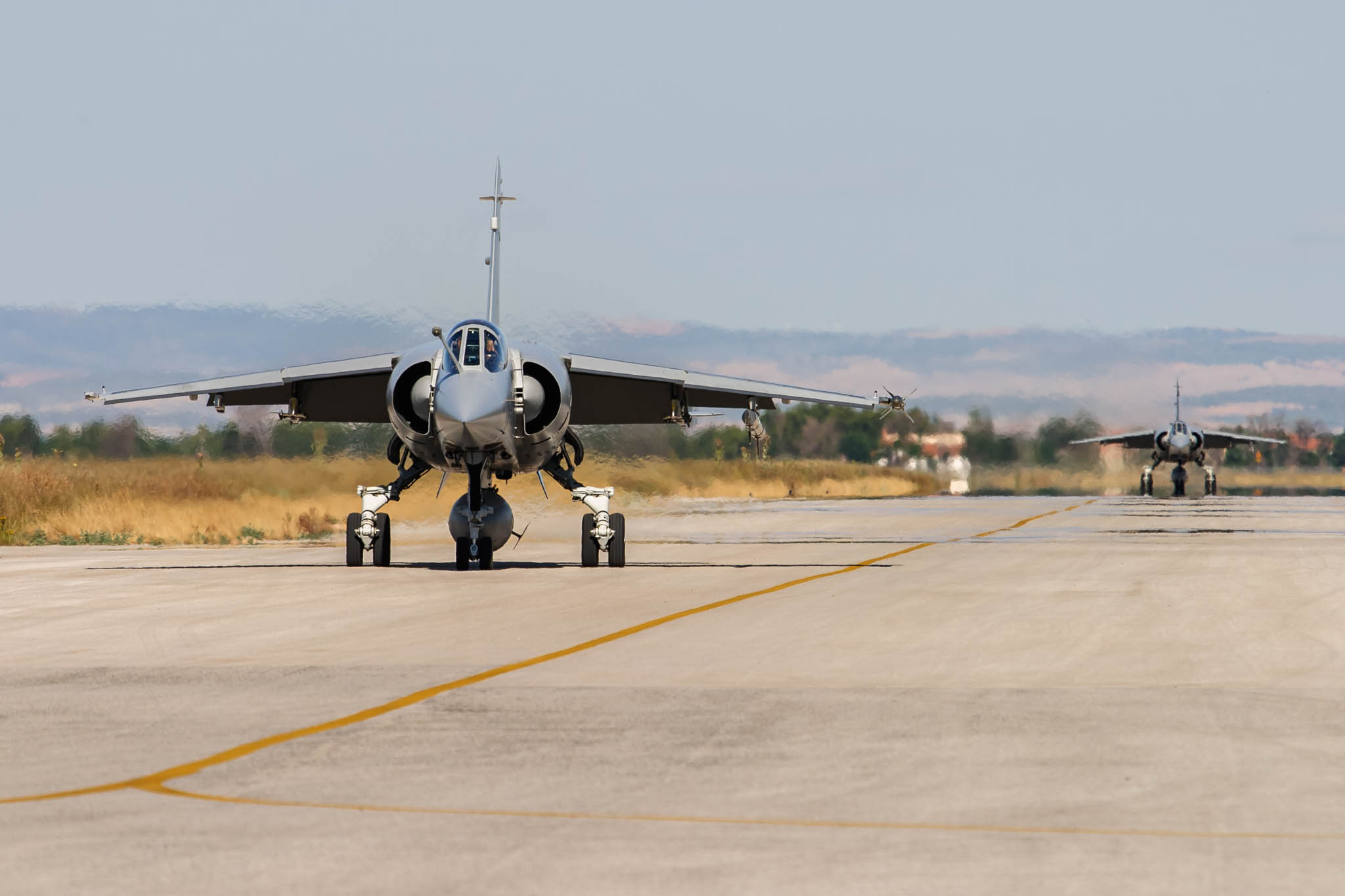 |
| The first image of the day, two Mirage F.1Ms taxi to the last chance holding point. |
| I was checked in, relieved to see my name on the list and greeted by a young Escuadron (Squadron) 142 pilot, in fact the youngest on the base, he later told me. He introduced me to the Public Relations Officer for Ala 14 (14 Wing). After agreeing to my photographic requests, my pilot guide for the day was issued some car keys and the all-important radio and we headed off to my first chosen location. It is always a thrill to drive along taxiways, the radio is vital, as it is essential to stay in contact with the tower at all times. My first point of call was the holding area for final checks, this was at the end of the main taxiway, which runs the length of the runway. Here I wanted to get nose on shots of the Mirages, as they made their way for take off. During my briefing, I was advised that there would be two flights of four Mirage F.1s in the morning and a similar number in the afternoon. The first mission was due to take-off at 9:30 a.m. In position, we could hear the Mirage's single SNECMA engines burst into life from the various Hardened Aircraft Shelter (HAS) locations, scattered on the north side of the base. I was told that they always seem to run five minutes late, today was no exception. |
 |
 |
 |
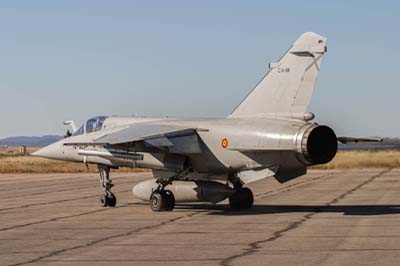 |
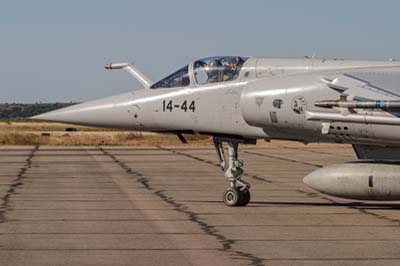
| The Mirage F.1M (C.14-72 coded 14-44), look how low the 2300 litre drop-tank which provides an extra 310 nm of range. Note, also the fixed but removable refuelling probe, absent from many of the Mirage images below. |
 |
 |
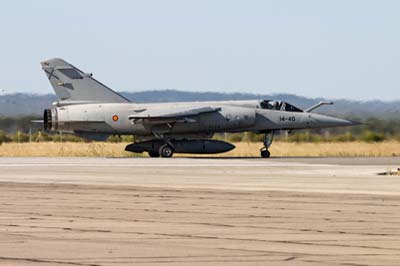 |
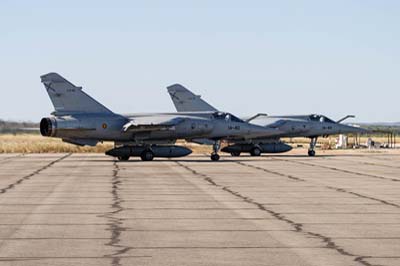
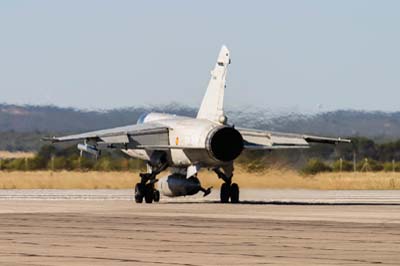
| From the final checks holding point, in pairs they position on the runway for take-off. |
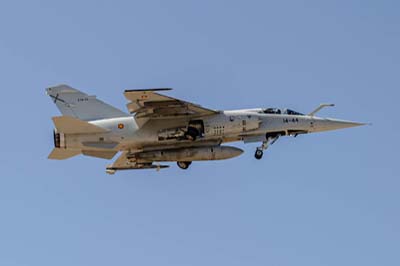 |
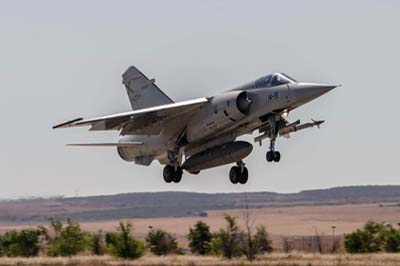 |
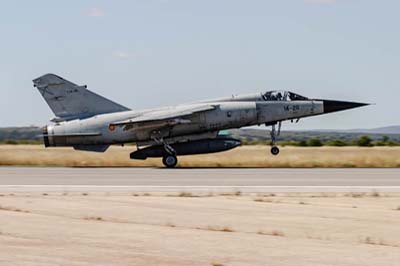 |
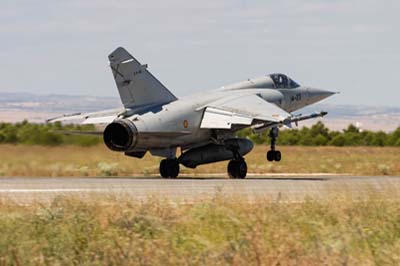 |
| By the time the second group of four had departed, the first group was due to return. Each mission tends to last around 45 minutes and I was now at my second requested position at the touch down point, for some approach and landing shots. My guide said that the pilots had been told to land towards the 100m mark, as a recent lightning strike had damaged the runway's surface. We later went out to inspect this damage, which appeared minimal, never-the-less, safety cannot not be compromised in any way. |
| Ala 14s two Squadrons With the morning missions over, we got a brief bite to eat and I gathered some more information from the pilots in the mess. There are forty pilots with Ala 14, twenty assigned to each squadron. Ala 14 still has around 50 operational Mirage F.1Ms divided between Esc 141 and Esc 142. The aircraft are interchangeable between the two squadrons, no squadron markings are carried and only the Ala 14 badge is displayed on the aircraft's intake. |
 |
 |
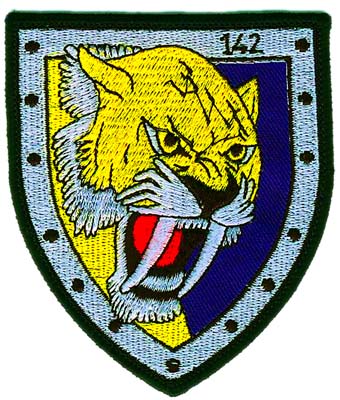 |
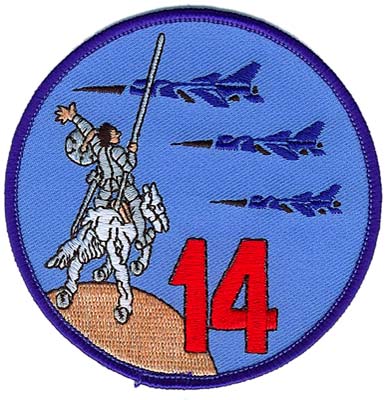
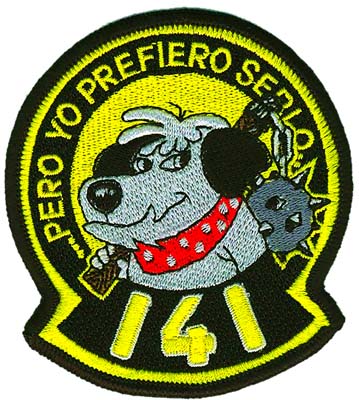
| The Ala 14 badge depicts Don Quixote saluting a flight of three Mirage F.1. The Esc 141 motto on their badge, "Pero yo Prefiero Serlo", translates as, "But I Prefer to be it." The Esc 142 depicted as a NATO Tiger Squadron, since its incorporation in 1986. |
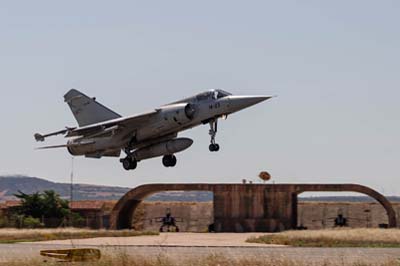
The two squadrons have quite different roles. Esc 141 is responsible for aerial interception, bombing and aerial interdiction. Two Esc 141 piloted Mirage F.1Ms are permanently on Quick Reaction Alert (QRA) duties, now more important than ever, since '9-11'. QRA training is performed on average two times a week, they aim to be airborne in 5 minutes. My guide could not recall however, the last time there was a launch for real. The QRA shelters were just opposite my second position, at the eastern end of the runway. Occasionally, when the need arises, Esc 141 are tasked to escort the President of Spain, when he is heading out to, or returning from, foreign visits. Left: Mirage F.1M (serial C.14C-42 coded 14-23) touches down opposite the QRA shelters. Esc 142 is responsible for both ground attack operations and pilot training. The nearby range at Bardenas is just 20 minutes flying time away and is frequently used for ground attack training. In 1986, Esc 142 was incorporated as a NATO 'Tiger Squadron', attending their first meeting at Cambrai in France that year. Training to Fight Before being assigned to Ala 14, pilots will start training on the ENAER T.35C Pilan at the Spanish Air Force Academy at San Javier. They should then progress to the CASA C-101 Aviojet. Successful potential fighter pilots will then be selected for the fighter course with Ala 23 at Talavera la Real on the SF-5B Freedom Fighter. Having accumulated over 100 hours on the SF-5B and five years since they first joined the Academy, pilots on graduation will transfer to one of four Fighter Wings, including Ala 14 at Albacete. The other Fighter Wings are; Ala 11 at Moron with the Eurofighter 'Tifón', Ala 12 at Torrejon and Ala 15 at Zaragoza both flying the EF/A-18A Hornet. All aspects of fighter training are carried out at Albacete. The diverse roles of the multi-mission Mirage F.1M range from aerial interception and bombing, to low-level and ground attack. Pilots have access to a Mirage simulator on the base, which was originally installed in 1978, they practice in pairs, mostly emergency procedures, in 45-minute sessions, almost weekly. By 1978, 5000 hours had been flown in the Mirage here, increasing to 100,000 by 1991 and 150,000 by 2000. They have now achieved 165,000 flying hours. Pilots should expect to perform air to air refuelling once a month, both day and night. Night flying missions are often flown and these are on Mondays to Thursdays only. Low-level training is a regular requirement also. My less experienced guide, said he was cleared down to 700 feet, the more experienced pilots are cleared to just 300 feet. One potential hazard during low-flying missions is from bird strikes, a particular threat is posed from the 'Buitre Negro' or Black Vulture. These very large birds are often seen between 500 and 1000 feet, he said. In July 2004 the Moroccan Air Force brought over their Mirage F.1s and F.5s for an exchange. I was told that they were impressed with the Moroccan's professionalism. Also in 2004, 142 Esc attended the NATO Tiger Meet at Schleswig-Jagel in Germany and participated in the operational phase after a long absence. I was told, that pilots particularly enjoy foreign deployments and multi-national exercises. They took part in the 'Cope Thunder' Exercise in Alaska in 2002 and hope they can participate in another soon, that is, if the budget is approved. They frequently fly against their friends from Zaragoza and Torrejon in their EF/A-18A Hornets. During a quiet period, my guide said he was very happy at Albacete, he was born locally. When asked if he would like to fly the Hornet or even the Eurofighter Tifón, he said transfers to other bases were difficult. Pilots are of a different breed altogether, very bright and they crave for, 'the need for speed'. In his dark glasses, I could not help thinking of Tom Cruise in the film 'Top Gun'. He later told me of his powerful motor bike, "you know like on Top Gun", he said with a smile, I laughed. On the down side there have been a number of losses. The first was in 1977, more recently on May 4, 2004. A 29-year-old pilot was killed, when he lost control of his aircraft returning from a successful air to air refuelling mission. The crash was in the Sierra de Alcaraz, an area restricted for military flights and known as Delta-98 zone. The EdA has lost twenty Mirage F.1s in total, over the past thirty years. This was in sixteen accidents, resulting in ten pilot fatalities. It must be said that only five Mirage have been lost in the last twelve years. On March 22, 2006 a Mirage F.1 crashed when on a training flight with two other jets, near the town of La Roda not far from the Albacete air base. The pilot ejected and escaped with various fractures, he was the 7,144th person to be saved by a Martin Baker ejection seat. How it all started 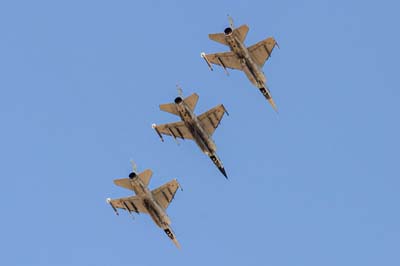 The Los Llanos air base at Albacete began in April 1929, when a pilots flying school was formed. As a result of the Spanish Civil War (1936-1939), the air force was split into a Nationalist air force and a Republican air force, which later surrendered to Franco at the end of the hostilities. In November 1939 the Ejército del Aire (EdA) was formed by combining the Nationalist force with the Republican force and Los Llanos was operated by the Spanish Air Force proper. Later, from 1962, the Transport Wing Ala 37 flew the DC-3 till 1974 at Los Llanos, before making way for fighters. The Los Llanos air base at Albacete began in April 1929, when a pilots flying school was formed. As a result of the Spanish Civil War (1936-1939), the air force was split into a Nationalist air force and a Republican air force, which later surrendered to Franco at the end of the hostilities. In November 1939 the Ejército del Aire (EdA) was formed by combining the Nationalist force with the Republican force and Los Llanos was operated by the Spanish Air Force proper. Later, from 1962, the Transport Wing Ala 37 flew the DC-3 till 1974 at Los Llanos, before making way for fighters.On June 1, 1974, Ala 14 with Esc 141 was formed at Base Aérea de Albacete - Los Llanos. It was not until June 18, 1975, when the first three Mirage F.1CEs of an initial batch of fifteen, were delivered to Esc 141. A second batch of ten Mirage F.1CE were ordered in 1977 and were delivered between June 1978 and May 1979. The second squadron, Esc 142, was activated in the spring of 1980. A further 48 aircraft (20 CE, 22 EE and 6 BE variants) were ordered in 1978 for delivery from 1980 to March 1983, making 73 Mirage F.1s in total (serials C.14C-01 to C.14C-73). The CE variant was a dedicated interceptor; the EE variant contained an inertial navigation unit for air-to-ground missions. The BE variant was a two-seat version of the CE. The Mirage F.1 Dassault developed the Mirage F.1 as a single-seat multi-mission fighter and attack aircraft, capable of all-weather interception. It first flew on 23rd December 1966. It has two 30mm DEFA 553 cannons, mounted on the lower central fuselage. It can carry 13,890 lbs. (6300 Kg) of external stores. They were initially armed with the Matra 550 Magic, which was retired in 1987 when it had become obsolete. It has also carried the Matra Super 530 air to air missile before upgrading to the AIM-9L Sidewinder. For ground attack it can carry combinations of Armat anti-radar missiles, an AM39 Exocet anti-ship missile or up to fourteen 250Kg bombs. The EdA Mirages were initially painted in a two-tone sand camo scheme. In 1989 they were re-painted in their current air superiority light grey polyurethane paint. A false cockpit was also painted on the aircraft's undersides (see image on left), in an attempt to confuse adversaries in aerial combat. Upgrade program to a common F.1M standard At a cost of $95 million and running from 1996 to 2001, 48 single seat and four twin seat aircraft (serials CE.14-27, 30, 31 and 87) under went an upgrade program by Thales (then Thomson-CSF), who sub-contracted to EADS/CASA. 35 aircraft were upgraded at EADS/CASA's main factory at Getafe, the remaining 17, were upgraded at the Air Armament Workshops (La Maestranza) at Albacete. The upgrades brought the Mirage up to a NATO and common standard. Primarily, the enhancements were for a revised cockpit configuration and improved communications systems, as well as for weapon, self-defence and navigational systems. Following these upgrades the various Mirage variants, were re-designated Mirage F.1M. How long can the Mirage keep Flying? 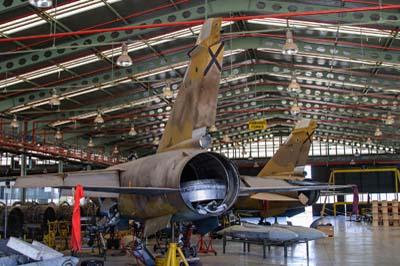
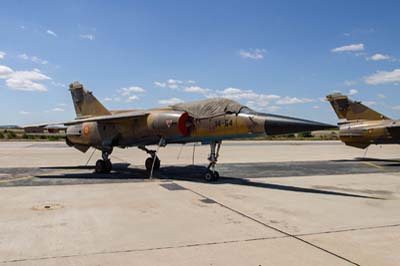
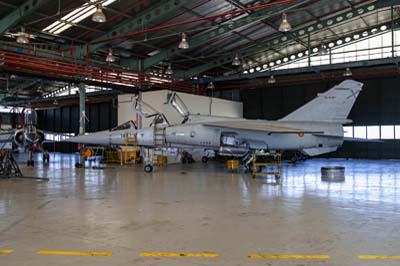 "No, not at all", I was told, "There is a lot of expertise and experience on the base", experience gained over the preceding 30 years, since the Mirage F.1 first arrived. Some of the Mirages have been withdrawn from service and used for spares reclamation. "No, not at all", I was told, "There is a lot of expertise and experience on the base", experience gained over the preceding 30 years, since the Mirage F.1 first arrived. Some of the Mirages have been withdrawn from service and used for spares reclamation.Left: Two ex Qatari Air Force Mirage F.1EDAs cannibalised for spares. Also, in 1994 and 1997 a further eleven ex Qatari Air Force, Mirage F.1EDAs (serials C.14-74 to C.14-84) and two twin-seat F.1DDAs (serials CE.14-85 and CE.14-86) were bought from Dassault, as a source for spares, they were not upgraded. An additional five, ex Armée de l'Air (AdlA) Mirage F.1s were delivered between 1994 and 1995. The order was for a twin-seat Mirage F.1B (serial CE.14-87 coded 14-73) (as shown left) and four Mirage F.1Cs (serials C.14-88 to C.14C-91). These ex AdlA jets were all upgraded with the rest to F.1M standard. |
 |
 |
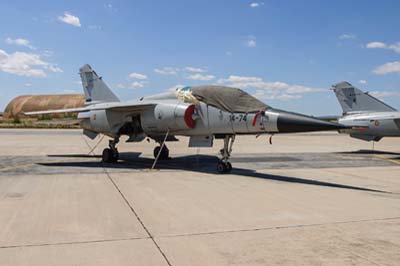 |
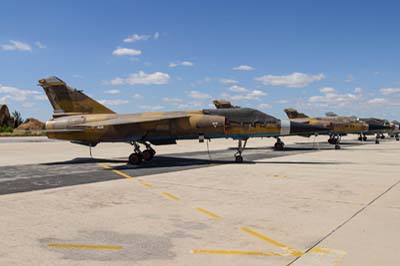
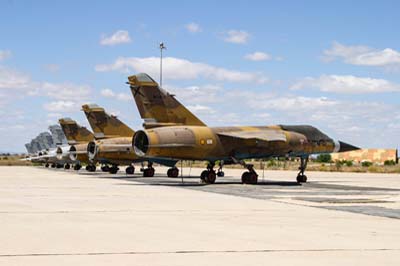
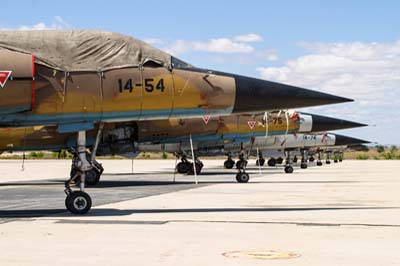
| Line up of the withdrawn ex Qatar Air Force Mirage F.1s (From left to right: Mirage F.1EDAs C.14C-76 '14-52' and C.14C-78 '14-54' also F.1DDA two-seat CE.14C-85 coded '14-74'). |
 |
 |
 |
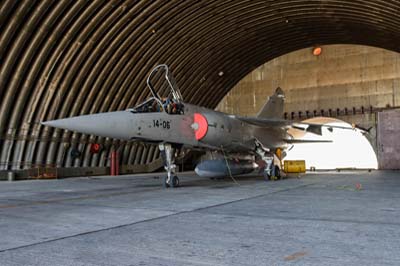 |
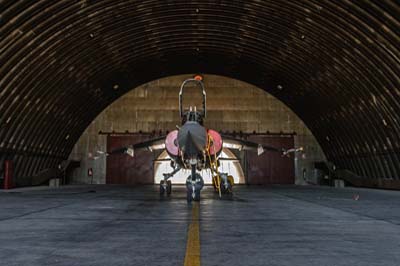
| Outside the maintenance hangar were around ten of the withdrawn engine-less airframes. Former Qatari Air Force machines, in their two-tone sand-camo schemes, were in this line up, while one or two others in a hangar were being worked on while I was there. The remaining ex Qatari aircraft are still stored on other parts of the air base. They are expecting to keep the Mirage flying a further ten years, until around 2015, when the Eurofighter finally replaces them. Mirage F.1M (serial C.14C-11 coded '14-06') in a Hardened Aircraft Shelter (HAS). |
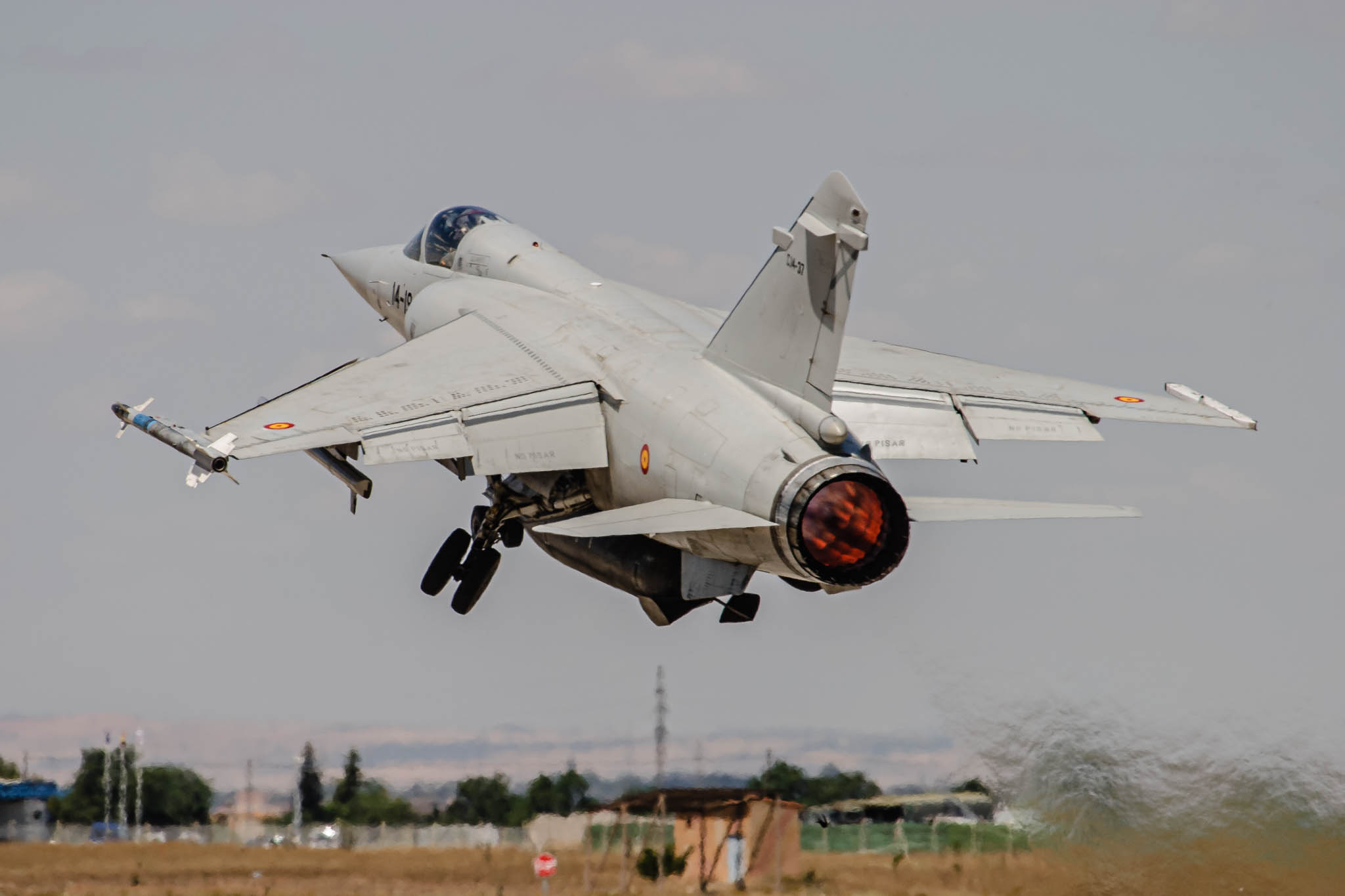 |
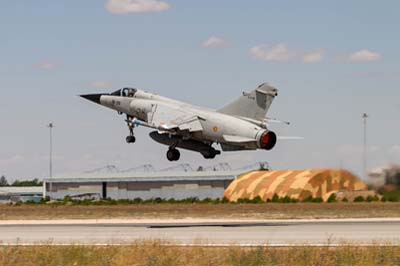
| Mirage F.1M C.14C-37 coded '14-19' departs in style. |
 |
 |
 |
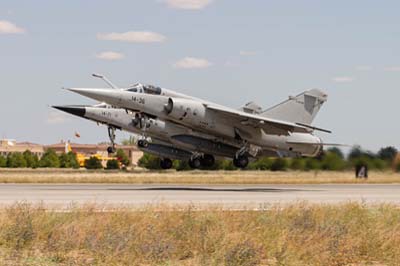 |
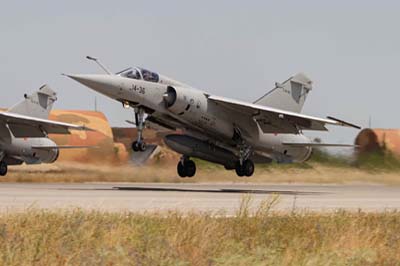
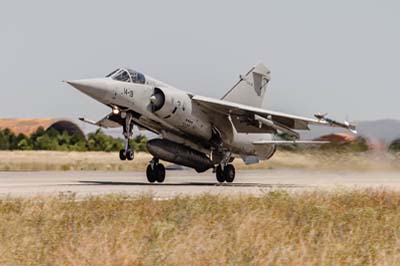
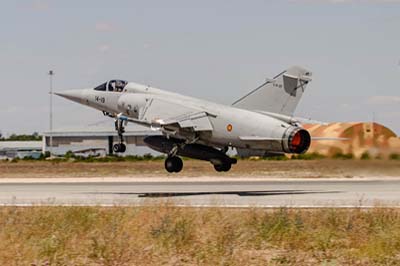
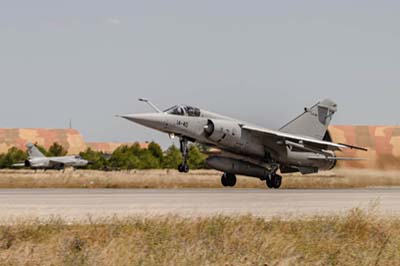
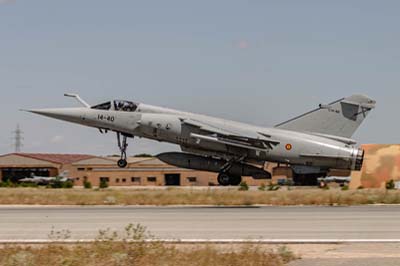
| Flying for the day ends at 14:30, so with the final launches due, we made our way to the mid-point of the runway. I was after some dramatic take off shots, as these venerable fighters leave the runway on full re-heat. I left the precise location for these shots, down to my pilot guide. The point, at which the aircraft rotates, depends on its weight and the prevailing weather conditions. We arrived in position, but found that the sun had moved around to the other side of the runway. |
 |
 |
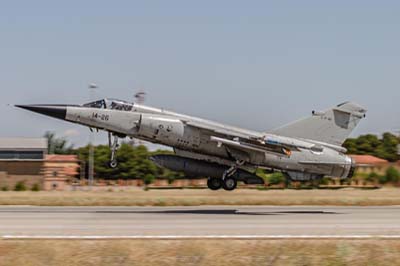 |
| A position across the runway would achieve the best results, so with a quick call to the tower, we were granted permission to cross the runway and position ourselves between markers 4 and 5. I was advised that I could not go closer than 50m from the runway for my photographs, which was really quite close enough! |
 |
 |
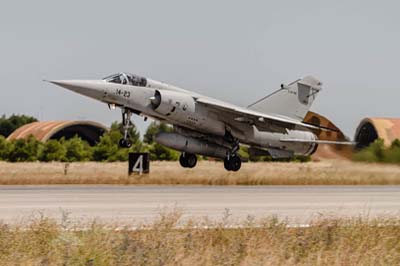 |
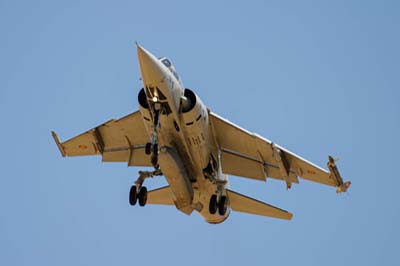
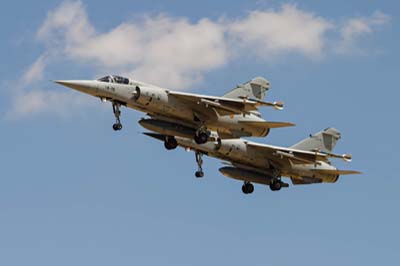
| Eventually the two batches of four Mirages appeared from the various hardened aircraft shelters (HAS), making their way to the holding point, at the end of the runway. They departed in pairs, for their final 45-minute sortie of the day. |
 |
 |
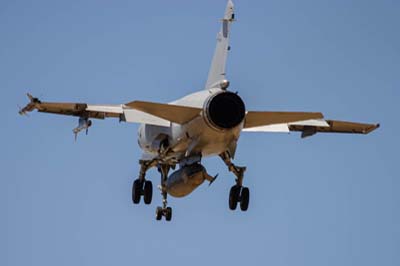 |
| Returning from the final sortie of the day, all flying should end by 14:30, prior to any night flying. |
| The Future The Spanish Air Force has ordered 87 Eurofighter Typhoons with options for a further 16 aircraft. 71 are to be single seats, designated C.16 EF-2000 Tifón and 16 are to be twin-seats (CE.16). The first Tifóns were handed over in a ceremony on October 9, 2003, at Getafe, where they operate from before their move to Ala 11 at Moron. Esc 113 (OCU) was formed in 2004 and will building up to 15 Tifóns (8 single and 7 two-seats). The first operational front line unit is now at Moron, as Esc 111 and is building up to 18 aircraft to become fully operations by the summer of 2006. They are due to be followed by Esc 112 in 2009 with their own 18 aircraft. Finally, Esc 141 and Esc 142 at Albacete, will receive their 18 aircraft each in 2012 and 2013 respectively, replacing what is left of the remaining Mirage F.1s. along with the EF/A-18 Hornets. |
 |
 |
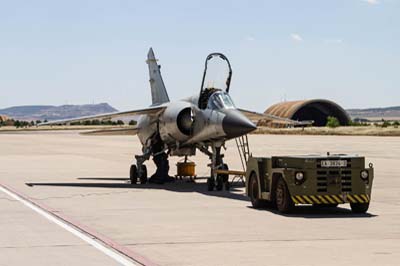 |
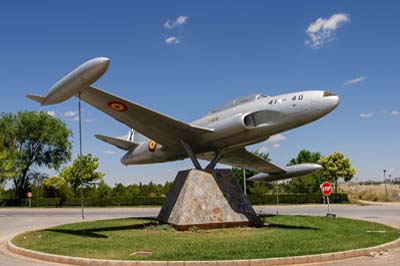
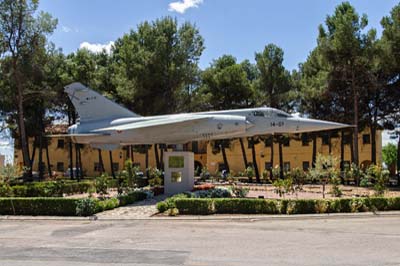
| Whilst the airfield was quiet once again, there was opportunity to photograph the two of the preserved aircraft here. The first was a T-33A (E.15-30 coded 41-40) which is just behind the guard post on the main gate. The second was a Mirage F.1 and was on display by the main buildings. It is fictitiously marked 'C.14-01' and coded '14-01', the real C.14-01 was active elsewhere that day, (see image above right). Having taken all the photographs I needed and after saying my good byes to the Base Commander and Public Relations Officer, I was on my way and well satisfied with my days work. |
|
 |
|
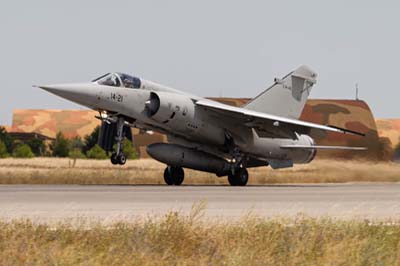
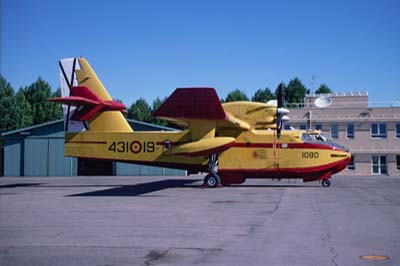
Addendum: In a tragic and ironic twist the oldest Mirage C.14-01 (see above) crashed on take-off just days before its 30th birthday. On May 30, 2005 just seven minutes after take-off from Neuburg in Germany, the Mirage F.1M crashed in flames, fortunately the pilot managed to eject safely. The 142 Squadron aircraft was involved with three others in the annual ELITE exercise which ran from May 27 to June 9, 2005. On January 20, 2009 two Mirage F.1s (F.1M C.14-40 '14-21' and F.1BM CE.14-31 '14-72') crashed near to Albacete 2 miles apart in a suspected mid-air collision, sadly killing all three aircrew. Left: Mirage F.1M (C.14-40 '14-21'') which crashed near to Albacete on January 20, 2009. Firefighting from the Air During the summer months Grupo 43 normally based at Torrejon, disperse their CL-215Ts around the country, as a precaution against forest fires. The aircraft pictured left (UD.13-19 coded 431-19 and 1080) of Esc 431, was used several times last summer when flying from Albacete. They aim to train for two hours every three days. I would like to thank all of those people I met and to the others who helped me from the Ejército Del Aire, for their generosity and assistance, in helping me put this report together. |
 |